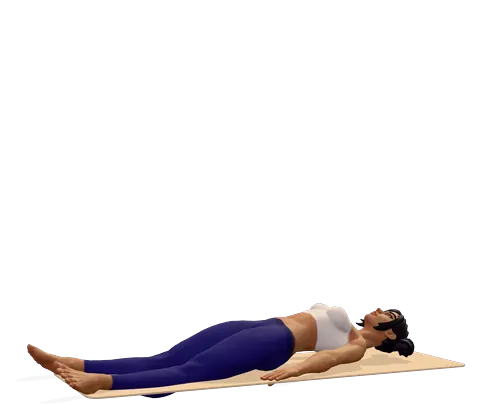
How to do Corpse Pose step by step
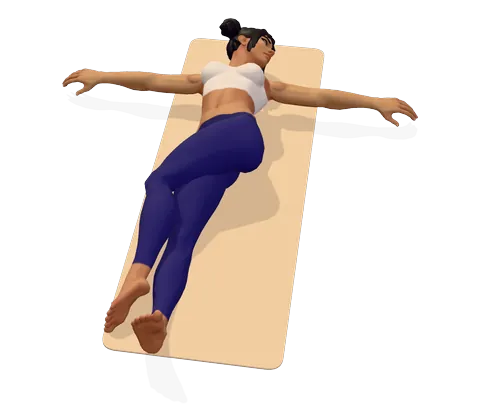
- Lie on your back on a mat or blanket. Let your feet fall apart, about mat-width, and let your toes drop outward.
- Rest your arms a little away from your sides, palms facing up. Tuck your shoulder blades gently under so your chest feels open.
- Lengthen the back of your neck by drawing your chin slightly toward your chest. Use a thin folded blanket under your head if your chin tips up.
- Close your eyes. Take two or three slow breaths, sighing out through the mouth, then let your breath move on its own.
- Move your attention slowly from your feet to the top of your head, letting each part feel heavy and soft.
- Stay for 5–10 minutes. When thoughts come, notice them and return to the feeling of your breath.
- To come out, deepen your breath, wiggle your fingers and toes, bend your knees and roll onto your right side. Rest there, then press up to sitting slowly.
Benefits and precautions
Benefits
- Lets the body settle and the heart rate slow after a yoga session
- A calming practice used in yoga programmes for stress, anxiety and sleep problems
- Trains attention and body awareness, the first steps of meditation
- Gives you time to notice tension in the jaw, shoulders and belly and let it go
- Can help lower blood pressure as part of a relaxation practice, alongside your treatment
Avoid or modify if
- Pregnancy (from about 20 weeks) — lie on your left side with a pillow between your knees instead of flat on your back
- Lower back pain — put a bolster or rolled blanket under your knees
- Acid reflux or breathing difficulty — raise your head and chest on a bolster or cushions
- Low blood pressure or dizziness — roll to your side and get up slowly
- Trauma or strong anxiety when the eyes are closed — keep your eyes open with a soft gaze and your hands on your belly
Corpse pose (Savasana) is the still, lying-down pose that ends almost every yoga class. You lie on your back with your arms and legs relaxed and do nothing, on purpose. That turns out to be surprisingly hard. Many teachers call Savasana the most important pose of the session, because it is where the body absorbs the practice and the nervous system shifts from effort to rest. This guide explains what corpse pose is, how to do it well, how long to stay and how to adapt it.
What is corpse pose called in yoga?
What is the Sanskrit name for corpse pose? It is Savasana, also written Shavasana. The meaning of Savasana or Shavasana is simple: shava means "corpse" and asana means "pose". The corpse pose meaning is not gloomy: the name asks you to lie as still as a body at rest, with no effort anywhere.
The corpse pose is also known as Mritasana, "dead man's pose", in some older texts. The corpse pose meaning in Hindi is the same: शवासन, from शव, "corpse".
Shavasana vs Savasana: which spelling is right?
Both. The first letter in Sanskrit is श, a "sh" sound, which is often written ś. When the accent mark is dropped you get "Savasana"; when the sound is spelled out you get "Shavasana". How do you say Savasana? Pronounce Savasana "shah-VAH-sah-nah". Do not confuse it with Svanasana, "dog pose" in yoga, which is a different word.
How to do Savasana well
The steps above show how to do corpse pose in yoga, the classic Shavasana pose for relaxation. These details make it restful rather than fidgety:
- Get warm first. Body temperature drops as you relax. Put on socks or a layer, or cover yourself with a blanket.
- Get comfortable, then stay still. Adjust once at the start. Stillness is part of the practice.
- Let the floor hold you. Notice the heels, calves, back of the pelvis, shoulder blades and head sinking into the mat.
- Soften the face. Unclench the jaw, let the tongue rest and the eyes sink back.
- Stay awake. The aim is relaxed awareness, not sleep. If you often doze off, keep your eyes slightly open.
Shavasana pose breathing techniques
Start with a few slow breaths with a longer out-breath, then stop controlling the breath and simply watch it. Counting breaths from one to ten and starting again is a simple way to stay present. For more guided patterns, try the breathing exercise timer.
How long to do corpse pose
A common guide is about 5 minutes for every 30 minutes of practice, so 5–10 minutes at the end of a typical class. Even 2–3 minutes helps. As a practice on its own, 10–20 minutes is enough. The meditation timer can ring a soft bell when your time is up, so you do not have to check a clock.
Savasana benefits: why this yoga pose matters
What is the main purpose of Savasana? To let the effects of the practice settle and to teach deep, conscious relaxation. The benefits of corpse pose in yoga come from that relaxation response: breathing and heart rate slow, muscles release and the mind becomes quieter.
- Stress and anxiety: relaxation practices like this are part of our yoga for stress and yoga for anxiety plans.
- Sleep: a short Savasana in bed can help you wind down; see yoga for sleep.
- Blood pressure: relaxation and slow breathing are used alongside treatment in yoga for high blood pressure. Keep taking your prescribed medicine.
Why is Savasana important in yoga? Without it, you finish a session still in "doing" mode. With it, you leave calmer, and you practise a skill you can use anywhere.
Shavasana benefits, side effects and contraindications
Savasana is very safe, but a few things can happen: you may fall asleep, feel light-headed when you get up too quickly, feel cold, or notice strong emotions as the body lets go. None of these are harmful. Get up slowly via your side, and keep your eyes open if closing them feels uneasy.
Corpse pose yoga for beginners: props and variations
Yoga Savasana pose for beginners is easiest with support. Corpse pose with a bolster under the knees takes pressure off the lower back, a folded blanket under the head keeps the neck long, and an eye pillow blocks light. Music is optional: many people prefer silence, and savasana music, if you use it, should be slow and without words.
- Constructive rest: knees bent, feet flat and wide, knees resting together. Good for a sore back.
- Side-lying Savasana: on your left side with pillows, for pregnancy or reflux.
- Reverse corpse pose (Advasana): lying face down, forehead on your stacked hands. Crocodile pose is a similar face-down rest; the benefits of crocodile pose include easy belly breathing.
- Corpse pose for kids: "melting like ice cream" or "floating like a starfish" for a minute or two.
A short Savasana script for relaxation
If you teach, or want to guide yourself, here is how to cue Savasana in plain words. Speak slowly, with long pauses:
"Lie down and make yourself comfortable. Let your feet fall open and your arms rest, palms up. Close your eyes. Take a deep breath in… and sigh it out. Feel your heels heavy, your legs heavy, your back resting on the floor. Let your shoulders soften, your hands soften, your face soften. Let your breath be natural. There is nothing to do now. When a thought comes, let it pass, and feel your breath again."
At the end of yoga, Savasana is closed gently: deeper breaths, small movements, then roll onto the side before sitting up.
Yoga Nidra and Shavasana
Yoga Nidra, "yogic sleep", is done lying in corpse pose, but it adds a structured guided meditation script: a body scan, breath awareness and visualisation. Corpse pose and yogic sleep are closely linked; you can think of Yoga Nidra as a guided, longer Savasana. Try our guided Yoga Nidra sessions of 10, 20 or 30 minutes. Savasana is not sleep, though. If you use it in bed to fall asleep, that is fine; in class, stay gently awake.
शवासन (Corpse Pose) — हिंदी में: पीठ के बल लेट जाएँ, पैरों को थोड़ा खुला छोड़ें और हाथों को शरीर से थोड़ा दूर, हथेलियाँ ऊपर की ओर रखें। आँखें बंद करें और साँस को अपने आप चलने दें। पैरों से सिर तक हर अंग को ढीला छोड़ें। 5–10 मिनट रुकें, फिर दाईं करवट लेकर धीरे से उठें। शवासन के फायदे: तनाव कम होता है, मन शांत होता है और नींद बेहतर हो सकती है। गर्भावस्था में बाईं करवट लेटकर करें।
Health conditions this pose is used for
Yoga for knee replacement recovery · Yoga for hip replacement recovery · Yoga for arthritis · Yoga for slip disc (herniated disc) · Yoga for spinal stenosis · Yoga for spondylolisthesis · Yoga for degenerative disc disease · Yoga for scoliosis · Yoga for tennis elbow · Yoga for leg cramps · Yoga for carpal tunnel syndrome · Yoga for fibromyalgia · Yoga for chronic pain · Yoga for lupus · Yoga for jaw pain (tmj) · Yoga for balance and fall prevention · Yoga for high blood pressure · Yoga for hyperthyroidism (overactive thyroid) · Yoga for uric acid and gout · Yoga for kidney health · Yoga for kidney stones · Yoga for anemia (low hemoglobin) · Yoga for healthy weight gain · Yoga for menopause · Yoga for endometriosis · Yoga for pms (premenstrual syndrome) · Yoga for postpartum recovery · Yoga for male fertility · Yoga for erectile dysfunction · Yoga for anxiety · Yoga for depression · Yoga for grief and loss · Yoga for bipolar disorder (complementary care) · Yoga for eating disorder recovery · Yoga for stress relief · Yoga for sleep and insomnia · Yoga for jet lag and travel fatigue · Yoga for shift work and night-shift sleep · Yoga for migraine and headache · Yoga for exam stress · Yoga for parkinson’s disease · Yoga for epilepsy (complementary care) · Yoga for adhd and attention · Yoga for autism (children) · Yoga for panic attacks · Yoga for social anxiety · Yoga for self-confidence · Yoga for anger management · Yoga for burnout and exhaustion · Yoga for addiction and quitting smoking · Yoga for vertigo and dizziness · Yoga for tinnitus · Yoga for memory in older adults · Yoga for stroke recovery · Yoga for multiple sclerosis · Yoga for restless legs syndrome · Yoga for chronic fatigue syndrome · Yoga for bronchitis · Yoga for heart health · Yoga for long covid recovery · Yoga for immunity · Yoga for gastritis · Yoga for gallstones · Yoga for hernia (safe movement) · Yoga for ibs · Yoga for ulcerative colitis and ibd · Yoga for premature grey hair · Yoga for glowing skin and acne · Yoga for dark circles · Yoga for psoriasis and eczema · Yoga for eye strain · Yoga for glaucoma (safe yoga) · Yoga for dry eyes · Yoga for motion sickness · Yoga for cancer recovery (supportive care) · Yoga for recovery after surgery
Where this practice is used
Chakras: Sahasrara (Crown Chakra)
Guided meditations in this posture: Body Scan Meditation · Sleep Meditation
Frequently asked questions
What is corpse pose in yoga?
Corpse pose (Savasana or Shavasana) is a resting pose where you lie on your back, arms and legs relaxed, eyes closed, and let the body become completely still while you stay gently aware.
How long should I stay in Savasana?
About 5 minutes for every 30 minutes of practice, so usually 5–10 minutes at the end of a class. As a practice on its own, 10–20 minutes.
What are the benefits of Savasana?
It slows the breath and heart rate, releases muscle tension and calms the mind. It is used in yoga programmes for stress, anxiety and sleep, and as part of relaxation for blood pressure alongside medical treatment.
Is it Savasana or Shavasana?
Both are correct. The Sanskrit word begins with a "sh" sound (श); "Savasana" drops the accent mark and "Shavasana" spells the sound out.
Is it okay to fall asleep in corpse pose?
It happens, and it is not harmful, but the aim is relaxed awareness. Keep your eyes slightly open or rest a hand on your belly to stay present.
Who should not lie flat in Savasana?
From about 20 weeks of pregnancy, lie on your left side instead. With acid reflux or breathing problems, prop your head and chest up. With lower back pain, put a bolster under your knees.
What is the difference between Savasana and Yoga Nidra?
Savasana is the resting pose itself. Yoga Nidra is a guided relaxation practice done lying in Savasana, with a body scan and breath awareness, usually for 10–30 minutes.
What is corpse pose called in Hindi?
शवासन (Shavasana): "shava" means corpse and "asana" means pose. Corpse pose benefits in Hindi-speaking classes are usually described as तनाव कम होना (less stress) and मन की शांति (a calm mind).
This page is for general education. Check with your doctor before starting yoga if you are pregnant, have a medical condition or an injury. Stop if you feel pain, dizziness or shortness of breath.