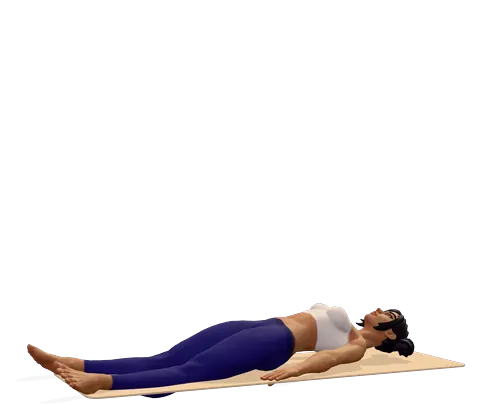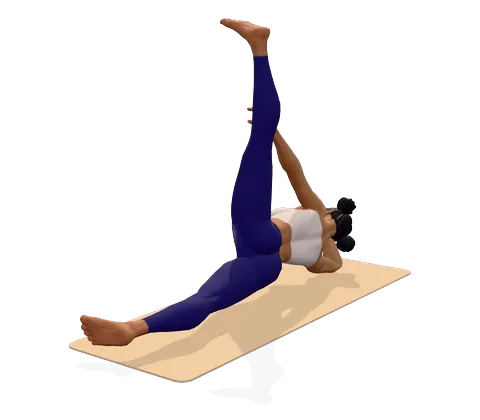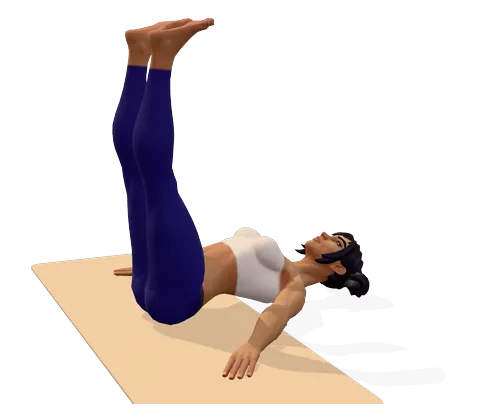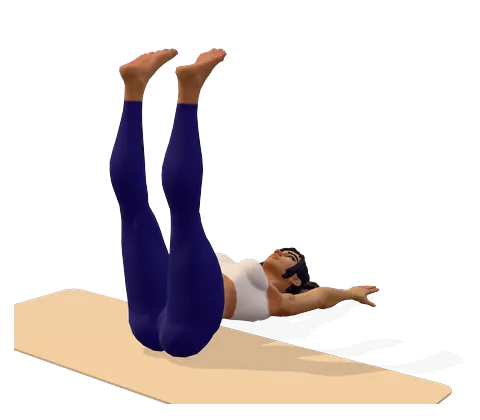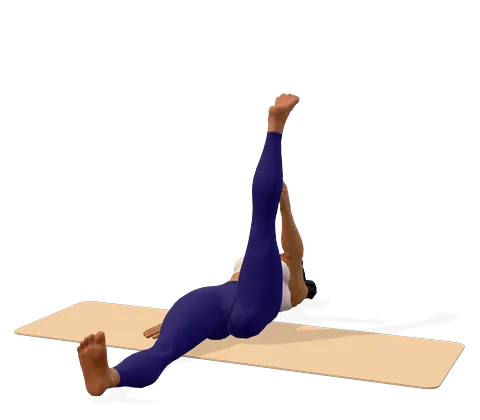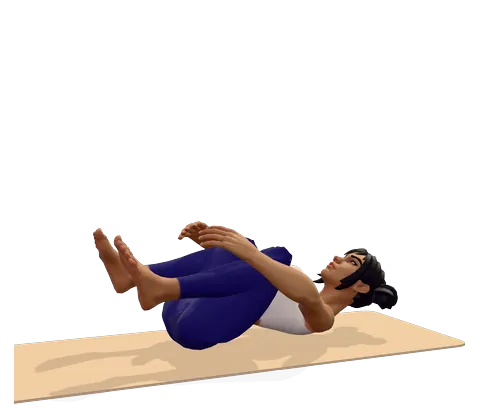
How to do Wind-Relieving Pose step by step
- Lie on your back with your legs straight and your arms by your sides.
- Breathing out, bend both knees and draw them toward your chest.
- Wrap your arms around your shins or hold your knees, and gently hug your thighs toward your belly. Keep your hips and lower back on the mat.
- If your neck is comfortable, breathe in, then as you breathe out lift your head and bring your chin toward your knees.
- Hold for 3–5 slow breaths (20–30 seconds). Feel your belly press softly against your thighs each time you breathe in.
- Lower your head first, then release your arms and slowly straighten your legs. Rest for a few breaths and repeat 2–3 times.
Where you feel Wind-Relieving Pose: what it stretches and strengthens
Hug your knees to your chest and relax your back. In the 3D guide, turn on Body guide: areas that stretch glow green and areas that work glow saffron.
Stretches
- Lower back
- Glutes
Strengthens
- Abs
Benefits and precautions
Benefits
- Gently presses the belly, which may help release trapped wind and ease bloating
- Stretches the lower back, hips and glutes
- Eases lower-back stiffness after sitting or backbends
- Used in yoga routines for constipation, digestion and back pain
- Slows the breath and helps you settle before sleep
- Lifting the head adds light work for the abdominal muscles
Avoid or modify if
- Pregnancy — do not press the knees into the belly; after the first trimester avoid lying flat, and ask your midwife
- Recent abdominal surgery, a hernia or acute stomach pain — wait for medical advice
- Neck pain or cervical spondylosis — keep your head on the floor
- Disc problems or osteoporosis — keep your head down and never round the spine forcefully; skip it if bending forward worsens back or leg pain
- Knee pain — hold behind the thighs instead of over the knees
- Practise on an empty stomach, not straight after a meal
Wind-relieving pose (Pavanamuktasana) is one of the simplest poses in yoga: you lie on your back and hug your knees into your chest. As the name suggests, the gentle pressure on the belly is traditionally used to help release trapped gas, and the rounded shape is also a soothing stretch for the lower back. This guide explains the name, how to do it well, what it may help with, the most useful variations and who should be careful.
What is the wind-relieving pose?
The wind-relieving pose Sanskrit name describes its purpose: pavana means "wind" or "air", mukta means "released" or "free" and asana means "pose". You will also see the wind relieving pose spelled Pawanmuktasana, and it is sometimes called supta pavanamuktasana ("lying wind-releasing pose"). Wind-release pose, wind relief pose and full wind pose are other names for the same supine yoga position.
Many yoga teachers use another Sanskrit name, Apanasana (knees-to-chest pose), for the same shape. Apana is the downward-moving breath or energy in yoga philosophy, linked to digestion and elimination. In practice, Apanasana usually means hugging the knees with the head resting on the floor, while the fuller wind-relieving pose adds the head lift you see in the 3D demo.
How to do wind-relieving pose correctly
The steps above take you in and out. These details make it more comfortable and more effective:
- Hug on the exhale. Draw the knees in as you breathe out and let them move slightly away as you breathe in. This gentle pumping is what massages the belly.
- Keep the tailbone down. If your hips curl off the mat, loosen your grip a little so the stretch stays in the lower back rather than the neck.
- Shoulders away from the ears. Especially when the head lifts, keep the upper back soft.
- Rock if it feels good. Small rocks from side to side massage the muscles along the spine.
How long to hold it and when to practise
Hold for 20–60 seconds and repeat 2–3 times. The best time is in the morning before breakfast or at least two to three hours after a meal. Practised in bed at night, the head-down version is an easy way to wind down.
Wind-relieving pose benefits in yoga
Gas, bloating and constipation
As a wind relieving yoga pose for bloating and belly comfort, it works in a simple, physical way: the thighs press gently on the lower belly while the breath moves it, which may help trapped wind pass. That is why it appears in yoga routines for constipation, digestion and IBS. Used as a wind relieving yoga pose for constipation, it works best alongside water, fibre and walking. It can ease discomfort, but it does not treat an underlying condition. See a doctor for ongoing constipation, pain, or any change in your bowel habits.
Lower back stiffness
Knees-to-chest is one of the best asanas for back pain relief when the cause is simple stiffness, and it is part of our yoga for back pain plan. As a yoga pose for lower back pain, it rounds and lengthens the lower back after long sitting or backbends such as bridge pose. Some disc problems feel worse when the spine bends forward; if the pose sends pain down a leg, stop.
Rest and sleep
Hugging the knees is naturally comforting, and slow belly breathing in this position helps many people settle before sleep.
Does it reduce belly fat?
No single pose burns fat from the belly. Pavanamuktasana benefits are about comfort and flexibility; for fat loss you need regular activity and diet. See our yoga for belly fat page for a realistic plan.
Wind-relieving pose variations
- Half wind-relieving pose (Ardha Pavanamuktasana): hug one knee at a time with the other leg straight. Traditionally the right knee comes first, pressing the lower right belly (where the large bowel starts), then the left. Half wind-relieving pose benefits people with stiff hips or knees because it is gentler.
- Head down (Apanasana): keep your head on the mat — the version for sore necks and bedtime.
- Wide knees: let the knees open wider than your body so there is room for the belly.
- Seated wind-relieving pose: sit on a chair or the floor and hug one knee to your chest, sitting tall.
- Standing wind relieving pose: stand tall and hug one knee in — a balance as well as a stretch.
In Satyananda (Bihar School) yoga, the pavanamuktasana series is something different: a set of gentle joint-freeing movements for the toes, ankles, knees, hips, wrists and neck, often taught to beginners before any asana.
Child's pose and wind-relieving pose
Both fold the knees toward the chest. In child's pose you kneel face down with your weight on the knees and shins, which some people find hard on the knees. In the wind-relieving pose you lie on your back, so the knees carry no weight and you control the pressure with your arms. If kneeling hurts, choose this one.
Wind-relieving pose side effects and precautions
The most common side effect is the one the pose is named for: passing wind — perfectly normal. Lifting the head can strain the neck if you hold it too long, and pressing on a full stomach can cause discomfort. In pregnancy, do not squeeze the knees against the belly; early on, a wide-knee version may feel fine, but check with your midwife, and after the first trimester avoid lying flat on your back.
Poses to do before and after
Good preparatory asanas for Pawanmuktasana are simple ones such as bridge and gentle leg stretches. It fits well after bridge and before a supine spinal twist, followed by a few minutes of rest. You can play these poses with voice cues in the guided sessions.
पवनमुक्तासन — wind relieving pose in Hindi: पीठ के बल लेटें, दोनों घुटने मोड़कर छाती की ओर लाएँ और हाथों से पकड़ लें। साँस छोड़ते हुए सिर उठाकर ठुड्डी घुटनों की ओर लाएँ, 20–30 सेकंड रुकें, फिर धीरे से वापस आएँ। यह आसन पेट की गैस, पेट फूलने और कब्ज़ में आराम दे सकता है और कमर की जकड़न कम करता है। खाली पेट करें; गर्भावस्था, हर्निया या पेट के ऑपरेशन के बाद न करें।
Health conditions this pose is used for
Yoga for back pain · Yoga for knee replacement recovery · Yoga for sciatica · Yoga for spinal stenosis · Yoga for spondylolisthesis · Yoga for degenerative disc disease · Yoga for belly fat · Yoga for uric acid and gout · Yoga for kidney stones · Yoga for period pain and menstrual cramps · Yoga for endometriosis · Yoga for grief and loss · Yoga for sleep and insomnia · Yoga for shift work and night-shift sleep · Yoga for restless legs syndrome · Yoga for digestion · Yoga for constipation · Yoga for ibs · Yoga for gas and bloating · Yoga for piles (hemorrhoids) · Yoga for varicose veins
Frequently asked questions
What is the wind-relieving pose good for?
It gently presses the belly, which may help release trapped gas and ease bloating, and it stretches the lower back and hips. It is also a calming pose before sleep.
How long should I hold wind-relieving pose?
Hold for 20–60 seconds and repeat 2–3 times. Beginners can hold for 3–5 breaths and rest between rounds.
Can wind-relieving pose help with constipation?
It may ease discomfort from gas and sluggish digestion as part of a routine with water, fibre and activity. It does not treat the cause, so see a doctor if constipation lasts or comes with pain.
Can I do Pavanamuktasana after eating?
It is better on an empty stomach or two to three hours after a meal. Pressing on a full stomach can cause discomfort or acid reflux.
Is the wind-relieving pose safe during pregnancy?
Do not press the knees into the belly. A wide-knee version may be fine early on with your midwife's approval; after the first trimester avoid lying flat on your back.
What is the difference between Apanasana and Pavanamuktasana?
Both are knees-to-chest poses on your back. Apanasana usually keeps the head down; Pavanamuktasana often adds a head lift toward the knees.
Is it normal to pass gas in this pose?
Yes. Releasing trapped wind is exactly what the pose is named for, so it is nothing to be embarrassed about. Practising at home on an empty stomach makes it more comfortable.
This page is for general education. Check with your doctor before starting yoga if you are pregnant, have a medical condition or an injury. Stop if you feel pain, dizziness or shortness of breath.