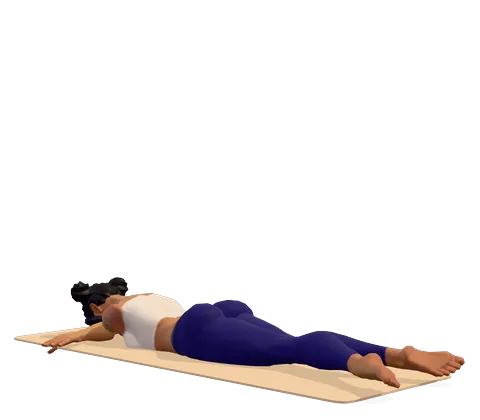
How to do Crocodile Pose step by step
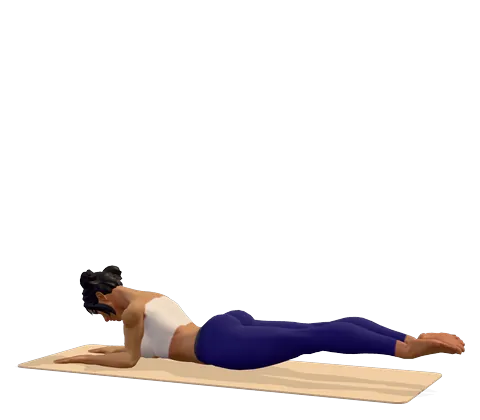
- Lie on your front. Move your feet wider than your hips, turn your heels in and let your toes point out to the sides.
- Fold your arms in front of you, each hand holding the opposite forearm or elbow, and rest your forehead on your forearms.
- Adjust until your chest is slightly lifted by the arms and your neck feels long and easy.
- Close your eyes. Let your legs, buttocks and shoulders go heavy.
- Breathe slowly through the nose. Feel your belly press into the mat as you breathe in and soften as you breathe out.
- Stay for 1–3 minutes, or for 30–60 seconds when resting between backbends.
- To come out, bring your legs together, place your hands under your shoulders and press back into child's pose or roll to one side.
Where you feel Crocodile Pose: what it stretches and strengthens
Rest on your forearms and breathe into your belly. In the 3D guide, turn on Body guide: areas that stretch glow green and areas that work glow saffron.
Stretches
- Lower back
Benefits and precautions
Benefits
- Relaxes the back, shoulders and legs after backbends or a long day
- Teaches slow belly breathing, because the floor gives feedback on every breath
- Keeps the lower back in a gentle, neutral curve, which many people with back pain find comfortable
- A calm rest for people who feel more at ease face-down than on their back
- Used as a rest position in yoga plans for sciatica, neck pain and knee pain
Avoid or modify if
- Pregnancy: do not lie on the belly; rest on your side with a pillow between the knees instead
- Recent abdominal surgery, a hernia or severe reflux that worsens when you lie face-down
- Breathing difficulty or a heart condition that makes lying on the front uncomfortable: use a side-lying rest
- Chin-in-palms version: skip it with spinal stenosis, spondylolisthesis or neck pain; stay in the flat, forehead-down version
- Tight hips or sore knees: bring the feet closer together and turn the toes in less
Crocodile pose (Makarasana) is a relaxation pose done lying on your front, legs apart and forehead resting on your folded arms. It looks like nothing is happening, yet it is one of the most useful rests in yoga: it lets the back settle after backbends such as cobra and locust, and the floor under your belly gives clear feedback on how you breathe. Here is how to do crocodile pose in yoga, what it is good for, its main variations and who should rest another way.
Crocodile pose in yoga: meaning and Sanskrit name
The crocodile yoga pose Sanskrit name comes from makara and asana ("pose"). What is a makara? In Indian mythology it is a water creature, usually shown as a crocodile, that carries the river goddess Ganga. Picture a crocodile lying flat in shallow water, completely still, with only its head raised: that is the shape and the mood of this asana.
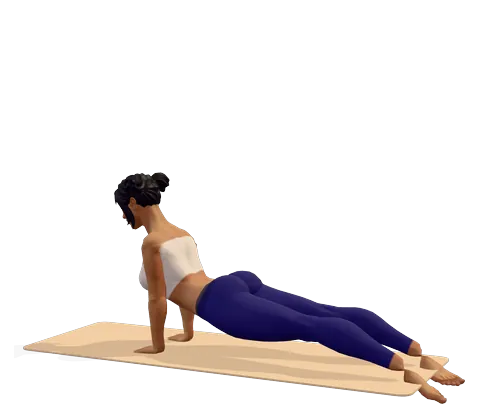
Crocodile pose is also known as alligator pose in some kids' yoga books. Do not confuse it with the "crocodile pose" of calisthenics and some arm-balance classes. That one is Nakrasana, a hovering push-up hold close to Chaturanga, and it is hard work rather than rest. Our 3D guide shows the classic resting Makarasana.
How to do crocodile pose: position and breathing
The Makarasana (crocodile pose) yoga steps are listed above. The details below make the difference between lying down and truly resting.
- Feet: wider than your hips with the toes out and heels in lets the thighs roll outward and the buttocks soften. If your hips or knees complain, bring the feet closer.
- Arms: stack your forearms and rest your forehead on them, so your nose is just off the floor. Some teachers place each hand on the opposite shoulder and rest the chin in the gap between the elbows; choose whatever keeps your neck long.
- Neck: if you turn your head to one side instead, switch sides halfway so the neck is not twisted for long.
- Shoulders: let them drop away from your ears. If they feel tight, move the elbows further apart.
Crocodile breathing
This is the heart of the pose. As you breathe in, feel your belly press into the mat and your lower back rise slightly; as you breathe out, feel both sink. Physiotherapists teach this same position, often called "crocodile breathing", to retrain relaxed breathing with the diaphragm. Count a slow four in and a slightly longer out, or use our breathing exercise timer to pace it.
Crocodile pose yoga benefits
Makarasana yoga pose benefits are gentle but real. It is not a stretch or a strength pose; its value is in rest, breath and a friendly position for the spine.
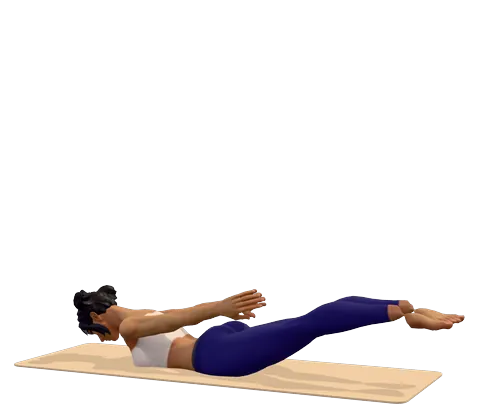
- Rest between backbends: after locust or bow, a minute here lets the back muscles relax before the next effort.
- Back comfort: lying flat on the front keeps a natural curve in the lower back. Many people with a disc problem find this position easier than lying on their back, which is why it appears in our yoga for sciatica plan.
- Neck: with the forehead supported and the neck in line, the neck muscles can switch off. It is part of our yoga for neck pain plan.
- Stress and breathing: slow belly breathing with the body fully supported helps the nervous system settle.
So is it a good yoga pose for lower back pain? For many people, yes, as a rest position. It is not a treatment on its own, nor one of the best asanas for back pain by itself; combine it with the stronger poses in our yoga for back pain plan, and see a physiotherapist if pain spreads down a leg.
Crocodile pose variations
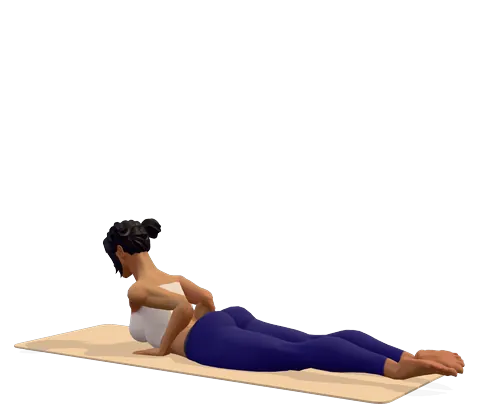
Chin in palms (the backbend version)
Prop yourself on your elbows, place your chin in your cupped palms and let the chest lift. This version adds a mild backbend, similar to sphinx pose, and is taught in Indian yoga therapy for the lower back. Move the elbows forward if the arch feels too strong, and skip it if arching hurts.
Half crocodile pose
From the flat pose, slide one knee up along the floor toward your elbow, keeping the inner thigh on the mat. It gently opens the hip and releases the side of the lower back. Hold for a minute each side. This half crocodile pose is a lovely yoga variation for tight hips.
Knee bends for the knees
With the forehead down, bend one knee slowly to bring the heel toward the buttock, then lower it; alternate legs 10 times. This gentle movement is why crocodile pose appears in our yoga for knee pain plan. Stay within a pain-free range.
Crocodile pose with bolster
For crocodile pose in restorative yoga, place a thin pillow under your belly to reduce the curve of the lower back, or a bolster under your chest if your shoulders are stiff. A rolled towel under the ankles helps if the tops of your feet feel sore. In yin yoga, crocodile pose and its variations are used as rests between long sphinx and seal holds.
Makarasana pose for beginners and kids
This is one of the easiest poses in yoga, so it suits complete beginners, seniors who can get down to the floor, and children. For kids, the crocodile or alligator yoga pose is a game: lie still like a crocodile in the river, then "snap" the arms open and closed like jaws. For yoga beginners, crocodile pose is a good place to learn to breathe into the belly before trying pranayama.
Makarasana benefits and contraindications
Because it is so gentle, crocodile pose has few contraindications. Avoid lying on your belly during pregnancy, after abdominal surgery or with a hernia, and use a side-lying rest if lying face-down makes breathing hard or your reflux worse. The chin-in-palms version is a backbend, so treat it with the same caution as sphinx and cobra.
Where crocodile fits in a practice
Use it between prone backbends (cobra, locust, bow), at the end of a back routine instead of lying on your back, or before sleep. In a guided session you can add it anywhere with the sequence builder.
Health conditions this pose is used for
Yoga for knee pain and osteoarthritis · Yoga for knee replacement recovery · Yoga for sciatica · Yoga for neck pain and cervical spondylosis · Yoga for hip replacement recovery · Yoga for slip disc (herniated disc) · Yoga for degenerative disc disease · Yoga for ankylosing spondylitis · Yoga for hyperthyroidism (overactive thyroid) · Yoga for postpartum recovery · Yoga for shift work and night-shift sleep · Yoga for bronchitis · Yoga for dry eyes · Yoga for motion sickness
Frequently asked questions
What is crocodile pose good for?
It relaxes the back and shoulders, teaches slow belly breathing and gives the spine a comfortable rest between backbends. Many people with back pain find it an easy position to relax in.
How long should I stay in crocodile pose?
One to three minutes as a relaxation pose, or 30–60 seconds between backbends. Longer is fine if you are comfortable and switch the head side if it is turned.
Is crocodile pose good for lower back pain?
As a rest position, often yes, because it keeps a natural curve in the lower back. The chin-in-palms version adds a gentle backbend that some people find helpful and others do not; stop if pain increases or spreads down a leg.
Can I do crocodile pose during pregnancy?
No. Avoid lying on the belly in pregnancy. Rest on your left side with a pillow between the knees instead.
What is the difference between crocodile pose and Shavasana?
Both are relaxation poses. Shavasana is done lying on the back; crocodile pose is done lying on the front, which suits people with back pain and makes belly breathing easier to feel.
Why is there a different crocodile pose in calisthenics?
In calisthenics and some arm-balance classes, "crocodile" means Nakrasana, a hovering hold near Chaturanga. It shares the English name but is a strength move, not the resting Makarasana.
What does Makarasana mean?
Makara is a crocodile-like water creature from Indian mythology and asana means pose, so Makarasana means crocodile pose.
This page is for general education. Check with your doctor before starting yoga if you are pregnant, have a medical condition or an injury. Stop if you feel pain, dizziness or shortness of breath.