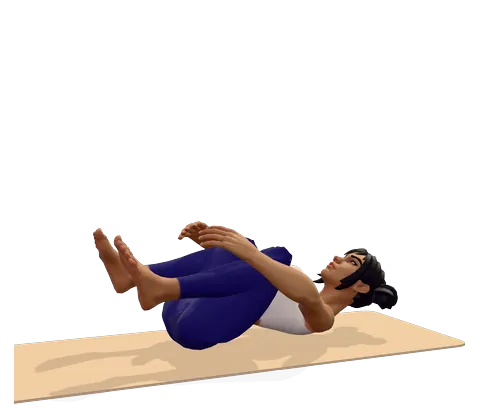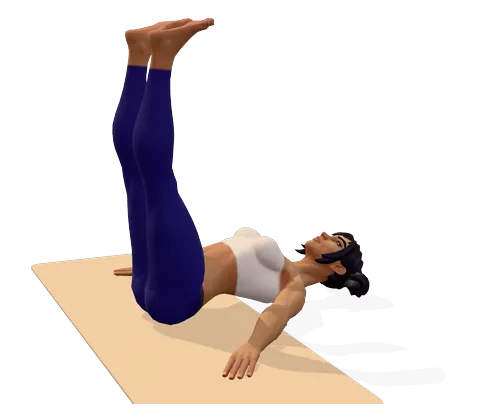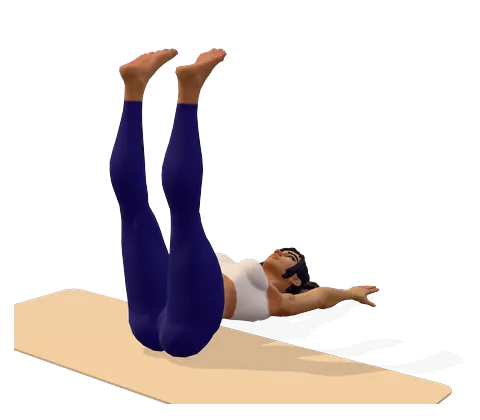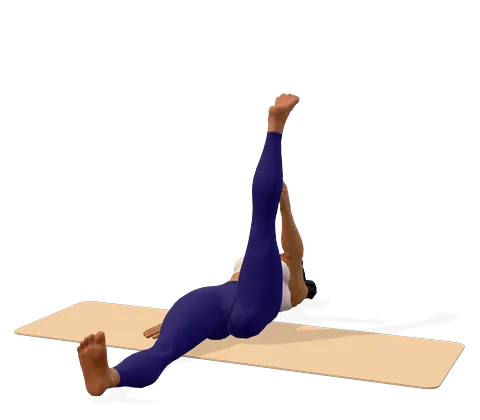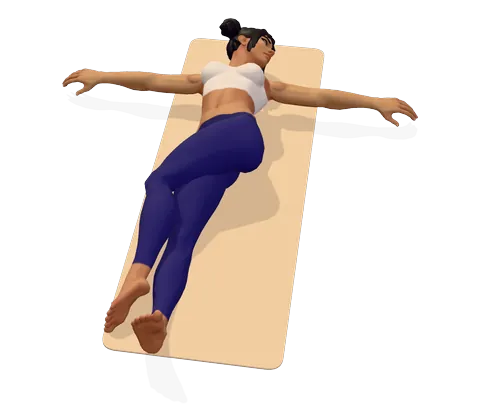
How to do Supine Spinal Twist step by step
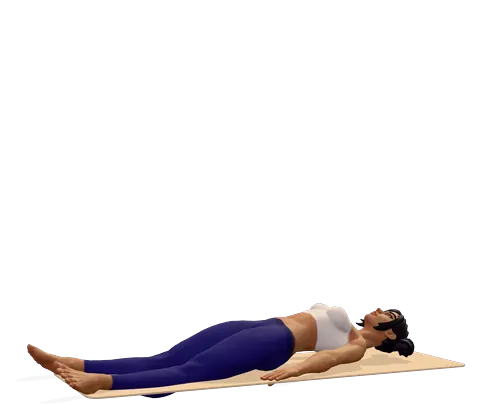
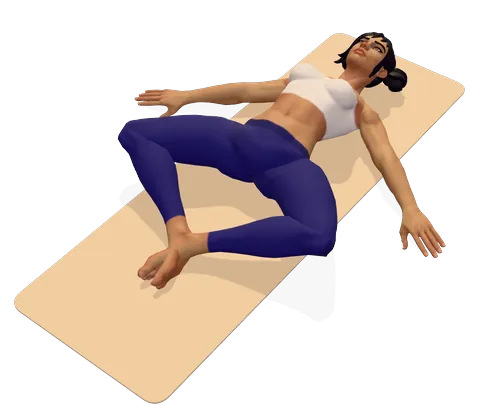
- Lie on your back with both legs straight. Stretch your arms out to the sides at shoulder height, palms down, in a T shape.
- Bend your left knee and draw it toward your chest. Shift your hips a little to the left so the twist stays centred on your spine.
- Breathing out, let your left knee fall across your body to the right. Your right hand can rest lightly on the outside of the left knee.
- Keep your left shoulder heavy on the floor. If it lifts, place a cushion or block under the left knee instead of forcing the knee down.
- Turn your head gently to the left, only as far as your neck is comfortable.
- Stay for 5–10 slow breaths (30–60 seconds), letting each exhale soften the twist.
- Breathing in, roll back to the centre and hug both knees in. Repeat on the other side for the same time.
Where you feel Supine Spinal Twist: what it stretches and strengthens
Let the knee drop across and keep both shoulders down. In the 3D guide, turn on Body guide: areas that stretch glow green and areas that work glow saffron.
Stretches
- Side waist
- Glutes
- Lower back
Benefits and precautions
Benefits
- Gently rotates the spine from the lower back to the neck
- Stretches the outer hip, glutes, lower back and chest
- Eases stiffness after long sitting, sleeping or backbends
- Used in yoga programmes for back pain, stress and sleep
- Light pressure on the belly may help digestion and trapped wind
- An easy, calming twist to end a practice before Savasana
Avoid or modify if
- Acute back pain, a disc herniation or a sciatica flare — twist only a little with both knees bent and supported, or skip it
- Recent spinal surgery or spinal fusion — do not twist until your surgeon allows it
- Pregnancy — avoid twisting across the belly; after the first trimester avoid lying flat, and ask your midwife
- Osteoporosis — keep the twist small and never pull the knee down with your hand
- Recent abdominal surgery or a hernia — wait for medical clearance
- Stop at any sharp, pinching or shooting pain
The supine spinal twist (Supta Matsyendrasana) is one of the gentlest twists in yoga: you lie on your back, drop one knee across your body and let the floor hold you while your spine rotates. Because gravity does the work, it suits beginners, stiff backs and the end of a long day. This guide explains the name, how to do the twist well, what it may help with, the muscles stretched, the most useful variations and who should be careful.
What is a supine spinal twist?
Is supine on your back? Yes: supine means lying face up, and prone means lying face down. A spinal twist is any movement that rotates the spine around its long axis. Most of that rotation comes from the middle and upper back; the lower back turns only a little, which is why forcing a twist from the hips is a common cause of discomfort. So the supine twist is simply a spinal rotational stretch done lying down.
The supine spinal twist Sanskrit name has three parts: supta means "reclining", Matsyendra means "lord of the fishes" (the yogi Matsyendranath, a teacher in the Hatha lineage) and asana means "pose". It is the lying cousin of the seated twist Ardha Matsyendrasana. Other names for this asana, a very common yoga pose, are reclined twist, reclining twist and lying spinal twist (supine twist). Whether a class calls it the reclined spinal twist or the reclining twist, Supta Matsyendrasana is the same shape.
How to do a supine spinal twist well
The steps above take you through one side. These alignment cues for the supine twist make it both deeper and safer:
- Shift before you twist. Moving the hips a little toward the bent-knee side keeps your spine in a straight line once you drop the knee.
- Shoulders win over knees. A knee that hovers above the floor is fine; a shoulder that lifts means you are twisting too far.
- Twist on the exhale. Let each breath out take you a few millimetres deeper, then rest there.
- Knee height changes the stretch. A knee drawn up near the chest stretches more of the lower back and outer hip; a lower knee opens the side of the waist.
- Do not pull. The hand on the knee is a weight, not a lever.
- Head last. Turning your head away adds a supine cervical spine rotation; keep it small if your neck is sensitive.
How long to hold it
Hold for 30–60 seconds per side in a normal class. In a slower or yin yoga practice, the supine twist can be held for 2–3 minutes with a cushion under the knee. Always give both sides the same time.
Supine spinal twist benefits
Most supine spinal twist pose benefits are about mobility and relaxation, not strength. You get the rotation without holding yourself up, so muscles can let go.
Back stiffness and back pain
A slow supine twist is a common back stretch after long hours of sitting. Gentle twists appear in many yoga for back pain programmes, where yoga overall has been found to reduce pain and improve function in chronic low back pain. If you have lower back pain when twisting, bend both knees and keep the movement small.
Digestion and trapped wind
Traditionally, twists are said to "massage" the belly. The real effect is modest: gentle movement and pressure on the abdomen may help trapped wind move and can feel relieving when you are bloated, which is why the pose appears in routines for digestion. Twists do not "wring out toxins" — your liver and kidneys do that.
Stress and sleep
Lying down with slow breathing is calming, and this lying spinal twist stretch is a favourite last yoga pose before bed. It is part of our plans for stress relief and better sleep.
Supine spinal twist muscles stretched
| Area | Muscles stretched |
|---|---|
| Hip of the bent leg | Gluteus maximus and medius, piriformis, the outer thigh |
| Waist and lower back | Obliques, quadratus lumborum, erector spinae |
| Chest and shoulders | Pectorals and the front of the shoulder on the same side as the bent leg |
Very little muscle has to work, which is why it feels like a rest rather than an exercise.
Supine spinal twist variations
- Both knees bent (lower trunk rotation): feet on the floor, let both knees sway slowly to one side, then the other. Physiotherapists call this supine spinal twist exercise lower trunk rotation or supine lumbar rotation, and what it does is gently mobilise the lower back. It is the best choice for beginners and sore backs.
- Supported reclined twist: a bolster or two pillows under the top knee, or lengthwise beside you so your chest can rest on it. The supported reclined twist pose is the restorative version.
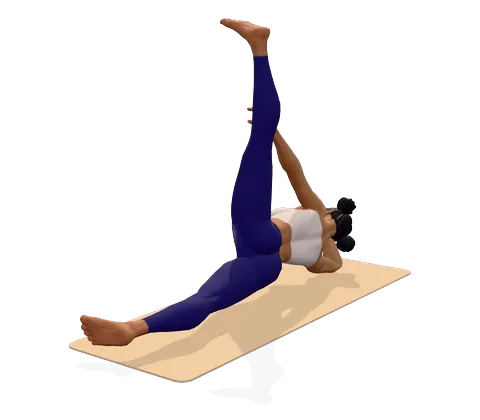
- Supine spinal twist with straight leg: straighten the top leg and hold the foot with your opposite hand or a strap. It is the most advanced supine spinal twist variation here, with a strong hamstring and outer-hip stretch.
- Eagle-leg twist: cross your thighs before you drop the knees to one side, for a deeper outer-hip stretch.
- With arm reach: sweep the top arm overhead in a slow arc to open the chest. This supine thoracic spinal twist targets the upper back.
- Prone spinal twist (scorpion): in yoga this is done lying on your front, reaching one foot across behind you. It opens the chest and hip flexors strongly; skip it in pregnancy.
Unlike this supine spinal twist, the Pilates spine twist is done sitting upright with straight legs, and it works the core rather than relaxing it.
Supine vs seated spinal twist
The seated spinal twist (Ardha Matsyendrasana) is the stronger version: you hold yourself upright and use your arms as leverage. Seated spinal twist benefits are similar, but it is easier to overdo, so for beginners the supine version comes first. The lying twist is passive: the floor supports your back and gravity sets the depth. If you cannot get down to the floor, a seated torso twist in a chair is a good supine spinal twist alternative for lower back pain — see chair yoga. Reclined twist vs supine twist? Same pose, different names.
Lower back pain when twisting: what to do
A mild pulling stretch is normal; sharp, pinching or shooting pain is not. Bend both knees, put a cushion under them, and twist less. If pain spreads down a leg, stop and read our guide to yoga for sciatica.
After spinal surgery, your surgeon, physical therapy or occupational therapy team usually sets spinal precautions — often no bending, lifting or twisting for a set period. These post-surgical spinal precautions apply after spinal fusion too, so do not do any twist until you are cleared. No yoga pose can "fix a twisted spine"; scoliosis and other spinal curves need a professional assessment.
Poses to do before and after
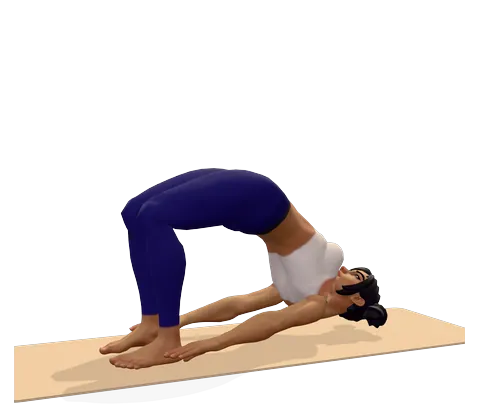
Warm up with knees-to-chest pose and bridge. After the twist, rest flat in Savasana for a minute. You can play this pose with voice guidance in the back pain and bedtime sessions under guided practice.
Health conditions this pose is used for
Yoga for back pain · Yoga for sciatica · Yoga for fibromyalgia · Yoga for chronic pain · Yoga for kidney stones · Yoga for endometriosis · Yoga for stress relief · Yoga for sleep and insomnia · Yoga for jet lag and travel fatigue · Yoga for shift work and night-shift sleep · Yoga for anger management · Yoga for burnout and exhaustion · Yoga for digestion · Yoga for constipation · Yoga for gallstones · Yoga for ibs · Yoga for gas and bloating
Frequently asked questions
What is the supine spinal twist good for?
It gently mobilises the spine, stretches the outer hips, lower back and chest, and helps you relax. It is used in yoga routines for back stiffness, stress, sleep and digestion.
How long should I hold a supine twist?
Hold for 30–60 seconds on each side. In a slow or yin class you can stay 2–3 minutes with a cushion under the knee.
Which side should I twist first?
Either. In a lying spinal twist, many classes start with the right leg over to the left; the 3D guide shows the left knee crossing first. What matters is giving both sides the same time.
Is it normal for my back to crack during the twist?
A few soft pops without pain are usually harmless. If the cracking comes with pain, twist less and ask a physiotherapist.
Is the supine spinal twist safe in pregnancy?
Avoid twisting across the belly. After the first trimester, also avoid lying flat on your back; a gentle seated twist that turns away from the belly is a common alternative, but ask your midwife first.
Can I do a supine twist before bed?
Yes. It is one of the most popular poses for a bedtime routine because it is passive and calming. Finish with a minute of slow breathing on your back.
What is the difference between Supta Matsyendrasana and Ardha Matsyendrasana?
Supta Matsyendrasana is the lying twist; Ardha Matsyendrasana is the seated half lord of the fishes twist, which is stronger because you hold yourself up and use your arms.
This page is for general education. Check with your doctor before starting yoga if you are pregnant, have a medical condition or an injury. Stop if you feel pain, dizziness or shortness of breath.