Yoga Nidra, often called "yogic sleep", is a guided relaxation you do lying down. You stay still, keep your eyes closed and simply listen, while the voice moves your attention through the body, the breath and a few calm images. It is a guided meditation for relaxation and rest that many people find easier than seated meditation, because there is nothing to do except follow. This page explains what happens in our script, how to choose a length, how to use it for sleep, and who should adapt it.
What is Yoga Nidra? Meaning and definition
The Sanskrit word nidra means sleep. The meaning of Yoga Nidra is a state between waking and sleeping: the body rests as deeply as in sleep while a thread of awareness stays with the voice. Modern Yoga Nidra grew out of older tantric practices and was shaped in the 20th century by Swami Satyananda of the Bihar School of Yoga. Today it is also known as a body scan with extra steps, or as "non-sleep deep rest" (NSDR).
Is Yoga Nidra real yoga, and is it meditation? It belongs to pratyahara, the limb of yoga that turns attention inward, so it is both: a yoga technique and a form of guided meditation. Read more about the style on our Yoga Nidra style guide.
How the Yoga Nidra guided practice works
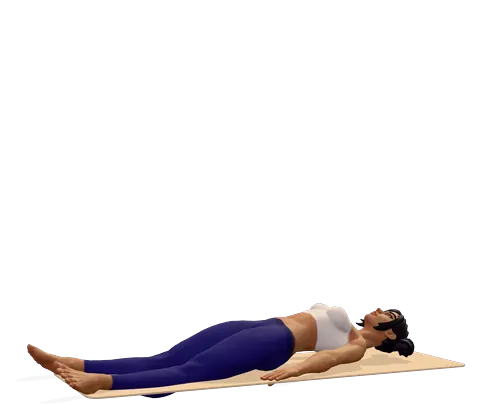
- Lie on your back on a mat or bed, as the 3D figure shows in Savasana (Corpse Pose). Cover yourself with a light blanket: the body cools as it relaxes.
- Choose the length (10, 20 or 30 minutes) and your language. The voice and the on-screen captions work in 28 languages.
- Press play. A soft singing-bowl bell begins the practice; the progress bar and "minutes left" show where you are.
- At the end a closing chime sounds and the practice is saved to My practice.
All three lengths use the same script. What changes is the silence between the lines: in the 10-minute version the pauses are short, in the 30-minute version they are long enough to sink deeply. There is no Yoga Nidra music under the voice, only the bells and silence. Pressing pause stops the practice; pressing play again continues from the same line. The page asks your phone to keep the screen awake while it plays (if your device ignores this, keep the screen on), set it face down, and turn the volume to a low, comfortable level.
Yoga Nidra steps: the stages of our script
Our script follows the classic Yoga Nidra techniques in plain words, so it translates well and works as a script for beginners. Here is what you will hear, step by step:
- Settling. Arrange the body, close the eyes, and take two slow breaths: in through the nose, out through the mouth. Then the breath is left to find its own rhythm.
- Sounds and contact. You notice sounds far away and close by, then feel where the body touches the floor.
- Sankalpa (resolve). You make a short positive wish in simple words, such as "I am calm and healthy", and repeat it silently three times.
- Rotation of awareness. The voice names body parts one by one: each finger of the right hand, the arm, the right side of the body and the leg down to the toes, then the left side, the back, the head and face. It ends with "the whole body, together".
- Breath awareness. Cool air in and warm air out at the nostrils, the belly rising and falling, then counting breaths backwards from 27 to 1.
- Opposite sensations. Heaviness, then lightness; warmth, then coolness. This trains the mind to watch feelings without reacting.
- Visualisation. A calm lake at sunrise, the colours of the sky on the water, a lotus slowly opening.
- Stillness. The pictures are let go, and you rest in the quiet space behind the closed eyes; in the 30-minute version this silence is the longest part.
- Sankalpa again. You return to your wish and repeat it three times with full attention.
- Coming back. Awareness of the breath, the body and the room; moving the fingers and toes, a stretch, rolling to the right side, and sitting up slowly.
If you want to write your own Yoga Nidra script, this order is a reliable template: settle, set the resolve, move through the body, then breath, sensations, images, stillness, the resolve again, and a slow return.
10, 20 or 30 minutes: which should you choose?
| Length | Best for |
|---|---|
| 10 minutes | A short guided Yoga Nidra meditation at lunch, a reset between tasks, or beginners who get restless |
| 20 minutes | The everyday choice: deep rest in the afternoon, or winding down in the evening |
| 30 minutes | Bedtime, insomnia, very tired or stressed days, and the deepest relaxation |
Yoga Nidra for sleep and insomnia
Is Yoga Nidra good before bed? Yes, it is one of the most popular ways to use it. As a guided meditation for sleep, practise in bed with the lights off and choose 20 or 30 minutes. If you fall asleep before the end, that is fine; the body got the rest it needed. For deep sleep, pair it with a short bedtime yoga routine and a few rounds of 4-7-8 or Bhramari on the breathing timer first.
If you want to practise the classic way, awake and aware, do it in the afternoon or early evening, lying on a mat rather than in bed. Many teachers say that a session when you are not sleepy teaches you to relax deeply while staying awake.
Benefits of Yoga Nidra and its limits
Small studies suggest regular practice may improve sleep quality and reduce stress and anxiety, and some people with long-term pain find it eases tension. The research is still limited, so treat these as likely, gentle benefits rather than a cure. Most people notice:
- Falling asleep more easily, and feeling more rested after a short nap.
- A quieter mind and less muscle tension: Yoga Nidra for anxiety and stress is one of its most common uses (see yoga for anxiety).
- Better body awareness, which helps in yoga poses and in daily posture.
- A simple daily practice for people who cannot sit comfortably for meditation.
Is Yoga Nidra safe? Who should adapt it
For most people it is very safe: you lie still and listen. A few points to keep in mind:
- Pregnancy: after about 20 weeks, lie on your left side with a pillow between the knees instead of flat on your back.
- Back pain: put a pillow or rolled blanket under your knees.
- Trauma, PTSD, severe depression or psychosis: deep relaxation can sometimes bring up strong feelings. Keep your eyes slightly open if that feels safer, stop whenever you want, and practise with your therapist's advice.
- Never listen while driving or doing anything that needs your attention.
Side effects are uncommon: some people feel drowsy or emotional afterwards. Sit for a minute before you stand up.
Yoga Nidra benefits in Hindi: योग निद्रा योग निद्रा लेटकर की जाने वाली गहरी विश्राम विधि है। पीठ के बल शवासन में लेटें, आँखें बंद करें और भाषा में "हिन्दी" चुनकर प्ले दबाएँ। आवाज़ आपको शरीर के हर अंग, साँस और शांत दृश्यों से ले जाएगी। इससे मन शांत होता है और नींद अच्छी आ सकती है। रोज़ 10–30 मिनट करें।
Frequently asked questions
How do I do Yoga Nidra at home?
Lie on your back on a mat or bed, cover yourself with a light blanket, choose a length and press play. Keep your body still and follow the voice. You don’t need any experience.
What if I fall asleep during the practice?
That is normal, especially at night, and it is not a mistake. With regular practice many people learn to stay aware for longer.
Should Yoga Nidra be a daily practice?
Daily practice gives the best results, but even two or three times a week helps. The 20-minute version is a good everyday length.
Any tips for Yoga Nidra beginners?
Start with the 10-minute version in the afternoon, keep your resolve short and simple, and don’t worry if your mind wanders or you drift off. Just come back to the voice.
Is Yoga Nidra dangerous?
No, it is a gentle relaxation. People with trauma or serious mental health conditions should practise with their therapist’s advice, and nobody should listen while driving.
Is the practice OK for Christians or people of any faith?
Our script has no chanting, mantra or religious content. It uses body awareness, breath and calm images, and your resolve can be any wish that is meaningful to you.
Is there Yoga Nidra for kids?
The same practice works for children: older children usually enjoy the 10-minute version at bedtime. Younger kids may prefer to lie with a parent nearby.
Can I read the script instead of listening?
The lines appear as captions while you listen, so you can follow along. The stages above show the whole structure.