Before you begin
- A regular, comfortable asana practice for some months, so the spine, hips and core are stable
- A steady seated posture you can hold for fifteen to twenty minutes without pain
- Comfort with slow, relaxed breathing, and with alternate nostril breathing without breath holds
- Basic ethical ground: kindness, honesty and moderation (the yamas and niyamas)
- Good sleep, regular meals and stable mental health; practise when life is steady, not in crisis
- For anything beyond gentle practice, guidance from an experienced teacher who knows you
The path through the chakras (traditional teaching)
- The sleeping serpent (tradition). Traditional texts describe kundalini shakti lying coiled three and a half times at Muladhara, at the base of the spine, asleep and blocking the entrance to the central channel.
- The three channels (tradition). Tradition describes thousands of subtle channels (nadis). Three matter most: Ida on the left, linked with the moon and cooling; Pingala on the right, linked with the sun and heating; and Sushumna in the center of the spine.
- Balancing Ida and Pingala (tradition). Hatha texts teach that when the flow through the left and right channels becomes balanced, for example through alternate nostril breathing, the breath is said to enter Sushumna and the mind becomes still.
- Piercing Brahma granthi (tradition). The first "knot" (granthi) is said to sit in the region of Muladhara and Svadhisthana. It is linked with attachment to the body, comfort and security, and is loosened through steady, grounded practice.
- Rising through the lower centers (tradition). As kundalini is said to rise, it passes through Svadhisthana and Manipura. Texts describe the dissolving of each element into the next: earth into water, water into fire.
- Piercing Vishnu granthi (tradition). The second knot is said to lie around Manipura and Anahata. It is linked with emotional attachment and the pull of feelings. Devotion, compassion and breath practice are said to loosen it.
- Through the heart and throat (tradition). At Anahata the "unstruck" inner sound is said to be heard, and at Vishuddha the elements dissolve into space. The practitioner is described as becoming calm and pure in speech.
- Piercing Rudra granthi (tradition). The third knot is said to lie at Ajna, between the eyebrows. It is linked with attachment to subtle powers and to the sense of a separate self. Only deep meditation is said to untie it.
- Union at the crown (tradition). At Sahasrara, the thousand-petalled lotus, kundalini (Shakti) is said to unite with Shiva, pure consciousness. The texts describe this union as liberation, and the energy is then said to return to rest.
- A modern reading. Many teachers today read this map as a symbolic description of the mind growing steadier, kinder and clearer. You do not need to believe it literally to benefit from the gentle practices.
Kundalini yoga exercises and practices
Seated spinal flex and circles asana
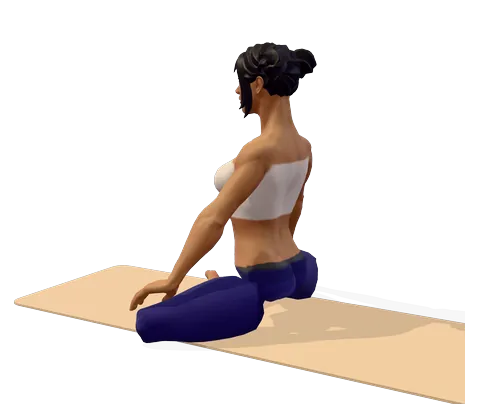
- Sit cross-legged and hold your shins or knees.
- Breathing in, gently rock the chest forward and arch the lower back.
- Breathing out, round the back and let the pelvis roll back.
- Keep the head level and the movement small and smooth, for one to two minutes.
- Then make slow circles with the upper body, first one way, then the other.
Caution: Move slowly with a stiff or painful back. Stop if you feel any sharp pain.
Cat and Cow asana
- Come onto hands and knees, hands under shoulders and knees under hips.
- Breathing in, lower the belly and lift the chest and gaze (Cow).
- Breathing out, round the spine and tuck the chin (Cat).
- Move with the breath for one to two minutes.
Caution: Use padding under sore knees. Keep the neck movement gentle.
Seated spinal twist asana
- Sit tall in an easy cross-legged pose.
- Breathing in, lengthen the spine.
- Breathing out, turn to the right, left hand on the right knee.
- Hold for five breaths, then change sides.
Caution: Twist from the middle of the back, not the neck. Avoid deep twists in pregnancy or with a disc injury.
Bridge pose asana
- Lie on your back with knees bent and feet hip-width apart.
- Breathing in, press through the feet and lift the hips.
- Hold for a few breaths with the chest broad.
- Breathing out, lower the spine slowly, one part at a time.
Caution: Keep the head still and do not turn the neck while the hips are lifted.
Mula Bandha (root lock), gentle form bandha
- Sit tall in a steady cross-legged pose.
- Breathing normally, gently lift the pelvic floor, as if stopping the flow of urine, about one third of your full effort.
- Hold lightly for a few breaths, then release completely.
- Repeat five to ten times, keeping the belly, jaw and face soft.
Caution: Never hold the breath with it at this stage. With pelvic pain, a very tight pelvic floor or in pregnancy, ask a pelvic health physiotherapist first. Relaxing matters as much as lifting.
Uddiyana Bandha (abdominal lock) bandha advanced — read only
- Practised only on a completely empty stomach, standing or seated.
- Breathe out fully and hold the breath out.
- Make a false in-breath without letting air in, so the belly draws in and up under the ribs.
- Hold only for a few seconds, release the belly, then breathe in slowly.
Caution: Advanced: learn from a teacher. Not in pregnancy or during menstruation, or with high blood pressure, heart disease, hernia, ulcers, inflammatory bowel disease, glaucoma or recent surgery.
Jalandhara Bandha (chin lock), learning the position bandha
- Sit tall with your hands on your knees.
- Lengthen the back of the neck and draw the chin gently down and back toward the top of the breastbone.
- Breathe normally for a few breaths, then lift the head.
- In tradition it is used with breath holds; here you only learn the position.
Caution: Avoid with a neck injury or cervical problems. Do not add breath holds without a teacher, especially with high blood pressure or heart disease.
Maha Bandha (the great lock) bandha advanced — read only
- Described here for understanding only.
- Traditionally, after a full out-breath, the chin lock, abdominal lock and root lock are applied together.
- The locks are held briefly, then released in reverse order before breathing in.
- Hatha texts describe it as helping to direct prana into the central channel.
Caution: Advanced practice with breath held out. It carries every caution of Uddiyana Bandha. Learn each lock separately first, and only with an experienced teacher.
Nadi Shodhana (alternate nostril breathing), no holds pranayama
- Sit tall and bring your right hand into Vishnu mudra.
- Close the right nostril with the thumb and breathe in through the left.
- Close the left nostril with the ring finger, open the right, and breathe out.
- Breathe in through the right, switch, and breathe out through the left. That is one round.
- Continue for three to five minutes, slowly and quietly, without holding the breath.
Caution: Keep the breath soft and never strain. If your nose is blocked, breathe slowly through both nostrils instead.
Breath of fire, short and gentle pranayama
- Sit tall on an empty stomach.
- Breathe rapidly and evenly through the nose, pulling the navel in on each out-breath and letting it relax on each in-breath.
- Beginners: one round of no more than thirty seconds, at a moderate pace.
- Then breathe slowly and normally for at least a minute.
Caution: Stop if you feel dizzy, tingling or anxious. Not for pregnancy, high blood pressure, heart disease, epilepsy, hernia, recent surgery, panic disorder or during menstruation. Longer rounds and forceful Bhastrika need a teacher.
Khechari mudra mudra advanced — read only
- Described here for understanding only.
- Hatha texts describe turning the tongue back and up into the space behind the soft palate.
- The texts link it with deep inner stillness and the flow of "nectar" (amrita).
- A gentle version, simply resting the tongue on the roof of the mouth, is safe to use in meditation.
Caution: Some traditional texts describe gradually cutting the tissue under the tongue. Never do this. It is dangerous and unnecessary.
Shambhavi mudra, gentle eyebrow-center gaze mudra
- Sit tall with your hands in Gyan or Chin mudra.
- With eyes half closed, look gently up toward the point between the eyebrows.
- Hold for a few breaths only, then close and relax the eyes.
- Build slowly, over weeks, to about a minute.
Caution: Stop at once if the eyes ache or you get a headache. Avoid with glaucoma, recent eye surgery or detached retina.
Ajapa japa (So Hum awareness) meditation
- Sit comfortably with your eyes closed.
- Silently hear "So" with each in-breath and "Hum" with each out-breath.
- If you like, imagine the breath travelling up the front of the spine on "So" and down on "Hum".
- Continue for five to ten minutes, keeping the breath natural.
Caution: Safe for most people. Keep the breath natural and let go of the mantra if you feel lightheaded.
Chakra dharana (concentration on the centers) meditation
- Sit tall with your eyes closed.
- Rest your attention at each center in turn, from the base of the spine to the crown.
- At each one, picture its colour and silently repeat its seed sound a few times.
- Finish by bringing attention back down to the base and feeling the ground.
Caution: If you feel "spaced out", end with attention at the feet and the base of the spine, and eat something light.
Kundalini is the name yoga and tantra give to a dormant spiritual energy, pictured as a serpent coiled at the base of the spine. In the traditional teaching, practice slowly wakes this energy and draws it up through the chakras to the crown of the head. This page explains where the idea comes from, what people describe when they talk about kundalini awakening, why intense practice carries real risks, and how to prepare gently. It is written for understanding, not to promise any experience.
Kundalini is a spiritual and traditional concept, not a medical or measurable one, and nothing here is medical advice. If you live with a mental-health condition, epilepsy, heart disease or high blood pressure, or are pregnant, talk to your doctor before any breathwork.
What is kundalini? Meaning and origin
The kundalini meaning in Sanskrit comes from kundala, "a coil" or "a ring", so the word means "she who is coiled"; the usual kundalini meaning in English is "serpent power". The word is feminine because it names shakti, the creative power of the Goddess, and some traditions honour her as a goddess in her own right.
What is kundalini shakti energy in simple words? Tradition says it is the same power that creates and sustains life, resting at the base of the body while we live ordinary, outward-facing lives. That is the kundalini shakti meaning: its "sleep" is our everyday state of mind, and its waking is awareness turning inward and becoming free.
Where the idea of the kundalini snake comes from
The kundalini philosophy grew out of Hindu tantra and was later taken into Hatha Yoga. Key sources include the Hatha Yoga Pradipika (around the fifteenth century), the Sat-Chakra-Nirupana (sixteenth century) and the Yoga Kundalini Upanishad. In 1919 Sir John Woodroffe, writing as Arthur Avalon, translated the Sat-Chakra-Nirupana as The Serpent Power, which introduced the idea to many Western readers.
Among modern kundalini books, Swami Satyananda Saraswati's Kundalini Tantra is widely read in India, and Gopi Krishna's autobiography describes a long, difficult awakening in frank terms.
How it connects the chakras, and kundalini yoga
Kundalini is the thread that ties the seven chakras together. It is said to sleep at the Muladhara, or root chakra, and to reach its goal at the Sahasrara, or crown chakra, so teachers usually begin kundalini chakra awakening with patient work at the root.
"Kundalini yoga" usually means a specific modern style of kriyas, breath of fire and chanting, taught in the West from 1969; we explain it on our page about that style. Classical Hatha Yoga aims at the same awakening through posture, pranayama, locks and meditation, so kundalini vs hatha yoga is less a contrast than two routes to one traditional goal.
What is kundalini awakening?
In the traditional sense, kundalini rising is the moment the energy is said to leave the root and enter the central channel (Sushumna). The texts describe a gradual kundalini awakening process, taking years of steady practice and ethical living, with the energy piercing three "knots" on the way. The stages shown on this page are best read as a map of the mind growing steadier, not a timetable.
Traditions describe several routes: long practice of breath and meditation, devotion, and shaktipat, the "transmission" of energy from a teacher to a student. Be cautious with anyone who sells a kundalini shaktipat initiation or promises fast results. Tradition itself warns that forcing the process, or chasing kundalini powers (siddhis), is unwise.
Kundalini awakening symptoms people report
People who describe kundalini awakening experiences report heat or electric sensations along the spine, tingling, spontaneous movements or shaking, strong waves of emotion, inner lights or sounds, vivid dreams, bursts of energy and deep peace. Asked how it feels, some also describe kundalini night sweats, nausea, headaches or racing thoughts. These experiences are real to the people who have them, but none of them proves that anything is "rising", and many overlap with stress, over-breathing, lack of sleep and medical conditions.
Kundalini syndrome and spiritual emergency
What is kundalini syndrome? It is a term from transpersonal psychology for a cluster of intense physical, emotional and mental effects that some people link to this practice. In the 1990s the psychiatrist Bruce Greyson developed a questionnaire to study such experiences. The psychiatrist Stanislav Grof and his wife Christina Grof used the wider term spiritual emergency for spiritual experiences that turn into a crisis, disturbing sleep, work and relationships. Modern psychiatric manuals also include a category for "religious or spiritual problems", so doctors can take such experiences seriously without assuming either illness or enlightenment.
Some reports of "kundalini psychosis" describe people whose intense practice was followed by mania, psychosis, severe anxiety or dissociation. A 2017 study from Brown University also documented a wide range of difficult meditation experiences, from fear and panic to changes in perception that lasted weeks. The honest conclusion about kundalini side effects is that intense practice can unsettle the nervous system, and a medical cause must always be ruled out.
When to stop and seek help
Stop practising and see a doctor or mental-health professional if you notice any of these kundalini awakening warning signs: sleeping very little for several nights, racing or unusual thoughts, hearing or seeing things others do not, feeling unreal or outside your body for long periods, panic attacks, thoughts of harming yourself, or symptoms that interfere with daily life. Get urgent medical help for chest pain, fainting, a seizure, or a sudden severe headache or weakness. Keep taking prescribed medicine and tell your doctor about your practice; a good teacher will encourage this.
Integration practices that settle the system
If practice has left you over-stimulated, the traditional advice matches common sense: stop breathwork and long meditation, eat regular warm meals, sleep, walk outdoors and spend time with people you trust. Short guided relaxation such as Yoga Nidra and a long rest in Corpse pose are gentler kundalini integration practices than more meditation.
Is kundalini awakening dangerous?
Why is kundalini dangerous, according to its own tradition? The Hatha texts warn that forceful breathing, long breath holds and locks, done without guidance, can cause harm. In modern terms, the main risks come from hyperventilation, long retention, sleep loss on intense retreats, and practising while mentally unwell. Gentle posture, relaxed breathing and short meditation carry very little risk for most people. So the real kundalini benefits and dangers depend far more on intensity and support than on the idea itself.
How to practise kundalini safely: a step-by-step start
If you want to know how to awaken kundalini, the most honest answer is that you do not aim for it. You build a steady body, calm breath and a kind, clear mind, and let whatever happens happen slowly. That is what the gentle kundalini shakti practices on this page are for.
Kundalini for beginners, step by step
- Weeks 1 to 4: three or four times a week, follow the guided "Gentle kundalini preparation" session on this page: spinal flexes, Cat and Cow, twists and Bridge, then rest. These simple kundalini exercises prepare the spine.
- Add breath: five minutes of alternate nostril breathing without holds, most days. Keep kundalini breathing soft and quiet, with the hands in Gyan mudra, the most common kundalini mudra.
- Add meditation: ten minutes of So Hum meditation, the classic kundalini mantra meditation for beginners, or a chakra meditation that moves attention from the base to the crown and back down.
- Only later, and briefly: short rounds of breath of fire or Kapalbhati, if no health condition rules them out. Kundalini breath of fire is the most common cause of dizziness and anxiety in beginners.
- Always end grounded: attention back at the base of the spine and the feet, then a snack or a walk.
Twenty to thirty minutes a day is a sensible daily kundalini practice, and our meditation timer can time the silent part. Kundalini in daily life also means the yamas and niyamas: honesty, non-harming, moderation and contentment, which tradition treats as the real foundation.
Common mistakes
- Chasing experiences, and judging your practice by sensations.
- Learning long breath holds and locks from videos.
- Stacking intense practice on top of stress, grief or poor sleep.
- Ignoring warning signs because someone called them "part of the process".
What research says
The coiled energy itself has not been measured, and science neither proves nor disproves it. Related practices have been studied, though. A randomised trial published in JAMA Psychiatry in 2021 found that kundalini yoga helped people with generalised anxiety more than a stress-education class, although cognitive behavioural therapy worked better. So kundalini for anxiety can be a useful extra, not a replacement for proven treatment; see yoga for anxiety for more. Research on slow breathing and meditation in general points to modest benefits for stress. The other side is equally clear: studies of meditators show that challenging experiences are more common than many teachers admit.
Kundalini shakti kya hai: meaning in Hindi (कुंडलिनी शक्ति) योग और तंत्र परंपरा में कुंडलिनी शक्ति को रीढ़ के आधार पर कुंडली मारे सोई हुई ऊर्जा माना जाता है, जो साधना से जागकर सहस्रार तक पहुँचती है। यह एक आध्यात्मिक मान्यता है, चिकित्सा तथ्य नहीं। Kundalini jagran in Hindi परंपरा में धीरे-धीरे होने वाली प्रक्रिया है: नियमित आसन, बिना साँस रोके अनुलोम-विलोम, "सो-हम" ध्यान और संयमित जीवन। तेज़ प्राणायाम या लंबा कुंभक बिना अनुभवी गुरु के न करें। नींद न आना, घबराहट या अजीब अनुभव हों तो अभ्यास रोकें और डॉक्टर से मिलें।
Frequently asked questions
Is kundalini real?
It is a traditional spiritual concept, so it cannot be tested like a nerve or a hormone. The experiences people describe are real to them, and some related practices have measurable effects on breathing and stress. Whether an energy is literally rising is a matter of belief, not evidence.
What are the benefits of kundalini awakening?
Tradition describes deep peace, clarity, compassion and freedom from fear as the kundalini shakti benefits. Modern practitioners mostly report calmer moods and better focus from the gentle practices. No benefit is guaranteed, and chasing an awakening often brings the opposite of peace.
How long does a kundalini awakening last?
Tradition treats it as a slow change over years, not an event. Intense experiences that some people call an awakening usually settle within days or weeks once intense practice stops. If they last, or disturb sleep and daily life, see a doctor.
Is kundalini the Holy Spirit, or is it satanic or demonic?
The idea comes from Hindu tantra and has its own meaning there. Some Christian writers compare it with the Holy Spirit, while others see it as incompatible with their faith or even call it evil. These are religious judgements. The gentle practices here are posture, breathing and quiet attention, and you can practise them without adopting any belief.
Is kundalini the same as kundalini yoga?
No. The first is the traditional idea of a coiled energy. The second is a modern style of practice, with kriyas, breath of fire and chanting, that aims to awaken it. Classical Hatha Yoga, meditation and devotion aim at the same goal in different ways.
What is the kundalini jagran mantra?
There is no single mantra. Tradition uses the seed sound of each chakra, OM, and the natural So Hum of the breath. Mantra is safest when practised gently, without forceful breathing or long breath holds.
Who should not practise these techniques?
Avoid strong breathwork, breath holds and locks if you are pregnant, or have high blood pressure, heart disease, epilepsy, glaucoma, a hernia, recent surgery, psychosis, bipolar disorder, severe depression or PTSD, unless your doctor agrees. Gentle movement, relaxed breathing and short meditation are usually fine.
Chakras, kundalini and the traditional powers linked to them come from yogic and tantric tradition. They are not anatomical structures and these descriptions are not medical claims. Meditation and gentle yoga are generally safe, but intense breathing, long breath holds or very long sittings can cause dizziness, anxiety or distress, and may not suit people with heart disease, high blood pressure, epilepsy, pregnancy or a history of psychosis, bipolar disorder or trauma. Keep any prescribed treatment, practise gently and stop if you feel unwell. See our medical disclaimer.