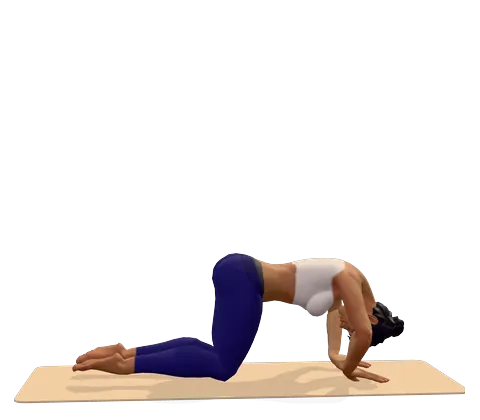
How to do Cat Pose step by step
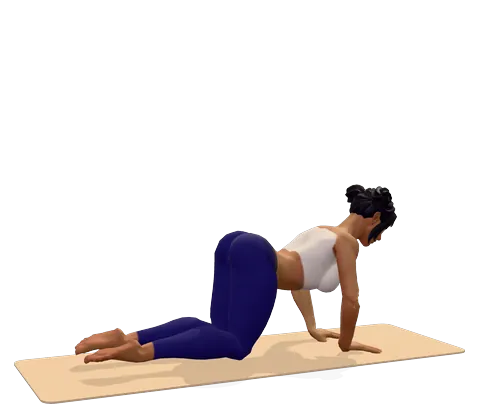
- Come onto your hands and knees in a table-top position: wrists under your shoulders, knees under your hips, fingers spread wide.
- Start with a flat back and your neck in line with your spine, gaze down at the mat.
- Breathe out and round your back up toward the ceiling, starting from your tailbone and moving up the spine.
- Push the floor away with your hands so your shoulder blades spread apart, and draw your belly button in toward your spine.
- Let your head drop and tuck your chin gently toward your chest.
- Hold for 2–3 breaths, or flow straight into cow pose on your next breath in.
- Return to a flat, neutral back before sitting back into child's pose to rest.
Where you feel Cat Pose: what it stretches and strengthens
Round your back up and draw your belly in. In the 3D guide, turn on Body guide: areas that stretch glow green and areas that work glow saffron.
Stretches
- Upper back
- Lower back
- Neck
Strengthens
- Abs
Benefits and precautions
Benefits
- Gently mobilises the whole spine, from the tailbone to the neck
- Stretches the back, shoulders and back of the neck
- Engages the abdominal muscles as you round up
- Links movement with the breath, which helps calm the mind
- An easy warm-up that suits most people, including beginners and seniors
- Used in yoga plans for back pain, neck pain, period pain and stress
Avoid or modify if
- Wrist pain or carpal tunnel: make fists, use blocks under the hands, or come onto your forearms
- Knee pain: fold a blanket under your knees, or do the seated cat-cow on a chair
- Neck injury: keep your head in line with your spine instead of dropping it
- Osteoporosis or an acute disc injury: move in a small, comfortable range and ask your physiotherapist before rounding deeply
- Late pregnancy: keep the cow phase shallow so the lower back does not sag
Cat pose (Marjaryasana) is a gentle yoga stretch on your hands and knees in which you round your spine up toward the ceiling, like a cat arching its back. On its own it stretches the back and neck; paired with cow pose (Bitilasana), it becomes the cat-cow flow, one of the most widely used warm-ups in yoga and back care. This page explains how to do cat pose, how to move between cat and cow with the breath, what the benefits are and how to adapt it.
What is cat pose in yoga? The Sanskrit name
The cat pose Sanskrit name comes from marjari, "cat", and asana, "pose". You will see it spelled Marjaryasana or Marjariasana; both are correct. To pronounce Marjariasana, say mar-jar-ee-AHS-uh-nuh. Cow pose is Bitilasana, from bitila, "cow", so the cat cow yoga pose Sanskrit name is Marjaryasana-Bitilasana.
The cat pose name in Hindi is मार्जरी आसन (मार्जरासन). In physiotherapy the same movement is called the "cat-camel" exercise, because the rounded back looks like a camel's hump.
How to do cat pose
The cat pose yoga steps and instructions above start from a neutral table-top. A few details make the difference between a real stretch and a small wobble:
- Push the floor away. As you round, press firmly through your hands. This spreads the shoulder blades and stretches the upper back, the area most people miss.
- Start the curve from the tailbone. Tuck the pelvis first, then let the rounding travel up the spine to the head. If only your neck moves, the spine is not really working.
- Belly in, not held. Draw the navel toward the spine on the breath out, but keep breathing.
- Soft elbows. Keep the arms straight without locking the elbows.
How to do cat cow pose with the breath
Cat cow pose is simply cat and cow linked with the breath, and it is usually the first flow beginners learn. It is the version most teachers mean when they say "cat pose".
- Start in table-top with a flat back.
- Breathe in into cow: let your belly sink toward the mat, lift your tailbone and your chest, broaden across the collarbones and look slightly forward.
- Breathe out into cat: tuck your tailbone, round your back up, push the floor away and drop your head.
- Repeat 5–10 rounds, moving slowly enough that each movement fills one full breath.
This is the cat cow pose breathing pattern: inhale for cow, exhale for cat. Letting the breath lead the movement is what makes it calming rather than just mobile. The full cow pose instructions are on the cow pose page.
How to cue cat-cow pose (and common mistakes)
If you teach friends or family, keep the cat pose cues simple: "Inhale, belly drops, heart forward. Exhale, round your back, chin to chest." Watch for three mistakes: moving only the head, sagging deep into the lower back in cow, and rushing the breath. A smaller, slower movement is better than a big, fast one.
Cat pose vs cow pose
| Cat (Marjaryasana) | Cow (Bitilasana) | |
|---|---|---|
| Spine | Rounds up (flexion) | Arches down (extension) |
| Breath | Breathe out | Breathe in |
| Stretches | Back, shoulders, back of the neck | Chest, belly, front of the neck |
| Head | Drops, chin tucked | Lifts, gaze forward |
Cat pose benefits
Cat pose yoga benefits, like cat cow pose benefits in general, come mainly from gentle movement. Spinal joints and discs like regular motion, and cat-cow moves each part of the spine through a comfortable range without any load.
Cat cow pose stretch for back pain and neck pain
Cat-cow is part of many exercise and yoga programmes for chronic back pain, where studies have found yoga can reduce pain and improve function. It is also a staple for stiff necks and shoulders after desk work. Move within a pain-free range; if one direction hurts, do more of the other and ask a physiotherapist.
Stress, periods and digestion
Slow, breath-led movement helps the nervous system settle, which is why cat-cow comes early in our routines for anxiety and stress. Many women find the gentle rounding eases period cramps, and it appears in our yoga for period pain plan. The rhythmic movement of the belly can also feel soothing for bloating and indigestion. Cat pose and cat-cow benefits for female and male practitioners are otherwise the same.
Cat cow pose benefits in pregnancy
Cat-cow is one of the most common prenatal poses, and it is part of our Gentle Prenatal Flow. On hands and knees the belly is supported by gravity rather than pressing on the spine, which many people find eases back discomfort. Keep the cow phase shallow and check with your doctor or midwife before exercising in pregnancy.
Cat cow pose exercise: muscles used
In cat, the abdominal muscles (rectus abdominis and transverse abdominis) contract to round the spine, while the erector spinae, rhomboids and trapezius lengthen. In cow it reverses: the back muscles shorten and the abdominals and chest lengthen. The shoulders and arms stay lightly active the whole time.
Cat pose variations and modifications
- Seated cat cow pose: sit tall with your hands on your knees, round your back as you breathe out and lift your chest as you breathe in. The chair cat cow is one of the best chair yoga poses for back pain, and it works at a desk.
- Standing cat pose: feet hip-width, knees bent, hands on your thighs. Useful when getting down to the floor is hard.
- Wrist-friendly: come onto your forearms or make fists. These are the simplest modifications for cat cow pose.
- Cat with a knee: as you round, draw one knee toward your nose; as you arch, reach that leg back. This leads into tiger pose.
- Cat cow puppy pose: after a few rounds, walk your hands forward and melt your chest down into extended puppy pose.
For kids, cat pose is easy to teach as a game, with the same benefits of a gentle stretch: "angry cat" for the round back and "happy cow" with a "moo" for the arch.
Cat cow to downward dog and child's pose
Cat-cow is a natural doorway to other poses. From table-top, tuck your toes and lift your hips into downward dog, or sit your hips back to your heels for child's pose to rest. It appears in many of our guided sessions, including the First Yoga Session and Back Pain Relief, with the voice counting you through each breath.
मार्जरी आसन — cat pose steps and benefits in Hindi: हाथों और घुटनों के बल आएँ, कलाइयाँ कंधों के नीचे और घुटने कूल्हों के नीचे रखें। साँस छोड़ते हुए पीठ को ऊपर की ओर गोल करें और ठुड्डी छाती की ओर लाएँ। साँस लेते हुए पेट नीचे और छाती ऊपर करें (गाय मुद्रा)। 5 से 10 बार धीरे-धीरे दोहराएँ। इससे रीढ़ लचीली होती है, कमर और गर्दन की अकड़न कम होती है और मन शांत होता है। कलाई या घुटनों में दर्द हो तो नीचे कंबल रखें।
Health conditions this pose is used for
Yoga for back pain · Yoga for neck pain and cervical spondylosis · Yoga for frozen shoulder · Yoga for desk workers and sitting all day · Yoga for arthritis · Yoga for slip disc (herniated disc) · Yoga for spinal stenosis · Yoga for spondylolisthesis · Yoga for degenerative disc disease · Yoga for scoliosis · Yoga for shoulder pain · Yoga for fibromyalgia · Yoga for chronic pain · Yoga for ankylosing spondylitis · Yoga for lupus · Yoga for jaw pain (tmj) · Yoga for height and posture · Yoga for balance and fall prevention · Yoga for low blood pressure · Yoga for hyperthyroidism (overactive thyroid) · Yoga for uric acid and gout · Yoga for kidney health · Yoga for kidney stones · Yoga for hormonal balance · Yoga for anemia (low hemoglobin) · Yoga for period pain and menstrual cramps · Yoga for irregular periods · Yoga for endometriosis · Yoga for pms (premenstrual syndrome) · Yoga for pregnancy (prenatal yoga) · Yoga for postpartum recovery · Yoga for pelvic floor and urinary incontinence · Yoga for erectile dysfunction · Yoga for anxiety · Yoga for grief and loss · Yoga for bipolar disorder (complementary care) · Yoga for eating disorder recovery · Yoga for stress relief · Yoga for jet lag and travel fatigue · Yoga for migraine and headache · Yoga for exam stress · Yoga for parkinson’s disease · Yoga for adhd and attention · Yoga for autism (children) · Yoga for ptsd and trauma · Yoga for panic attacks · Yoga for social anxiety · Yoga for anger management · Yoga for burnout and exhaustion · Yoga for addiction and quitting smoking · Yoga for vertigo and dizziness · Yoga for tinnitus · Yoga for memory in older adults · Yoga for stroke recovery · Yoga for multiple sclerosis · Yoga for chronic fatigue syndrome · Yoga for copd · Yoga for bronchitis · Yoga for heart health · Yoga for long covid recovery · Yoga for snoring and sleep apnea · Yoga for acidity and acid reflux · Yoga for gastritis · Yoga for gallstones · Yoga for hernia (safe movement) · Yoga for ibs · Yoga for gas and bloating · Yoga for piles (hemorrhoids) · Yoga for ulcerative colitis and ibd · Yoga for premature grey hair · Yoga for dark circles · Yoga for psoriasis and eczema · Yoga for glaucoma (safe yoga) · Yoga for dry eyes · Yoga for motion sickness · Yoga for cold hands and feet (circulation) · Yoga for cancer recovery (supportive care)
Where this practice is used
Chakras: Svadhisthana (Sacral Chakra) · Anahata (Heart Chakra) · Vishuddha (Throat Chakra)
Frequently asked questions
What is cat pose good for?
Marjariasana benefits the back, shoulders and neck: the pose stretches them and gently mobilises the spine. Combined with cow pose, it is a common warm-up and part of many yoga programmes for back pain and stress.
What is the difference between cat pose and cow pose?
In cat pose you round your back up and breathe out; in cow pose you let your belly sink, lift your chest and breathe in. Together they form the cat-cow flow.
How many rounds of cat-cow should I do?
Five to ten slow rounds, each movement lasting one full breath, is a good warm-up. You can do it daily, including first thing in the morning.
Is cat-cow good for lower back pain?
For most people, yes. It gently moves the spine without load, and it appears in many back pain programmes. Stay in a pain-free range and ask a physiotherapist if pain spreads down a leg.
Can I do cat-cow during pregnancy?
Usually yes; it is one of the most common prenatal exercises. Keep the arch shallow and check with your doctor or midwife first.
What is cat pose called in Hindi?
Marjariasana in Hindi is written मार्जरी आसन (Marjari asana); marjari means cat.
What is the difference between cat pose and camel pose?
Cat pose rounds the back on hands and knees. Camel pose (Ustrasana) is a kneeling backbend that arches the spine the other way. In physiotherapy, "cat-camel" refers to the cat-cow movement.
This page is for general education. Check with your doctor before starting yoga if you are pregnant, have a medical condition or an injury. Stop if you feel pain, dizziness or shortness of breath.