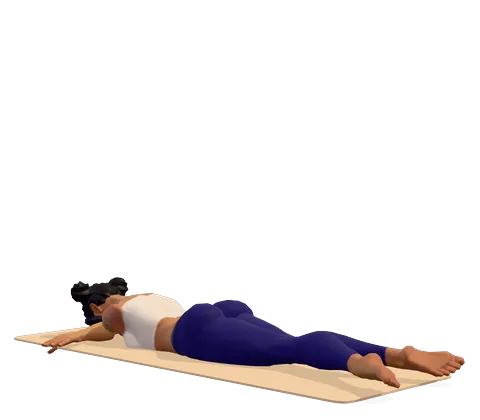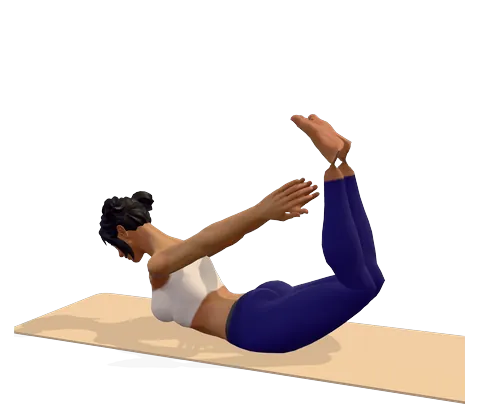
How to do Bow Pose step by step
- Lie on your front with your arms beside your body and your forehead or chin on the mat.
- Bend both knees and bring your heels toward your buttocks, knees about hip-width apart.
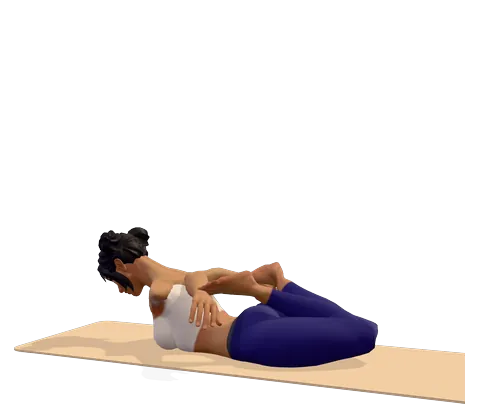
- Reach back and hold the outside of each ankle with the same-side hand, thumbs and fingers together.
- Breathe in and press your feet back and up into your hands. Let that kick lift your thighs, chest and head off the mat while your arms stay straight.
- Roll your shoulders back, open your chest and look forward. Your weight rests on your belly.
- Hold for 3–5 breaths (about 20 seconds), breathing into your chest and back rather than holding your breath.
- Breathe out, lower your thighs and chest, release your ankles and rest with your head to one side.
Where you feel Bow Pose: what it stretches and strengthens
Kick your feet into your hands to lift your chest. In the 3D guide, turn on Body guide: areas that stretch glow green and areas that work glow saffron.
Stretches
- Chest
- Front thighs
- Hip flexors
Strengthens
- Lower back
- Glutes
- Hamstrings
Benefits and precautions
Benefits
- Stretches the whole front of the body: chest, shoulders, abdomen, hip flexors and thighs
- Strengthens the back, buttocks and backs of the legs
- Opens the chest and shoulders, a counter to hours of sitting and screen time
- Energising and warming, useful in a morning routine
- Part of yoga programmes for type 2 diabetes and a stronger core
- Builds toward deeper backbends such as wheel pose
Avoid or modify if
- Pregnancy: do not practise; it presses the whole weight onto the belly
- High blood pressure, heart disease, recent stroke or migraine: the effort is strong; choose locust with steady breathing instead
- Hernia, peptic ulcer or recent abdominal surgery
- Lower back or neck injury, spondylolisthesis or pain when you arch
- Knee injury: use a strap so the knees do not bend deeply
- Practise on an empty stomach, at least 2–3 hours after a meal
Bow pose (Dhanurasana) is a backbend in which you lie on your front, hold your ankles and lift your chest and thighs so that your body curves like a drawn bow and your arms become the string. It is one of the classic backbends of Hatha yoga and a big step up from cobra and locust. This page covers what bow pose is, how to do it correctly, the prep poses and easier versions that get you there, its real benefits and the contraindications you need to know.
What is bow pose? Sanskrit name and related poses
The bow pose Sanskrit name comes from dhanu, meaning "bow" (as in bow and arrow), and asana, meaning "pose", with the pronunciation dah-noo-RAHS-uh-nuh. The Hindi name for the pose is धनुरासन, with the same meaning: धनुष is a bow.
Several other poses share the name, which can be confusing:
- Upward bow pose (Urdhva Dhanurasana) is wheel pose, a full backbend from lying on your back; Urdhva Dhanurasana benefits are similar but it needs much more strength and flexibility.
- Bow and arrow pose (Akarna Dhanurasana) is the seated archer pose, where one foot is drawn toward the ear like an archer drawing a string. Akarna Dhanurasana benefits are mostly for the hips and hamstrings.
- Standing bow pose (Dandayamana Dhanurasana), taught in hot yoga, is a one-legged balance close to dancer pose.
How to do bow pose correctly
The Dhanurasana pose steps are listed above. The secret is that the lift comes from your legs, not your arms. Keep the arms straight like ropes and kick your feet back into your hands: that kick is what raises the chest.
Bow pose cues and alignment
- Knees hip-width. They tend to splay wide. Wide knees squeeze the lower back; keep them no wider than your hips.
- Straight arms. Bent elbows mean you are pulling with the arms. Straighten them and let the legs do the work.
- Lift the thighs as well as the chest. If only the chest rises, the bend collapses into the lower back. Press the feet up to lift the knees.
- Broad chest, soft neck. Roll the shoulders back and look forward; do not drop the head back.
- Keep breathing. The belly is pressed into the floor, so breathe into the chest and back. Short, steady breaths are fine.
Hold for 3–5 breaths and repeat once or twice. Some traditions add a gentle rocking bow, moving forward and back with the breath; only try it once the still pose is easy.
Bow pose for beginners: prep poses and modifications
If you cannot reach your ankles yet, you are not alone. Use these bow pose yoga variations for beginners, roughly in this order:
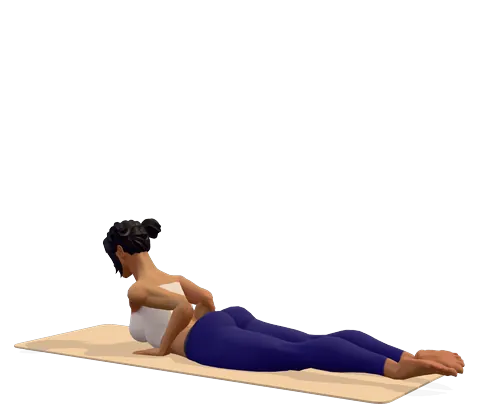
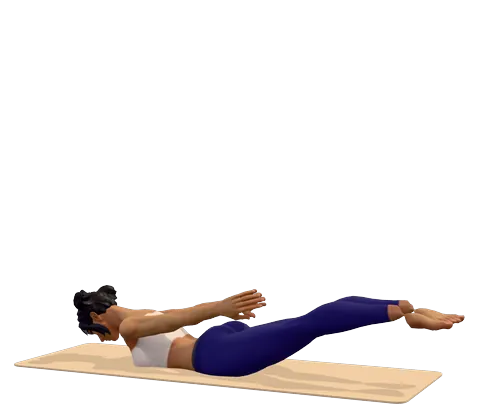
- Prep poses: practise locust pose for back strength and a low lunge or lying quad stretch for the fronts of the thighs. These are the best bow pose prep.
- Half bow pose: prop yourself on your right forearm, bend your left knee and hold the left ankle with your left hand, then kick the foot back to lift the thigh. Switch sides. Half bow pose benefits are the same stretch with half the effort, which makes it ideal for beginners and for testing your knees.
- Bow pose with strap: loop a strap around the fronts of both ankles and hold the ends. The strap bridges the gap if your hands do not reach.
- Full bow pose: hold both ankles and lift. How to do full bow pose well: lift a little, breathe, and let the height come from the kick of your legs over weeks.
A bow pose alternative for anyone who cannot lie on the belly is camel pose with hands on the hips, or a standing backbend with hands on the lower back.
Bow pose yoga benefits
What is bow pose good for? It is one of the few yoga poses that stretches the entire front of the body while strengthening the entire back of it, and those are its main benefits. The bow pose stretch reaches the chest, shoulders, abdomen, hip flexors and quadriceps.
Posture, back and energy
Bow pose opens the shoulders and chest that round forward at a desk and works the muscles that pull you upright. Like other backbends, it tends to feel energising, which is why many people like it in the morning. It is a strong pose, though, and not the first yoga pose for back pain; start with sphinx and cobra if your back is sore.
Diabetes and belly fat
Dhanurasana is part of several yoga programmes studied for type 2 diabetes, where regular yoga practice has been linked with better blood sugar control. Traditional texts say the pressure on the belly massages the abdominal organs; that idea is not proven, and the benefit more likely comes from regular practice as a whole. See our yoga for diabetes plan, and keep taking your medicine. Bow pose also works the core, but no single pose burns fat from the belly; our yoga for belly fat plan explains what does help.
Bow pose benefits for female and male practitioners
The benefits are the same for everyone: a strong back and an open front body. Some women find gentle backbends ease period cramps, while others prefer to skip strong belly-down poses during their period; both are fine. Claims about bow pose benefits for skin have no research behind them.
Bow pose anatomy: muscles worked
| Strengthens | Stretches |
|---|---|
| Erector spinae along the spine | Chest and front of the shoulders |
| Gluteus maximus and hamstrings (the kick) | Quadriceps and hip flexors |
| Rhomboids and rear shoulders | Abdominal muscles |
Bow pose vs locust, wheel and dancer
| Pose | How it differs from bow |
|---|---|
| Locust (Salabhasana) | No hands on the feet; the back lifts you alone. Easier, and the best preparation. |
| Wheel (Urdhva Dhanurasana) | From lying on the back, pressing up on hands and feet. Much deeper and harder. |
| Dancer (Natarajasana) | The same leg kick, done standing on one leg. Standing bow pose vs dancer pose: standing bow tilts the chest further forward, dancer stays more upright. |
Standing bow pose benefits include balance and focus as well as the backbend, so it suits people who cannot lie on the belly but can stand steadily.
Dhanurasana precautions and contraindications
Dhanurasana benefits and contraindications go together: the same strong effort that builds strength also raises blood pressure and puts weight on the belly. Skip it in pregnancy, with high blood pressure or heart disease, hernia, peptic ulcer, recent abdominal surgery, or an injured lower back, neck or knee. Practise on an empty stomach. If you feel pinching in the lower back, lower down, use the half bow, and keep the knees closer together.
A short bow pose sequence
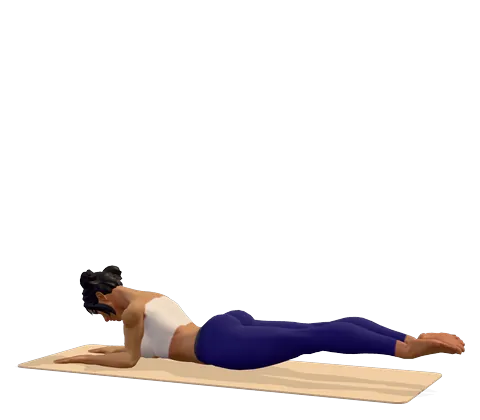
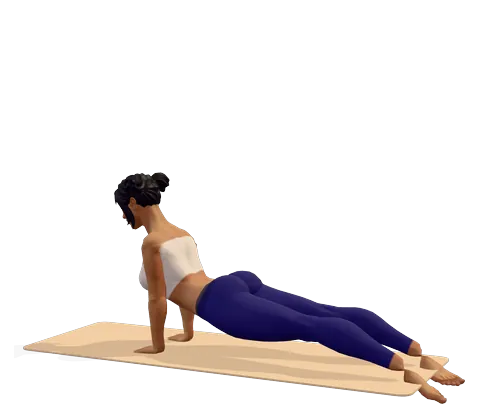
Warm up with cobra and three rounds of locust, stretch the thighs in a low lunge, then do bow pose twice. Rest in crocodile pose between rounds and finish in child's pose to round the spine the other way.
धनुरासन — bow pose steps and benefits in Hindi: पेट के बल लेटें, घुटने मोड़ें और हाथों से टखने पकड़ें। साँस लेते हुए पैरों को हाथों की ओर पीछे धकेलें, जिससे छाती और जाँघें ज़मीन से ऊपर उठें। 15 से 20 सेकंड रुकें और साँस छोड़ते हुए नीचे आएँ। धनुरासन के फायदे: पीठ मज़बूत होती है, छाती और पेट में खिंचाव आता है और शरीर में ऊर्जा आती है। गर्भावस्था, हाई ब्लड प्रेशर, हृदय रोग, हर्निया या कमर की चोट में यह आसन न करें।
Health conditions this pose is used for
Yoga for diabetes · Yoga for belly fat · Yoga for fatty liver · Yoga for male fertility
Where this practice is used
Chakras: Manipura (Solar Plexus Chakra)
Frequently asked questions
What is bow pose good for?
Bow pose stretches the chest, shoulders, abdomen and thighs while strengthening the back, buttocks and hamstrings. It helps posture, feels energising and prepares you for deeper backbends.
Why can't I reach my ankles in bow pose?
Usually the fronts of the thighs are tight. Loop a strap around your ankles, practise the half bow one side at a time, and stretch the quadriceps in a low lunge. Reach improves within a few weeks.
How long should I hold bow pose?
Hold for 3–5 breaths (about 15–20 seconds) and repeat once or twice. Rest in crocodile or child's pose between rounds.
Who should not do Dhanurasana?
Avoid it in pregnancy, with high blood pressure or heart disease, hernia, peptic ulcer, recent abdominal surgery, or a lower back, neck or knee injury.
Is bow pose good for back pain?
It strengthens the back, but it is a strong backbend and not a first choice when your back hurts. Start with sphinx, cobra and locust, and add bow only once they feel easy and pain-free.
Is bow pose suitable for kids?
Yes, most children enjoy it, especially the rocking bow. Keep holds short and let them use one leg at a time if both is too much.
What is the difference between bow pose and upward bow pose?
Dhanurasana is done lying on the front, holding the ankles. Upward bow (Urdhva Dhanurasana, or wheel) is done by pressing up from lying on the back, and is far more demanding.
This page is for general education. Check with your doctor before starting yoga if you are pregnant, have a medical condition or an injury. Stop if you feel pain, dizziness or shortness of breath.