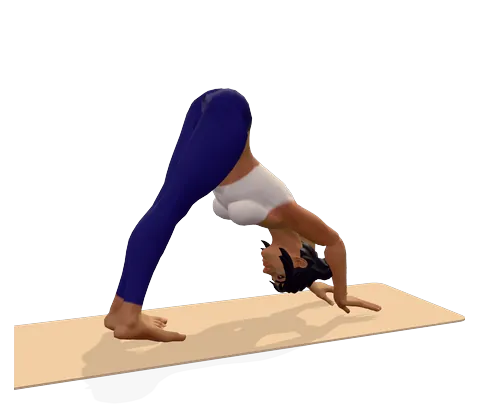
How to do Downward-Facing Dog Pose step by step
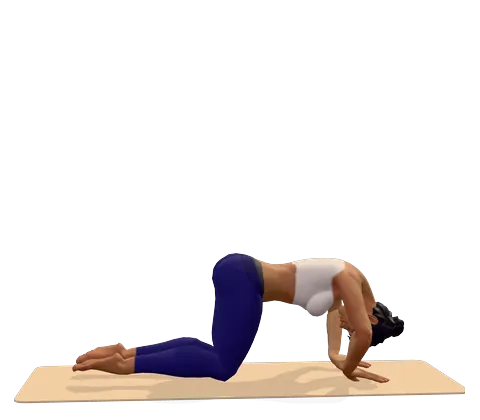
- Start on your hands and knees with your hands a little in front of your shoulders and your knees under your hips. Spread your fingers wide.
- Tuck your toes under. Breathe out and lift your knees off the floor, sending your hips up and back.
- Keep your knees bent at first and lengthen your spine, so your back is long and flat rather than rounded.
- Press the floor away with your whole hand, especially the base of the index finger and thumb. Let your head hang between your upper arms.
- Slowly straighten your legs as far as your hamstrings allow and reach your heels toward the mat. They do not need to touch it.
- Hold for 5–8 slow breaths (30–45 seconds), keeping your neck relaxed and your breath smooth.
- To come out, bend your knees and lower them to the mat, then rest in child's pose.
Where you feel Downward-Facing Dog Pose: what it stretches and strengthens
Push the floor away and send your hips up and back. In the 3D guide, turn on Body guide: areas that stretch glow green and areas that work glow saffron.
Stretches
- Hamstrings
- Calves
- Shoulders
Strengthens
- Arms
- Abs
- Front thighs
Benefits and precautions
Benefits
- Stretches the hamstrings, calves, shoulders and the long muscles of the back
- Strengthens the shoulders, arms and upper back, and builds wrist strength over time
- Lengthens the spine and can ease stiffness from sitting
- Mild inversion: the head is below the heart, which many people find refreshing
- Links poses in Surya Namaskar and Vinyasa, and prepares you for handstand and other arm balances
Avoid or modify if
- Uncontrolled high blood pressure, glaucoma or a detached retina — the head is below the heart; use the wall or chair version
- Wrist pain or carpal tunnel — come onto your forearms (dolphin) or use the chair version
- Shoulder injury or frozen shoulder — avoid weight on the painful arm until movement returns
- Later pregnancy — keep holds short and feet wide, and skip it if you feel dizzy or breathless
- Recent eye, ear or head surgery, or during a migraine attack — skip it
Downward-facing dog (Adho Mukha Svanasana) is the pose most people picture when they think of yoga: hands and feet on the floor, hips high, body in an upside-down V. It stretches the whole back of the body, strengthens the arms and shoulders and connects many poses in a flowing class. It is also one of the poses beginners find hardest to get right, so this guide focuses on how to do downward dog correctly, what to change if it feels wrong, and who should avoid it.
What is the downward facing dog pose?
The downward dog meaning is literal: a dog stretching with its chest low and its tail high. The Adho Mukha Svanasana meaning, from the Sanskrit, breaks down simply: adho means "downward", mukha means "face", shvana means "dog" and asana means "pose". For Adho Mukha Svanasana pronunciation, say "AH-doh MOO-kah shvah-NAH-sah-nah".
The downward facing dog pose is also called down dog, and in many languages people search by the local name: "perro boca abajo" is the downward facing dog pose in Spanish, and German classes use "herabschauender Hund" for Adho Mukha Svanasana. The downward facing dog pose hindi name is अधोमुख श्वानासन. Our voice guide speaks the cues in 28 languages, including all three.
Adho Mukha Svanasana vs Parvatasana
In the Indian Surya Namaskar, step 8 is called Parvatasana, "mountain pose", because the body forms a peak. It is almost the same shape. In Adho Mukha Svanasana the focus is on a long spine and active arms; in Parvatasana many teachers ask for the heels to press down and the gaze toward the knees or navel. (Do not confuse it with the standing mountain pose, Tadasana; the sun salutation moves from mountain pose to downward dog and back.)
Is downward facing dog a yoga pose for resting?
In Ashtanga and Vinyasa, experienced students treat it as a resting pose between stronger ones. For a beginner it is real work. Is downward facing dog a standing pose? Some systems group it with standing poses, others with mild inversions, because the head is lower than the hips.
How to do downward dog correctly
The biggest mistake is chasing straight legs and flat heels at the cost of a rounded back. A long spine matters more. These downward facing dog pose cues and alignment tips help:
- Bend your knees first. Lift the sitting bones high with bent knees until the back is long, then straighten the legs only as far as the back stays long.
- Hands do the work. Press through the knuckles, especially the index finger, so the weight does not sink into the heel of the hand and the wrists.
- Arms and shoulders. Turn the upper arms slightly outward and let the shoulder blades widen. Do not let the chest sag toward the floor.
- Heels toward, not onto, the floor. Many people never touch their heels down; that is fine.
- Head relaxed. Let the head hang in line with the arms, without looking at your feet.
Downward facing dog pose for beginners
Adho Mukha Svanasana for beginners works best in short holds: 3–5 breaths, rest in child's pose, repeat. Walk your feet wider if your hamstrings are tight; a wide leg downward facing dog pose for tight hamstrings takes pressure off the lower back. Pedal your feet, bending one knee then the other, to warm the calves.
Downward facing dog pose benefits
The main downward dog benefits are a long stretch for the back of the legs and stronger shoulders. It is also a calming pose once you can hold it with an easy breath. Because it lengthens the spine without twisting or deep bending, it appears in our yoga for back pain plan, often with bent knees.
Two popular claims need care. Downward facing dog pose benefits for weight loss come from the whole practice around it, such as rounds of sun salutation, not from the pose itself. Downward facing dog pose benefits for skin are often mentioned because blood flows toward the head, but there is no good evidence that it changes your skin.
Downward dog muscles worked and stretched
| Muscles stretched | Muscles strengthened |
|---|---|
| Hamstrings (back of the thighs) | Deltoids and rotator cuff (shoulders) |
| Calves: a strong downward dog calf stretch | Triceps and serratus anterior |
| Latissimus dorsi and the sides of the chest | Quadriceps (front of the thighs) when you straighten the legs |
| Soles of the feet and Achilles tendons | Muscles along the spine and deep core |
Downward facing dog pose variations and modifications
- Downward facing dog pose in chair yoga: hands on the back of a steady chair or a table, walk back until the arms and back form a long line. This is the best downward facing dog pose alternative for seniors, wrist pain or high blood pressure. See chair yoga.
- Three legged downward facing dog pose (Eka Pada Adho Mukha Svanasana): lift one leg straight up behind you, hips level.
- Revolved dog (Parivrtta Adho Mukha Svanasana): reach one hand to the opposite ankle for a twist.
- Dolphin plank (Makara Adho Mukha Svanasana): forearms down, body in a plank line; good for shoulder strength.
- Downward dog push up: bend the elbows to lower the head toward the floor, then press back up. This downward dog exercise is a strength drill toward handstand (Adho Mukha Vrksasana).
Downward dog pose for kids is taught with a wagging "tail" (hips) and a bark on the breath out.
Downward dog vs upward dog and cobra
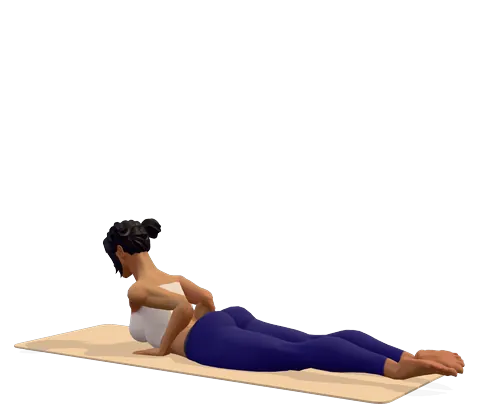
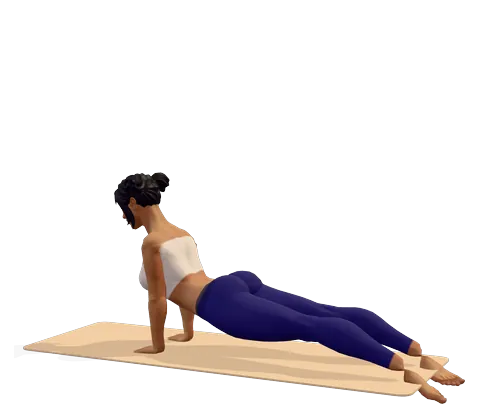
Downward dog vs upward dog: they are opposites. Down dog folds the body at the hips with the head low; upward-facing dog pose is a backbend with the chest lifted and the thighs off the floor. Moving from downward dog to upward dog and back is the core of a Vinyasa flow. Upward dog vs cobra: in cobra the legs and hips stay on the floor, so it is gentler. A downward dog to cobra flow is a good way to learn the movement before trying upward dog.
अधोमुख श्वानासन (Downward Dog) — हिंदी में: हाथों और घुटनों के बल आएँ, पंजे मोड़ें और साँस छोड़ते हुए कूल्हे ऊपर उठाएँ ताकि शरीर उल्टे V जैसा बने। घुटने थोड़े मुड़े रह सकते हैं; पीठ लंबी रखें और एड़ियाँ ज़मीन की ओर ले जाएँ। 30–45 सेकंड रुकें। इसके फायदे: पैरों के पिछले हिस्से और पिंडलियों में खिंचाव, कंधे और बाँहें मज़बूत। उच्च रक्तचाप, ग्लूकोमा या कलाई में दर्द हो तो कुर्सी वाला रूप करें।
Health conditions this pose is used for
Yoga for back pain · Yoga for leg cramps
Where this practice is used
Chakras: Ajna (Third Eye Chakra)
Frequently asked questions
How do you do downward dog correctly?
From hands and knees, tuck your toes and lift your hips with your knees bent. Lengthen your spine first, then straighten your legs only as far as your back stays long. Press through your whole hands and let your head hang.
Do my heels need to touch the floor in downward dog?
No. Most people's heels stay above the mat, especially at first. Reach them toward the floor, but keep your back long.
What muscles does downward dog stretch and work?
It stretches the hamstrings, calves, lats and shoulders, and strengthens the shoulders, triceps, quadriceps and core.
Why do my wrists hurt in downward dog?
Usually the weight sinks into the heel of the hand. Spread your fingers, press through the knuckles and shift some weight back into your legs. If pain continues, try the forearm or chair version.
Who should not do downward-facing dog?
People with uncontrolled high blood pressure, glaucoma, a detached retina, a recent eye or head surgery, or a painful shoulder or wrist injury should avoid it or use the chair version. Skip it during a migraine attack.
Is Parvatasana the same as downward dog?
Almost. Parvatasana ("mountain pose") is the name used in Indian Surya Namaskar for step 8. The shape is the same; some teachers ask for heels down and the gaze toward the navel.
What is downward dog called in Hindi?
अधोमुख श्वानासन (Adho Mukha Shvanasana): "adho" means downward, "mukha" means face and "shvana" means dog.
This page is for general education. Check with your doctor before starting yoga if you are pregnant, have a medical condition or an injury. Stop if you feel pain, dizziness or shortness of breath.