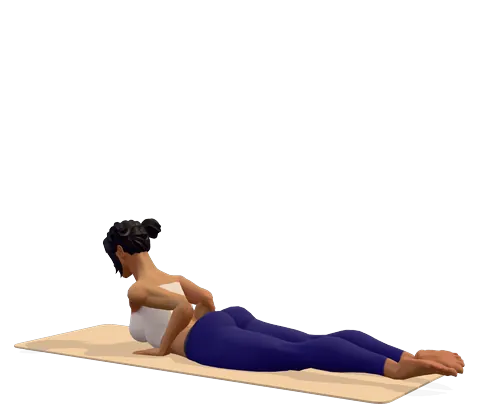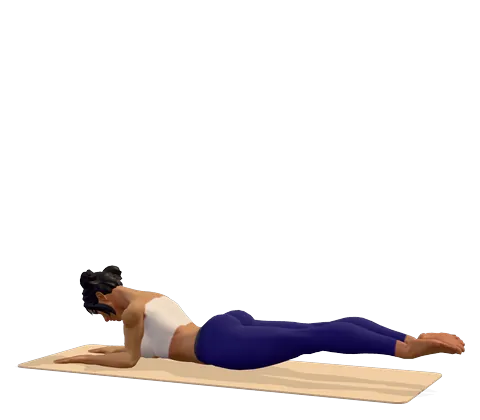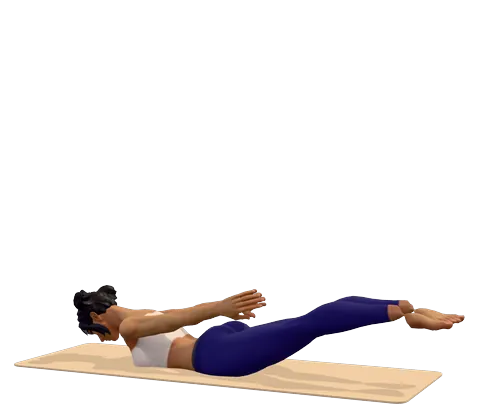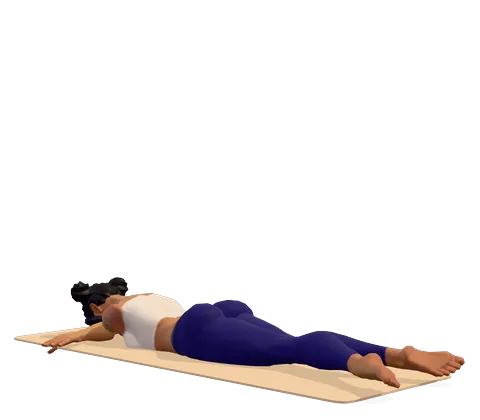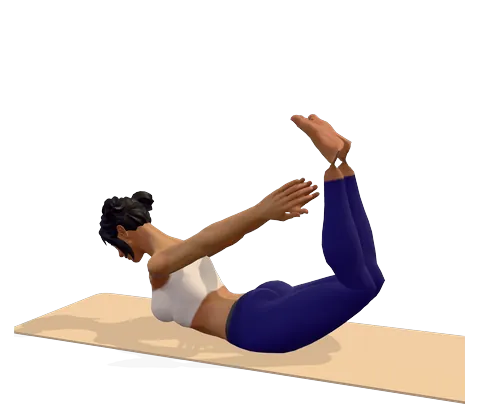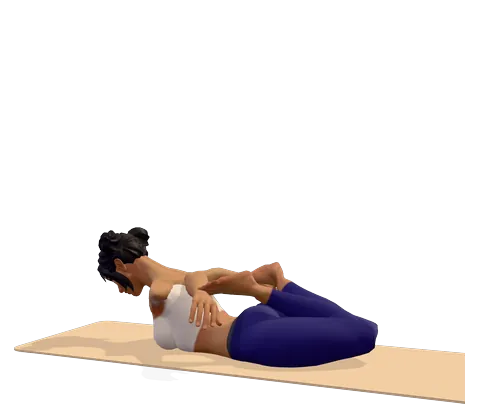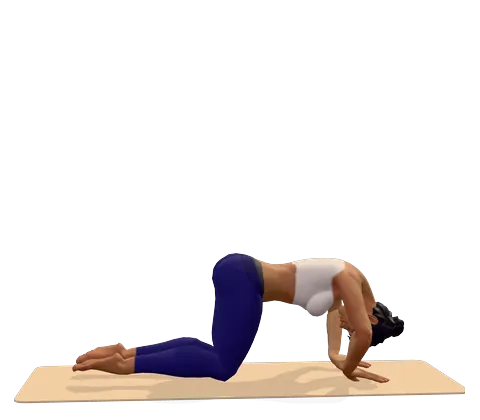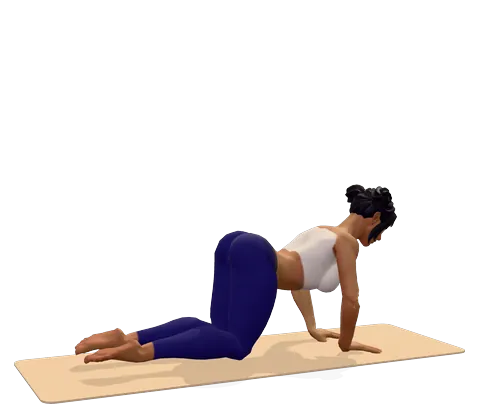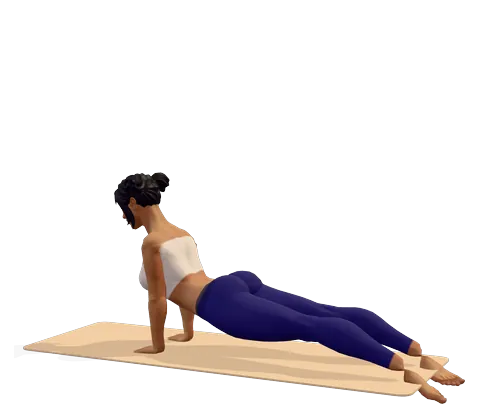
How to do Upward-Facing Dog Pose step by step
- Lie on your front with your legs straight and hip-width apart, the tops of your feet flat on the mat.
- Place your palms on the mat beside your lower ribs, fingers spread and pointing forward, elbows pointing back.
- Breathe in, press into your hands and the tops of your feet, and straighten your arms to lift your chest.
- Lift your thighs and knees off the floor so only your hands and the tops of your feet touch the mat.
- Draw your shoulders back and down, broaden your chest forward through your arms and look straight ahead.
- Hold for 1–5 breaths, keeping the legs firm and the lower belly gently drawn in.
- Breathe out and lower your thighs, chest and forehead to the mat, or lift your hips back into downward-facing dog.
Where you feel Upward-Facing Dog Pose: what it stretches and strengthens
Press into your hands and lift your thighs off the floor. In the 3D guide, turn on Body guide: areas that stretch glow green and areas that work glow saffron.
Stretches
- Chest
- Abs
- Hip flexors
Strengthens
- Arms
- Lower back
- Wrists
Benefits and precautions
Benefits
- Strengthens the arms, wrists, shoulders and the muscles along the spine
- Stretches the chest, abdomen and the fronts of the hips
- Counters slouching and helps an upright posture
- Builds the strength and control needed for deeper backbends
- Links breath and movement in Sun Salutations and flowing practice
Avoid or modify if
- Wrist pain or carpal tunnel syndrome: use cobra or sphinx pose, or put your hands on blocks
- Lower back injury, spondylolisthesis or pain when you arch: choose a low cobra instead
- Pregnancy: do not lie on the belly; replace it with cow pose on hands and knees
- Recent abdominal surgery, hernia or shoulder injury
- Stop if you feel pinching in the lower back or neck
Upward-facing dog pose (Urdhva Mukha Svanasana) is a backbend on straight arms in which only your hands and the tops of your feet touch the floor. It is the "up dog" of Ashtanga and Vinyasa Sun Salutations, where it follows Chaturanga and leads into downward dog. Done well, it strengthens the arms and back and opens the chest; done in a hurry, it sinks into the lower back and shoulders. This page shows how to get it right, when to choose cobra instead, and how to flow from up dog to down dog.
Upward-facing dog pose: Sanskrit name and meaning
Urdhva means "upward", mukha means "face" and svana means "dog", so Urdhva Mukha Svanasana in English is simply "upward-facing dog". Picture a dog stretching its chest forward after a nap. Its partner is Adho Mukha Svanasana, whose meaning is "downward-facing dog" (adho = downward). Teachers often say adho mukha and urdhva mukha svanasana in one breath because the two poses are practised together.
The usual Urdhva Mukha Svanasana pronunciation is OORD-vah MOO-kah shvah-NAHS-uh-nuh. In Hindi it is ऊर्ध्व मुख श्वानासन. The short name "up dog" has the same meaning and is what you will hear most in English-speaking classes.
How to do upward facing dog pose safely
The steps above take you in and out. These upward facing dog pose cues fix the problems teachers see most often:
- Shoulders up by the ears. Press the floor away and roll the shoulders back so the collarbones widen. If you cannot, your hands are probably too far forward; place them beside your lower ribs.
- Hanging in the lower back. Keep your thighs lifted and firm and draw the lower belly gently in. The bend should spread through the upper back, not fold at one point.
- Thighs resting on the floor. That turns the pose into a straight-arm cobra. Press the tops of the feet down to lift the knees.
- Locked elbows. Keep the arms straight but not hyperextended; a micro-bend protects the joints.
- Head thrown back. Look forward, or slightly up only if your neck feels long.
In a flow you hold up dog for one inhale. As a separate pose, 3–5 breaths is enough.
Upward facing dog pose benefits
Among yoga backbend poses, upward facing dog asks more of you than most, so its benefits lean toward strength as well as stretch. The arms and shoulders carry your weight, the back muscles hold the curve and the legs stay active.
- Posture: the chest opening and back strength counter the forward hunch of desk work, which is why backbends like this feature in our yoga for posture plan.
- Upper-body strength: together with plank and Chaturanga, repeated up dogs build strong wrists, triceps and shoulders.
- Breathing: the upward dog stretch through the chest and belly lets the ribs expand more freely.
- Energy: as part of flowing Sun Salutations it raises your heart rate and warms the body.
Is upward dog good for sciatica or back pain?
For some people, gentle extension eases back and leg symptoms; for others, especially with stenosis or a slipped vertebra, it makes them worse. Upward dog for sciatica is a strong choice, so start with sphinx or a low cobra, and use our yoga for back pain plan for gentler poses. If pain spreads down the leg, stop and ask a physiotherapist.
Upward facing dog pose muscles worked
| Muscles used (strengthen) | Muscles stretched |
|---|---|
| Triceps and the front of the shoulders | Chest (pectorals) |
| Erector spinae along the spine | Abdominal muscles |
| Lower trapezius and serratus anterior | Hip flexors and the fronts of the thighs |
| Gluteals, hamstrings and quadriceps | Tops of the feet and ankles |
Upward dog vs cobra pose
This is the yoga pose most similar to upward facing dog, and the two are often confused. The difference between upward facing dog and cobra pose comes down to three things.
| Upward-facing dog | Cobra (Bhujangasana) | |
|---|---|---|
| Arms | Straight, carrying weight | Bent, mostly guiding |
| Legs and hips | Thighs and knees off the floor | Legs and pelvis on the floor |
| Main work | Arms, shoulders and back | Back muscles |
| Best for | Stronger, flowing practice | Beginners and back care |
The traditional Indian Surya Namaskar uses cobra pose at this point, while Ashtanga and Vinyasa classes use up dog. Both are correct; choose the one that suits your back and wrists today. (Upward-facing bow pose, by contrast, is the full wheel, a much deeper backbend from lying on your back.)
Up dog to down dog, and up dog vs down dog
In a flow, you move from upward dog to downward dog on an exhale: lift the hips up and back while rolling over your toes, or flip one foot at a time. Going the other way, downward to upward dog, passes through plank and Chaturanga.
Upward dog vs downward dog: up dog is a backbend that opens the front of the body, while downward facing dog pose is an inverted V that stretches the backs of the legs and lengthens the spine. Downward facing dog pose benefits (Adho Mukha Svanasana benefits) include stretching the hamstrings and calves and strengthening the shoulders, so the pair balances each other well.
Upward facing dog pose modifications for beginners
- Start from cobra: practise cobra for a few weeks, then try lifting the thighs for one breath.
- Blocks under the hands: gives the chest more room and eases wrists and shoulders.
- Knees down: keep the knees on the mat and straighten the arms; a half-way step toward the full pose.
- Chair version: stand facing a sturdy chair or counter, hands on the edge, and lean in while lifting the chest. The chair yoga forms of up dog and downward facing dog pose are gentle options for seniors.
Pregnant? Swap up dog for cow pose on hands and knees. With wrist pain, sphinx on the forearms gives a similar opening without loading the wrists.
ऊर्ध्व मुख श्वानासन — upward facing dog pose in Hindi: पेट के बल लेटें, हथेलियाँ कमर के पास पसलियों के बगल में रखें। साँस लेते हुए हाथ सीधे करें, छाती ऊपर उठाएँ और जाँघें व घुटने ज़मीन से ऊपर रखें। कंधे कानों से दूर रखें और सामने देखें। इससे बाँहें, कंधे और पीठ मज़बूत होते हैं और छाती खुलती है। कलाई या कमर में दर्द हो तो भुजंगासन करें।
Frequently asked questions
What is the difference between upward dog and cobra?
In upward dog the arms are straight and the thighs lift off the floor, so the arms and shoulders carry you. In cobra the elbows bend and the legs and pelvis stay down, which makes it gentler on the back and wrists.
How long should I hold upward-facing dog?
In a flowing sequence, one breath in. As a separate pose, 3–5 breaths. Longer holds tend to make people sink into the shoulders and lower back.
Why does upward dog hurt my lower back?
Usually the thighs have dropped or the hands are too far forward, so the bend collapses into the lower back. Lift and firm the thighs, draw the belly in, move the hands back beside your ribs, or use cobra instead.
Is upward-facing dog good for beginners?
It is a level-two pose. Beginners do best starting with sphinx and cobra, then trying up dog with blocks under the hands or the knees down.
Which muscles are used in upward facing dog?
It strengthens the triceps, shoulders, back muscles and legs, and stretches the chest, abdomen and hip flexors.
Can I do up dog with wrist pain?
Try blocks under the hands, a folded mat under the heels of the hands, or switch to sphinx pose on your forearms. If pain persists, get your wrist checked.
Is up dog part of Surya Namaskar?
In Ashtanga and Vinyasa Sun Salutations, yes. The traditional Indian 12-step Surya Namaskar uses cobra pose at that point instead.
This page is for general education. Check with your doctor before starting yoga if you are pregnant, have a medical condition or an injury. Stop if you feel pain, dizziness or shortness of breath.