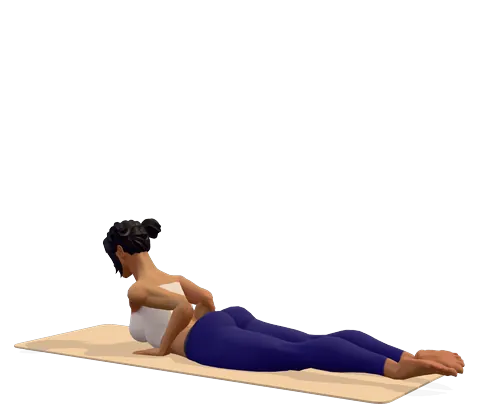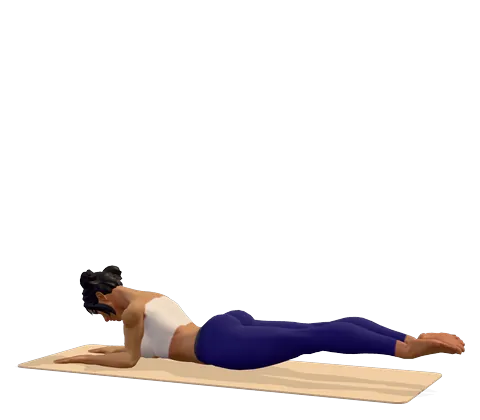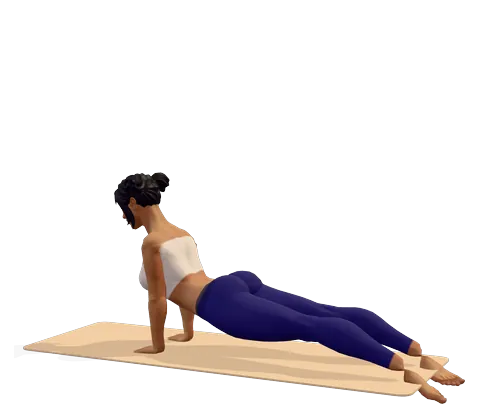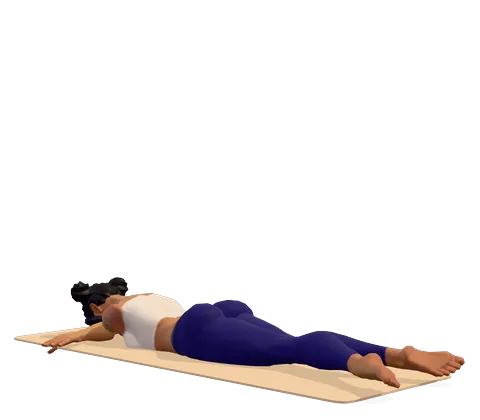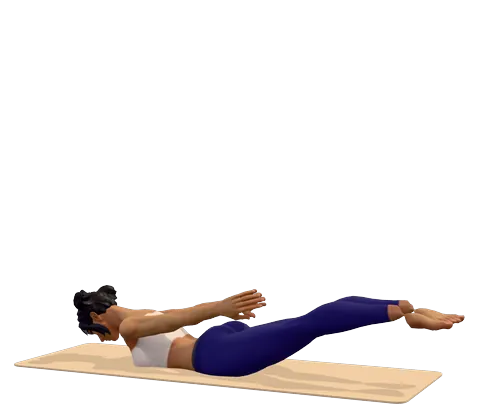
How to do Locust Pose step by step
- Lie on your front with your forehead or chin on the mat, legs straight and hip-width apart or together, tops of the feet down.
- Place your arms alongside your body, palms facing down or toward your thighs.
- Press your pubic bone gently into the mat and firm your legs so the kneecaps lift.
- Breathe in and lift your head, chest, arms and legs off the floor at the same time. Reach your fingers back toward your feet.
- Keep the back of your neck long and your gaze on the floor a little in front of you. Only your belly and pelvis stay on the mat.
- Hold for 3–5 breaths (about 20 seconds), breathing steadily rather than holding your breath.
- Breathe out and lower slowly. Turn your head to one side and rest before repeating once or twice.
Where you feel Locust Pose: what it stretches and strengthens
Lift your chest and legs together, reaching long. In the 3D guide, turn on Body guide: areas that stretch glow green and areas that work glow saffron.
Stretches
- Chest
Strengthens
- Lower back
- Glutes
- Hamstrings
Benefits and precautions
Benefits
- Strengthens the whole back body: spine, buttocks, backs of the legs and rear shoulders
- Trains the muscles that keep you upright, a direct help for rounded posture
- Prepares the body for deeper backbends such as bow and wheel
- Firms the core and pelvic floor as you stabilise the lift
- Part of yoga programmes for posture and for PCOS
- Needs no props and little space, so it fits a short home routine
Avoid or modify if
- Pregnancy: do not practise lying on the belly; do bird-dog on hands and knees instead
- Recent abdominal surgery, hernia or a peptic ulcer
- Acute back injury, spondylolisthesis or back pain that sharpens when you arch: lift only the legs or skip it and ask your physiotherapist
- Heart disease or high blood pressure: skip the high, strong versions and never hold your breath
- Neck pain: keep your gaze down and your forehead low
Locust pose (Salabhasana) is a yoga backbend done lying on your front in which you lift your chest, arms and legs off the floor without pushing with your hands. The whole back of the body has to do the work, which makes it one of the best yoga poses for building back strength. This page explains the name, how to do locust pose in yoga with good alignment, its benefits, the half locust for beginners and the stronger variations.
Locust pose in yoga: meaning and Sanskrit name
The Sanskrit word shalabha means "locust" or "grasshopper", and asana means "pose". When the legs lift behind you, the body looks like a locust resting with its tail raised. You will see two spellings of the locust pose Sanskrit name: Salabhasana (the simplified spelling) and Shalabhasana (closer to the sound). They are the same pose.
The locust pose Sanskrit pronunciation is shah-lah-BAHS-uh-nuh. The locust pose Hindi name is शलभासन, and the Shalabhasana meaning in Hindi is the same: शलभ is a locust or grasshopper.
How to do locust pose: alignment and cues
The Shalabhasana procedure is short: the locust pose yoga steps and instructions above take less than a minute. Small details decide whether you feel it in your back muscles or in a pinch in your lower back.
- Length first, height second. Reach your head forward and your feet back before you lift. A long, low locust is better than a high, crunched one.
- Anchor the pelvis. Press the pubic bone down. This protects the lower back and makes the buttocks and hamstrings lift the legs.
- Straight legs. Bent knees usually mean the hamstrings are cramping; lower the legs a little and keep them straight.
- Firm, not clenched, buttocks. Squeezing hard can turn the thighs outward. Keep the big toes pointing straight back.
- Neck neutral. Look at the floor, not forward. Craning the head up is the most common mistake.
- Keep breathing. People tend to hold their breath in effort. Breathe steadily through the nose.
Hold for 3–5 breaths and repeat two or three times with a short rest between. Our 3D guide holds it for about 20 seconds by default.
Locust pose benefits
What is locust pose good for? Mainly strength. Most daily life pulls us forward, and Salabhasana benefits come from training the muscles that pull us back.
Posture and back strength
Weak back extensors are linked with a rounded upper back and a forward head. Because it works them directly, locust is a key pose in our yoga for posture plan. Back-strengthening exercises in general are part of many programmes for chronic lower back pain, but if your back is in an acute flare, rest first and ask your physiotherapist before lifting.
Core, hormones and energy
Holding the lift switches on the deep abdominal and pelvic-floor muscles, which is why locust appears in the Core Strength session in our guided sessions. It is also included in our yoga for PCOS plan, where regular yoga practice has been studied as a support to medical care; the pose supports that routine but does not treat the condition on its own. Traditional texts also credit Shalabhasana with helping digestion because the belly presses into the floor.
Shalabhasana muscles worked
Among beginner poses, locust pose strengthens the glutes and back muscles more than most.
| Strengthens | Stretches |
|---|---|
| Erector spinae and deep spinal muscles | Chest and front of the shoulders |
| Gluteus maximus and hamstrings | Abdomen and hip flexors |
| Rear shoulders, rhomboids and triceps | Front of the neck (gently) |
The locust pose stretch is mild; this is a strengthening pose first.
Locust pose variations
Half locust: Shalabhasana pose for beginners
The classical Indian version starts with one leg. Make fists or place your palms under your thighs, rest your chin on the mat, and lift one straight leg for a few breaths, then the other. This yoga pose, half locust (Ardha Shalabhasana), teaches you to lift from the buttock without twisting the hips. When both sides feel steady, lift both legs together, and later add the chest and arms as the 3D guide shows.
Other locust pose yoga variations
- Arms under the body: the Bikram locust pose, taught in hot yoga, places the arms under the body with the palms down, which helps the legs lift higher.
- Locust pose with arms forward: often called locust pose B or "superman". Reaching the arms forward makes the lift harder because the lever is longer.
- Hands clasped behind the back: interlace your fingers behind you and lift the knuckles toward your feet for a stronger chest and shoulder opening.
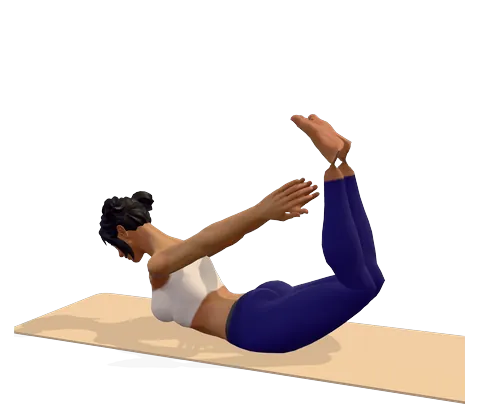
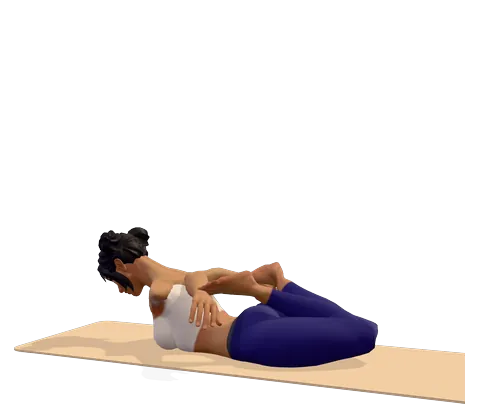
- Locust pose grasp one foot: bend one knee and hold the foot with the same-side hand, a step toward bow pose.
- Locust pose advanced (full locust): a strong version in which the legs swing high over the back with the arms under the body. It needs years of backbend practice and is not for beginners.
For kids, locust pose is a favourite "flying" shape: arms back like wings, legs up like a tail. See yoga for kids for more playful animal poses.
Locust pose vs bow pose
If you grab your feet in locust, you are on your way to bow pose (Dhanurasana). The difference: in locust the back muscles lift you with no help, while in bow the hands hold the ankles and the legs kick back to pull the chest higher. Locust builds the strength; bow uses it for a deeper stretch. Bow pose for beginners is much easier after a few weeks of regular locust.
Shalabhasana pose precautions
See the caution box above. Two points matter most. First, never hold your breath while lifting, especially if you have high blood pressure or heart disease; keep the lift low and the breath steady. Second, if you feel pinching in the lower back, lower your chest and lift only your legs, or only one leg. Pain that spreads into a leg is a sign to stop.
A locust pose sequence
Warm up with cobra pose or sphinx, then do three rounds of locust. Rest between rounds in crocodile pose, and finish in child's pose to round the back the other way.
शलभासन — locust pose yoga in Hindi: पेट के बल लेटें, हाथ शरीर के पास रखें। साँस लेते हुए सिर, छाती, बाँहें और दोनों पैर एक साथ ज़मीन से ऊपर उठाएँ, नज़र नीचे रखें। 15 से 20 सेकंड सामान्य साँस लेते रहें, फिर धीरे से नीचे आएँ। शलभासन के फायदे: पीठ, कमर और नितंब की मांसपेशियाँ मज़बूत होती हैं और शरीर की मुद्रा सुधरती है। गर्भावस्था, हर्निया या पेट के ऑपरेशन के बाद यह आसन न करें।
Health conditions this pose is used for
Yoga for knee replacement recovery · Yoga for posture and tech neck · Yoga for hip replacement recovery · Yoga for scoliosis · Yoga for osteoporosis and bone health · Yoga for ankylosing spondylitis · Yoga for height and posture · Yoga for high cholesterol · Yoga for pcos and pcod · Yoga for prostate health · Yoga for male fertility · Yoga for erectile dysfunction
Frequently asked questions
What is locust pose good for?
It strengthens the back, buttocks, hamstrings and rear shoulders, which helps posture and supports a healthy back. It also prepares you for deeper backbends like bow pose.
Is Salabhasana the same as Shalabhasana?
Yes. Both spellings come from the Sanskrit shalabha, "locust". Salabhasana is a simplified spelling; Shalabhasana is closer to how the word sounds.
How long should I hold locust pose?
Hold for 3–5 breaths (about 15–20 seconds) and repeat two or three times. Beginners can start with 2–3 breaths or with one leg at a time.
Why can I only lift my legs a little?
That is normal. The lift comes from the buttocks and back muscles, which take time to strengthen. Keep the legs straight and long rather than high, and try the half locust with hands under the thighs.
Is locust pose good for lower back pain?
Strengthening the back muscles is part of many back pain programmes, and a low locust is usually well tolerated once pain has settled. Avoid it during an acute flare and stop if pain sharpens or spreads down a leg.
Can I do locust pose during pregnancy?
No. Avoid lying on your belly in pregnancy. Bird-dog on hands and knees works the same back muscles safely; ask your doctor or midwife about exercise.
What is the difference between locust pose and superman?
Superman is locust with the arms reaching forward. It is harder because the arms are a longer lever, so start with the arms alongside the body.
This page is for general education. Check with your doctor before starting yoga if you are pregnant, have a medical condition or an injury. Stop if you feel pain, dizziness or shortness of breath.