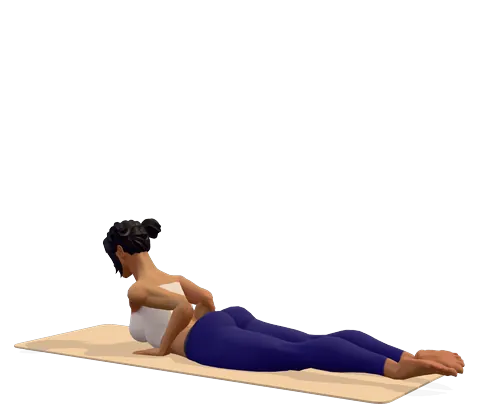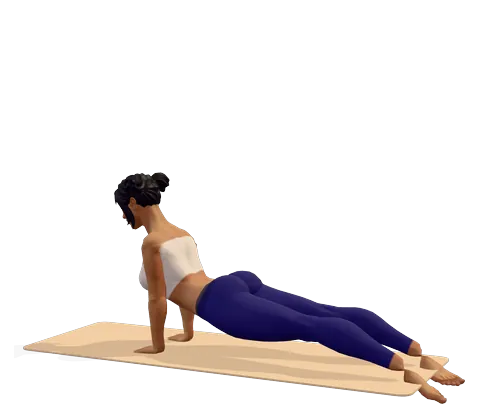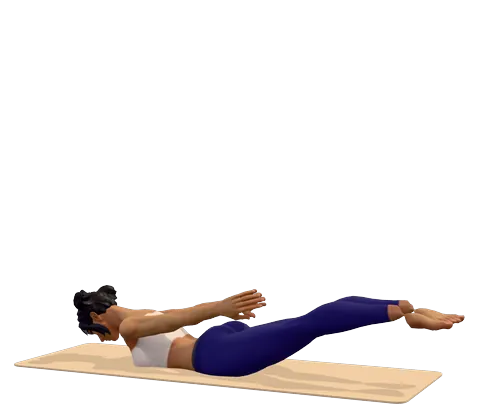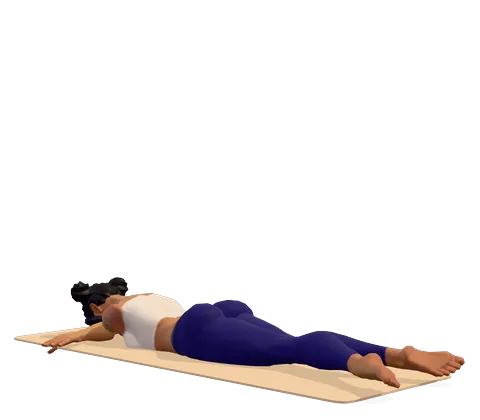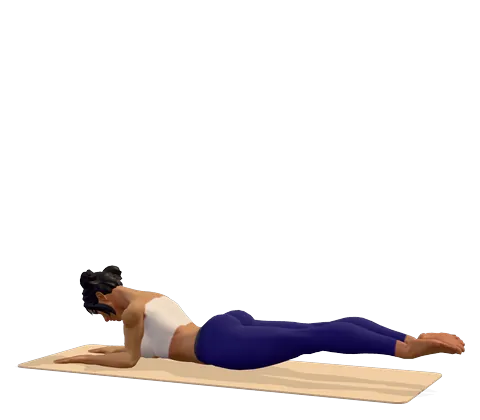
How to do Sphinx Pose step by step
- Lie on your front with your legs straight and hip-width apart, the tops of your feet on the mat.
- Place your elbows under your shoulders, forearms parallel and pointing forward, palms flat or lightly cupped.
- Press your forearms and the tops of your feet into the mat and lift your chest and head.
- Draw your shoulders gently back and down, away from your ears, and lengthen the back of your neck. Look straight ahead.
- Let your belly and buttocks soften. Breathe slowly into your back ribs.
- Stay for 5–10 breaths (30–60 seconds) as an active pose, or up to 3–5 minutes in a yin practice if your back feels comfortable.
- To come out, slide your elbows forward, lower your chest and rest your forehead on your stacked hands for a few breaths.
Where you feel Sphinx Pose: what it stretches and strengthens
Press your forearms down and draw your chest forward. In the 3D guide, turn on Body guide: areas that stretch glow green and areas that work glow saffron.
Stretches
- Abs
- Chest
Strengthens
- Lower back
Benefits and precautions
Benefits
- Gently extends the lower and middle back, the reverse of long hours of sitting
- Stretches the chest, shoulders and abdomen, which helps a rounded posture
- Builds light endurance in the upper-back and neck muscles
- Easy on the wrists because the weight rests on the forearms
- Used in yoga programmes for back pain, neck pain and asthma
- Calm enough to hold for minutes in yin and restorative yoga
Avoid or modify if
- Pregnancy after the first trimester: do not lie on the belly; use cat and cow pose on hands and knees instead
- Spinal stenosis, spondylolisthesis or facet joint pain that worsens when you arch: ask your physiotherapist first
- Recent abdominal surgery or a hernia
- Shoulder injury: move the elbows a little forward or rest your chest on a bolster
- Stop if you feel sharp or pinching pain in the lower back, or pain spreading down a leg
Sphinx pose (Salamba Bhujangasana) is a supported backbend in which you lie on your front and rest your weight on your forearms, like the Great Sphinx of Egypt with its paws stretched forward. It is the lowest and gentlest of the prone backbends, so it suits beginners, stiff backs and long, quiet holds in yin yoga. This guide covers how to do the sphinx pose well, what it stretches, how it compares with cobra, and when to choose something else.
Sphinx pose in yoga: Sanskrit name and meaning
The Sanskrit name is built from three words: salamba ("supported"), bhujanga ("serpent" or "cobra") and asana ("pose"). So Salamba Bhujangasana literally means "supported cobra", and the English name comes from the Egyptian statue rather than from Sanskrit. The sphinx pose Sanskrit pronunciation is sah-LAHM-bah boo-jahn-GAHS-uh-nuh. The sphinx pose Hindi name is सालम्ब भुजंगासन.
What does sphinx pose do? It lets your spine bend backward while the forearms carry part of your weight. The muscles along the back still work, but far less than in cobra pose, and the arch spreads gently through the lower and middle back.
How to do sphinx pose: alignment and cues
Follow the step-by-step instructions above for the sphinx pose asana, then check these points. They are the sphinx pose cues a teacher would give while walking around the room.
- Elbows under or slightly in front of the shoulders. Elbows too far back crank the lower back; walk them forward if you feel a pinch.
- Pull back without moving. Imagine drawing your forearms toward your hips against the mat. This lifts the chest forward and takes pressure off the lumbar spine.
- Do not hang in your shoulders. Press the forearms down so the upper back stays broad instead of collapsing between the shoulder blades.
- Legs relaxed or active. In an active sphinx, press the tops of the feet down and firm the thighs. In a yin sphinx, let the legs and buttocks go soft.
- Neck in line. Look ahead or slightly down, never up at the ceiling.
How long to hold sphinx pose
As an active sphinx pose exercise, 30–60 seconds is plenty, repeated two or three times. In yin yoga, sphinx pose is held for 3–5 minutes, because there the benefits come from time and relaxation rather than effort. For a long hold, lower down and rest for a few breaths if you feel any aching, then come back up.
Sphinx pose benefits
The main sphinx pose advantages are for the spine and posture. It reverses the rounded shape of sitting, stretches the front of the body and trains the back muscles to hold you upright, all without heavy load on the wrists.
Sphinx pose for lower back pain and sciatica
Gentle back extension is part of many yoga programmes for chronic back pain, where studies have found yoga can reduce pain and improve function. Physiotherapists also use lying on the elbows as an extension exercise for some disc problems, when bending backward eases or centralises leg pain. That is why you will read about sphinx pose for a herniated disc and for sciatica. But it does not suit everyone: if the pose makes leg pain spread further down, stop and see our yoga for sciatica plan or a physiotherapist. With scoliosis, most people find sphinx pose comfortable when the forearms press evenly; ask your therapist about holding times.
Neck, chest and breathing
Holding the head up with a long neck gently works the deep neck and upper-back muscles, which is why sphinx appears in our yoga for neck pain plan and in the Neck and Shoulder Release session. The open chest also lets the breath move more freely into the ribs, and it is used in yoga routines for asthma alongside breathing practice.
Sphinx pose: what does it stretch?
| Stretches | Strengthens (lightly) |
|---|---|
| Abdominal muscles and hip flexors | Erector spinae along the spine |
| Chest and front of the shoulders | Muscles between the shoulder blades |
| Front of the neck | Deep neck muscles that hold the head up |
In yin yoga language, the sphinx pose target area is the lower spine, where the long hold gently compresses and nourishes the back of the spine rather than stretching muscle. For flexibility, sphinx pose prepares the spine for bigger backbends.
Sphinx pose vs cobra pose
The difference between sphinx pose and cobra is where you carry your weight. In sphinx, the forearms are on the floor, so the backbend is lower and the wrists are free. In cobra, the hands are under the shoulders and the arms can lift you higher, which asks more of the back and wrists. If you are asking what Bhujangasana is and its benefits, cobra is the stronger parent pose: it strengthens more, while sphinx is easier to hold for long. Start with sphinx if you are new, sore or working on your wrists.
Sphinx pose variations and alternatives
- Sphinx pose with bolster (supported): slide a bolster or two folded blankets under your chest and armpits. This is the best version for long, restful holds.
- Sphinx pose for beginners: walk the elbows further forward so the chest is lower, and place a thin blanket under the hips.
- Sphinx pose in a chair: sit tall facing a table, rest your forearms on it and gently lift your breastbone. A useful alternative for seniors and one of several chair yoga poses for back pain.
- Seal pose (advanced): sphinx with straight arms, the hands placed forward and wider. It is a deeper yin version, so only try it if sphinx feels easy.
- With the head resting: stack your fists and rest your chin on them to switch off the neck.
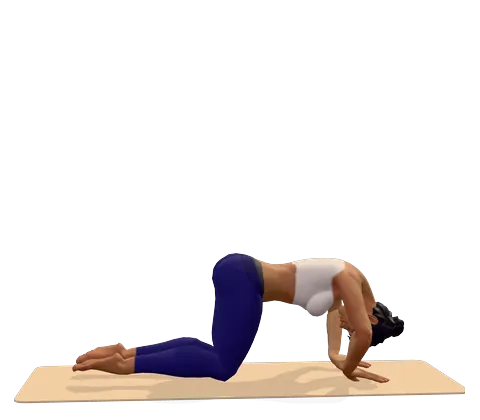
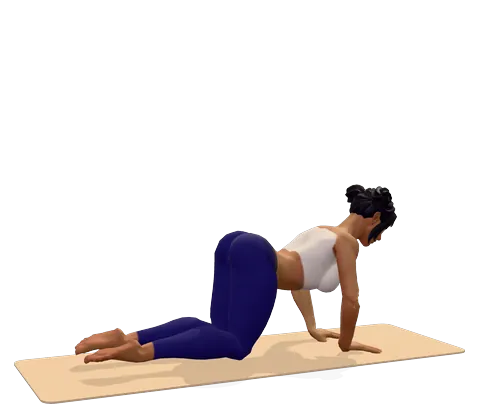
In pregnancy, skip lying on the belly and use an all-fours cow pose instead; that is the safer sphinx pose alternative for prenatal yoga.
A short sphinx pose sequence
Warm up in child's pose and a few rounds of cat and cow, then hold sphinx for a minute. Lower into crocodile pose to rest, repeat sphinx, and finish in child's pose to round the back the other way. The Back Pain Relief session in our guided sessions uses sphinx in exactly this way, with voice cues.
सालम्ब भुजंगासन — sphinx pose yoga in Hindi: पेट के बल लेटें और कोहनियाँ कंधों के ठीक नीचे रखें, बाँहें आगे की ओर। बाँहों को ज़मीन पर दबाते हुए छाती ऊपर उठाएँ, गर्दन सीधी रखें और पेट ढीला छोड़ें। 30 से 60 सेकंड धीरे साँस लें। इसके फायदे: कमर को हल्का सहारा देकर पीछे की ओर मोड़ता है, छाती खुलती है और बैठने से आई अकड़न कम होती है। गर्भावस्था में या कमर में तेज़ दर्द हो तो यह आसन न करें।
Health conditions this pose is used for
Yoga for back pain · Yoga for sciatica · Yoga for neck pain and cervical spondylosis · Yoga for desk workers and sitting all day · Yoga for slip disc (herniated disc) · Yoga for degenerative disc disease · Yoga for shoulder pain · Yoga for ankylosing spondylitis · Yoga for asthma · Yoga for long covid recovery
Frequently asked questions
What is sphinx pose good for?
Sphinx pose gently extends the lower and middle back, stretches the chest and belly and helps counter slouching. It is used in yoga programmes for back pain and neck pain and is easy on the wrists.
How long should you hold sphinx pose?
Hold it for 30–60 seconds as an active exercise, or 3–5 minutes in yin yoga if your back is comfortable. Come down and rest if you feel aching or pinching.
Is sphinx pose easier than cobra?
Yes. In sphinx the forearms stay on the floor, so the backbend is lower and the wrists carry no weight. Cobra lifts higher and needs more back strength.
Is sphinx pose good for a herniated disc?
Sometimes. Lying on the elbows is an extension exercise that physiotherapists use for some disc problems when it reduces leg pain. If pain spreads further down the leg, stop and get advice before continuing.
Can I do sphinx pose while pregnant?
In early pregnancy some people feel fine, but after the first trimester you should not lie on your belly. Do cat and cow pose on your hands and knees instead.
What is the Sanskrit name for sphinx pose?
Salamba Bhujangasana, meaning "supported cobra pose" (salamba = supported, bhujanga = cobra, asana = pose).
How do I do Bhujangasana if sphinx feels easy?
Move your hands under your shoulders, keep the elbows bent and close to your ribs, and lift the chest using your back muscles. See the step-by-step cobra pose page for details.
This page is for general education. Check with your doctor before starting yoga if you are pregnant, have a medical condition or an injury. Stop if you feel pain, dizziness or shortness of breath.