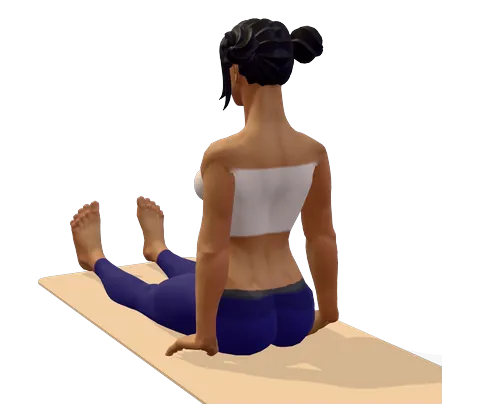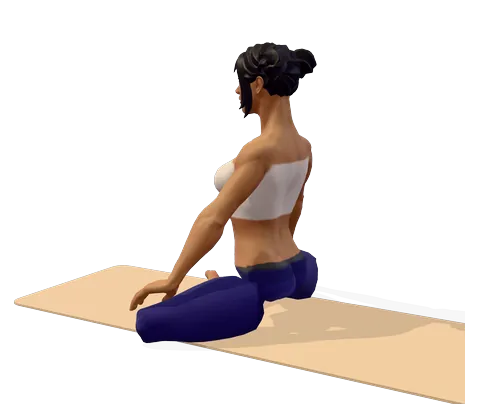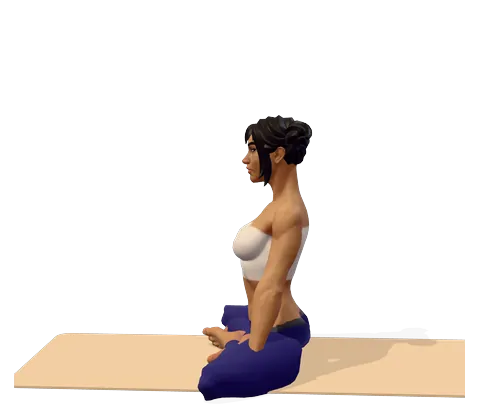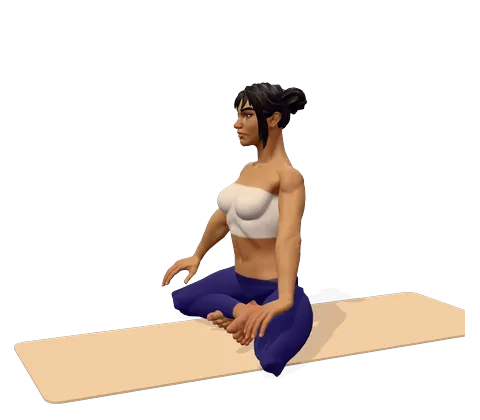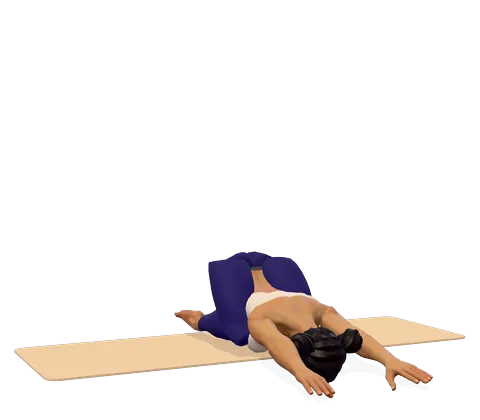
How to do Child’s Pose step by step
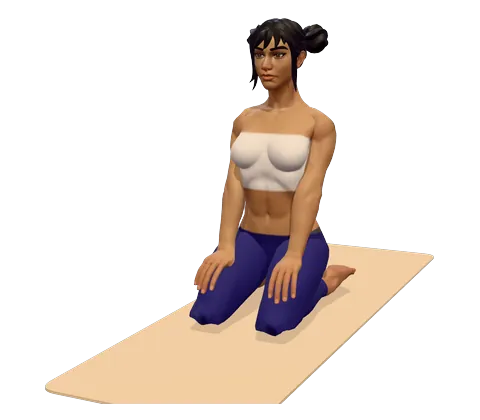
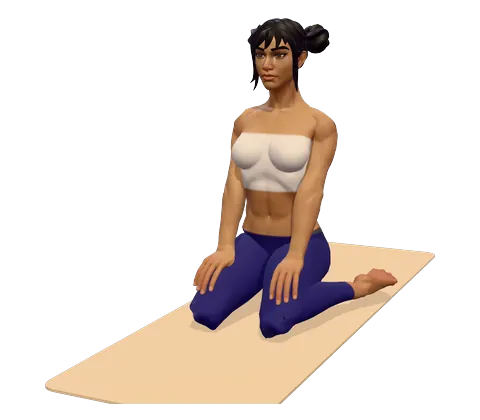
- Kneel on your mat with your big toes touching and your knees about hip-width apart, or wider if you want more room for the belly.
- Sit back toward your heels. If your bottom does not reach them, put a folded blanket or cushion between your heels and your hips.
- Breathe out and fold forward from the hips, lowering your chest onto or between your thighs.
- Rest your forehead on the mat, a block or a cushion so your neck can relax completely.
- Stretch your arms forward with the palms down, or rest them beside your legs with the palms up.
- Stay for 30 seconds to 2 minutes, breathing slowly into the back of your ribs. Let your shoulders and jaw soften.
- To come out, walk your hands back toward your knees and slowly roll up to sitting, lifting your head last.
Where you feel Child’s Pose: what it stretches and strengthens
Rest your forehead down and breathe into your back. In the 3D guide, turn on Body guide: areas that stretch glow green and areas that work glow saffron.
Stretches
- Lower back
- Glutes
- Ankles
Benefits and precautions
Benefits
- Gently stretches the lower and middle back, the hips, the fronts of the thighs and the ankles
- With the arms forward, lengthens the shoulders and the broad muscles of the back
- A calm, supported shape that invites slow breathing; used in yoga for stress, anxiety and sleep
- Often eases tightness in the lower back after backbends or long periods of standing
- A safe place to pause and catch your breath at any point in a practice
- Part of yoga routines for back pain, period discomfort and digestion
Avoid or modify if
- Knee pain or injury — put a rolled blanket behind the knees, sit on a cushion, or lie on your back and hug your knees instead
- Pregnancy — take the knees wide so the belly has room, and skip it if it feels uncomfortable
- Stiff or painful ankles — place a folded blanket under the ankles
- Dizziness or pressure in the head — rest your forehead on a block or stacked fists so the head stays higher
- Recent abdominal surgery or a hernia — ask your doctor first
- Stop if it sends pain down a leg; some people with a disc problem feel worse when the back rounds
Child's pose (Balasana) is the pose you return to whenever you need a rest in yoga: kneel, sit back toward your heels, fold forward and let your forehead rest on the floor. It looks simple, and it is, but small choices — how wide the knees are, where the arms go, what supports the head — decide whether it feels like a stretch or a real rest. Below: how to do it well, what it helps with, the muscles it stretches, variations and when to choose something else.
What is child's pose? Balasana meaning
The child's pose Sanskrit name is Balasana: bala means child and asana means pose. The shape resembles a small child curled up asleep, which is where the Balasana meaning comes from. The child pose name in Hindi is बालासन (Balasana), with the same meaning. Physiotherapists use a very similar stretch, which they call the shell stretch or prayer stretch. Child's pose in Pilates classes is usually called rest position.
It is not the same as Shashankasana (hare pose), though they look alike. The difference between Balasana and Shashankasana is mostly purpose: Shashankasana is usually taught from Vajrasana with the arms stretched forward as an active posture, while Balasana is a resting pose in which you let go.
How to do child's pose correctly (Balasana or child pose kaise kare)
Follow the steps above, then adjust these details until the pose feels easy:
- Knees together or wide? Knees together gives more stretch to the back and a feeling of being held. Knees wide (wide-knee child's pose) makes room for the belly and chest and stretches the inner thighs.
- Hips toward heels. The back lengthens as the hips sink. If they hover high, a cushion on your heels lets you relax instead of holding yourself up.
- Support the head. If your forehead does not reach the floor, rest it on a block, a cushion or your stacked fists.
- Choose your arms. Arms forward adds a shoulder and upper-back stretch; arms back beside the legs lets the shoulders drop and feels more restful.
- Breathe into your back. With the belly resting on the thighs, you can feel each breath widen the back of the ribs.
How long to do Balasana
Between flowing poses, 3–5 breaths is enough. As a rest or a stretch, stay 1–3 minutes. Many people use child's pose breathing — slow breaths into the back — for a minute or two before sleep.
Child's pose benefits: what does it help with?
What is child's pose good for? Mainly two things: a gentle stretch for the back, hips and thighs, and a calm, sheltered position that slows the breath. That combination is why it appears in so many of our plans, from yoga for back pain to yoga for sleep.
Child's pose for lower back pain relief
Many people find the gentle rounding eases a tight, tired lower back, especially after backbends such as cobra pose or a day on their feet. With the arms stretched forward, child's pose also stretches the upper back and helps upper back pain from hunching. It does not suit everyone: some people with a disc problem feel worse when the back rounds. Child's pose causing back pain is a sign to stop, and try lying on your back with your knees hugged in instead.
Calm, sleep and periods
Resting the forehead and slowing the breath helps many people feel calmer, which is why the pose is part of our plans for stress, anxiety and sleep. For women, child pose benefits include easing period cramps for some: a wide-knee version with a cushion under the belly is part of our yoga for period pain routine.
A few honest limits: child's pose does not burn meaningful calories, so it is not a weight-loss pose, and there is no good evidence that it improves skin or hair.
What muscles does child's pose stretch?
| Area | Muscles stretched |
|---|---|
| Back | Erector spinae along the spine; latissimus dorsi when the arms reach forward |
| Hips and thighs | Gluteal muscles; quadriceps at the front of the thighs; inner thighs in the wide-knee version |
| Shoulders | Back of the shoulders and upper arms, with the arms forward |
| Ankles and feet | Front of the shins and tops of the feet |
Child's pose variations and modifications
- Child's pose variations for beginners: a cushion between heels and hips and another under the forehead remove most of the strain.
- Child's pose modifications for knee pain: roll a blanket and tuck it deep behind the knees, or skip kneeling and lie on your back hugging your knees to your chest.
- Child's pose with a side reach: walk both hands to the right to stretch the left side of the body, then change sides.
- Parsva Balasana (thread the needle): from all fours, slide one arm under the chest and rest that shoulder and ear on the mat — a twist for the upper back.
- Supported: rest your chest and head on a bolster or pillows along the thighs. In pregnancy, take the knees wide and use this version so the belly is never squeezed; see prenatal yoga for more.
- Child's pose variations for seniors: sit on a chair, feet apart, and fold forward with your forearms on your thighs. You can also kneel on a bed with a pillow under your head — an easy way to do child pose in bed before sleep.
Children love it too: in yoga for kids it is often called the "little mouse" or "rest" pose.
Child's pose vs downward dog, puppy pose and happy baby
Child's pose vs downward dog: both lengthen the back, but downward dog is active, with the weight on the hands and feet, while child's pose is passive. Puppy pose keeps the hips above the knees and the chest melting down — a stronger shoulder and upper-back stretch. Child's pose vs frog pose: frog takes the knees very wide with the hips in line with them, a much deeper inner-thigh stretch. Happy baby (Ananda Balasana) shares the "child" name but is done lying on your back holding your feet.
Child's pose in a flow
It links naturally with other poses: from child's pose to cobra (slide forward onto your belly and lift the chest), from child's pose to downward dog (tuck the toes and lift the hips), or from child's pose to upward dog in a Sun Salutation. It also makes a good cool-down at the end of any session, and every guided session on our practice page gives you the chance to rest in it.
Balasana contraindications and precautions
Balasana benefits come with few contraindications, but read the caution box above: knee injuries, late pregnancy without a wide-knee setup, recent abdominal surgery and back pain that worsens when you round all call for a change of position. If your head feels heavy or you feel dizzy, raise it on a block.
बालासन (Balasana) — हिंदी में: घुटनों के बल बैठें और एड़ियों पर पीछे की ओर बैठ जाएँ। साँस छोड़ते हुए आगे झुकें और माथा ज़मीन पर रखें, हाथ आगे फैलाएँ या पैरों के पास रखें। 30 सेकंड से 2 मिनट तक आराम से साँस लें। बालासन के फायदे (child pose ke fayde): कमर, कूल्हे और जाँघें हल्की खिंचती हैं, मन शांत होता है और नींद में मदद मिल सकती है। घुटने में चोट हो या गर्भावस्था में, घुटने चौड़े रखें या पीठ के बल लेटकर घुटने छाती से लगाएँ।
Health conditions this pose is used for
Yoga for back pain · Yoga for sciatica · Yoga for spinal stenosis · Yoga for spondylolisthesis · Yoga for degenerative disc disease · Yoga for plantar fasciitis and heel pain · Yoga for leg cramps · Yoga for fibromyalgia · Yoga for chronic pain · Yoga for jaw pain (tmj) · Yoga for hyperthyroidism (overactive thyroid) · Yoga for hormonal balance · Yoga for anemia (low hemoglobin) · Yoga for menopause · Yoga for period pain and menstrual cramps · Yoga for fertility · Yoga for endometriosis · Yoga for pms (premenstrual syndrome) · Yoga for pregnancy (prenatal yoga) · Yoga for postpartum recovery · Yoga for anxiety · Yoga for grief and loss · Yoga for bipolar disorder (complementary care) · Yoga for eating disorder recovery · Yoga for stress relief · Yoga for sleep and insomnia · Yoga for shift work and night-shift sleep · Yoga for migraine and headache · Yoga for exam stress · Yoga for epilepsy (complementary care) · Yoga for adhd and attention · Yoga for autism (children) · Yoga for ptsd and trauma · Yoga for panic attacks · Yoga for social anxiety · Yoga for anger management · Yoga for burnout and exhaustion · Yoga for addiction and quitting smoking · Yoga for tinnitus · Yoga for restless legs syndrome · Yoga for chronic fatigue syndrome · Yoga for cold and cough · Yoga for immunity · Yoga for digestion · Yoga for constipation · Yoga for ibs · Yoga for gas and bloating · Yoga for piles (hemorrhoids) · Yoga for ulcerative colitis and ibd · Yoga for hair fall and hair growth · Yoga for premature grey hair · Yoga for glowing skin and acne · Yoga for dark circles · Yoga for psoriasis and eczema · Yoga for eye strain · Yoga for dry eyes · Yoga for cancer recovery (supportive care)
Where this practice is used
Chakras: Muladhara (Root Chakra) · Ajna (Third Eye Chakra)
Frequently asked questions
What is child's pose good for?
It gently stretches the back, hips, thighs and ankles, and gives you a calm resting position that slows the breath. It is used for back tension, stress, sleep and as a rest during any practice.
How long should I stay in Balasana?
Three to five breaths between other poses, or 1–3 minutes when you use it as a rest or a stretch. Come out slowly, lifting your head last.
What should I do if child's pose hurts my knees?
Put a rolled blanket behind your knees or a cushion between your heels and hips. If it still hurts, lie on your back and hug your knees to your chest for a similar back stretch.
Is child's pose safe in pregnancy?
Usually yes with the knees wide apart so the belly has room, and with a bolster or pillows under your chest. Skip it if you feel any pressure or discomfort.
Is child's pose good for lower back pain?
For many people, yes — the gentle rounding eases tension. If rounding makes your pain worse or it spreads down a leg, stop and ask a physiotherapist.
What is the difference between child's pose and downward dog?
Downward dog is an active pose with your weight on your hands and feet. Child's pose is a passive rest with your hips back toward your heels.
What does Balasana mean?
"Bala" means child and "asana" means pose, so Balasana means child's pose. In Hindi it is बालासन.
This page is for general education. Check with your doctor before starting yoga if you are pregnant, have a medical condition or an injury. Stop if you feel pain, dizziness or shortness of breath.