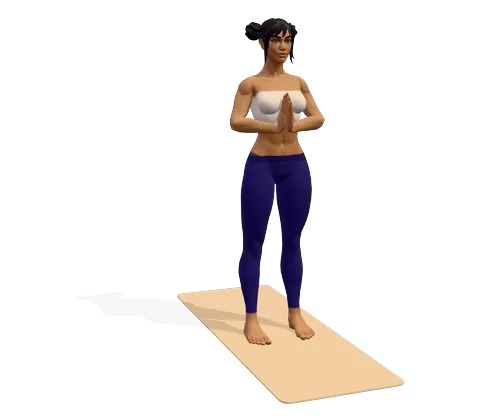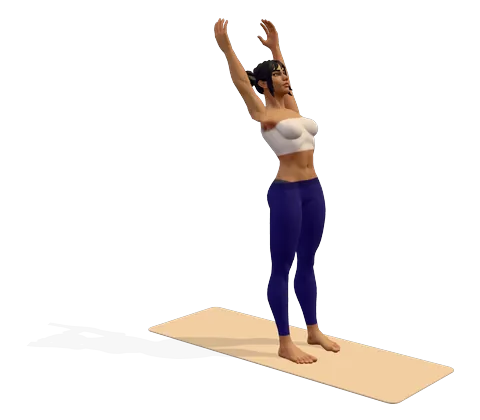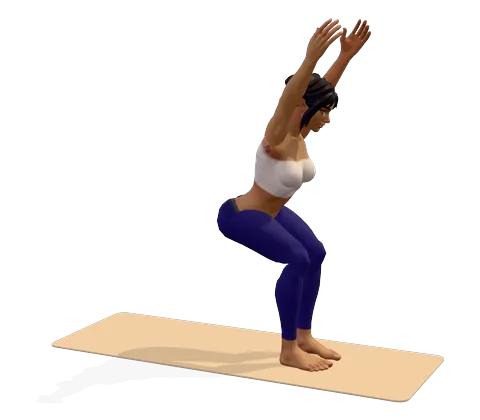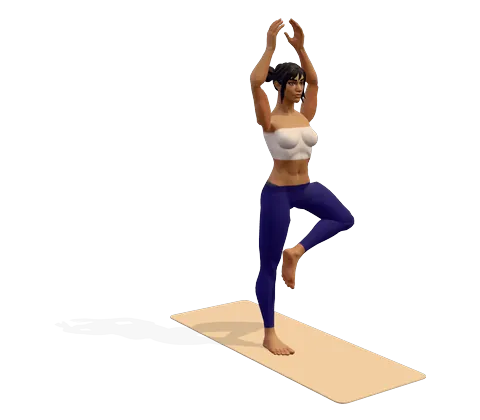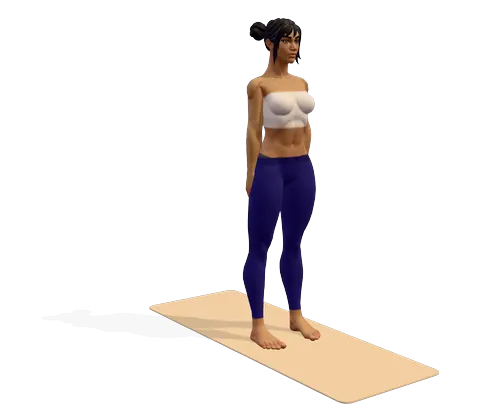
How to do Mountain Pose step by step
- Stand with your feet together, or hip-width apart if that feels steadier. Point your toes forward and let your arms hang by your sides.
- Lift and spread your toes, then lay them back down. Feel your weight spread evenly over the heel, the base of the big toe and the base of the little toe on both feet.
- Firm your thighs gently without locking your knees. Let your tailbone point down so your lower back is neither arched nor flattened.
- Stack your ribs over your pelvis and your shoulders over your hips. Roll your shoulders up, back and down, and let your arms hang with palms facing your thighs.
- Lengthen the back of your neck and lift the crown of your head, chin parallel to the floor. Soften your face, jaw and eyes.
- Breathe slowly through your nose and stay for 30 seconds to 1 minute (5–10 breaths), noticing any sway and letting it settle.
- To finish, relax your thighs and shoulders and take one more easy breath before moving into the next pose.
Where you feel Mountain Pose: what it stretches and strengthens
Press evenly through both feet and lengthen up through the crown. In the 3D guide, turn on Body guide: areas that stretch glow green and areas that work glow saffron.
Strengthens
- Front thighs
- Abs
- Ankles
Benefits and precautions
Benefits
- Builds awareness of how you stand, which helps correct slouching and uneven weight
- Wakes up the feet, ankles and thigh muscles that keep you upright
- Trains the small balance reactions you use every day when walking and standing
- Gives a quiet moment to settle the breath and focus before a practice
- Acts as the starting and reset position for Surya Namaskar and most standing poses
- Safe and simple enough for beginners, seniors and kids
Avoid or modify if
- Low blood pressure, dizziness or vertigo — stand with your feet hip-width apart, near a wall or a chair, and keep your eyes open
- Balance problems or Parkinson’s disease — stand with a wall behind you or a chair in front, never alone on a slippery floor
- Knee hyperextension — keep a tiny bend in the knees instead of pushing them back
- Varicose veins or swollen legs — keep the hold short and shift gently rather than standing still for long
- Pregnancy — stand with feet hip-width apart for a wider, steadier base
Mountain pose (Tadasana) is the basic standing pose of yoga: feet grounded, spine long, arms resting by your sides. It looks like doing nothing, but the way you stand here is the way you will stand in Tree, Triangle and every other standing posture. It is also the first and last position of Surya Namaskar. Below: what Tadasana is, how to do it well, benefits, muscles used, variations and precautions.
What is mountain pose in yoga?
Mountain pose is a neutral, active standing position. The Sanskrit name is usually explained like this: tada means "mountain" (it can also mean "palm tree") and asana means "pose". Picture a mountain: broad at the base, straight and still. In Hindi it is written ताड़ासन.
The purpose of mountain pose is to learn neutral alignment while you are still. Once you can feel where your weight sits in a simple stand, you can keep that feeling when the pose gets harder.
Why some books show Tadasana with arms up
Because tada can mean palm tree, many Indian schools and school syllabi teach Tadasana as the palm tree pose: fingers interlocked, arms stretched overhead and heels lifted onto the toes. Both are correct within their traditions. On this page Tadasana means the flat-footed mountain pose; the arms-up stretch is covered in Raised Arms Pose and in the variations below.
Samasthiti vs Tadasana
Samasthiti means "equal standing" (sama = equal, sthiti = state). In Ashtanga yoga, Samasthiti is the attention stance at the start of the sun salutations, feet together and hands at the sides, often with the palms joined. In most other styles the two names describe the same shape. The difference between Tadasana and Samasthiti is mostly in the name and the moment you use it, not in the body.
How to do mountain pose correctly (Tadasana kaise kare)
The steps above give the full procedure of Tadasana. These mountain pose cues fix what usually goes wrong:
- Weight too far back or forward. Rock slowly forward and back, then stop where your weight feels spread between heels and balls of the feet.
- Locked knees. Pushing the knees back tips the pelvis and strains the joint. Firm the thigh muscles instead; the knees stay straight but soft.
- Rib cage flaring. If your lower ribs poke forward, breathe out and let them soften down toward your hips.
- Chin up or pushed forward. Slide the head back until your ears sit roughly above your shoulders.
- Holding your breath. Stillness should not mean tension. Let the belly move a little with each breath.
How long and how many times? Stay 30–60 seconds on its own, or a few breaths between standing poses. Once or twice a day, for example after long sitting, is plenty.
Tadasana benefits: what is mountain pose good for?
Tadasana yoga benefits are mostly about posture, balance and attention, including Tadasana benefits for the spine: standing well spreads the load through the joints and lets the breath move freely. That is why Tadasana appears in our plans for posture and tech neck, neck pain and knee pain, where calm standing work helps you use the legs evenly.
Is Tadasana good for back pain?
It can help as part of a wider routine. Standing with a neutral pelvis, rather than swayed or tucked, often eases the dull ache that comes from standing badly. Mountain pose will not fix a disc problem on its own, but it is a safe place to practise the posture your physiotherapist asks for. If standing still makes your back pain worse, shift your weight gently or sit down.
Does Tadasana increase height?
Height is set by your genes and growth plates; once they close in the late teens, no exercise makes bones longer. Tadasana can help you stop slumping, so you stand at your full natural height. For teenagers it is a healthy stretch, not a growth treatment.
Tadasana muscles used
| Muscles working | What they do in the pose |
|---|---|
| Muscles of the feet and calves | Keep the arches lifted and make tiny balance corrections |
| Quadriceps (front of the thighs) | Hold the knees straight without locking them |
| Glutes and deep core | Keep the pelvis level and support the lower back |
| Muscles along the spine and between the shoulder blades | Hold the chest open and the head balanced |
Mountain pose variations and modifications
- Mountain pose with arms up: raise your arms overhead, palms facing each other. This is also called Upward Salute (Urdhva Hastasana).
- Interlocked fingers, palm tree style: interlock your fingers, turn the palms up and stretch; lift the heels only if your balance is good.
- Cactus arms: bend the elbows to 90 degrees at shoulder height to open the chest.
- Against a wall: heels, buttocks and the back of the head near the wall show you what "straight" feels like.
- Chair yoga mountain pose: sit tall at the front of a chair, feet flat. It suits seniors and anyone who cannot stand for long.
Mountain pose for beginners and kids
Tadasana for beginners: feet hip-width apart, a wall nearby, eyes open. It is the first pose in our yoga for beginners guide. Children enjoy it as a game ("be a mountain the wind cannot move"); the benefits for kids are body awareness, a calmer moment and better posture at a desk.
Mountain pose vs downward dog, and Tadasana vs Vrikshasana
In some Indian Surya Namaskar sequences, the inverted-V shape is called Parvatasana, which also translates as "mountain pose". That is the same shape as downward-facing dog, a completely different pose from standing Tadasana. If an instruction says "mountain pose" in the middle of a sun salutation, it usually means the dog shape.
Tadasana and Vrikshasana (tree pose) are close partners: you begin tree pose from mountain pose and simply lift one foot. If you can stand quietly in Tadasana for a minute, tree pose is the natural next step.
Mountain pose precautions and contraindications
Few people need to avoid Tadasana completely. The main precautions are about falling and fainting: with low blood pressure, vertigo or poor balance, keep your eyes open, feet apart and a wall close by, and stand up slowly from lying. Standing balance work with support is part of our yoga for Parkinson’s plan for the same reason.
A short mountain pose sequence
A simple Tadasana sequence for the morning: stand still for five breaths, sweep the arms up, fold into a gentle standing forward bend, roll back up and sit into chair pose. Repeat three times. You can follow it with the voice guide in the guided sessions.
ताड़ासन (Tadasana) — हिंदी में: पैरों को साथ रखकर सीधे खड़े हों और वज़न दोनों पैरों पर बराबर रखें। घुटने सीधे लेकिन ढीले रखें, कंधे पीछे और नीचे, सिर का ऊपरी हिस्सा ऊपर की ओर। 30 सेकंड से 1 मिनट तक धीरे-धीरे साँस लेते रहें। ताड़ासन के फायदे: खड़े होने का ढंग सुधरता है, पैर और जाँघें मज़बूत होती हैं और संतुलन व एकाग्रता बढ़ती है। चक्कर आते हों तो दीवार के पास अभ्यास करें।
Health conditions this pose is used for
Yoga for knee pain and osteoarthritis · Yoga for knee replacement recovery · Yoga for neck pain and cervical spondylosis · Yoga for posture and tech neck · Yoga for desk workers and sitting all day · Yoga for hip replacement recovery · Yoga for arthritis · Yoga for scoliosis · Yoga for osteoporosis and bone health · Yoga for shoulder pain · Yoga for tennis elbow · Yoga for plantar fasciitis and heel pain · Yoga for flat feet · Yoga for leg cramps · Yoga for carpal tunnel syndrome · Yoga for ankylosing spondylitis · Yoga for lupus · Yoga for height and posture · Yoga for balance and fall prevention · Yoga for low blood pressure · Yoga for high cholesterol · Yoga for fatty liver · Yoga for uric acid and gout · Yoga for kidney health · Yoga for kidney stones · Yoga for anemia (low hemoglobin) · Yoga for healthy weight gain · Yoga for pregnancy (prenatal yoga) · Yoga for pelvic floor and urinary incontinence · Yoga for depression · Yoga for bipolar disorder (complementary care) · Yoga for eating disorder recovery · Yoga for jet lag and travel fatigue · Yoga for memory and concentration · Yoga for exam stress · Yoga for parkinson’s disease · Yoga for adhd and attention · Yoga for autism (children) · Yoga for ptsd and trauma · Yoga for social anxiety · Yoga for self-confidence · Yoga for addiction and quitting smoking · Yoga for vertigo and dizziness · Yoga for memory in older adults · Yoga for stroke recovery · Yoga for multiple sclerosis · Yoga for copd · Yoga for bronchitis · Yoga for heart health · Yoga for immunity · Yoga for gastritis · Yoga for gallstones · Yoga for hernia (safe movement) · Yoga for glowing skin and acne · Yoga for glaucoma (safe yoga) · Yoga for dry eyes · Yoga for motion sickness · Yoga for varicose veins · Yoga for cold hands and feet (circulation) · Yoga for recovery after surgery
Where this practice is used
Chakras: Muladhara (Root Chakra)
Guided meditations in this posture: Walking Meditation
Frequently asked questions
What is Tadasana and its benefits?
Tadasana (mountain pose) is the basic standing pose of yoga. It improves posture and body awareness, strengthens the feet and legs, trains balance and gives you a steady starting point for other standing poses.
How long should I hold mountain pose?
Hold it for 30 seconds to 1 minute (5–10 slow breaths). Between other standing poses, a few breaths are enough.
What is the difference between Tadasana and Samasthiti?
Samasthiti means "equal standing" and is the name used in Ashtanga yoga for the ready position at the start of the sun salutations. The shape is almost the same as Tadasana; the difference is mainly the name and where it is used.
Can Tadasana increase height?
No exercise lengthens bones after the growth plates close. Tadasana can help you stop slouching, so you stand at your full natural height and look taller.
Can we do Tadasana for back pain?
Yes, gently. Standing with a neutral pelvis often eases the ache that comes from poor standing posture. If pain spreads down a leg or gets sharper, stop and ask a doctor or physiotherapist.
What is Tadasana in Hindi?
Tadasana in Hindi is ताड़ासन. "Tada" means mountain or palm tree and "asana" means pose. Tadasana ke fayde: better posture, stronger legs and steadier balance.
Who should be careful with mountain pose?
People with low blood pressure, vertigo, poor balance or Parkinson’s disease should stand near a wall or chair and keep their eyes open. With knee hyperextension, keep a slight bend in the knees.
This page is for general education. Check with your doctor before starting yoga if you are pregnant, have a medical condition or an injury. Stop if you feel pain, dizziness or shortness of breath.