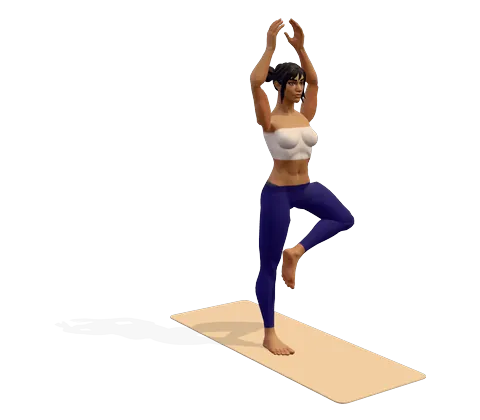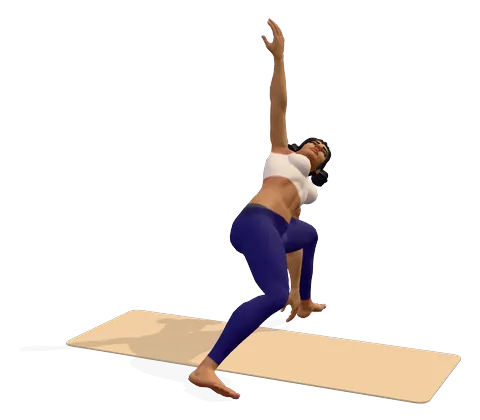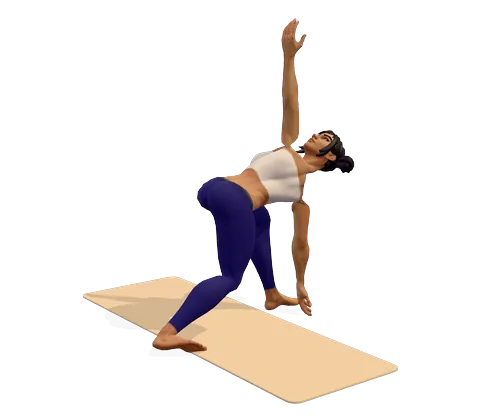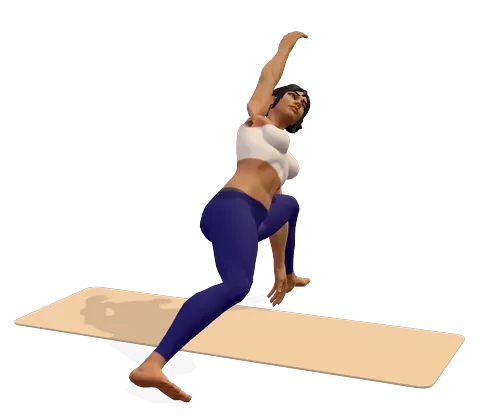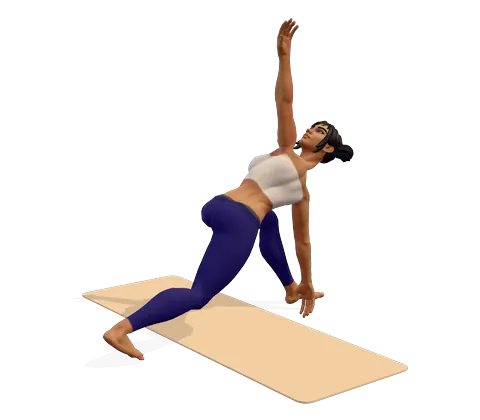
How to do Revolved Side Angle Pose step by step
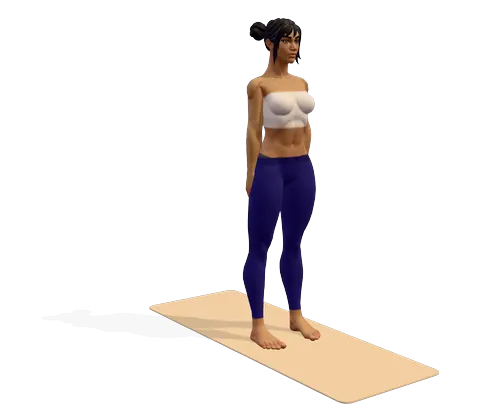
- Stand at the front of your mat. Step your right foot back about one leg-length and bend your left knee until it sits over your left ankle.
- Lift your right heel so you stand on the ball of the back foot. Keep the back leg straight and strong, hips facing the front of the mat.
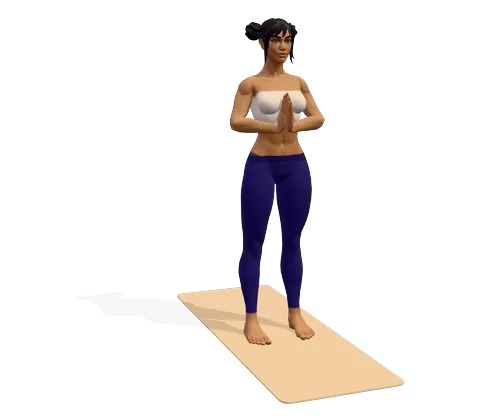
- Bring your palms together at your chest. Breathe in and lengthen your spine; breathe out and twist to the left, hooking your right elbow outside your left knee.
- For the full pose, lower your right hand to the floor or a block outside your left foot and reach your left arm straight up.
- Turn your chest toward the ceiling with each breath out. Keep the left knee in line with the second toe and look up only if your neck is comfortable.
- Hold for 3–5 breaths (about 20–30 seconds).
- To come out, bring your left hand down, untwist, step forward to stand, and repeat on the other side.
Where you feel Revolved Side Angle Pose: what it stretches and strengthens
Hook your elbow outside the knee and twist from your belly. In the 3D guide, turn on Body guide: areas that stretch glow green and areas that work glow saffron.
Stretches
- Side waist
- Hip flexors
- Upper back
Strengthens
- Front thighs
- Glutes
- Abs
Benefits and precautions
Benefits
- Rotates the upper and middle back, which often stiffens with long hours of sitting
- Strengthens the front thigh, buttocks and the deep muscles of the standing leg
- Stretches the hip flexors of the back leg, the outer hip and the side of the chest
- Works the oblique abdominal muscles that turn and steady the trunk
- Trains balance and coordination on a narrow base
- Asks for steady attention, which many people find calming
Avoid or modify if
- Pregnancy — avoid deep closed twists that press the belly; try an open twist instead, with your prenatal teacher’s guidance
- Recent spine, hip or abdominal surgery, or an acute disc problem — twist only after your doctor or physiotherapist agrees
- Knee pain in the front leg — keep the lunge shallow or lower the back knee to the mat
- Neck pain or dizziness — keep your gaze down or to the side instead of up
- Low blood pressure — come up slowly from the lunge to avoid light-headedness
Revolved side angle pose (Parivrtta Parsvakonasana) combines a deep lunge with a strong twist of the upper body. Your legs build heat and stability while your chest turns toward the sky, so the pose asks for strength, balance and mobility at once. In many yoga classes it is simply called twisted side angle, and some books name it revolved extended side angle pose. This guide covers what the pose is, how to set it up, realistic benefits, easier versions and how it compares with its cousins.
What is revolved side angle pose in yoga?
What is Parivrtta Parsvakonasana? It is the twisted form of extended side angle pose. In the extended version you open your chest to the side; in the revolved version you turn the other way, so the arm on the back-leg side crosses over the front thigh.
Parivrtta Parsvakonasana meaning and pronunciation
The revolved side angle pose Sanskrit name has four parts: parivrtta means "revolved" or "turned around", parsva "side" or "flank", kona "angle" and asana "pose". So the twisted side angle pose Sanskrit name literally means "turned side-angle posture". For Parivrtta Parsvakonasana pronunciation, say par-ee-VRIT-tah parsh-vah-koh-NAHS-anna. The side angle pose Sanskrit name without the twist is Utthita Parsvakonasana.
How to do revolved side angle pose safely
The 3D guide shows the high-lunge version with the back heel lifted, which is how most modern classes teach it. In the Iyengar version of Parivrtta Parsvakonasana, common in Iyengar yoga, the back heel presses down and the back foot turns in. Both are correct; the lifted heel makes it much easier to square the hips.
These revolved side angle pose cues solve most problems:
- Build the lunge first. Front knee over the ankle, back thigh lifted. If the lunge sags, the twist has no base.
- Lengthen, then turn. Grow tall on the in-breath and twist on the out-breath. Twisting a slumped spine only compresses it.
- Turn from the ribs, not the neck. If you can only look up by cranking your neck, look down or sideways.
- Keep both hips level. The back-leg hip tends to drop; draw it slightly forward and up.
- Use the arm as a guide, not a lever. Forcing the elbow against the knee pushes the knee out of line.
Revolved side angle pose benefits
The main benefits of revolved side angle pose come from pairing a demanding standing position with rotation of the spine: the legs work, the core stabilises and the upper back turns.
Benefits of oblique twists for the back
Standing twists use the oblique muscles of the belly and the small rotator muscles along the spine. Moving the upper back through rotation can ease the stiffness of long sitting, and gentle twisting appears in many yoga programmes for back pain. It is not a cure for back problems, though, and a deep loaded twist is not the place to start if your back is sore today.
Does twisted side angle help digestion?
Yoga tradition says twists "wring out" the organs. There is little direct research on this, but many people feel less bloated after a flow that includes twisting. Our yoga for digestion plan uses softer twists; leave strong ones until two hours after a meal.
Parivrtta Parsvakonasana for beginners: variations and modifications
An easy revolved side angle pose keeps the twist with far less strain. Try these revolved side angle pose modifications in order:
- Back knee down. Lower the back knee to a folded blanket, as in low lunge. The benefits of this twisted lunge (Parivrtta Anjaneyasana) are much the same, with far easier balance.
- Prayer twist. Keep the hands in prayer and hook the elbow outside the knee — the most common beginner shape.
- Hand on a block. Put a block outside the front foot so you do not collapse to reach the floor.
- Chair version. For Parivrtta Parsvakonasana with a chair, sit sideways on the seat, one leg forward and one back, and twist toward the front knee — useful for seniors or after injury.
Bound revolved side angle pose (Baddha Parivrtta Parsvakonasana)
The revolved side angle pose with bind wraps the lower arm under the front thigh and the top arm behind the back until the hands meet. The extra benefits of Baddha Parivrtta Parsvakonasana are a stronger shoulder opening and deeper rotation, but it needs open shoulders. Use a strap, and release the bind if your knee drifts or your breath becomes short.
Revolved side angle pose for kids
Children can do the knee-down prayer twist as a "look behind you" game. Keep holds short and skip the full bind.
Parivrtta Parsvakonasana vs Utthita Parsvakonasana and revolved triangle
How do you do Utthita Parsvakonasana? Your hips face the long side of the mat, the front forearm rests on the thigh and your chest opens sideways. Extended side angle pose benefits lean toward the inner thighs, groin and side body; variations of extended side angle pose include the hand on a block or a bind. The revolved pose squares the hips forward and turns the chest the other way, so it is harder for balance and stronger for rotation.
Revolved triangle is the straight-leg version of the same twist. To do Parivrtta Trikonasana, shorten your stance, straighten the front leg and place the hand by the front foot. Revolved triangle pose benefits include a stronger hamstring stretch, while the bent knee here builds more thigh strength. Extended side angle vs triangle pose works the same way: bent front knee versus straight leg. See our revolved triangle guide for Parivrtta Trikonasana benefits in full.
Preparatory poses and a revolved side angle sequence
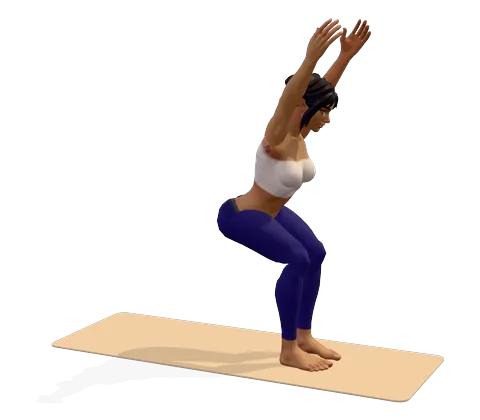
Good Parivrtta Parsvakonasana preparatory poses open the hips and wake up the spine: cat and cow, chair pose, and revolved chair pose in yoga (Parivrtta Utkatasana), whose benefits are similar — a twist on bent knees with feet together, so balance is easier. Low lunge and Warrior I open the hip flexors of the back leg.
A simple Parivrtta Parsvakonasana sequence: chair, revolved chair, knee-down twist, then the full pose on each side. Follow it with a wide-legged forward fold; its revolved form, Parivrtta Prasarita Padottanasana, has similar benefits with both feet grounded. Rest in child's pose. You can build this revolved side angle sequence with voice guidance in the sequence builder.
Parivrtta Parsvakonasana benefits and precautions
The benefits only hold if the pose feels safe. Parivrtta Parsvakonasana contraindications are listed in the caution box above. The key rule: twisting should never cause sharp pain in the back, groin or knee. If it does, come out, lower the back knee and twist less. With osteoporosis, keep twists gentle, never lever with the arms, and ask your doctor what range is safe.
Parivrtta Parsvakonasana in Hindi is परिवृत्त पार्श्वकोणासन. The box below gives the steps and Parivrtta Parsvakonasana benefits in Hindi.
परिवृत्त पार्श्वकोणासन (Parivrtta Parsvakonasana) — हिंदी में: दाहिना पैर पीछे ले जाएँ और बायाँ घुटना मोड़ें। हथेलियाँ जोड़कर साँस छोड़ते हुए बाईं ओर मुड़ें और दाहिनी कोहनी बाएँ घुटने के बाहर रखें। 20–30 सेकंड रुकें, फिर दूसरी तरफ़ करें। इसके फायदे: पीठ के ऊपरी हिस्से में लचीलापन, जाँघों और पेट की साइड की मांसपेशियों में ताकत, और बेहतर संतुलन। गर्भावस्था, पीठ की ताज़ा चोट या ऑपरेशन के बाद यह आसन न करें।
Frequently asked questions
What is revolved side angle pose good for?
It strengthens the legs and buttocks, stretches the hip flexors, rotates the upper back and trains balance. Many people use it to counter stiffness from long sitting.
Is revolved side angle pose a side bend?
No, it is a twist. What do side bends work? Mainly the side waist and the muscles between the ribs. A twist works the obliques and the rotator muscles of the spine instead.
How long should I hold Parivrtta Parsvakonasana?
Hold for 3–5 breaths (about 20–30 seconds) on each side. A short, well-aligned twist is better than a long one with the knee drifting.
Why can I not reach the floor in revolved side angle?
Most people cannot at first. Use a block, keep your hands in prayer or lower your back knee. Rotation in the upper back improves slowly with regular practice.
Can I do revolved side angle pose during pregnancy?
Deep closed twists that press the belly are generally avoided in pregnancy. An open twist, turning away from the front leg, with a prenatal teacher is a safer option.
What are some other twisting yoga poses names?
Revolved triangle, revolved chair, the seated twist Ardha Matsyendrasana, Bharadvaja’s twist and the supine spinal twist are common twisting poses.
This page is for general education. Check with your doctor before starting yoga if you are pregnant, have a medical condition or an injury. Stop if you feel pain, dizziness or shortness of breath.