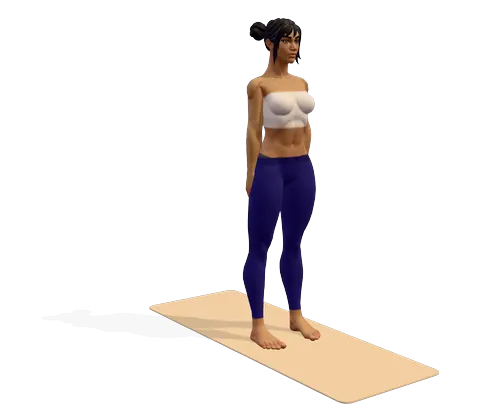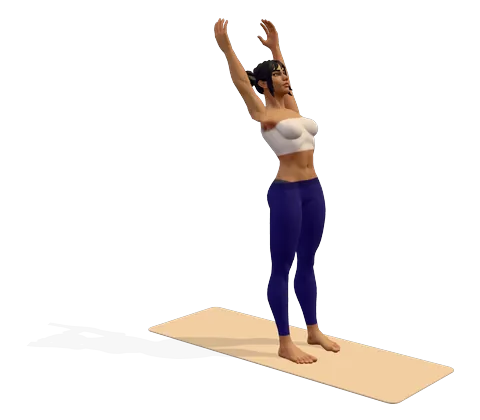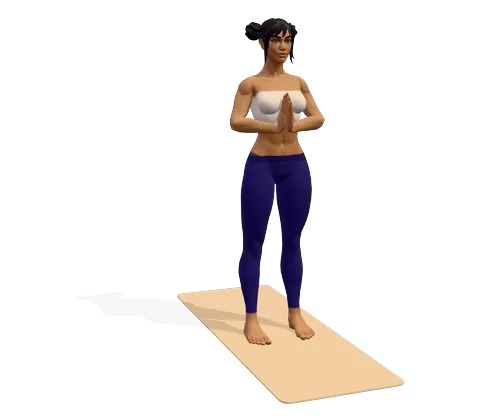
How to do Prayer Pose step by step
- Stand at the front of your mat with your feet together or slightly apart, weight spread evenly over both feet.
- Let your arms hang for a moment, then roll your shoulders up, back and down.
- Bring your palms together in front of your chest, thumbs lightly touching the breastbone and fingers pointing up.
- Press the palms together gently and evenly. Let the elbows relax out to the sides, a little lower than the wrists.
- Lengthen your spine, keep the chin level and close your eyes or rest your gaze softly on the floor ahead.
- Breathe slowly through your nose for 15–30 seconds (3–6 breaths), letting your attention settle on the breath.
- To finish, open your eyes, release your hands to your sides, or breathe in and sweep the arms up to begin Surya Namaskar.
Where you feel Prayer Pose: what it stretches and strengthens
Press palms together gently and let your shoulders soften down. In the 3D guide, turn on Body guide: areas that stretch glow green and areas that work glow saffron.
Stretches
- Chest
Strengthens
- Arms
- Shoulders
- Spine
Benefits and precautions
Benefits
- Brings attention to the present moment before and after practice
- Encourages an upright, balanced standing posture
- Gently engages the chest, shoulders and arms through the light palm press
- Slows and evens the breath, which many people find calming
- Sets the rhythm for Surya Namaskar and marks a clear start and finish
- Simple enough for kids, seniors and complete beginners
Avoid or modify if
- Dizziness or low blood pressure — keep the eyes open and the feet slightly apart, with a wall close by
- Poor balance — practise seated, or stand with your back near a wall
- Wrist pain or carpal tunnel syndrome — keep the palm press very light and the wrists soft; stop if fingers tingle
- Shoulder or elbow pain — lower the hands a little or let the elbows drop closer to the body
Prayer pose (Pranamasana) is the standing position with palms joined at the heart that begins and ends every round of Surya Namaskar. It asks very little of the muscles, yet it does an important job: it gathers your attention, steadies the breath and gives the practice a clear starting point. This page explains what Pranamasana is, how to do it well, its benefits, the namaste gesture behind it, useful variations and the few precautions to keep in mind.
What is Pranamasana (prayer pose) in yoga?
The Sanskrit name has two parts: pranam means "to bow" or "to greet with respect" and asana means "pose". So the meaning of Pranamasana is "greeting pose" or "salutation pose". Pranamasana in English is usually called prayer pose or namaste pose, and Pranamasana in Hindi is प्रणामासन.
The hand position itself is a mudra called Anjali Mudra (anjali means "offering"). You can use it standing, seated in meditation or kneeling. When people ask what the prayer pose in yoga is called, the answer depends on the context: Pranamasana for the standing pose in sun salutation, Anjali Mudra for the gesture on its own.
How to do Pranamasana step by step
The steps above cover how to do prayer pose from start to finish. These details make the difference between just standing there and actually arriving:
- Feet first. Build the pose from the ground up, exactly as in mountain pose: toes spread, weight even, knees soft.
- Even press. Press the base of the palms and all ten fingertips together with equal, light pressure. A gap between the palms is fine; a hard squeeze is not needed.
- Hands at the breastbone. Thumbs rest near the centre of the chest. If the hands drift up toward the chin, the shoulders usually rise too.
- Elbows soft. Let them hang slightly lower than the wrists so the shoulders can stay relaxed.
- Quiet face. Unclench the jaw and soften the eyes. This is where the calming effect really comes from.
How long should you hold it? In a flowing sun salutation, one breath out. As a pose on its own, 15–30 seconds, or up to a few minutes if you use it as a short standing meditation.
Pranamasana in Surya Namaskar
In the classical 12-step sun salutation, Pranamasana is position 1 and position 12. You breathe out as you join the palms, then breathe in and sweep the arms up into Hasta Uttanasana (raised arms pose). At the end of the round you return to prayer pose, pause for a breath and notice how your body feels before the next round.
The benefits of Pranamasana in Surya Namaskar are mostly about rhythm. Pausing here keeps the sequence from becoming a rushed workout, gives your heart rate a moment to settle between rounds and reminds you to move with the breath.
Benefits of Pranamasana
The prayer pose meaning, a respectful bow, tells you what it is for: a pause, not a workout. It is not a strengthening or stretching exercise in any big way. Its value is in posture, breathing and attention:
- A calm start. A few slow breaths with the palms joined is a simple way to shift from a busy day into practice, and it is part of many routines for stress relief.
- Posture. Standing tall with the chest open and shoulders relaxed trains the same alignment as Tadasana.
- Arm and chest engagement. The light palm press gently switches on the chest and upper arms and helps you feel the shoulder blades settle.
- Focus. Many people find that joining the hands at the centre of the body helps the mind stop wandering, which is why the gesture is used in meditation.
Namaste posture benefits are real but modest. Some sources list many more, such as curing anxiety or balancing hormones. There is no good evidence for claims like that, so treat this pose as a calm, useful pause rather than a treatment.
Namaste pose meaning, and why yoga ends with it
Namaste comes from Sanskrit namah ("bow") and te ("to you"): "I bow to you". It is an everyday greeting in India and Nepal, used much like "hello" and "thank you", with the palms joined in front of the chest. Namaskar is the same greeting, often felt to be a little more formal.
Why do teachers say namaste after yoga? It is a way of thanking the group and closing the practice with respect. You do not have to say it; the gesture alone, or simply sitting quietly for a moment, serves the same purpose.
Yoga prayer pose variations
- Seated prayer pose: sit cross-legged in Easy Pose or on a chair with the palms joined. Good for meditation and for anyone who cannot stand for long.
- Prayer position kneeling: kneel and sit back on your heels with the hands at your chest.
- Prayer squat: in Garland Pose (Malasana) the palms join and the elbows press the knees gently apart. Prayer squat pose benefits include open hips and ankles.
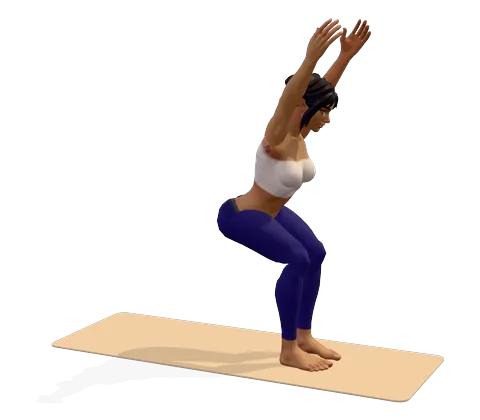
- Prayer twist: from chair pose, hook one elbow outside the opposite knee with the palms joined. This is revolved chair, a much stronger pose.
- Reverse prayer pose: palms join behind the back, fingers pointing up. Reverse prayer pose benefits are a deep stretch for the front of the shoulders, chest and forearms, but it is hard on stiff shoulders and wrists; start by holding opposite elbows behind you instead.
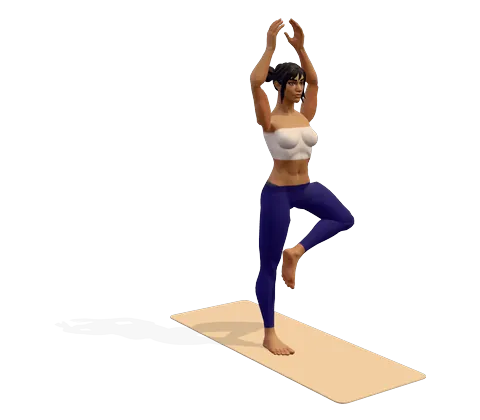
- Eka Pada Pranamasana: "one-foot prayer pose", a balance in which the sole of one foot rests on the inner thigh of the standing leg with the palms joined. It is very close to tree pose.
The prayer stretch for wrists and forearms
Outside yoga, the prayer pose stretch is a common desk exercise: palms joined at the chest, then slowly lower the hands toward the waist while keeping the palms together until you feel a stretch along the inner forearms. Hold for about 15–30 seconds. It suits people who type all day. If you have carpal tunnel syndrome, keep it gentle and stop if your fingers go numb or tingle, and ask your doctor or physiotherapist which stretches suit you.
Prayer pose for kids and beginners
Pranamasana is often the very first pose children learn. Ask them to "press the palms like a closed flower", take three slow breaths and then "open the flower" by spreading the fingers. For adult beginners it is a helpful habit to start every session with a minute of prayer pose. Our guided sessions begin and end this way, with the voice counting you in.
प्रणामासन (Pranamasana) — हिंदी में: मैट के आगे सीधे खड़े हों, पैर साथ और वज़न दोनों पैरों पर बराबर। दोनों हथेलियाँ छाती के सामने जोड़ें और कंधों को ढीला रखें (Pranamasana kaise kare)। आँखें बंद करके 3–6 बार धीरे साँस लें। प्रणामासन के फायदे (Pranamasana ke fayde): मन शांत होता है, साँस धीमी होती है और खड़े होने का ढंग सुधरता है। यह सूर्य नमस्कार का पहला और आख़िरी आसन है।
Health conditions this pose is used for
Yoga for carpal tunnel syndrome
Frequently asked questions
What is Pranamasana and its benefits?
Pranamasana is the standing prayer pose with palms joined at the chest. It steadies the breath, focuses attention, supports good standing posture and marks the start and end of each round of Surya Namaskar.
What does Pranamasana mean?
"Pranam" means to bow or greet with respect and "asana" means pose, so Pranamasana means greeting or salutation pose. In English it is called prayer pose or namaste pose.
How long should I hold prayer pose?
In Surya Namaskar, for one breath out. On its own, 15–30 seconds, or longer as a short standing meditation.
Is Pranamasana the same as Anjali Mudra?
Anjali Mudra is the hand gesture of joined palms. Pranamasana is the whole standing pose that uses that gesture.
Pranamasana vs Samasthiti: what is the difference?
Samasthiti is the Ashtanga name for the ready stance, usually with the arms by the sides. Pranamasana adds the palms joined at the chest.
Why do people say namaste after yoga?
It means "I bow to you" and is a respectful way to thank the group and close the practice. Saying it is optional.
Are there any Pranamasana contraindications?
Very few. People who feel dizzy standing still should keep their eyes open and stand near a wall. With wrist pain or carpal tunnel, keep the palm press very light.
This page is for general education. Check with your doctor before starting yoga if you are pregnant, have a medical condition or an injury. Stop if you feel pain, dizziness or shortness of breath.