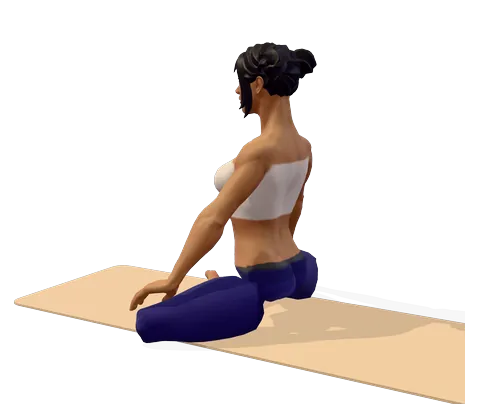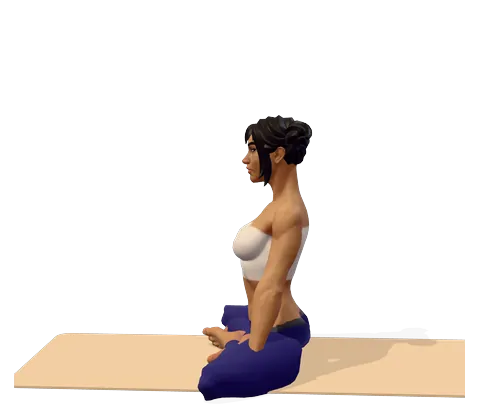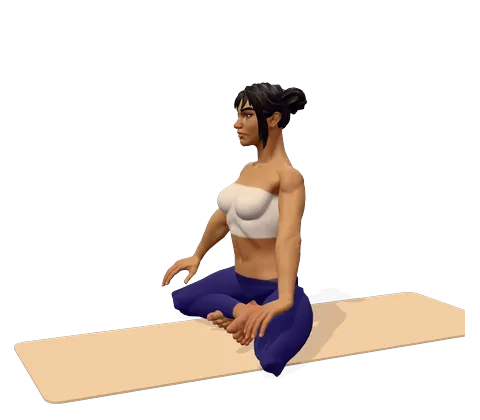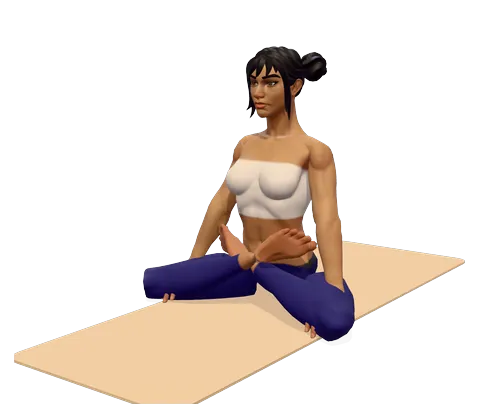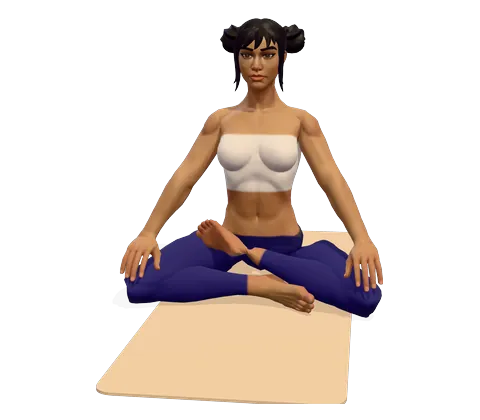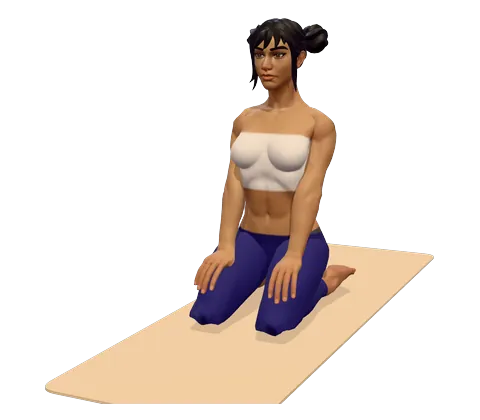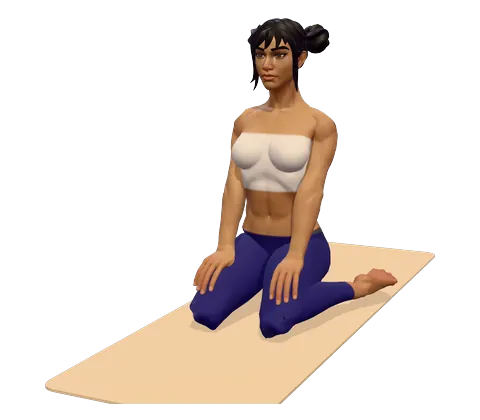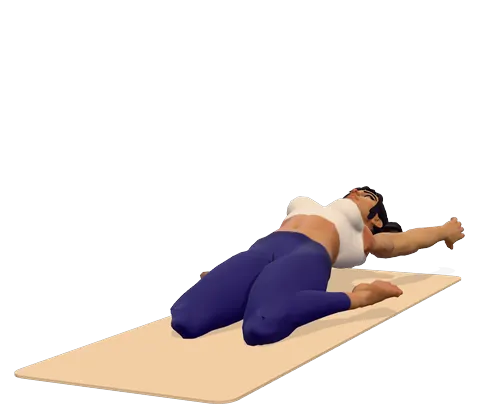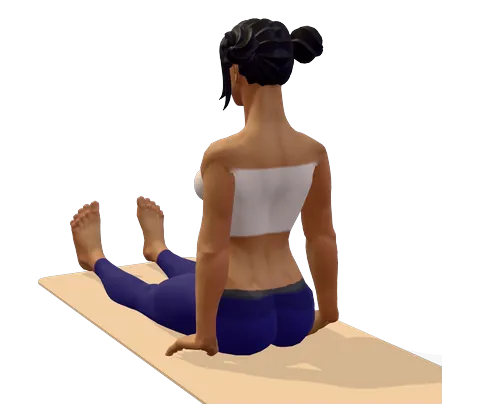
How to do Staff Pose step by step
- Sit on the mat with your legs straight out in front of you, feet together or hip-width apart. If your lower back rounds, sit on a folded blanket.
- Use your hands to move the flesh of each buttock back and out, so you sit on the front of your sitting bones.
- Place your palms on the mat beside your hips, fingers pointing toward your feet. Press down lightly to help the spine lift.
- Flex your feet so the toes point up, and press the backs of your thighs and heels into the mat. The kneecaps lift gently.
- Lengthen up through the crown of your head. Draw the shoulders back and down and let the chest open without puffing the ribs forward.
- Hold for 30–60 seconds (about 5–10 slow breaths), keeping the legs active and the breath smooth.
- Relax the legs, lean back onto your hands or shake the legs out gently, then move into the next seated pose.
Where you feel Staff Pose: what it stretches and strengthens
Sit tall, press your legs down and flex your feet. In the 3D guide, turn on Body guide: areas that stretch glow green and areas that work glow saffron.
Stretches
- Hamstrings
- Calves
Strengthens
- Spine
- Front thighs
- Abs
Benefits and precautions
Benefits
- Trains upright sitting posture by strengthening the back muscles
- Gently stretches the hamstrings and calves
- Wakes up the thigh muscles (quadriceps), which support the knees
- Teaches the pelvic position needed for every seated forward bend and twist
- A calm, low-effort pose that builds body awareness for beginners
- Opens the chest and shoulders a little, which makes breathing feel easier
Avoid or modify if
- Lower back pain or very tight hamstrings — sit on a blanket and bend your knees rather than slumping
- Wrist pain — place your fingertips on blocks or rest your hands on your thighs
- Knees that bend backward (hyperextension) — keep a slight softness or a rolled towel under the knees
- Acute sciatica or a hamstring tear — keep the knees bent and ask your physiotherapist before straightening the legs
- Later pregnancy — sit on a blanket with the legs wider apart to make room for the belly
Staff pose (Dandasana) is the basic seated pose of yoga: you sit with a tall spine, legs straight out in front and hands beside your hips. It looks easy, but most people find their back rounding within seconds. Learning to sit upright here is the foundation for forward bends, twists and breathing practice. Below you will find how to do it correctly, its benefits, common mistakes, modifications and how it relates to plank and "four-limbed staff pose".
What is staff pose in yoga?
The Sanskrit name comes from danda, meaning "stick", "staff" or "rod", and asana, meaning pose. So the Dandasana meaning in English is simply "staff pose" or "stick pose": the spine is meant to be as straight as a walking staff. Dandasana pronunciation is roughly "dun-DAH-suh-nuh", and Dandasana in Hindi is written दंडासन.
What type of posture is Dandasana? It is a seated, symmetrical pose. B.K.S. Iyengar described it as the seated partner of mountain pose: just as Tadasana is often called the template for all standing postures, staff pose is the template for the seated ones. Some teachers even call Tadasana "standing staff pose", and its yoga variations (arms up, on tiptoes) follow the same idea.
A common search asks about "Dandasana benefits for teeth". This comes from confusing danda (staff) with danta (tooth). Staff pose has nothing to do with teeth.
What is Dandasana in Surya Namaskar?
The same word appears in other poses, which causes confusion. In some styles of Surya Namaskar, the straight-body plank position is called Dandasana ("stick pose") because the whole body forms one straight line. In other styles that position is Phalakasana (plank pose). So Dandasana vs Phalakasana is often a difference of naming, not of shape.
Chaturanga Dandasana (four-limbed staff pose) is different again. Four-limbed staff pose vs plank: in plank the arms are straight; in Chaturanga you bend the elbows and lower the straight body until it hovers just above the floor. The benefits are mainly strength: in Chaturanga Dandasana the muscles worked are the triceps, chest (pectorals), front shoulders and abdominals. Chaturanga Dandasana for beginners is done with the knees down.
How to do staff pose correctly (Dandasana kaise kare)
The steps above give the full Dandasana procedure. These staff pose cues help with alignment:
- Sit on the front of your sitting bones. If you roll onto the back of the pelvis, the lower back rounds and the whole pose collapses. A folded blanket under the buttocks tilts the pelvis forward for you.
- Legs active, not rigid. Press the backs of the thighs down and flex the feet. Toes point to the ceiling, not out to the sides.
- Hands support, shoulders stay down. If your arms are short for your trunk, the shoulders hunch up. Put a block under each hand.
- Ribs stay soft. Lift the chest from the back of the body; don't push the front ribs forward like a soldier.
Dandasana pose common mistakes
The four most common mistakes are a slumped lower back, locked or over-straightened knees, feet falling out to the sides, and shoulders lifting toward the ears. Each one has the same fix: make it easier first — blanket, blocks, bent knees — then add effort. You will feel your back muscles working and a gentle stretch at the back of the legs. You should not feel pain in the knees or a pulling behind the knee joint.
Staff pose yoga benefits (Dandasana ke fayde)
The main benefits of Dandasana are posture and awareness. Holding the spine upright against gravity strengthens the muscles along the back, and pressing the legs down gently stretches the hamstrings and calves. Because nothing is moving, you can notice habits such as slumping or lifting one shoulder.
Pressing the backs of the knees toward the floor is very close to "quadriceps setting", a common exercise in knee rehabilitation. That is why staff pose appears in our yoga for knee pain plan. It may help support the knee as part of a regular programme; it does not repair joint damage, so follow your doctor's or physiotherapist's advice.
Staff pose muscles and stretch
| Works (strengthens) | Stretches |
|---|---|
| Erector spinae along the spine | Hamstrings (back of the thighs) |
| Quadriceps (front of the thighs) | Calves and back of the knees |
| Deep abdominal and hip flexor muscles | Chest and front of the shoulders |
Dandasana for beginners: modifications
- Staff pose with blocks: a block under each hand lets you press down and lift the spine without hunching.
- Staff pose hands back, knees bent: place the hands behind the hips and bend both knees until the back is straight. This is the best version if your hamstrings are tight.
- Staff pose one knee bent: bend one knee with the foot flat, keep the other leg straight, then switch. It lets you feel each hamstring separately.
- Against a wall: sit with your back against a wall to learn what "upright" feels like.
- Staff pose on a chair: sit near the front edge of a chair, heels on the floor, legs straight, spine tall. This is a good version for seniors and for desk breaks.
Staff pose variations and progressions
Once you can sit tall for a minute, staff pose becomes the starting point for many other exercises:
- Staff pose forward fold: from Dandasana, hinge forward from the hips into seated forward bend. Dandasana vs Paschimottanasana: the leg action is the same; the forward bend adds hip flexion.
- Staff pose twist: keep the legs straight, place one hand behind you and turn the chest gently toward that side.
- Staff pose leg lifts: with hands beside the hips, lift one straight leg a few centimetres and lower it slowly. This builds hip flexor and core strength.
- Viparita Dandasana: the "inverted staff pose" is an advanced backbend with the forearms and head on the floor. How to do Viparita Dandasana is only relevant after years of backbend practice — see inverted staff pose.
Staff pose contraindications and precautions
Staff pose is safe for most people, which is why lists of Dandasana benefits and contraindications are short. The precautions in the caution box are mainly about wrists, tight hamstrings and knees that over-straighten. If you feel pain spreading down one leg, bend the knees at once and stop; that is a nerve signal, not a normal stretch.
A simple Dandasana sequence
For yoga Dandasana preparation, a few rounds of cat-cow and a standing forward bend warm the back and hamstrings. A short seated sequence could be: staff pose, head-to-knee pose on each side, seated forward bend, then upward plank as a counter-stretch. You can practise these with the voice guide in the guided sessions.
दंडासन (Dandasana) — हिंदी में: दंडासन कैसे करें: ज़मीन पर बैठकर दोनों पैर सामने सीधे फैलाएँ, पंजे ऊपर की ओर रखें। हथेलियाँ कूल्हों के पास ज़मीन पर रखें और रीढ़ को सीधा ऊपर की ओर खींचें। 30 से 60 सेकंड तक सामान्य साँस लेते हुए रुकें। दंडासन के फायदे: बैठने की मुद्रा सुधरती है, पीठ की मांसपेशियाँ मज़बूत होती हैं और जाँघों के पीछे की मांसपेशियों में हल्का खिंचाव आता है। कमर में दर्द हो तो कंबल पर बैठें और घुटने थोड़े मोड़ लें।
Health conditions this pose is used for
Yoga for knee pain and osteoarthritis · Yoga for knee replacement recovery · Yoga for spondylolisthesis · Yoga for plantar fasciitis and heel pain · Yoga for flat feet · Yoga for leg cramps · Yoga for glaucoma (safe yoga) · Yoga for recovery after surgery
Frequently asked questions
What is Dandasana and its benefits?
Dandasana (staff pose) is a seated pose with the legs straight out and the spine upright. It strengthens the back muscles, stretches the hamstrings, wakes up the thigh muscles and teaches good sitting posture.
How long should I hold staff pose?
Hold for 30–60 seconds, or about 5–10 slow breaths. In a seated sequence you may hold it for just a few breaths between poses.
Why can't I sit up straight in staff pose?
Usually because of tight hamstrings, which pull the pelvis backward. Sit on a folded blanket and bend your knees slightly until your lower back can lift.
What is the difference between staff pose and plank?
Staff pose (Dandasana) is a seated pose. Plank is on the hands and toes, though some Surya Namaskar styles call the plank position "Dandasana" because the body is straight like a stick.
Is staff pose good for knee pain?
Pressing the backs of the knees down works the quadriceps, similar to exercises used in knee rehab, so it can be part of a knee programme. Keep the knees soft if they over-straighten and ask your physiotherapist.
Is Dandasana good for beginners?
Yes. It is one of the first seated poses to learn. Use a blanket, blocks or bent knees until you can sit tall without strain.
What does Dandasana mean?
Danda means stick or staff and asana means pose. The name describes the straight, upright spine.
This page is for general education. Check with your doctor before starting yoga if you are pregnant, have a medical condition or an injury. Stop if you feel pain, dizziness or shortness of breath.