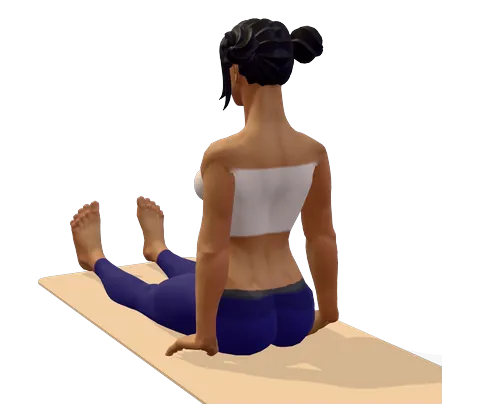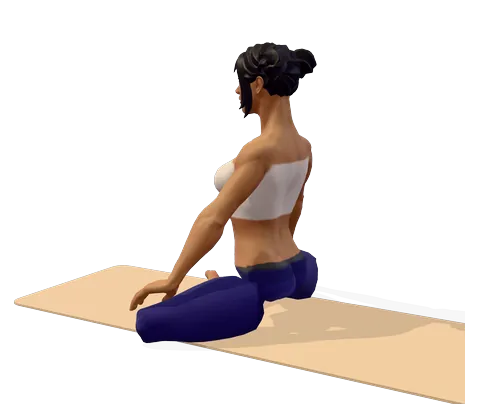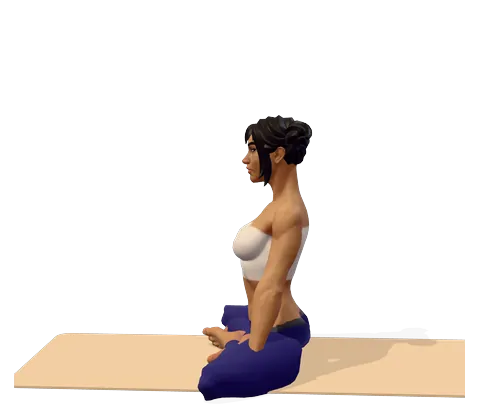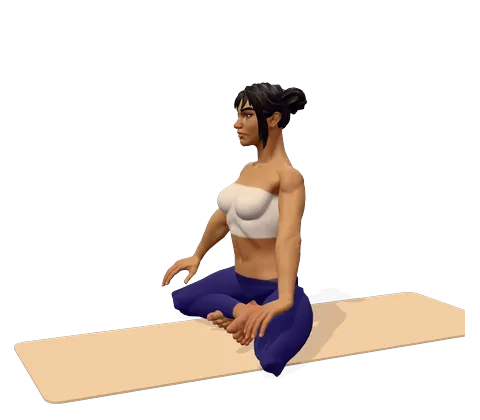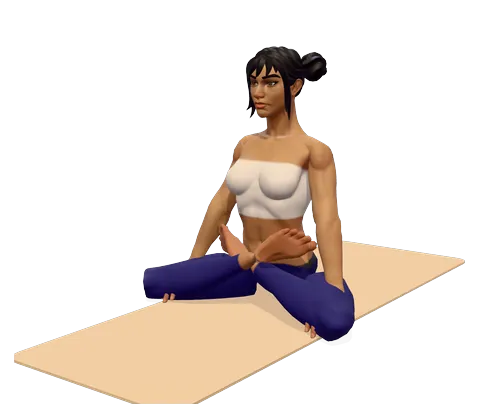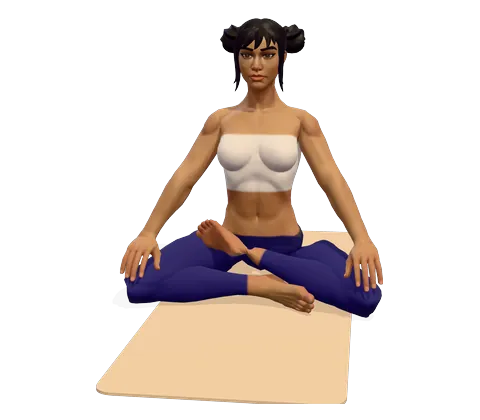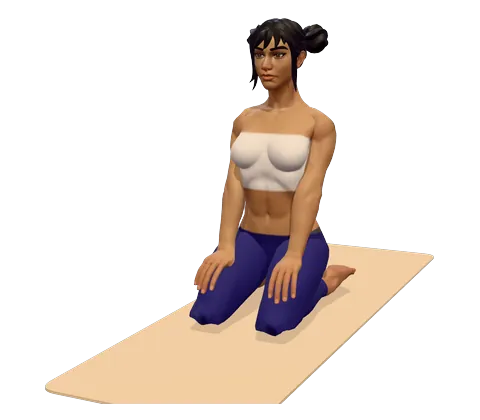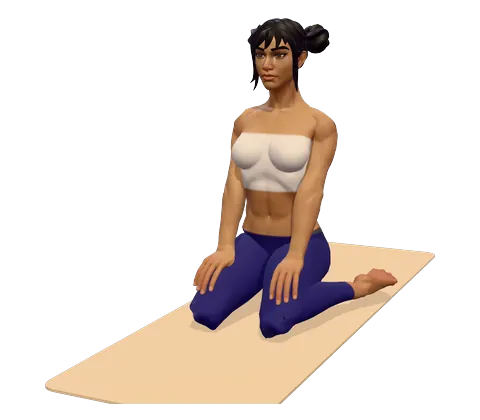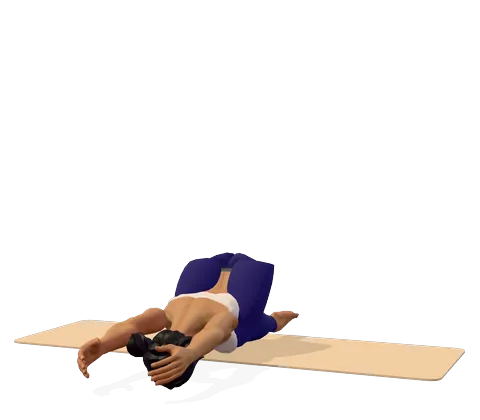
How to do Hare Pose step by step
- Kneel with your knees together and sit back on your heels (Vajrasana). Rest your hands on your thighs and sit tall.
- Breathe in and raise both arms overhead, shoulder-width apart, palms facing each other.
- Breathe out and fold forward from the hips, arms in line with your ears, until your palms and forearms rest on the mat ahead of you.
- Rest your forehead on the mat or on a block. Keep your buttocks on or close to your heels.
- Stay for 5–8 slow breaths (30–60 seconds), letting your back and shoulders soften on each breath out.
- Breathe in and lift your arms and trunk back up together until you sit tall on your heels.
- Breathe out, lower your hands to your thighs and rest for a few breaths before moving on.
Where you feel Hare Pose: what it stretches and strengthens
Fold forward from your heels and let your back round. In the 3D guide, turn on Body guide: areas that stretch glow green and areas that work glow saffron.
Stretches
- Lower back
- Shoulders
- Upper back
Benefits and precautions
Benefits
- Gently lengthens the back, shoulders and sides of the body
- Slows the breath and helps the body settle, so it suits stress and evening practice
- A soft counter-pose after backbends such as cobra and camel
- Stretches the fronts of the ankles and thighs in the kneeling base
- Rests the head low without turning you upside down
- Easy to learn and needs no props, so it fits beginners and kids
Avoid or modify if
- Knee pain, recent knee surgery or a knee replacement: pad the knees or use the chair version instead of forcing the kneel
- Acute low back pain or a slipped disc in a flare-up: avoid rounded forward bends until your physiotherapist agrees
- Uncontrolled high blood pressure, glaucoma or vertigo: keep your forehead high on a block, come up slowly and skip the head-down Sasangasana version
- Pregnancy: widen the knees to make room for the belly and rest your chest on a bolster, or skip it if it presses on the abdomen
- Recent abdominal surgery or a hernia
Hare pose (Shashankasana) is a kneeling forward bend: you sit on your heels, stretch your arms forward and fold until your forehead rests on the mat, like a hare crouched low in the grass. It is easy to learn and calming, which is why it appears in most Indian yoga routines and in the Common Yoga Protocol practised on International Yoga Day. Here is what the name means, how to breathe in it, how it differs from child's pose, and who should adapt it.
What is hare pose? Meaning of the Sanskrit name
Shashanka joins shasha ("hare") and anka ("mark"). "The one marked with a hare" is a poetic Indian name for the moon, because the shadows on the full moon are traditionally seen as a hare. That is why some books translate Shashankasana as moon pose, although other moon poses in modern yoga are standing side bends. Add the Sanskrit word asana ("seat" or "pose") and you have the name of the hare or rabbit pose asana: Shashankasana (शशांकासन).
In English the meaning is kept simple: hare pose and rabbit pose name the same shape. Rabbit pose Sanskrit pronunciation is sha-shahn-KAHS-uh-nuh.
Rabbit pose (Sasangasana) is a stronger shape
In hot yoga and some Kundalini classes, "rabbit pose" means Sasangasana: you hold your heels, tuck your chin and roll onto the crown of your head, lifting the hips until the thighs are upright. This advanced rabbit pose loads the neck, so skip it with neck problems, glaucoma or high blood pressure. The 3D figure shows the gentle version.
How to do hare pose with the breath
What makes Shashankasana more than a rest is Shashankasana breathing: the arms rise on the inhale, the body folds on the exhale, and you breathe slowly while you stay down. Let each breath out be a little longer than the breath in; this is what gives the pose its settling effect.
You can hold it for 30–60 seconds (our 3D guide holds it for about 45 seconds by default) or practise a dynamic hare pose: move in and out 5–8 times, arms up as you breathe in, folding as you breathe out. The moving version is a pleasant warm-up for a stiff back in the morning.
Rabbit pose yoga cues and common mistakes
- Hips float up off the heels. Fold less deeply, or put a folded blanket between your calves and thighs.
- Forehead does not reach the floor. Rest it on a block, a cushion or two stacked fists. Never strain the neck.
- Shoulders feel pinched. Place your hands wider and let the elbows bend slightly.
- Tops of the feet hurt. Put a rolled towel under your ankles.
- Light-headed when you come up. Rise slowly, arms first, and pause on your heels before standing.
Hare pose benefits
Shashankasana benefits are about release and calm rather than strength. The fold lengthens the muscles along the spine, the reaching arms open the shoulders and the sides of the back, and resting the forehead with slow breathing helps the body switch into a quieter state.
Rabbit pose benefits for stress, focus and blood pressure
Forward bends with the head supported are common in routines for stress relief and for winding down before bed. Classical texts describe Shashankasana as soothing anger and restlessness, and our plans for concentration and eye strain use it simply to rest the eyes for a minute. Because the head stays near floor level rather than fully upside down, it is also part of our yoga for high blood pressure plan: forehead on a block, easy breath, slow return. Yoga may support treatment but does not replace your medicine.
Does rabbit pose help hair growth?
You may read that rabbit pose yoga helps hair growth because blood flows toward the head. There is no good evidence for rabbit pose benefits for hair. Enjoy it for your back and your mood, and see a doctor about hair loss.
Muscles in the rabbit pose stretch
The stretch reaches the erector spinae (the long muscles beside the spine), the latissimus dorsi (the wide back muscles pulled by your reaching arms), the back of the shoulders and the buttocks. The kneeling base stretches the quadriceps and the fronts of the ankles.
Hare pose vs child's pose (Shashankasana vs Balasana)
People often ask about the difference between Balasana and Shashankasana, because all of these hare and rabbit poses look alike from a distance.
| Hare pose (Shashankasana) | Child's pose (Balasana) | Rabbit pose (Sasangasana) | |
|---|---|---|---|
| Arms | Raised, then stretched forward | Usually beside the body | Holding the heels |
| Head | Forehead on the mat | Forehead on the mat | Crown of the head on the mat |
| Breath | Moves with the arms | Free, resting | Controlled effort |
| Level | Beginner | Beginner | Advanced |
If you only want to rest, choose child's pose. If you want the stretch and the breath rhythm, choose hare pose.
Hare pose yoga variations and rabbit pose for beginners
- Blanket and block: the easiest rabbit pose variation for beginners.
- Chair version: a rabbit pose alternative for sore knees. Sit near the front of a chair and fold forward with your forearms on your thighs, as in chair yoga.
- Hands behind the back: clasp your hands behind you and let them lift as you fold, for an extra shoulder stretch.
- Fists at the navel: press two fists into the lower belly before folding. If you are wondering how to do Mandukasana, it starts from this same kneeling fold.
- Hare and cobra flow: slide forward into cobra pose on an inhale and back into hare on an exhale, moving the spine both ways.
For kids, rabbit pose works as a story: hop like a bunny, then curl up small and hide. Keep it short and let them choose how low to go.
Precautions for hare pose
Beyond the caution box: in pregnancy, a wide-knee version with a bolster under the chest is kinder than folding onto the belly. If knee pain or a pulling in the lower back does not ease within a few breaths, come out.
A short rabbit pose sequence
Start in Sukhasana (easy pose) or Vajrasana, do three rounds of dynamic hare, then hold it. Add camel pose for a backbend and return to hare as the counter-pose, then finish lying in Shavasana. You can save this order in the sequence builder and let the voice guide you.
The box below gives rabbit pose yoga in Hindi: the steps and the benefits of Shashankasana in a few simple lines.
शशांकासन — hare pose in Hindi: वज्रासन में घुटनों के बल बैठें। साँस लेते हुए दोनों हाथ ऊपर उठाएँ, साँस छोड़ते हुए आगे झुकें और माथा व हथेलियाँ ज़मीन पर रखें। 30 से 60 सेकंड धीरे साँस लें, फिर साँस लेते हुए ऊपर आएँ। शशांकासन के फायदे: पीठ और कंधों में खिंचाव आता है, मन शांत होता है और तनाव कम होता है। घुटनों में दर्द या चक्कर आने की समस्या हो तो सावधानी रखें।
Health conditions this pose is used for
Yoga for high blood pressure · Yoga for hyperthyroidism (overactive thyroid) · Yoga for memory and concentration · Yoga for anger management · Yoga for hair fall and hair growth · Yoga for premature grey hair · Yoga for dark circles · Yoga for eye strain
Where this practice is used
Chakras: Ajna (Third Eye Chakra) · Sahasrara (Crown Chakra)
Frequently asked questions
What is Shashankasana good for?
It gently stretches the back and shoulders, slows the breath and helps the body relax. It is a common counter-pose after backbends and a calm choice for evening practice.
Is hare pose the same as child's pose?
They are close relatives. In hare pose the arms are raised and then stretched forward, and the movement follows the breath; in child's pose the arms usually rest beside the body and the aim is simply to rest.
What is the Sanskrit name for rabbit pose?
In classical Hatha yoga, rabbit pose or hare pose is Shashankasana. In hot yoga, rabbit pose means Sasangasana, a stronger version with the crown of the head on the floor.
How long should I stay in hare pose?
Hold it for 30–60 seconds with slow breathing, or move in and out 5–8 times with the breath. Beginners can start with shorter holds and a block under the forehead.
Can I do hare pose with bad knees?
Put a folded blanket behind the knees and between the calves and thighs. If kneeling still hurts, sit on a chair and fold forward with your forearms on your thighs.
Is hare pose a good yoga pose for back pain?
For a stiff back, yes: it gently lengthens the spine. It is not one of the best asanas for back pain during an acute flare or a disc problem, so pair it with the other asanas and poses in our yoga for back pain plan once the pain has settled, and ask a physiotherapist if you are unsure.
Is hare pose safe with high blood pressure?
The gentle version with the forehead on a block is used in yoga routines for high blood pressure. Come up slowly, keep taking your medicine, skip the head-down Sasangasana version and ask your doctor if your blood pressure is not controlled.
This page is for general education. Check with your doctor before starting yoga if you are pregnant, have a medical condition or an injury. Stop if you feel pain, dizziness or shortness of breath.