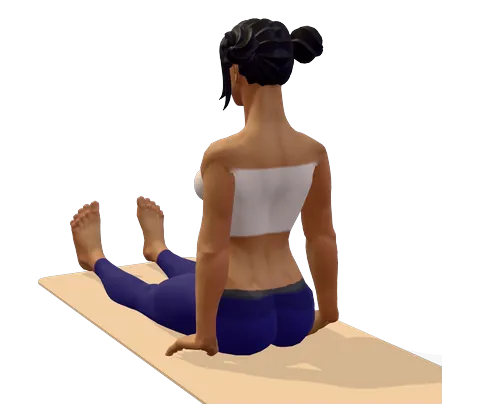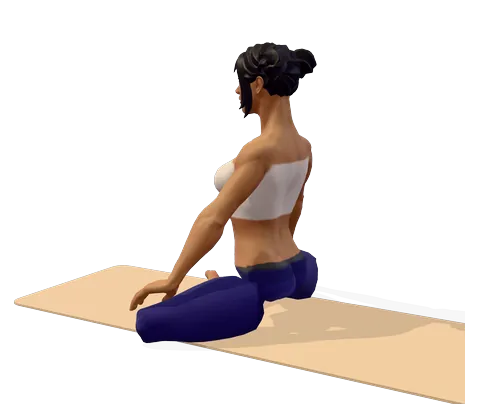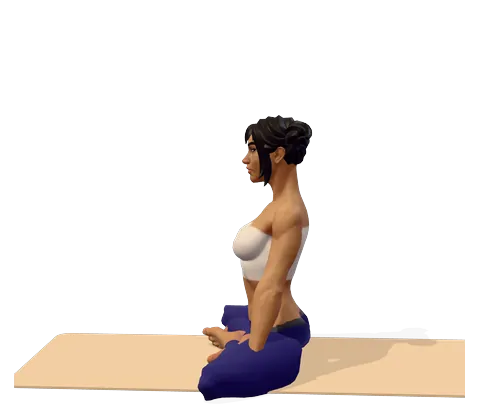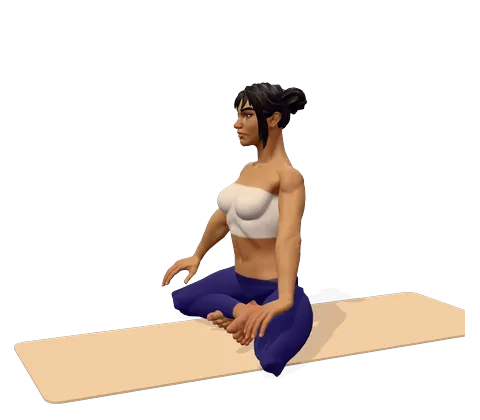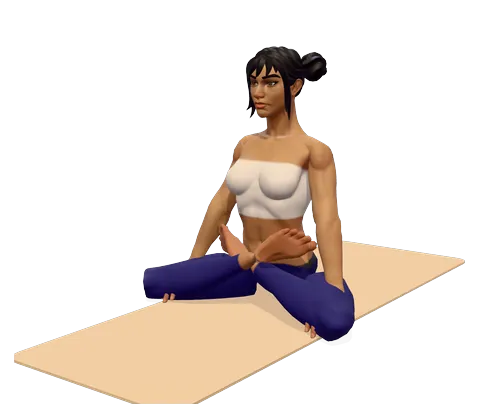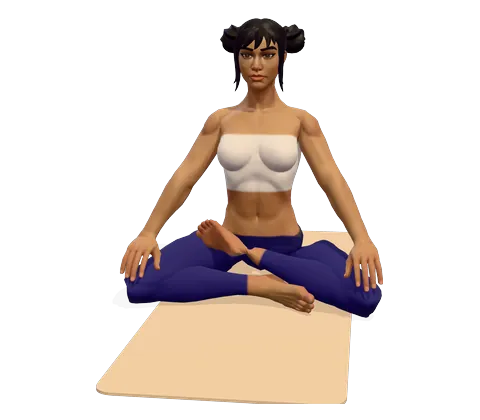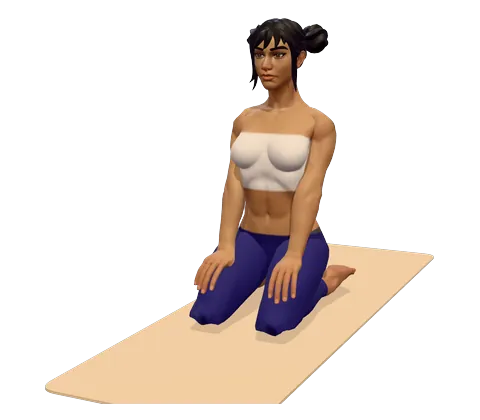
How to do Thunderbolt Pose step by step
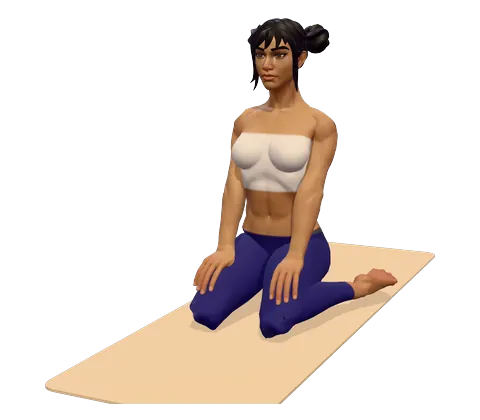
- Kneel on the mat with your knees together and your shins and the tops of your feet flat on the floor. Bring your big toes to touch and let the heels fall slightly apart.
- Breathe out and sit back slowly so your buttocks rest on your heels, or in the hollow between them.
- Place your hands on your thighs just above the knees, palms down.
- Lengthen your spine, draw your shoulders back and down and keep your chin level. Your head, neck and back form one straight line.
- Close your eyes or look softly ahead and breathe slowly through your nose for 1–5 minutes.
- To come out, lean forward onto your hands, lift your hips and stretch your legs out one at a time. Bend and straighten the ankles a few times.
Where you feel Thunderbolt Pose: what it stretches and strengthens
Sit on your heels and let your spine rise tall. In the 3D guide, turn on Body guide: areas that stretch glow green and areas that work glow saffron.
Stretches
- Front thighs
- Ankles
- Knees
Strengthens
- Spine
Benefits and precautions
Benefits
- The one pose tradition allows straight after a meal; sitting upright may ease post-meal heaviness and reflux
- Keeps the spine upright with little effort, so it suits breathing practice and meditation
- Stretches the front of the thighs, knees, ankles and the tops of the feet
- A good alternative for people whose hips make cross-legged sitting uncomfortable
- Calm and simple; used in our plans for digestion, acidity, diabetes and blood pressure
Avoid or modify if
- Knee injury, knee arthritis that hurts when bending, meniscus tear or knee replacement — sit on a chair or easy pose instead
- Ankle or foot injury, or pain on the top of the foot — put a rolled towel under the ankles or skip the pose
- Poor circulation, varicose veins or numbness in the legs — keep the time short
- Later pregnancy — widen the knees and sit on a cushion; do not do the reclined version
- Stop if you feel sharp pain in the knees; stretch in the thighs and ankles is normal, knee pain is not
Thunderbolt pose (Vajrasana) is a kneeling seat: you sit on your heels with your knees together and your spine upright. Thunderbolt pose is also known as diamond pose or adamantine pose, and it is the one yoga pose traditionally recommended right after a meal. Because it needs no hip flexibility, it is often easier than sitting cross-legged.
What is Vajrasana in yoga?
The name comes from Sanskrit: vajra means "thunderbolt" or "diamond" — the unbreakable weapon of the god Indra — and asana means pose. So what is Vajrasana called in English? The Vajrasana meaning in English gives three names: thunderbolt pose, diamond pose or adamantine pose, all describing something firm and steady. The Vajrasana meaning in Hindi is वज्रासन, "the seat of the thunderbolt". So if you wonder which asana the thunderbolt pose refers to, it is always this kneeling seat.
What is lightning bolt pose? Usually another name for chair pose (Utkatasana), a standing pose. Lightning bolt pose benefits are leg strength and stamina; it is not Vajrasana.
How to do Vajrasana step by step (Vajrasana kaise kare)
The steps above are the full procedure of Vajrasana. The 3D guide shows the figure from the side so you can see the straight line from ears to hips. For a comfortable thunderbolt pose:
- Knees together, heels slightly apart. Sitting in the hollow between the heels is easier on the ankles than sitting on top of them.
- Spine tall, belly soft. Don't lean back or push the chest forward. Let the breath move the belly gently.
- Diamond pose hands: rest the palms on the thighs, or join the thumb and index finger in a simple mudra.
How to do Vajrasana without pain: props for beginners
Many people find that thunderbolt pose hurts the feet, ankles or knees at first. These modifications help:
- Thunderbolt pose with a block: sit on a block or thick cushion placed between the heels. This reduces how far the knees bend.
- Blanket under the shins: a folded blanket under the knees and shins softens a hard floor.
- Rolled towel under the ankles: if the tops of the feet or ankles hurt, a small roll under the front of the ankles lifts the pressure.
Vajrasana time duration: how long to sit
Thunderbolt pose for beginners: start with 30 seconds to 1 minute and add a little each day. After meals, 5–10 minutes is the common advice. There is no fixed time limit, but stop sooner if your legs go numb. The ideal time for Vajrasana is any time, including right after eating, when other poses should wait.
Thunderbolt pose benefits (Vajrasana ke fayde)
What is Vajrasana good for? Its main benefits are simple: an upright, stable seat that needs no hip flexibility, a steady stretch for the front of the thighs, knees and ankles, and a calm position for slow breathing such as Anulom Vilom or for meditation.
Vajrasana after meals: benefits for digestion
Yoga tradition says to wait 2–3 hours after eating before practice — with one exception. Sitting in thunderbolt pose after eating, even after dinner, is widely recommended. The benefits of Vajrasana after a meal are partly common sense: sitting upright instead of lying down keeps stomach contents from rising, which is standard advice for acid reflux. Traditional texts also say it helps digestion; this has not been well tested, so treat it as a comfortable habit rather than a treatment. See our plans for yoga for digestion and yoga for acidity, or play the After-Meal Digestion session in guided practice.
Vajrasana vs walking after a meal: studies suggest a short, easy walk after eating can lower the rise in blood sugar, so walking is well worth doing. Vajrasana is a good choice when you can't walk; you can also do both.
Diabetes, blood pressure and weight loss
Vajrasana appears in our yoga for diabetes and high blood pressure plans as a calm seat for slow breathing. Regular yoga practice may help both conditions alongside your prescribed medicine, but no single pose lowers blood sugar or blood pressure on its own. Thunderbolt pose benefits for weight loss are small: it burns few calories, though sitting upright after eating may help you notice when you are full.
Is Vajrasana good for back pain or sciatica?
For many people with back pain, Vajrasana is more comfortable than sitting cross-legged because the lower back keeps its natural curve. It is not a treatment, though. Is Vajrasana good for sciatica? Some people find it comfortable; if kneeling increases leg pain or numbness, stop and ask a physiotherapist.
Vajrasana muscles stretched and involved
| Stretches | Works gently |
|---|---|
| Quadriceps (front of the thighs) | Back muscles that hold the spine upright |
| Knees and the front of the ankles | Deep core and pelvic floor muscles |
| Tops of the feet and toes | Neck muscles that keep the head level |
Vajrasana variations
- Thunderbolt pose on toes: kneel with the toes tucked under and sit back on the heels. It stretches the soles of the feet — intense at first, so start with a few breaths.
- Thunderbolt twist pose: place the right hand on the left knee and turn gently to the left, then change sides.
- Forward fold: from Vajrasana, fold forward into hare pose, forehead to the floor.
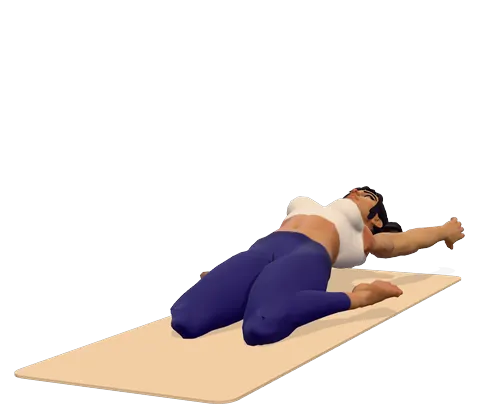
- Supta Vajrasana (reclined thunderbolt pose): lean back onto the forearms and then the back. Reclined thunderbolt pose benefits are a deep thigh and belly stretch, but it is advanced. Supta Vajrasana for beginners means only leaning back onto the hands. Contraindications: knee, lower back or neck problems, and pregnancy.
- Laghu Vajrasana (little thunderbolt pose): an advanced kneeling backbend with the head dropping toward the feet. Little thunderbolt pose benefits include a strong front-body stretch.
- Diamond pose for kids: thunderbolt pose for kids works well at story time.
Vajrasana vs Virasana, Sukhasana and Padmasana
Hero pose vs thunderbolt pose: in Virasana the feet move apart and you sit on the floor between them; in Vajrasana you sit on your heels. The difference between Virasana and Vajrasana is that hero pose rotates the knees more. Vajrasana vs Sukhasana and Vajrasana vs Padmasana: cross-legged seats need open hips; kneeling needs comfortable knees and ankles.
Vajrasana contraindications and precautions
Is Vajrasana bad for knees? Not for healthy knees, but deep kneeling can hurt with knee arthritis, a meniscus tear or after knee surgery; our knee pain plan leaves it out for that reason. Vajrasana ke fayde aur nuksan — benefits and side effects — are both about the knees and ankles: sore joints or numb feet are signs to add props or sit less. Can we sit in Vajrasana during pregnancy? Usually yes, with the knees apart and a cushion under the hips, if it feels comfortable; check with your doctor or midwife.
वज्रासन (Vajrasana) — हिंदी में: वज्रासन कैसे करें: घुटनों के बल बैठें, दोनों घुटने साथ रखें और पैरों के अँगूठे आपस में मिलाएँ। धीरे से एड़ियों पर बैठ जाएँ, हथेलियाँ जाँघों पर रखें और रीढ़ सीधी रखें। 1 से 5 मिनट तक धीमी साँस लें; भोजन के बाद 5–10 मिनट बैठ सकते हैं। वज्रासन के फायदे: खाने के बाद सीधे बैठने से पेट का भारीपन और एसिडिटी में आराम मिल सकता है, रीढ़ सीधी रहती है और ध्यान के लिए यह स्थिर आसन है। घुटने या टखने में चोट हो तो यह आसन न करें।
Health conditions this pose is used for
Yoga for plantar fasciitis and heel pain · Yoga for flat feet · Yoga for diabetes · Yoga for high blood pressure · Yoga for healthy weight gain · Yoga for prostate health · Yoga for vertigo and dizziness · Yoga for digestion · Yoga for acidity and acid reflux · Yoga for gastritis · Yoga for gas and bloating · Yoga for piles (hemorrhoids) · Yoga for hair fall and hair growth · Yoga for premature grey hair
Where this practice is used
Chakras: Ajna (Third Eye Chakra) · Sahasrara (Crown Chakra)
Frequently asked questions
What is Vajrasana and its benefits?
Vajrasana (thunderbolt or diamond pose) is a kneeling seat in which you sit on your heels with a straight spine. It gives a stable seat for breathing and meditation, stretches the thighs, knees and ankles, and is the one pose traditionally done right after a meal.
Can I do Vajrasana after eating?
Yes. It is the one yoga pose traditionally recommended after meals, including after dinner. Sit for 5–10 minutes with a relaxed belly and slow breathing.
How long should I sit in Vajrasana?
Beginners can start with 30 seconds to 1 minute. After meals, 5–10 minutes is common. Stop sooner if your legs go numb or your knees hurt.
Is Vajrasana bad for the knees?
Not for healthy knees. With knee arthritis, a meniscus tear or a knee replacement, deep kneeling can hurt — sit on a block between the heels, or use a chair instead, and ask your physiotherapist.
Why does thunderbolt pose hurt my ankles?
The tops of the feet and ankles are stretched strongly. Put a rolled towel under the front of the ankles and a blanket under the shins, and build up slowly.
What is the difference between Vajrasana and Virasana?
In Vajrasana you sit on your heels; in Virasana (hero pose) the feet move apart and you sit on the floor between them, which rotates the knees more.
Is Vajrasana safe during pregnancy?
Usually yes, with the knees apart and a cushion under the hips, as long as it feels comfortable. Avoid the reclined version and check with your doctor or midwife.
This page is for general education. Check with your doctor before starting yoga if you are pregnant, have a medical condition or an injury. Stop if you feel pain, dizziness or shortness of breath.