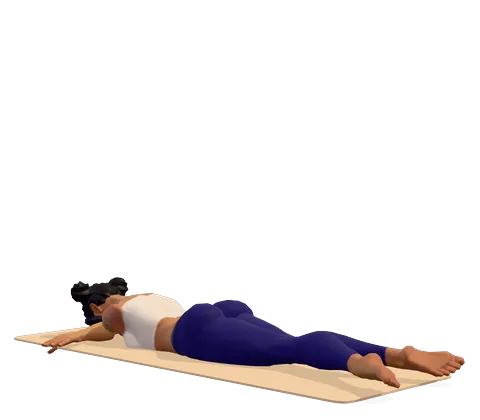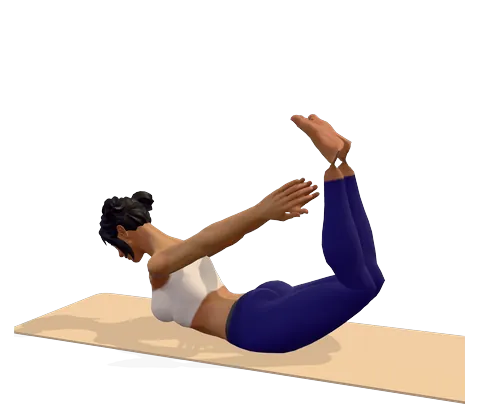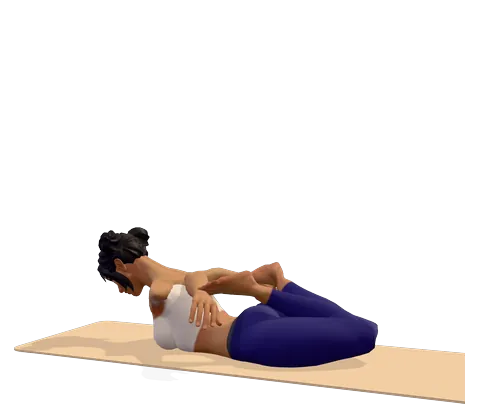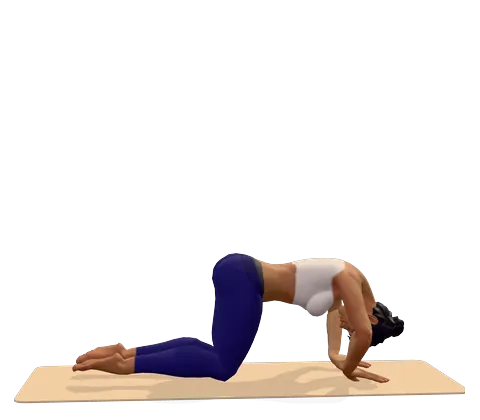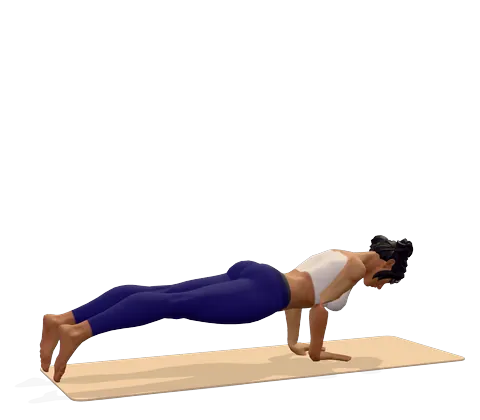
How to do Four-Limbed Staff Pose step by step
- Start in plank pose with your hands under your shoulders and your body in one straight line.
- Shift forward onto the tips of your toes so your shoulders move slightly in front of your wrists.
- Breathe out and bend your elbows straight back, keeping them close to the sides of your ribs.
- Lower slowly as one unit until your upper arms are about parallel to the floor, shoulders at elbow height, not lower.
- Keep your chest broad, your belly drawn in and your gaze slightly forward. The body hovers just above the mat.
- Stay for one breath out in a flow, or 1–3 breaths as a strength hold.
- Breathe in and roll over your toes into upward dog or cobra, or lower all the way to the mat and rest.
Where you feel Four-Limbed Staff Pose: what it stretches and strengthens
Lower slowly with elbows hugging your sides. In the 3D guide, turn on Body guide: areas that stretch glow green and areas that work glow saffron.
Strengthens
- Arms
- Chest
- Abs
Benefits and precautions
Benefits
- Builds strength in the triceps, chest, shoulders and upper back
- Works the whole core, which must hold the body straight while you lower
- Strengthens the wrists and forearms
- Teaches the controlled lowering used in every Vinyasa and Ashtanga flow
- Prepares you for arm balances such as crow and side crow
Avoid or modify if
- Shoulder injury, rotator cuff problems or shoulder impingement — use Ashtanga Namaskara (knees, chest, chin) instead
- Wrist pain or carpal tunnel — skip the pose or ask a physiotherapist about forearm alternatives
- Pregnancy — avoid it; lower with knees down only if comfortable, or skip
- After abdominal surgery or with abdominal separation (diastasis recti) — wait until a doctor or physiotherapist clears you
- High blood pressure — keep the hold short and never hold your breath
Chaturanga Dandasana (four-limbed staff pose) is a low plank: from a high plank you bend the elbows and hover, body straight, just above the floor. In a Vinyasa class you may do it twenty times without thinking. That is the problem. Done with sagging hips and elbows flaring out, it is one of the most common causes of sore shoulders in yoga. Done well, it is one of the best upper-body strength builders there is. This page shows how to do Chaturanga correctly, how to build up to it and what to do instead when it is not right for you.
What is Chaturanga in yoga?
What does Chaturanga mean? The Chaturanga yoga meaning is literal: chatur means "four", anga means "limb", danda means "staff" or "stick", and asana means "pose". So the four limbed staff pose in Sanskrit describes a body as straight as a staff, supported on four limbs: two hands and two feet. In Hindi, the four limbed staff pose is written चतुरंग दंडासन.
The staff in the name links it to another staff pose in yoga, Dandasana, the seated pose with legs straight and spine tall. What is staff pose? The same straight line, but sitting upright. Chaturanga is that staff turned face-down and held on four limbs. The word Chaturanga also names the ancient Indian board game that became chess; there, the four limbs were the four divisions of an army. The game and the pose share only the word.
How to do Chaturanga correctly
The Chaturanga Dandasana steps above give the full shape. These Chaturanga Dandasana alignment tips make the difference:
- Shift forward first. Before bending the elbows, move your shoulders a little ahead of your wrists. Without this, your elbows end up behind you and your shoulders dip.
- Elbows back, not out. Your elbows should brush your ribs and point toward your heels, stacked over your wrists at the bottom.
- Stop at elbow height. Your shoulders should never drop below your elbows. Going lower puts heavy strain on the front of the shoulder joint.
- Chest wide. Keep the collarbones broad and the shoulder blades flat on the back, not squeezed together or rounded forward.
- One piece. Hips stay level with the shoulders. The belly neither sags toward the floor nor pikes up.
Chaturanga Dandasana common mistakes
| Mistake | Why it matters | Fix |
|---|---|---|
| Dipping too low | Shoulders roll forward and pinch | Put a block under your chest as a "stop" marker |
| Elbows flaring out | Loads the shoulder, not the triceps | Hug elbows in; hands a little narrower |
| Hips sagging | Strains the lower back | Draw the belly in; lower the knees |
| Hips high, chest crashing | No real strength built | Go back to plank and lower more slowly |
| Holding the breath | Tension and a spike in blood pressure | Lower on a steady breath out |
Chaturanga Dandasana breathing technique
Lower on the breath out and move into the next pose on the breath in. If you cannot breathe steadily while you lower, the full version is too heavy for now; use the knees-down version instead.
Chaturanga Dandasana for beginners
How to do Chaturanga as a beginner: build it in stages, and use Chaturanga Dandasana modifications on days you are tired. These Chaturanga prep drills and practice tips take a few weeks of short practice:
- Plank holds. Hold plank pose for 20–30 seconds with good form.
- Knees-down Chaturanga. From plank, lower your knees, then bend your elbows back and lower your chest to elbow height. This is the main modification.
- Ashtanga Namaskara. Lower to knees, chest and chin, which is how many Indian sun salutations do it. See knees-chest-chin pose.
- Slow negatives. From full plank, lower for a count of five and then lie down. Do 3–5.
- Block support. Place a block lengthwise under your breastbone and lower until your chest lightly touches it.
Only when these feel steady should you try the full low plank hold in a flow.
Chaturanga Dandasana benefits in yoga
The main four limbed staff pose benefits are strength and control. It works the triceps, pectorals (chest), front shoulders and serratus anterior, while the core, glutes and thighs keep the body straight. That makes it a strong low plank exercise that also teaches you to stay steady, the base for arm balances such as crow pose. Staff pose benefits, by contrast, are mostly about posture: the seated Dandasana trains a tall spine rather than strength.
Because most people do Chaturanga many times in a class, small errors add up. If a shoulder aches after class, take the knees-down version for a few weeks and see a physiotherapist if it does not settle.
Chaturanga vs plank, and the Vinyasa link
Low plank vs high plank: in high plank the arms are straight and the load is moderate; in Chaturanga the elbows bend to about ninety degrees and the load on the arms and chest is much higher. Four limbed staff pose vs plank is therefore a big step up in difficulty, not a small variation. The low plank in Sanskrit is simply Chaturanga Dandasana.
Chaturanga vs Vinyasa: Chaturanga is a single pose, while a "vinyasa" is the linking sequence plank, Chaturanga, upward-facing dog, downward dog. Moving from Chaturanga to upward dog, roll over your toes and keep the thighs lifted. If upward dog is too much, lower fully and lift into cobra instead. This Chaturanga yoga flow is the heart of Vinyasa yoga and of Ashtanga sun salutations.
Low plank and yoga Chaturanga variations
- One legged four limbed staff pose: lift one foot a few centimetres as you lower. Advanced; keep the hips level.
- Low plank knee to elbow: hold a low plank and draw one knee toward the same-side elbow. A core drill, not for beginners.
- Wall Chaturanga: stand facing a wall, hands at chest height, and bend the elbows straight back. A gentle way to learn the arm path.
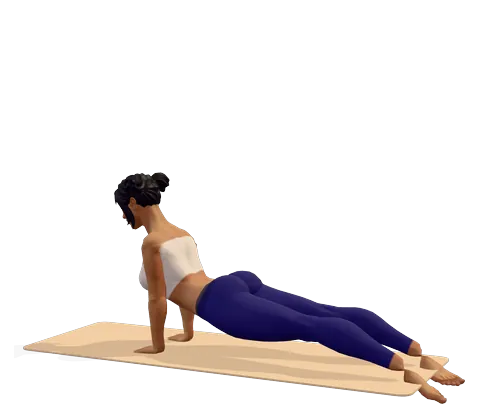
Chaturanga is not one of the lower back pain yoga poses. For back relief, gentler yoga poses such as cat-cow and child's pose serve you better, and a sagging Chaturanga can irritate a sore back.
चतुरंग दंडासन (Chaturanga Dandasana) — हिंदी में: प्लैंक से थोड़ा आगे की ओर झुकें, कोहनियों को पसलियों के पास रखते हुए पीछे की ओर मोड़ें और साँस छोड़ते हुए शरीर को सीधी रेखा में नीचे लाएँ। कंधे कोहनियों से नीचे न जाएँ। शुरुआत में घुटने ज़मीन पर रखकर अभ्यास करें। फायदे: बाँहें, छाती, कंधे और पेट की मांसपेशियाँ मज़बूत होती हैं। कंधे या कलाई में चोट हो तो यह आसन न करें।
Frequently asked questions
What is Chaturanga in yoga?
Chaturanga Dandasana (four-limbed staff pose) is a low plank. From plank you bend your elbows straight back and hover with your body straight, shoulders at elbow height, just above the floor.
How do I do Chaturanga properly?
Shift forward from plank, bend your elbows straight back along your ribs, and stop when your shoulders are level with your elbows. Keep your hips level and your chest wide, and lower on a breath out.
Why does Chaturanga hurt my shoulders?
Usually the shoulders drop below the elbows or the elbows flare out, which loads the front of the shoulder. Lower less, hug the elbows in, or use the knees-down version.
How can beginners build up to Chaturanga?
Practise plank holds, knees-down Chaturanga, knees-chest-chin pose and slow lowering from plank. A block under the chest shows you where to stop.
What is the difference between Chaturanga and plank?
In plank the arms are straight. In Chaturanga the elbows bend to about ninety degrees and the body hovers low, which is much harder.
What does Chaturanga mean?
"Chatur" means four, "anga" means limb and "danda" means staff: a body as straight as a staff on four limbs. The word also names an ancient Indian board game, the ancestor of chess.
Who should avoid Chaturanga?
People with shoulder or wrist injuries, pregnant women, anyone recovering from abdominal surgery or with abdominal separation, and anyone who cannot lower without the hips sagging.
This page is for general education. Check with your doctor before starting yoga if you are pregnant, have a medical condition or an injury. Stop if you feel pain, dizziness or shortness of breath.