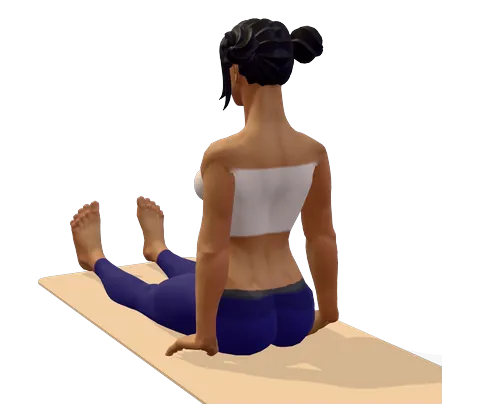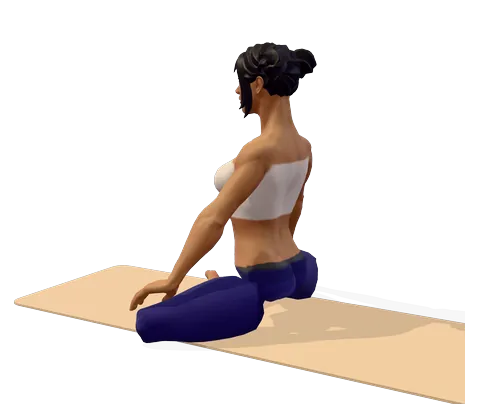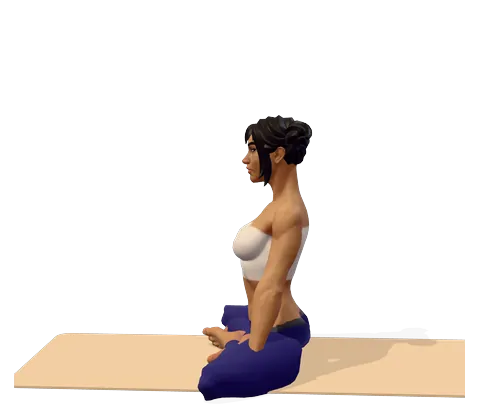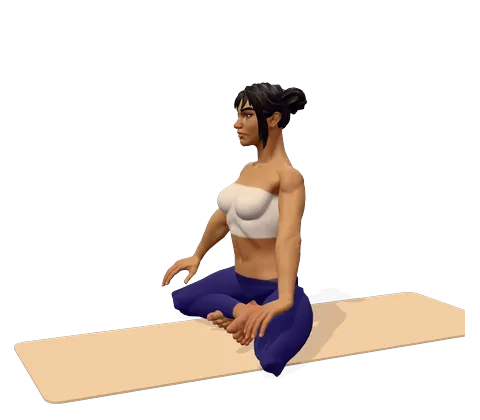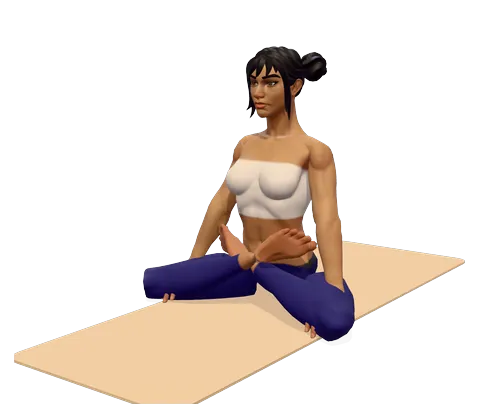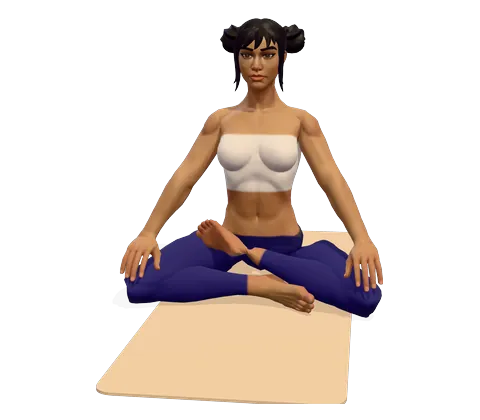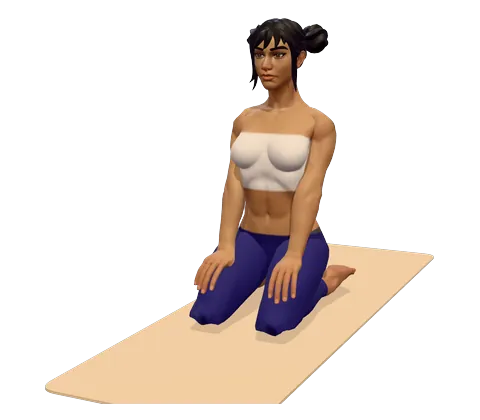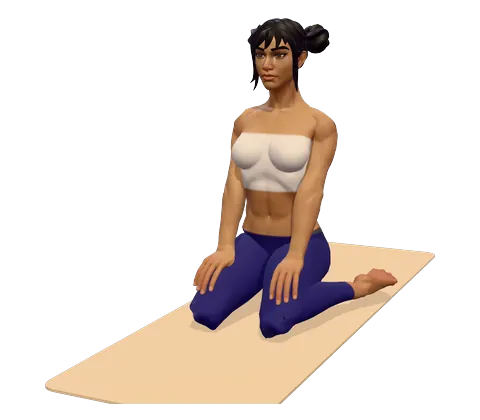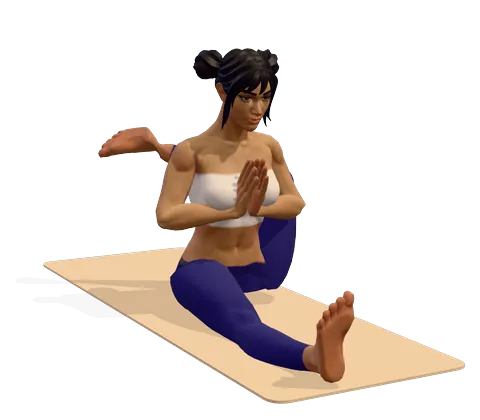
How to do Foot-Behind-the-Head Pose step by step
- Warm up fully first. Sit in Dandasana with both legs straight, on a folded blanket if your lower back rounds.
- Keep the right leg straight on the floor. Bend the left knee, turn it out and cradle the left shin in your arms, rocking it gently to open the hip.
- Hold the left foot or ankle with both hands and lift the whole leg, turning the thigh out from the hip, until the shin comes up beside the left shoulder.
- Lower your head and chest slightly, slide the left shoulder under the left knee, and ease the lower leg behind your neck, with the foot resting beyond the right shoulder.
- Slowly lift your head and chest, pressing the back of your head gently against the calf so the leg stays in place. Keep the right leg active and straight.
- Bring your palms together in front of your chest. Hold for 10–20 seconds (2–4 slow breaths).
- Hold the left foot with both hands, lift the leg over your head and lower it slowly to the floor. Rest, then repeat with the right leg behind your head.
Where you feel Foot-Behind-the-Head Pose: what it stretches and strengthens
Keep your chest lifted and press your head gently back against the leg. In the 3D guide, turn on Body guide: areas that stretch glow green and areas that work glow saffron.
Stretches
- Hamstrings
- Glutes
- Hip flexors
Strengthens
- Neck
- Spine
Benefits and precautions
Benefits
- Deeply stretches the hamstrings, buttocks and outer hip of the lifted leg
- Strengthens the neck and back muscles that lift the chest against the leg
- Builds the hip mobility used in advanced seated and arm-balance poses
- Needs patient, steady breathing, which trains calm under effort
- Prepares for both-legs-behind-the-head poses and arm balances in advanced practice
Avoid or modify if
- Beginners and anyone who has not built very open hips and hamstrings — use the preparation poses only
- Neck problems, cervical disc disease or whiplash — the leg presses on the back of the neck
- Slipped disc, sciatica or sacroiliac (SI) joint pain
- Hip replacement, hip labral tear or knee injury — do not attempt
- Pregnancy and osteoporosis — do not attempt
- Joint hypermobility — the pose can overstretch ligaments; work with strength, not range
Foot-behind-the-head pose (Eka Pada Sirsasana) is an advanced seated hip opener in which one leg stays straight on the floor and the other leg is placed behind the head, with the hands in prayer in front of the chest. It demands very open hips and hamstrings and a strong neck and back. It is rated level 4, and most people should spend months on preparation before trying the full pose. This page explains the name, the prerequisites, a safe progression, the benefits and the clear reasons not to try it.
What is Eka Pada Sirsasana? Meaning of the name
The Sanskrit breaks down as eka ("one"), pada ("foot" or "leg"), sirsa ("head") and asana ("pose") — "one foot to the head pose". In English it is called the foot behind head yoga pose, the leg behind head pose, the one leg behind the head pose or simply the foot-behind-the-head pose. Some teachers number its forms and call this seated one Eka Pada Sirsasana 1, because the pose has several variations.
Is it related to headstand or head to knee pose?
No. Sirsasana alone means headstand. People asking why standing on your head is good for you, or about the benefits of headstand pose in yoga, want that page; its prep poses for headstand are different. The seated head to knee pose, Janu Sirsasana, is a head to knee forward bend yoga pose for beginners — nothing like this one. The standing head to knee pose and the standing separate leg head to knee pose from hot yoga are forward bends too. And a yoga pose with the feet over the head, such as plow pose, is an inversion, not this seated hip opener.
Prerequisites and preparation
Only work toward the full pose if you can comfortably sit in full lotus, hold a deep tortoise pose and fold forward over straight legs with a flat back. Never pull the leg behind the head by force or with someone pushing you.
A safe progression, over weeks or months:
- Hip rotation: fire log pose and bound angle.
- Cradle the leg: seated, hug one shin horizontally in both arms and rock it gently side to side.
- Hamstrings: reclining hand-to-big-toe pose and seated forward bend.
- Lying version first: on your back, draw one leg up and bring the foot beside the head — the floor supports your spine.
- Shoulder under the knee: practise Kurmasana, where the shoulders go under the knees.
How to do Eka Pada Sirsasana (Eka Pada Sirsasana kaise kare)
The steps above show the left leg first, as the 3D guide does. Key points:
- Rotation from the hip. The thigh turns out at the hip joint. If you feel twisting in the knee, stop.
- Head goes down, then back. Bend the head forward to let the leg pass behind the neck, then lift the head to press back against the calf. The pressure is gentle.
- Keep the chest lifted. Slumping lets the leg slide down and loads the neck. Draw the shoulder blades back.
- Active straight leg. Press the back of the right leg down and flex the foot; it anchors the pose.
- Come out with control. Always lift the leg off with your hands, never by jerking your head. Afterwards, rest your hips with your legs on the wall in legs up the wall pose.
Leg behind head pose benefits
The main Eka Pada Sirsasana benefits are a very deep stretch of the hamstrings, buttocks and outer hip of the lifted leg, and strong work for the neck and back muscles that hold the chest upright against the weight of the leg. It builds the hip mobility needed for advanced arm balances and poses such as yogic sleep pose. It also teaches calm breathing under effort. These are practical and traditional benefits; there is no research showing special health effects, and it is not a yoga pose for back pain or lower back pain. For back pain relief, yoga poses should be gentle: beginner yoga poses for back pain and chair yoga poses for back pain are in our poses for yoga for back pain guide.
| Stretches | Works |
|---|---|
| Hamstrings of the lifted leg | Neck extensors (pressing the head back) |
| Gluteal muscles and deep hip rotators | Muscles along the spine |
| Hip flexors of the straight leg | Core muscles (keeping the chest lifted; see the benefits of boat pose) |
Variations: both feet behind the head and standing versions
- Lying (supine) version: the gentlest; the back rests on the floor.
- Standing foot behind the head pose (Durvasasana): the same leg position while standing on one leg. It is one of the hardest standing on one leg poses in yoga — only for very advanced students.
- Both feet behind the head pose: the seated feet behind the head position is called Dwi Pada Sirsasana, the feet behind head pose name most books use. Lying down, the legs behind the head yoga pose name is Yoga Nidrasana, the legs behind the head position name used in the Ashtanga intermediate series.
- Arm balances: Eka Pada Koundinyasana II and similar poses build on this hip shape.
Unlike simple hands behind head or arms behind head poses, none of these are beginner shapes. A head resting on hand pose, such as the kneeling thinker pose Veerasana, or a pose with hands behind back is far easier. The benefits of mountain pose, often taught as an arms above head pose, include better posture and balance. If you are looking for a yoga pose for beginners, start with our yoga for beginners guide.
Who should never try it
Avoid this pose with any neck problem, disc problem, sciatica, SI joint pain, hip or knee injury, in pregnancy, with osteoporosis and after a hip replacement: hip precautions after surgery mean strict avoidance of deep hip flexion (see yoga after hip replacement). Very flexible (hypermobile) people should also be careful — reaching the pose easily does not mean it is safe. Stop at once if you feel tingling or numbness in a leg, pain in the neck, or a pinch deep in the hip. Good modifications for yoga poses like this one are simply the preparation steps above.
एक पाद शीर्षासन (Eka Pada Sirsasana) — हिंदी में: दंडासन में बैठें, दायाँ पैर सीधा रखें। बाएँ पैर को कूल्हे से बाहर घुमाकर उठाएँ और धीरे से सिर के पीछे रखें, फिर हथेलियाँ छाती के सामने जोड़ें। 10–20 सेकंड रुकें और हाथों से पैर उठाकर नीचे लाएँ। फायदे: हैमस्ट्रिंग और कूल्हों में गहरा खिंचाव, गर्दन और पीठ मज़बूत। यह बहुत कठिन आसन है — गर्दन, कमर, घुटने या कूल्हे की समस्या और गर्भावस्था में न करें।
Frequently asked questions
What is the foot-behind-the-head pose called?
In Sanskrit it is Eka Pada Sirsasana, "one foot to the head pose". With both legs behind the head it is Dwi Pada Sirsasana, and the lying version with both legs is Yoga Nidrasana.
What are the benefits of the leg behind head pose?
It deeply stretches the hamstrings, buttocks and outer hip, strengthens the neck and back, and builds hip mobility for advanced poses. It is not a therapeutic pose.
How long does it take to get your leg behind your head?
It varies widely. For most adults it takes months or years of regular hip and hamstring work, and some people never reach it because of their hip bone shape. That is normal and not a failure.
Is Eka Pada Sirsasana dangerous?
It can be if forced. The main risks are to the neck, the lower back, the knee and the hip. Only try it with very open hips, a warm body and no pain.
Is Eka Pada Sirsasana a headstand?
No. "Sirsa" means head, and Sirsasana alone is headstand, but Eka Pada Sirsasana is a seated hip opener with one leg behind the head.
What is a good preparation for the leg behind head pose?
Fire log pose, bound angle, cradling the leg, reclining hand-to-big-toe pose, seated forward bend and tortoise pose, practised regularly over many weeks.
This page is for general education. Check with your doctor before starting yoga if you are pregnant, have a medical condition or an injury. Stop if you feel pain, dizziness or shortness of breath.