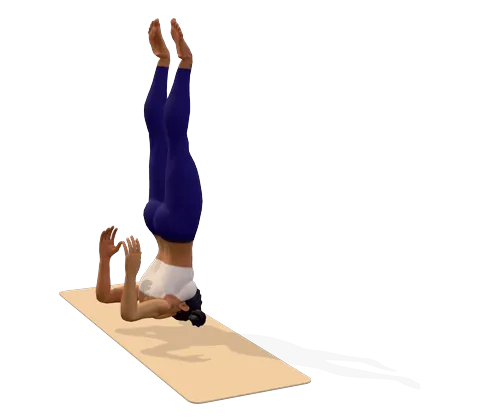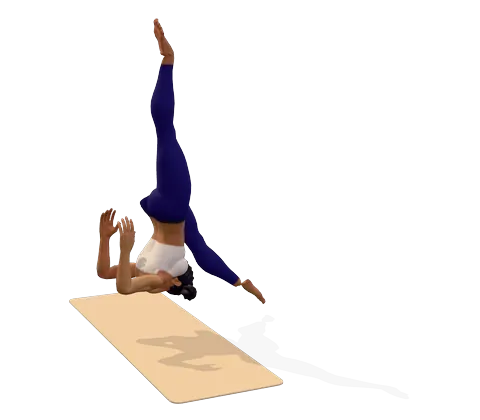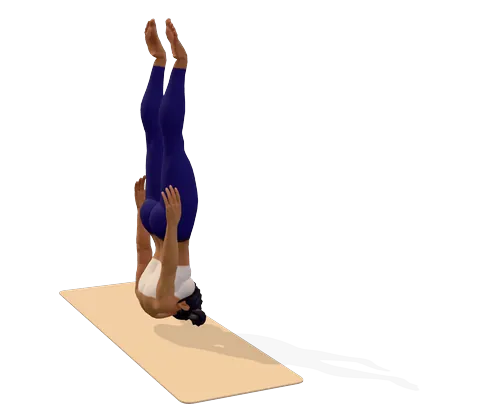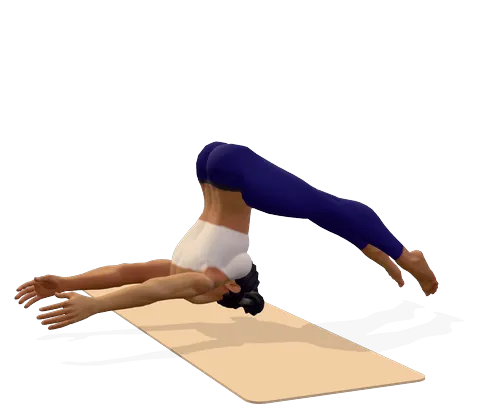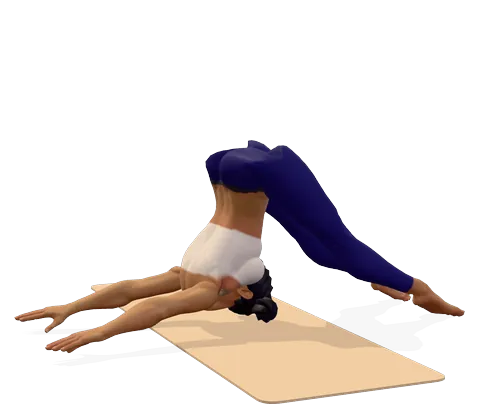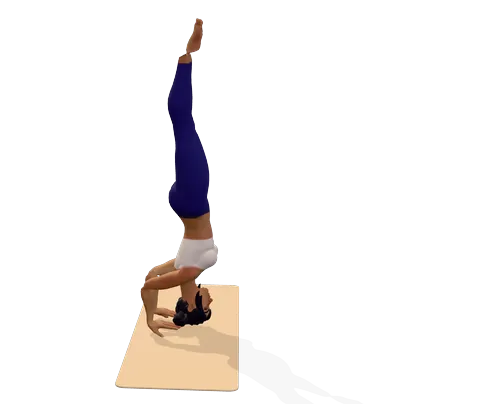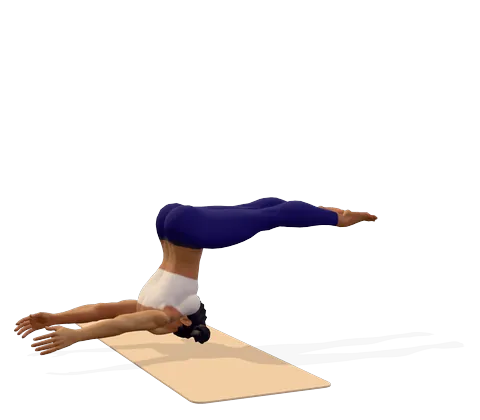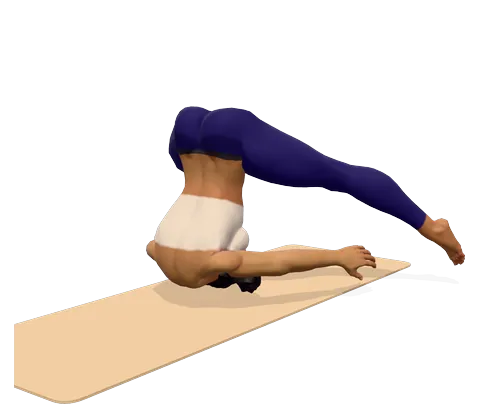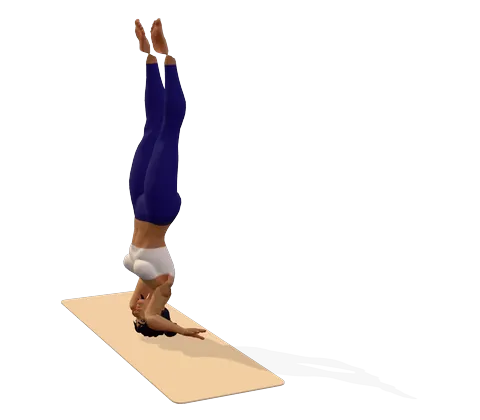
How to do Headstand step by step
- Kneel facing a wall on a folded mat. Place your forearms down with your elbows shoulder-width apart and interlace your fingers, knuckles a few centimetres from the wall.
- Place the crown of your head on the mat, with the back of your head cupped in your palms.
- Tuck your toes, lift your hips and walk your feet toward your face until your hips are over your shoulders.
- Bend your knees, draw them to your chest and let your feet float off the floor. Do not kick or jump. Then slowly straighten your legs up toward the wall.
- Press your forearms and wrists down and lift your shoulders away from your ears, so most of your weight is on your arms, not your head.
- Hold for 5–10 slow breaths (about 30 seconds) at first. Build time gradually over weeks.
- Come down slowly: bend your knees and lower your feet with control. Rest in child's pose for several breaths before you sit up.
Where you feel Headstand: what it stretches and strengthens
Press your forearms down so your neck carries little weight. In the 3D guide, turn on Body guide: areas that stretch glow green and areas that work glow saffron.
Strengthens
- Shoulders
- Abs
- Neck
Benefits and precautions
Benefits
- Strengthens the shoulders, upper back, arms and core
- Trains balance and body awareness upside down
- Builds focus and calm concentration
- Prepares you for forearm stand and other inversions
- Many practitioners find a short, steady inversion refreshing and energising
Avoid or modify if
- High blood pressure, heart disease, glaucoma, a detached retina or recent eye surgery
- Neck injury, cervical spondylosis or osteoporosis of the spine — no weight on the head
- Pregnancy — do not practise
- Epilepsy, recent stroke or head injury, or during a migraine attack
- During your period many people choose to skip inversions
- Within two to three hours of a meal
Headstand (Salamba Sirsasana) is the classic yoga inversion: your forearms and the crown of your head form a base, and your body rises straight up above them. Traditional yoga calls it the "king of asanas", and it is also one of the poses most often done badly. This headstand tutorial focuses on doing it safely: what the pose is, the honest prerequisites, a wall method for beginners, neck-safe alignment, the real benefits and who should not do it.
What is headstand yoga? Sirsasana and Shirshasana
The headstand meaning in Sanskrit comes from three parts: salamba means "supported", sirsa (also spelled shirsha) means "head", and asana means "pose". Sirsasana, Shirshasana and शीर्षासन (its Hindi name) are the same headstand asana. "Supported" refers to the arms, which carry most of your weight.
- Salamba Sirsasana 1: forearms on the floor, fingers interlaced around the head. This is the version the 3D figure shows and the one to learn first.
- Salamba Sirsasana II (tripod): palms flat on the floor, elbows over the wrists, forming a tripod with the head. Useful later, but it puts more weight on the head.
Do not confuse it with Janu Sirsasana, the seated head-to-knee forward bend whose benefits are about stretching the hamstrings. Only the word "head" is shared.
Headstand prep: honest prerequisites and prep poses
The main risk in headstand is the neck. The head should carry only a small share of your weight, and that is only possible if your shoulders and arms are strong enough to take the rest. Before you go upside down, you should be able to:
- Hold dolphin pose (forearms down, hips high) for 60 seconds without your chest sinking.
- Hold a forearm plank for 60 seconds.
- Walk your feet in from dolphin with your head on the floor and keep the neck long with no pain.
If you can, ask an experienced teacher to check your set-up in person the first few times. A few centimetres of misplacement can put the load on your neck.
Headstand yoga steps for beginners: the wall method
Here is how to learn it step by step at home. Practise on a firm, folded mat (not a soft cushion), a few times a week, and stay at each stage until it feels calm.
- Set-up only: forearms, hands and head in place; lift the hips and walk in. Hold for five breaths with your feet on the floor.
- One knee at a time: draw one knee to your chest, then the other, keeping the spine vertical.
- Tuck: float both feet up with bent knees, as in the steps above. This teaches control and replaces kicking up.
- Legs up at the wall: straighten the legs slowly with the heels near the wall.
- Away from the wall: once you can go up and down in a slow tuck, move the mat a little away from the wall.
Learning a headstand against a wall is not a weakness; it is how most people practise safely for months. How to do a headstand without a wall comes naturally once the tuck is controlled.
Headstand alignment: protecting your neck
- Arm position: elbows no wider than your shoulders; wrists firm and pressing down, not collapsing outward.
- Crown, not forehead: the very top of the head touches the floor. Resting on the forehead bends the neck back.
- Lift the shoulders: press the forearms down so the shoulders move away from the floor and the neck stays long.
- No kicking: a kick throws weight into the neck. If you cannot float up with bent knees yet, stay at an earlier stage.
- Straight line: draw the ribs in and squeeze the legs so the body does not arch like a banana.
If you feel pressure in the neck, eyes or face, come down at once.
Headstand benefits (Shirshasana ke fayde)
What does headstand do for you? The clear benefits are strength in the shoulders, arms and core, better balance, and the focus that comes from holding a demanding pose calmly. Many people also find a short inversion refreshing.
| Muscles | Role |
|---|---|
| Deltoids, trapezius, serratus anterior | Lift the shoulders and protect the neck |
| Forearms and triceps | Carry most of the weight and correct balance |
| Abdominals, back muscles | Keep the body straight |
| Glutes and legs | Hold the legs together and lifted |
Headstand benefits for hair growth, the brain, face or skin are widely claimed online. There is no good research behind them, and being upside down raises pressure in the eyes and head, which is exactly why people with glaucoma or high blood pressure must avoid it. The benefits for weight loss are small, and there are no special benefits for females or males.
Is headstand good for you? For a healthy person who builds up slowly, it is a useful strength and balance pose. Holding it for a long time or practising it daily is not necessary; a steady 30–60 seconds is plenty for most people.
Headstand bench, stool or chair
A yoga headstand bench or stool has a padded hole for the head and supports your shoulders, so your head hangs free and the neck carries no weight — the main headstand bench benefits. A chair can be used the same way in Iyengar yoga. These props are a sensible choice if your neck is sensitive, but they do not remove the other risks of inversion — they are still not for high blood pressure, glaucoma or pregnancy.
Headstand vs handstand and shoulder stand
In a handstand the head stays free and the hands take all the weight, so it needs more shoulder and wrist strength. Forearm stand uses a similar forearm base without the head touching the floor. Shoulder stand is traditionally practised after Sirsasana as a calming counterpart. Pressing from headstand to handstand is a very advanced transition.
Headstand variations
- Tripod headstand: Sirsasana 2, hands flat, the version often taught in gymnastics. Learn it after the forearm version is steady.
- Straddle or split legs: lowers the centre of gravity and trains control.
- Pike lift: lifting both straight legs together without bending the knees. Needs strong core and open hamstrings.
- Lotus legs: for experienced students with comfortable lotus.
Headstand (Sirsasana) contraindications: who should not do it
Do not practise Sirsasana with high blood pressure (see yoga for high blood pressure), heart disease, glaucoma, a detached retina, recent eye surgery, epilepsy, a neck injury or cervical spondylosis (see yoga for neck pain), osteoporosis of the spine, or during pregnancy. Skip it during a migraine attack and after a meal; many people also skip inversions during their period. Legs-up-the-wall pose is a gentle alternative for most people, and if you have a health condition, ask your doctor first. Rest in child's pose after every inversion.
Sirsasana and headstand benefits in Hindi (Shirshasana ke fayde) — शीर्षासन कैसे करें: घुटनों के बल बैठें, कोहनियाँ कंधों की चौड़ाई पर रखें और उंगलियाँ आपस में फँसाएँ। सिर का ऊपरी हिस्सा ज़मीन पर हथेलियों के बीच रखें, कूल्हे उठाएँ और पैरों को चेहरे की ओर लाएँ। घुटने मोड़कर धीरे से पैर ऊपर उठाएँ और सीधे करें; ज़्यादातर वज़न बाँहों पर रहे, सिर पर नहीं। शुरुआत में दीवार के सहारे 20–30 सेकंड रुकें और फिर बालासन में आराम करें। फायदे: कंधे, बाजू और कोर मज़बूत होते हैं, संतुलन और एकाग्रता बढ़ती है। हाई ब्लड प्रेशर, हृदय रोग, ग्लूकोमा, गर्दन की चोट या गर्भावस्था में यह आसन न करें।
Frequently asked questions
How long should a beginner hold headstand?
Start with 5–10 breaths (about 30 seconds) at a wall. Increase slowly over weeks; 30–60 seconds is enough for most people.
How do I do a headstand without hurting my head or neck?
Place the crown of the head down, keep your elbows shoulder-width apart and press your forearms down so your shoulders lift. Float up with bent knees instead of kicking, and come down if you feel any neck pressure.
Is Sirsasana good for hair growth?
There is no reliable evidence that inversions help hair growth, skin or the brain. Practise Sirsasana for strength, balance and focus.
Should I learn headstand with a wall?
Yes. A wall makes practice safer while you learn to go up and down with control. Move away from it only when your tuck is steady.
Can I do a headstand after eating?
No. Wait two to three hours after a meal before any inversion.
Is headstand or handstand easier?
Most people find Sirsasana easier to balance because the base is wider, but it involves the neck. Handstand needs more shoulder and wrist strength but keeps weight off the head.
What is a headstand bench?
A padded stool that supports the shoulders so the head hangs free. It removes neck load but still is not suitable with high blood pressure, glaucoma or in pregnancy.
Who should not do Shirshasana?
People with high blood pressure, heart disease, glaucoma, epilepsy, neck injuries, cervical spondylosis or spinal osteoporosis, and pregnant women. Skip it during a migraine and after meals.
This page is for general education. Check with your doctor before starting yoga if you are pregnant, have a medical condition or an injury. Stop if you feel pain, dizziness or shortness of breath.