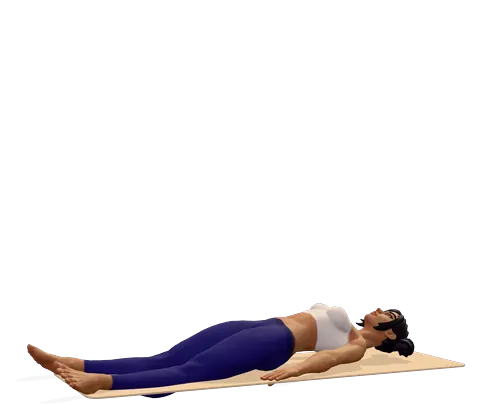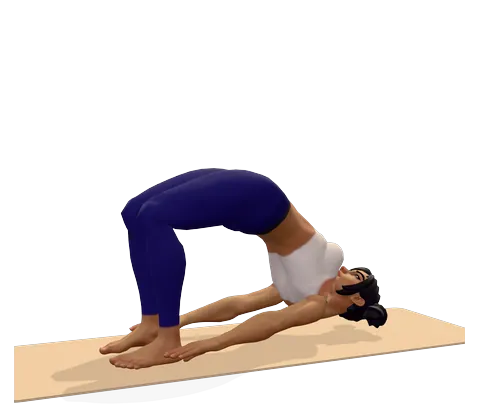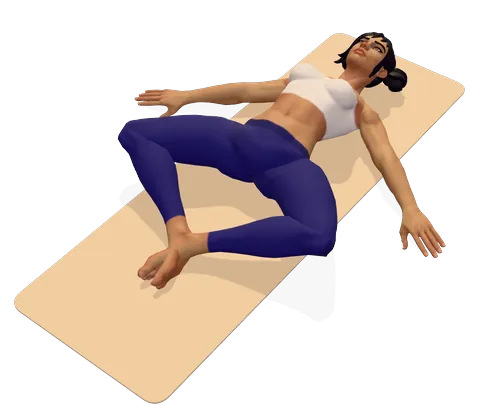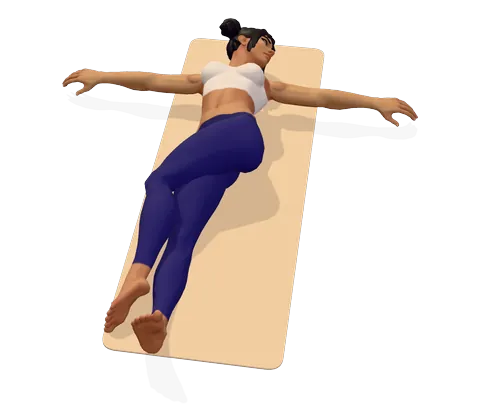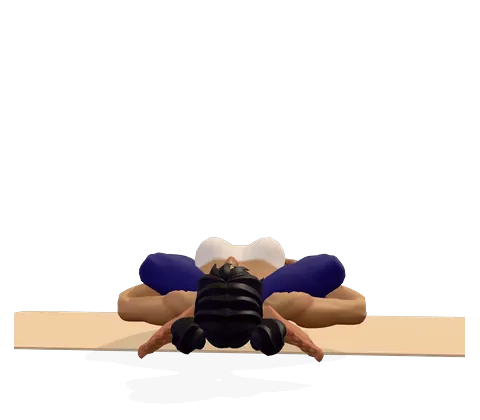
How to do Yogic Sleep Pose step by step
- Warm up well first: hip openers, hamstring stretches and at least one side of foot-behind-the-head pose. Lie on your back on a folded blanket.
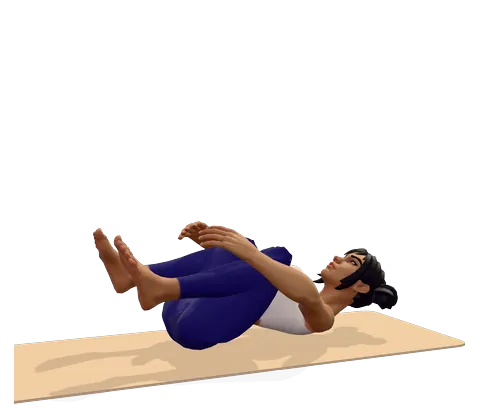
- Draw both knees toward your chest and let them open wide, outside your ribs. Hold the outer edges of your feet.
- Guide one leg at a time behind your head: lift the head slightly, ease the back of the knee over the shoulder and rest the leg behind the neck.
- Bring the second leg behind your head in the same way and hook the ankles together behind your neck.
- Wrap your arms around your legs, or in the classic form around your back to clasp the hands. Rest your head on your crossed ankles.
- Breathe slowly into the back ribs for 3–5 breaths (about 20 seconds). Keep the face and throat soft.
- Release the ankles, lift the head and lower one leg, then the other. Rest in corpse pose with the knees bent.
Where you feel Yogic Sleep Pose: what it stretches and strengthens
Draw your legs behind your head and rest in the fold. In the 3D guide, turn on Body guide: areas that stretch glow green and areas that work glow saffron.
Stretches
- Hamstrings
- Glutes
- Lower back
Benefits and precautions
Benefits
- Gives a very deep stretch to the hamstrings, glutes and lower back
- Opens the hips in external rotation more than almost any other pose
- Asks for calm, steady breathing in a compressed position, which trains focus
- Folds and compresses the abdomen; traditionally said to stimulate digestion
- A peak pose of the Ashtanga intermediate series that brings together years of hip and hamstring work
Avoid or modify if
- Not for beginners — only after you can do foot-behind-the-head pose comfortably on both sides
- Pregnancy, hernia or recent abdominal surgery — avoid
- Herniated disc, sciatica, recent back injury or neck problems — avoid; the spine and neck are strongly flexed
- Knee, hip or groin injury, and any hip replacement — avoid
- High blood pressure, heart disease or glaucoma — the belly and chest are compressed; ask your doctor and skip it if unsure
- Never force a leg behind the head or use your hands to pull it there; sharp pain means come out at once
Yogic sleep pose (Yoga Nidrasana) is an advanced posture in which you lie on your back, place both legs behind your head and rest there as if in a deep, curled-up sleep. It asks for very open hips, long hamstrings and a supple back, and it usually takes years of practice. Despite its name, it is not a pose for helping you fall asleep. This page explains what the name means, the prerequisites, how to approach it safely and, for readers looking for sleep, where to go instead.
What is yogic sleep pose?
In Sanskrit, yoga means "union", nidra means "sleep" and asana means "pose". The pose is written both as Yoga Nidrasana and Yoganidrasana, so you may see "yogic sleep pose (Yoganidrasana)", "yogi sleep pose" or "yoga sleep pose" as the English name. As a yoga sleep position it only looks restful from the outside: the yogi sleep position is actually strong, deep work. The shape is the one shown by the 3D guide: lying on the back, both legs behind the head, ankles crossed behind the neck and arms wrapped around the legs. In the classic form the arms reach round the back and the hands clasp under the lower back.
It is one of the peak poses in yoga's Ashtanga intermediate series, where it comes straight after the foot-behind-the-head poses. Sleeping tortoise pose, from the primary series, is its closest preparation. The name suggests that a practitioner who has done the preparation can rest in this position as easily as in sleep.
Yogic sleep pose vs Yoga Nidra
These two are often confused. Yoga Nidra is a guided relaxation you do lying still in corpse pose: you rotate your attention through the body, breathe slowly and set a sankalpa (a short positive intention). How does Yoga Nidra work? It moves you into a state between waking and sleep, which many people find deeply calming. Small studies suggest Yoga Nidra may help with stress relief and sleep quality, though it does not replace deep sleep at night. Yoga Nidra and meditation are close cousins, and both often begin with simple breathing techniques. It needs no flexibility at all, so Yoga Nidra for beginners is easy to start. Why go to Yoga Nidra rather than a pose? Because the relaxation itself is the practice.
So what is yogic sleep? If you mean the relaxation practice, try our free guided Yoga Nidra session (10, 20 or 30 minutes). If you mean the posture, read on. The only "poses for yoga nidra" are corpse pose and, if you prefer, lying on your side with a pillow between your knees.
Prerequisites: are you ready?
There is no true yoga sleep pose for beginners. Work on the preparation for months first. You are probably ready to explore Yoga Nidrasana when you can:
- Place each leg behind your head in Eka Pada Sirsasana without strain, on both sides.
- Fold flat with your arms under your knees in tortoise pose.
- Rest comfortably in plow pose and deep hip openers such as happy baby and baddha konasana.
- Breathe calmly while folded, without holding your breath.
Yoga Nidrasana contraindications are listed in the caution box above; read them before you try.
If any of these cause pain in your knees, groin, lower back or neck, you are not ready. Forcing the legs behind the head is a common cause of hip, knee and lumbar disc injuries.
How to do yogic sleep pose safely
Follow the steps above, and keep these points in mind:
- Warm first, always. Only attempt it at the end of a full practice, never cold.
- Lead from the hip. The thigh bone rotates outward in the hip socket; the knee should not twist. Keep the foot flexed to protect the knee.
- Use the head and shoulders, not force. Lift the head slightly to make space for the leg to slide behind it, then let the head rest back on the ankles.
- One leg at a time. If the second leg will not go, stay with one leg behind the head and hold the other knee toward the chest.
- Use a blanket under the back to protect the spine.
Easier stages
A practical yogic sleep position for most people is simply the knees wide toward the armpits, holding the feet as in happy baby. A step further is one leg behind the head while lying down, the other leg straight on the floor. Both give many of the same hip and hamstring stretches.
Yogic sleep pose benefits
For those who can do it, the main benefits are physical: a deep stretch for the hamstrings, glutes and lower back, and a strong outward rotation of the hips. Holding still and breathing steadily in such a folded position also trains calm and focus. Traditional texts say it stimulates digestion, but there is no research on this pose. It is not a yoga pose for back pain; the deep spinal flexion can make a disc problem worse. Press the Body guide button on the 3D demo to see the stretched areas glow green.
Looking for yoga poses for sleep instead?
Does yoga help you sleep? For many people, yes: a short routine of gentle poses and slow breathing before bed can make it easier to fall asleep. How to get good sleep with yoga? Keep it slow, dim the lights and finish lying still. Good bedtime yoga poses for sleep are relaxing yoga poses before bed that need no effort:
- Child's pose for a few minutes, forehead down.
- Legs up the wall, which many people find calming.
- A gentle lying twist, then corpse pose, the classic resting pose in yoga and the relaxing pose at the end of yoga classes; the benefits of the savasana yoga pose come from lying completely still.
These are the real sleeping asanas in yoga, the yoga asanas for good sleep and relaxation, and yoga poses for better sleep you can do as yoga in bed to fall asleep. Our yoga for sleep and insomnia page and the guided Bedtime Yoga for Sleep session in practice put them in order with a voice guide.
योगनिद्रासन (Yoga Nidrasana) — हिंदी में, yoga ke fayde in Hindi: यह एक कठिन आसन है जिसमें पीठ के बल लेटकर दोनों पैर सिर के पीछे रखे जाते हैं और बाँहें पैरों के चारों ओर लपेटी जाती हैं। इससे जाँघ के पीछे, कूल्हों और कमर में गहरा खिंचाव आता है। इसे केवल वही लोग करें जो एक पैर सिर के पीछे आराम से रख पाते हैं। गर्भावस्था, हर्निया, स्लिप डिस्क, गर्दन या घुटने की समस्या में यह आसन न करें। यह "योग निद्रा" (लेटकर किया जाने वाला ध्यान) से अलग है।
Frequently asked questions
What is Yoga Nidrasana?
Yoga Nidrasana, or yogic sleep pose, is an advanced posture in which you lie on your back with both legs behind your head, ankles crossed and arms wrapped around the legs or back.
Is yogic sleep pose the same as Yoga Nidra?
No. Yoga Nidrasana is a very flexible posture. Yoga Nidra is a guided relaxation done lying still in corpse pose, and anyone can do it.
Can beginners do yogic sleep pose?
No. It needs very open hips and hamstrings and usually years of practice. Beginners can try happy baby pose or a one-leg version with a teacher's guidance.
What are the prerequisites for Yoga Nidrasana?
Comfortable foot-behind-the-head pose on both sides, a flat tortoise pose, an easy plow pose and calm breathing while deeply folded.
What are the benefits of Yoga Nidra?
Studies suggest Yoga Nidra may reduce stress and improve sleep quality for some people. It combines deep relaxation, body scanning, slow breathing and a sankalpa, or intention.
Is yogic sleep pose good for sleep?
Not really; it is a demanding posture. For sleep, choose child's pose, legs up the wall, a gentle twist and corpse pose, or a guided Yoga Nidra session.
Who should not do Yoga Nidrasana?
Anyone who is pregnant, has a hernia, a disc problem, a neck, knee or hip injury, a hip replacement, or uncontrolled blood pressure or heart disease.
This page is for general education. Check with your doctor before starting yoga if you are pregnant, have a medical condition or an injury. Stop if you feel pain, dizziness or shortness of breath.