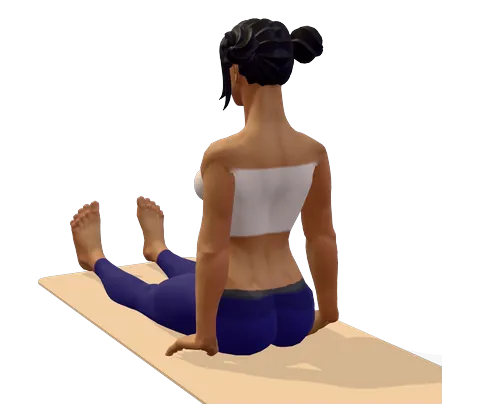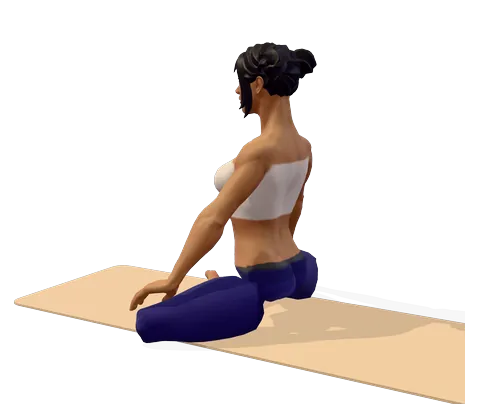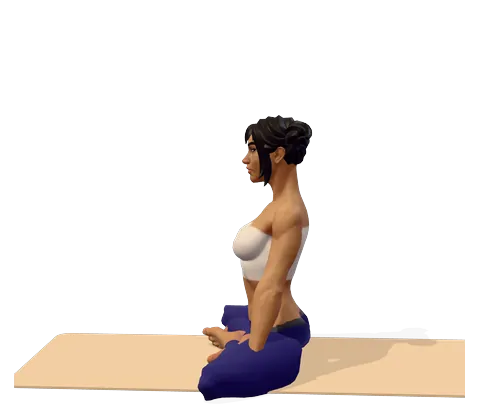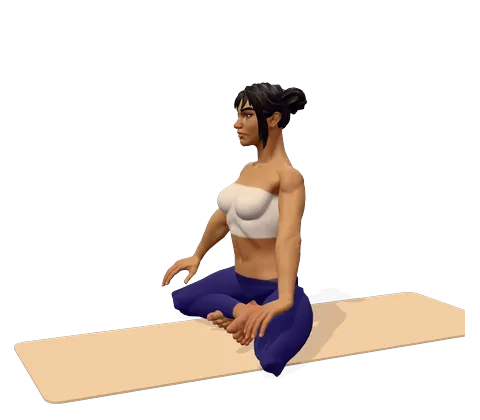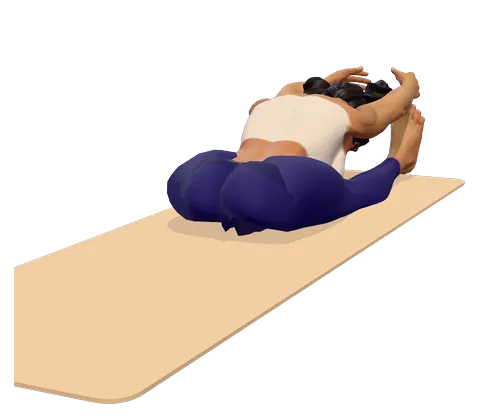
How to do Seated Forward Bend step by step
- Sit in staff pose with your legs straight and together, feet flexed. If your lower back rounds, sit on a folded blanket.
- Breathe in and lengthen your spine, lifting your arms overhead or resting your hands beside your hips.
- Breathe out and hinge forward from the hips, leading with your chest rather than your head.
- Hold your shins, ankles or the sides of your feet — or loop a strap around the soles if you cannot reach. Bend your knees as much as you need.
- With each breath in, lengthen the front of the body a little; with each breath out, fold a little deeper without forcing.
- Once you reach your limit, let your neck relax and stay for 30 seconds to 1 minute.
- To come out, breathe in, lift your chest and roll up slowly to sitting. Lean back on your hands for a few breaths.
Where you feel Seated Forward Bend: what it stretches and strengthens
Fold from your hips and feel the whole back body lengthen. In the 3D guide, turn on Body guide: areas that stretch glow green and areas that work glow saffron.
Stretches
- Hamstrings
- Lower back
- Calves
Strengthens
- Front thighs
Benefits and precautions
Benefits
- Stretches the hamstrings, calves and the muscles along the back
- A calming pose that encourages slow breathing and a quiet mind
- Part of many yoga programmes for diabetes, high blood pressure and menopause
- Helps counter stiffness in the legs from running, cycling and long sitting
- Traditionally said to support digestion by gently compressing the abdomen
- Prepares the body for deeper forward bends and seated poses
Avoid or modify if
- Herniated or bulging disc, sciatica or acute lower back pain — skip the fold or keep the spine long with bent knees
- Hamstring tear or pain at the sit bones — bend the knees and keep the stretch mild
- Pregnancy — separate the legs to make room for the belly and do not compress the abdomen
- Recent abdominal surgery, hernia or a full stomach
- Osteoporosis — avoid deep rounding of the spine; ask your doctor which movements are safe
Seated forward bend (Paschimottanasana) is one of the classic yoga poses: you sit with your legs straight and fold forward over them. It stretches the entire back of the body — calves, hamstrings and the muscles along the spine — and its calming effect makes the seated forward bend a common cool-down pose at the end of a session. Many people cannot touch their toes at first, and that is fine. This guide explains how to do Paschimottanasana step by step, its benefits, easier versions for tight hamstrings and when to avoid it.
What is Paschimottanasana?
Paschimottanasana is the Sanskrit name for seated forward bend. It breaks down into paschima, "west", uttana, "intense stretch", and asana, "pose". Traditionally yoga was practised facing the rising sun, so the back of the body faced west — the Paschimottanasana meaning is therefore "intense stretch of the back of the body". The Paschimottanasana pronunciation is roughly pash-chee-moh-tahn-AHS-ah-nah. In English it is called seated forward bend or seated forward fold, and in Hindi पश्चिमोत्तानासन.
The Hatha Yoga Pradipika praises this pose above many others. Modern teachers value it for simpler reasons: it is safe for most people when done slowly, and it shows you clearly how flexible your legs and back are today.
How to do Paschimottanasana (Paschimottanasana kaise kare)
The steps above take you in and out. How to do a forward fold correctly comes down to where you bend:
- Fold from the hips, not the waist. Imagine your pelvis as a bowl tipping forward. If the pelvis stays upright and only the back rounds, the stretch lands in the lower back.
- Bend the knees if needed. Soft knees let the pelvis tip forward. A seated forward fold with knees bent is better than a rounded back with straight legs.
- Use a strap. Loop it around the soles and walk your hands along it. Do not pull yourself down with the arms.
- Chest toward the thighs. Aim your breastbone toward your knees, not your forehead toward your shins.
- Relax at the end. Only when you reach your limit, let the head and neck hang.
How long and how many times
Hold for 30 seconds to 1 minute. How many times should you do Paschimottanasana? Repeat it 2–3 times, going a little further each time. In yin yoga, where the pose is called caterpillar, it is held for 3–5 minutes with a relaxed spine. Practise on an empty stomach, 2–3 hours after a meal. Can you do Paschimottanasana in one day? Not the full fold; hamstring flexibility builds over weeks and months of regular practice.
Seated forward bend benefits (Paschimottanasana ke fayde)
What is seated forward bend good for? The first benefit of the seated forward bend stretch is flexibility in the hamstrings and calves, which tighten with long sitting, running and cycling. The fold also lengthens the back muscles and teaches the hip hinge you use every time you bend to pick something up.
The second benefit is calm. Forward bends turn your attention inward, and slow breathing in this position can help you settle. That is why Paschimottanasana appears in our plans for high blood pressure, menopause and diabetes. In diabetes, studies of regular yoga programmes suggest better blood sugar control; no single pose does that on its own, and you should keep taking your prescribed medicine. Traditional texts also link the gentle pressure on the belly with better digestion.
What does Paschimottanasana stretch?
| Stretches | Works gently |
|---|---|
| Hamstrings (backs of the thighs) | Quadriceps, which keep the knees straight |
| Calves and the soles of the feet | Hip flexors, which draw the chest forward |
| Erector spinae and lower back | Abdominal muscles as you fold |
| Gluteal muscles | — |
In short, the target muscles of the seated forward bend are the hamstrings, calves and back; the muscles used to hold it are mainly the quadriceps and hip flexors.
Seated forward bend for beginners
How to do Paschimottanasana for beginners? Start high and soft. These seated forward bend modifications give a gentle version of the pose:
- Blanket under the hips so the pelvis can tip forward.
- Knees bent over a rolled blanket, belly resting toward the thighs.
- Strap around the feet instead of reaching for the toes.
- Restorative version: a bolster or pillows on the legs, forehead resting on them. Good in the evening.
- Seated forward bend in a chair: sit near the front edge of a chair, feet flat, and fold over your thighs. This chair yoga version suits seniors and office breaks.
Paschimottanasana variations
- Janu Sirsasana: one leg straight and the other foot against the inner thigh — head-to-knee pose is the one-leg seated forward bend and often easier to learn first.
- Trianga Mukhaikapada Paschimottanasana: one leg bent back beside the hip as in hero pose, the other straight, then fold.
- Parivrtta Paschimottanasana (revolved): hold the outer edge of the opposite foot and turn the chest up — a seated forward bend and twist in one.
- Legs apart: the wide-leg version is Upavistha Konasana.
Paschimottanasana vs Uttanasana and Dandasana
Paschimottanasana vs Uttanasana: the standing forward bend uses gravity and carries your body weight on the legs, while the seated version is steadier and easier to control. Paschimottanasana vs Dandasana: staff pose is the upright starting position; the forward fold begins from it.
What is the seated forward bend test?
The sit-and-reach test used in schools and gyms is essentially this shape: you sit with straight legs and reach forward along a box to measure hamstring and lower-back flexibility. Yoga practice may improve your score, but the pose is about a comfortable, even stretch rather than distance.
Is Paschimottanasana good for back pain?
It depends on the cause. For general stiffness, a gentle bent-knee fold often feels good. But is forward fold bad for your back? It can be if you have a disc problem or sciatica, because rounding forward presses the discs from the front. If the seated forward bend gives you lower back pain, stop. See the yoga for back pain plan and ask a physiotherapist.
Paschimottanasana contraindications and precautions
The caution box lists the main seated forward bend contraindications. Paschimottanasana precautions come down to three rules: never bounce, never pull with the arms, and always bend the knees rather than round the lower back. Afterwards, balance the fold with a gentle backbend such as upward plank, its traditional counter-pose. You can practise both with the voice guide in our guided sessions.
पश्चिमोत्तानासन (Paschimottanasana in Hindi) — कैसे करें: पैरों को सामने सीधा फैलाकर बैठें। साँस लेते हुए रीढ़ लंबी करें, साँस छोड़ते हुए कूल्हों से आगे झुकें और पिंडलियाँ, टखने या पंजे पकड़ें; ज़रूरत हो तो घुटने हल्के मोड़ें। 30 सेकंड से 1 मिनट रुकें, फिर धीरे से ऊपर आएँ। पश्चिमोत्तानासन के फायदे: पैरों के पीछे और कमर में खिंचाव आता है और मन शांत होता है। स्लिप डिस्क, साइटिका, गर्भावस्था या पेट के ऑपरेशन के बाद इसे न करें।
Health conditions this pose is used for
Yoga for diabetes · Yoga for high blood pressure · Yoga for menopause · Yoga for migraine and headache
Frequently asked questions
What is Paschimottanasana and its benefits?
Paschimottanasana (seated forward bend) is a seated fold over straight legs. It stretches the hamstrings, calves and back, calms the mind, and is part of yoga programmes for diabetes, high blood pressure and menopause.
Why can I not touch my toes in seated forward bend?
Tight hamstrings and a stiff pelvis are the usual reasons. Sit on a blanket, bend your knees and use a strap. Flexibility improves with regular practice over weeks.
How long should I hold Paschimottanasana?
Hold for 30 seconds to 1 minute and repeat 2–3 times. In yin yoga the pose is held for 3–5 minutes with a relaxed spine.
Is seated forward fold bad for your back?
Not for most people when done slowly with bent knees. With a herniated disc, sciatica or acute back pain, skip it or ask a physiotherapist first.
What is the difference between Paschimottanasana and Janu Sirsasana?
In Paschimottanasana both legs are straight. In Janu Sirsasana one leg is bent with the foot against the inner thigh, so you stretch one leg at a time.
Can I do seated forward bend after eating?
It is better to wait 2–3 hours, because the fold presses on the abdomen.
What is Paschimottanasana called in English?
Seated forward bend or seated forward fold. The Sanskrit name means "intense stretch of the west", the west being the back of the body.
This page is for general education. Check with your doctor before starting yoga if you are pregnant, have a medical condition or an injury. Stop if you feel pain, dizziness or shortness of breath.