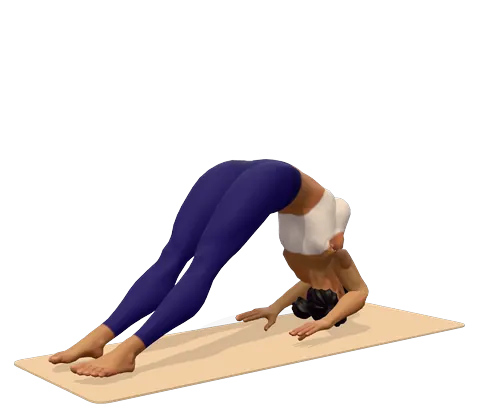
How to do Inverted Staff Pose step by step
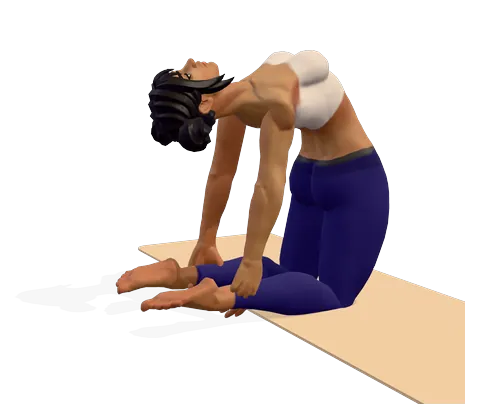
- Warm up well first: several rounds of bridge, camel and at least two or three full wheel poses. Do not attempt this pose cold.
- Lie on your back, bend your knees and place your feet flat, hip-width apart, close to your seat. Put your palms beside your ears, fingers pointing toward your shoulders.
- Press into your hands and feet and lift onto the crown of your head, as you would halfway into wheel pose. Keep most of your weight in your hands, not your neck.
- Lower one elbow to the floor, then the other, shoulder-width apart. Interlace your fingers and cup the back of your head, as in headstand.
- Press your forearms firmly down and push your chest back toward your hands so the shoulders open and the weight moves off your head. Keep your knees bent and feet planted, or walk the feet away to straighten the legs if that stays easy.
- Hold for 3–5 steady breaths (about 15 seconds). Breathe smoothly; if the breath becomes short or your neck feels squashed, come down.
- To come out, walk your feet back in, tuck your chin slightly, release your hands and lower your shoulders and then your back to the floor. Rest with your knees hugged to your chest.
Where you feel Inverted Staff Pose: what it stretches and strengthens
Press your forearms down and lift your chest through. In the 3D guide, turn on Body guide: areas that stretch glow green and areas that work glow saffron.
Stretches
- Chest
- Shoulders
- Abs
Strengthens
- Lower back
- Glutes
- Arms
Benefits and precautions
Benefits
- Opens the chest, the front of the shoulders and the upper back more deeply than most backbends
- Stretches the hip flexors, thighs and abdomen
- Strengthens the shoulders, buttocks and the muscles along the spine
- Builds the forearm strength and shoulder stability used in headstand and forearm stand
- The supported chair version gives a restful chest opening for experienced students
- Asks for steady breath and calm focus in a demanding shape
Avoid or modify if
- High blood pressure, heart disease, glaucoma or a detached retina — the head is below the heart and there is weight on the head
- Any neck injury or neck pain, including cervical spondylosis — the neck carries some load in this pose
- Back injury, spondylolisthesis, a recent disc problem or pain when you arch — skip it and ask a physiotherapist
- Shoulder injury, frozen shoulder or wrist and elbow pain
- Pregnancy, headache or a migraine attack, and the first months after abdominal surgery
- Not a beginner pose: learn a steady wheel and headstand with a teacher first
Inverted staff pose (Viparita Dandasana) is an advanced backbend in which you rest on your forearms and the crown of your head while your chest arches up and your feet press into the floor. It asks for open shoulders, a flexible upper back and a stable neck all at once. This page explains what the pose is, who is ready for it, a safe step-by-step progression, the supported chair and bench versions, and the cautions you should take seriously.
What is inverted staff pose in yoga?
The Sanskrit name has three parts: viparita means "inverted" or "turned the other way", danda means "staff" or "stick", and asana means "pose". The "staff" refers to the straight, strong body of Dandasana (staff pose), the seated pose where the legs stretch forward like a rod. Holding a staff pose teaches you to keep the legs and spine long; Viparita Dandasana turns that staff over and bends it into an arch.
You will see two main forms. Dwi pada Viparita Dandasana ("two-footed", also written dvi pada) is the classic version with both feet on the floor. In the Sanskrit of dwi pada Viparita Dandasana, dwi means two and pada means foot, so a two legged inverted staff pose in yoga simply has both feet down. Eka pada Viparita Dandasana is the one legged inverted staff pose, with one leg lifted straight up. The 3D figure shows the two-footed form with the knees bent, which is how most people first practise it.
Are you ready for Viparita Dandasana?
Be honest with yourself here. Inverted staff pose yoga is usually taught only after these are comfortable and pain-free:
- A steady wheel pose with straight arms, held for five breaths, two or three times in a row.
- A controlled headstand on the forearms, because you use the same interlaced-hands base.
- Arms that lift overhead next to your ears without the lower ribs flaring or the lower back pinching.
- No neck, shoulder or lower back pain in daily life.
If any of these is missing, stay with the preparation below for a few more months. There is no benefit in forcing the shape early.
Step-by-step progressions
Stage 1: Build the parts
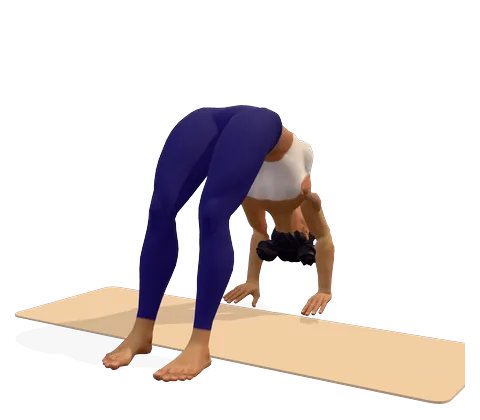
Practise bridge pose and camel pose to open the thighs and chest. Add extended puppy pose for the shoulders and dolphin-style forearm holds for strength. Two or three sessions a week are enough.
Stage 2: Wheel with a pause on the head
From lying on your back, press halfway up and rest lightly on the top of your head for one breath, keeping most of the weight in your hands. Then either press up into wheel or lower down. This teaches you to control the head position.
Stage 3: Forearms down, knees bent
From the head position, bring the elbows down one at a time and clasp the hands. Keep the knees bent and feet close, exactly as the 3D guide shows. Work on pushing the chest back toward the hands; this is the action that lifts weight off the neck.
Stage 4: Straighten the legs
Only when stage 3 is easy, walk the feet away a little at a time until the legs are straight and the body forms a long arch. Keep the heels down and the inner feet pressing into the floor.
Stage 5: Advanced entries
Experienced students drop back into Viparita Dandasana from headstand, or lift one leg for the one-legged version. Learn these with an experienced teacher, never alone.
Supported version: over a chair or a viparita dandasana bench
In the Iyengar tradition the pose is often done lying back over a folding chair. You sit facing the chair back with your legs through it, lie back so the front edge of the seat meets your shoulder blades, hold the chair legs and rest your head on a bolster. A curved viparita dandasana bench does the same job. These supported versions let the chest open without holding your own weight, but they are still strong backbends, not chair yoga poses for back pain. If your back hurts, gentler poses for yoga for back pain are a better place to start — see our yoga for back pain plan.
Not the same thing: people searching for an "inverted back table pose" usually mean an inversion table. An inversion table, an inverted bed or an inverted chair for back pain is exercise equipment that tips you upside down. Viparita Dandasana is a yoga backbend. Neither should be used for back pain without advice from your doctor or physiotherapist.
Viparita Dandasana benefits
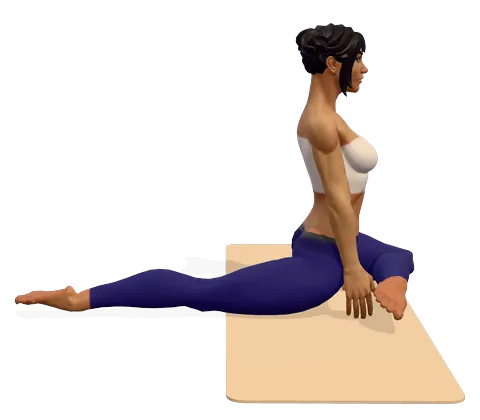
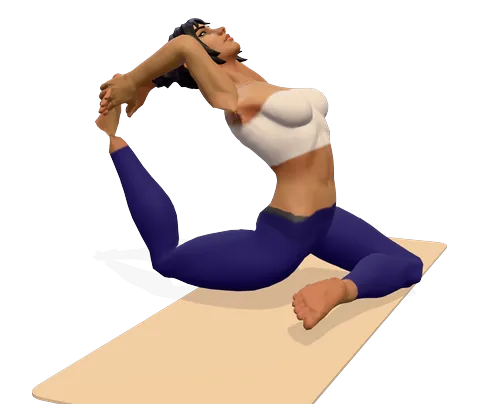
The main benefits of Viparita Dandasana are physical: a deep opening of the chest and shoulders, a strong stretch through the front of the hips and thighs, and strength in the arms, buttocks and back. Because the shoulders work in a full overhead position, many teachers use it to improve shoulder range for backbends such as king pigeon pose.
Is it an inversion?
Partly. The head is below the heart, so it shares the cautions of other inverted yoga positions. People often read about inverted pose benefits such as a sense of alertness; any such effect of inverted yoga poses is modest and not a reason to push into a pose you are not ready for.
Muscles worked
| Strengthens | Stretches |
|---|---|
| Deltoids, triceps and the muscles around the shoulder blades | Chest (pectorals) and the large back muscles (latissimus dorsi) |
| Gluteal muscles and hamstrings | Hip flexors and quadriceps |
| Erector spinae along the back | Abdominal muscles and the front of the neck |
Common mistakes and how to fix them
- Weight sinking into the head. Press the forearms down and move the chest toward the hands. If you cannot, go back to stage 2.
- Elbows sliding apart. Keep them shoulder-width; a strap just above the elbows helps.
- Knees and feet turning out. Keep the feet parallel and knees pointing forward to protect the lower back.
- Holding the breath. A backbend this deep needs slow, even breathing. Come down when the breath gets short.
Poses before and after
Warm up with bridge, camel and wheel. Afterwards, release the back with child's pose, a supine twist and knees to chest, then rest in corpse pose. You can build this order in the sequence builder and follow it with the voice guide.
Frequently asked questions
What is Viparita Dandasana?
Viparita Dandasana, or inverted staff pose, is an advanced backbend in which you rest on your forearms and the top of your head, with your chest arched and your feet on the floor. The name means "inverted staff pose".
What is dwi pada Viparita Dandasana?
It is the two-footed version, with both feet on the floor. "Dwi" (or "dvi") means two and "pada" means foot. The one-legged version, eka pada Viparita Dandasana, lifts one leg straight up.
Is inverted staff pose good for beginners?
No. It is an advanced pose. Beginners should first learn bridge, camel, a steady wheel pose and a forearm headstand, ideally with a teacher, before trying it.
What are the benefits of Viparita Dandasana?
It opens the chest and shoulders, stretches the hip flexors and thighs, and strengthens the shoulders, buttocks and back. The supported chair version gives a gentler chest opening for experienced students.
How long should I hold inverted staff pose?
About 3–5 breaths, or 15 seconds, is enough. Repeat once or twice if it feels steady, and always follow with a counter-pose such as knees to chest or child's pose.
Who should not do Viparita Dandasana?
Skip it if you have high blood pressure, heart disease, glaucoma, neck, shoulder or back injuries, if you are pregnant, or during a headache or migraine.
What is a viparita dandasana bench?
It is a curved wooden prop used in Iyengar yoga. You lie back over it so your chest opens with support, similar to the chair version. It is still a strong backbend, not a tool for back pain.
This page is for general education. Check with your doctor before starting yoga if you are pregnant, have a medical condition or an injury. Stop if you feel pain, dizziness or shortness of breath.