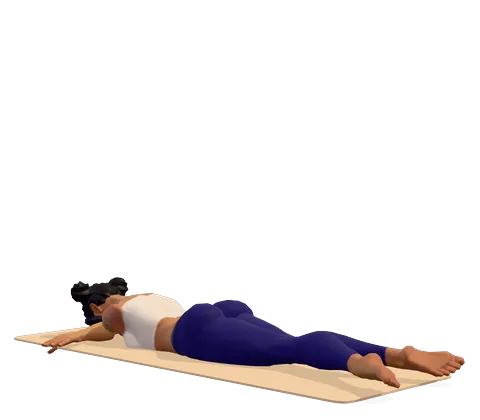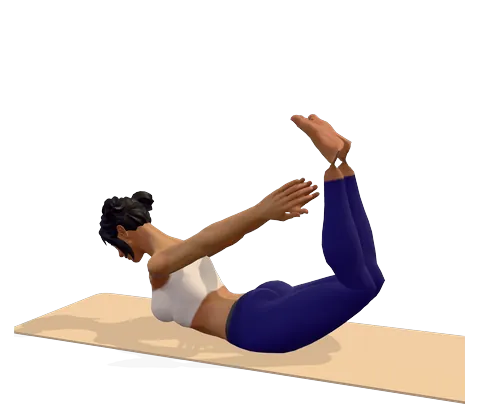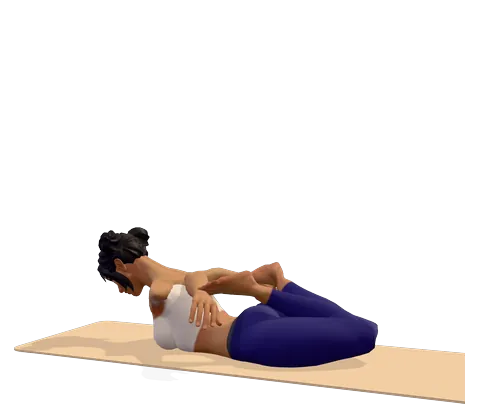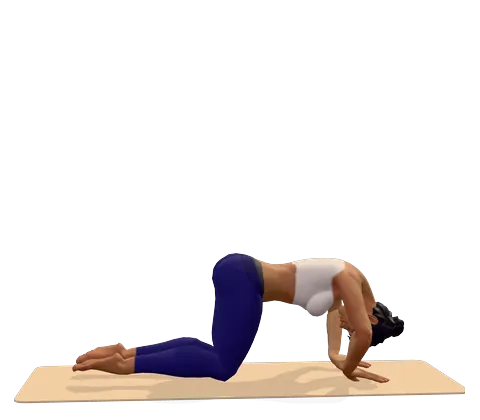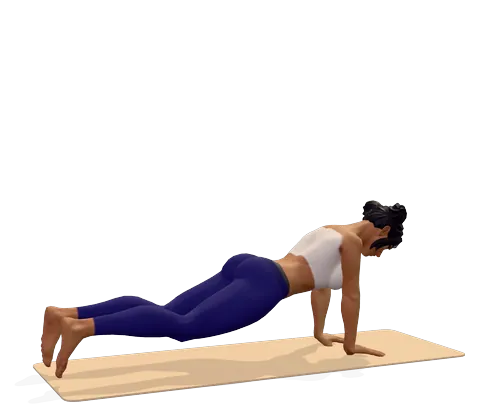
How to do Plank Pose step by step
- Start on your hands and knees with your wrists under your shoulders and your fingers spread wide.
- Step one foot back, then the other, so your legs are straight and you balance on your hands and the balls of your feet, feet hip-width apart.
- Make one straight line from your head to your heels: hips level with your shoulders, not higher and not sagging.
- Press the floor away so your upper back is broad, and gently draw your belly in toward your spine.
- Firm your thighs and reach your heels back. Look at the mat just in front of your hands so your neck stays long.
- Hold for 3–6 steady breaths (15–30 seconds), breathing through your nose. Do not hold your breath.
- To come out, lower your knees to the mat and sit back into child's pose.
Where you feel Plank Pose: what it stretches and strengthens
Hold one straight line from head to heels. In the 3D guide, turn on Body guide: areas that stretch glow green and areas that work glow saffron.
Strengthens
- Abs
- Shoulders
- Arms
Benefits and precautions
Benefits
- Strengthens the deep core muscles that support the spine
- Builds strength in the shoulders, arms, wrists and chest
- Trains the body to stay in one line, which carries over to better posture
- Works the buttocks and thighs as they hold the legs straight
- Prepares you for Chaturanga, side plank and arm balances such as crow
- Part of every round of Surya Namaskar, which raises your heart rate
Avoid or modify if
- Wrist pain or carpal tunnel — do a forearm plank or a wall plank instead
- Shoulder injury — avoid weight-bearing on the painful arm until your physiotherapist clears it
- High blood pressure — keep holds short and breathe steadily; never hold your breath
- Pregnancy, and after childbirth or a C-section — ask your doctor or women's health physiotherapist first
- Lower back pain that increases during the hold — drop to your knees or stop
Plank pose (Phalakasana) is one of the simplest ways to build core strength: you hold your body in one straight line, like a plank of wood, balanced on your hands and toes. It is the fifth step of Surya Namaskar, a warm-up in most yoga classes and the same "high plank" you find in any fitness routine. This guide covers plank pose correct form, what it does for your body, how long to hold it and how to make it easier or harder.
What is plank pose in yoga?
What is the Sanskrit word for plank pose? The Sanskrit name comes in three versions. Phalakasana comes from phalaka, "plank" or "board", and asana, "pose"; say "pah-lah-KAH-sah-nah". Kumbhakasana comes from kumbhaka, the pause of the breath (from kumbha, "pot"), because in some traditions you hold the breath briefly in this position during sun salutations. The Bihar School calls a similar hold Santolanasana, "balancing pose". Many Indian Surya Namaskar charts call step 5 Dandasana, "stick pose", for the same straight line.
Whatever the name, Kumbhakasana yoga pose and Phalakasana mean the same shape: a straight-arm plank. In Hindi it is written फलकासन, and plank position in Hindi classes is also called कुंभकासन. Plank exercise in Hindi fitness videos is usually just प्लैंक.
Plank pose correct form
The steps above show how to do a plank pose. Most problems come from the hips or the shoulders:
| Mistake | What it does | Fix |
|---|---|---|
| Hips sagging | Loads the lower back | Draw the belly in, squeeze the buttocks lightly, lower the knees if needed |
| Hips piked up | Takes the work out of the core | Lower the hips to shoulder height; check in a mirror |
| Shoulders sinking | Strains the shoulders and wrists | Push the floor away so the shoulder blades spread |
| Hands in front of the shoulders | Pressure on the front of the shoulder | Stack wrists under shoulders |
| Head dropping or lifting | Strains the neck | Gaze at the mat just ahead of the hands |
| Holding the breath | Raises blood pressure | Keep a slow, steady breath |
Useful plank pose cues are "long line", "push the floor away" and "heels back". In the plank position, shoulders stay over the wrists and away from the ears.
Plank pose benefits
How does plank help your body? It teaches the deep abdominal muscles, the back muscles and the shoulders to hold the spine steady while the limbs carry weight. That is the kind of strength you use every day when lifting, carrying and standing tall.
Plank pose muscles worked
The muscles used in plank pose are mainly the transverse abdominis and rectus abdominis (front of the core), the obliques, the muscles along the spine, the deltoids and serratus anterior (shoulders), the triceps, the chest, the gluteal muscles and the quadriceps. High plank muscles worked are similar to a forearm plank, with more load on the arms and wrists.
Is plank good for lower back pain?
Core-endurance exercises like plank are often part of exercise programmes for chronic low back pain, and a strong trunk helps many people. Form matters: a sagging plank can make pain worse. As a plank exercise for lower back pain, start on your knees or at a wall, keep holds short, and stop if pain increases. Our yoga for back pain plan builds up to it gently. Do planks help with posture? They can, because they train you to hold a neutral spine without effort.
Plank pose benefits for weight loss and belly fat
Plank strengthens and firms the abdominal muscles, but no exercise burns fat from one spot. Plank exercise benefits for belly fat come only as part of regular activity and a healthy diet. Done in rounds of Surya Namaskar, plank helps raise your heart rate; see our yoga for weight loss and yoga for belly fat plans, and estimate your practice with the calories calculator. Plank pose benefits for female practitioners are the same as for anyone, and core strength is especially useful before and long after pregnancy (with medical advice).
Plank pose time: how long to hold
There is no ideal plank position average time. For most people a 20–60 second high plank hold, repeated 2–3 times, is plenty; good form matters more than long holds. As a plank exercise time for beginners, start with 10–15 seconds and add 5 seconds each week. In a yoga flow you usually stay for one or a few breaths.
Plank pose for beginners and variations
Each Phalakasana variation below changes the load, so pick the one you can hold with good form.
- Wall plank exercise for beginners: hands on a wall at chest height, walk your feet back and hold a straight line. Good for seniors and after injury.
- Knee plank: knees down, body straight from head to knees. The best plank position for beginners and an easy plank exercise at home.
- Forearm plank: elbows under shoulders, easier on the wrists.
- High plank shoulder taps: tap one hand to the opposite shoulder, keeping the hips still. This is a dynamic plank pose: the shape stays, but the limbs move.
- One-leg plank: lift one foot a few centimetres off the floor.
- Side plank: roll onto one hand and the side of one foot. See side plank pose for how to do this side plank exercise safely.
For kids, plank pose becomes "be a strong board" for a count of five, which suits a short plank pose kids yoga game.
High plank vs low plank, and what comes next
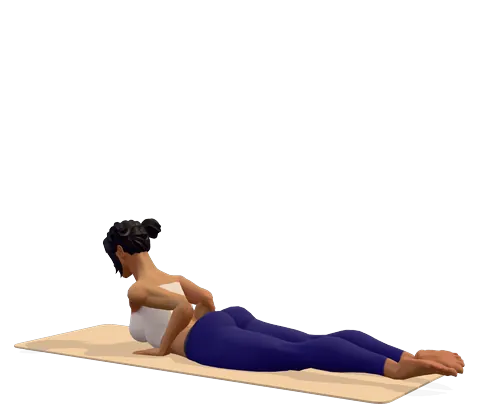
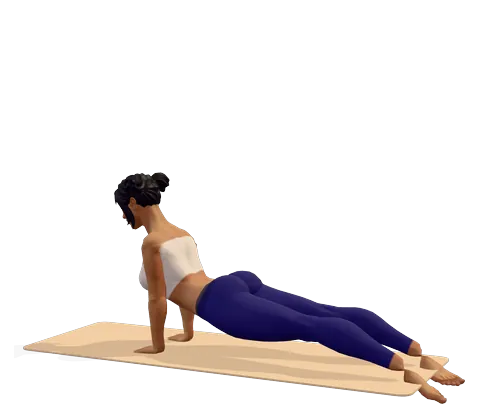
The high plank position is this pose, arms straight; gyms call it the high plank exercise. Low plank is Chaturanga Dandasana, where the elbows bend and the body hovers just above the floor; it is much harder on the shoulders. In a Vinyasa flow you move from plank pose to Chaturanga, then transition to a backbend such as upward dog or cobra. If you wonder how to do Bhujangasana, see our cobra pose guide. Upward plank pose in Hindi, पूर्वोत्तानासन (Purvottanasana), is the face-up reverse plank. Plank strength is also the base for crow: if you are learning how to do Bakasana for beginners, practise plank first.
फलकासन (Plank Pose) — हिंदी में: हाथों को कंधों के ठीक नीचे रखें और पैरों को पीछे ले जाकर पंजों पर संतुलन बनाएँ। सिर से एड़ी तक शरीर एक सीधी रेखा में रहे — कूल्हे न ऊपर उठें, न नीचे गिरें। पेट को हल्का अंदर खींचें और साँस चलती रहे। शुरुआत में 15–30 सेकंड रुकें। फायदे: पेट और कमर की मांसपेशियाँ, कंधे और बाँहें मज़बूत होती हैं। कलाई या कंधे में चोट हो तो घुटनों या दीवार के सहारे करें।
Health conditions this pose is used for
Yoga for weight loss · Yoga for belly fat
Where this practice is used
Chakras: Manipura (Solar Plexus Chakra)
Frequently asked questions
What is plank pose in yoga?
Plank pose (Phalakasana or Kumbhakasana) is a straight-arm hold in which your body forms one straight line from head to heels, balanced on your hands and toes. It is step 5 of Surya Namaskar.
How long should I hold plank pose?
Beginners can start with 10–15 seconds and build up. For most people 20–60 seconds, repeated 2–3 times, is plenty. Stop when your form breaks.
What muscles does plank pose work?
The deep and front abdominal muscles, obliques, back muscles, shoulders, triceps, chest, buttocks and thighs.
Is plank good for lower back pain?
Core-strength exercises such as plank are often part of back pain programmes, but only with good form. Start on your knees or at a wall and stop if pain increases. Ask a physiotherapist if you have a disc problem.
What is the difference between high plank and low plank?
High plank has straight arms. Low plank (Chaturanga) has bent elbows with the body hovering just above the floor, which is harder on the shoulders.
Can plank reduce belly fat?
It strengthens the abdominal muscles, but no exercise burns fat from one area. Combine it with regular activity and a healthy diet.
Is plank safe with high blood pressure?
Holding any static exercise raises blood pressure for a short time. Keep holds short, breathe steadily and never hold your breath. Ask your doctor first if your blood pressure is not controlled.
What is plank pose called in Hindi?
फलकासन (Phalakasana) or कुंभकासन (Kumbhakasana).
This page is for general education. Check with your doctor before starting yoga if you are pregnant, have a medical condition or an injury. Stop if you feel pain, dizziness or shortness of breath.