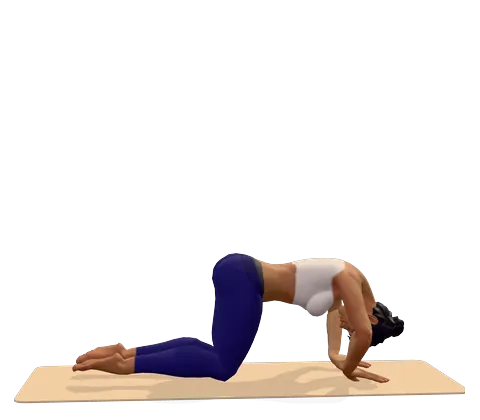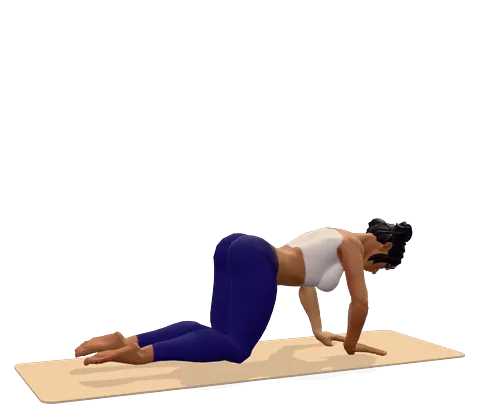
How to do Tabletop Pose step by step
- Come onto your hands and knees on the mat. Place a folded blanket under your knees if they are sensitive.
- Stack your wrists directly under your shoulders, fingers spread and pointing forward, with the middle fingers parallel.
- Place your knees directly under your hips, hip-width apart. Rest the tops of your feet on the mat.
- Make your back flat like a table: lengthen from your tailbone to the crown of your head, and draw your belly gently in.
- Press the floor away with your hands so your shoulder blades widen and do not sink toward each other. Keep your elbows straight but not locked.
- Keep your neck long and look down at the mat, slightly in front of your hands. Breathe evenly for 15–30 seconds (3–6 breaths).
- To come out, sit back onto your heels or rest in child's pose.
Where you feel Tabletop Pose: what it stretches and strengthens
Stack your wrists under your shoulders and knees under your hips. In the 3D guide, turn on Body guide: areas that stretch glow green and areas that work glow saffron.
Strengthens
- Shoulders
- Wrists
- Abs
Benefits and precautions
Benefits
- Gently strengthens the shoulders, arms and wrists
- Wakes up the deep core muscles that keep the back flat
- Teaches neutral spine alignment used in many other poses
- A stable starting point for cat-cow, bird dog, downward dog and lunges
- Low-impact and suitable for most beginners, older adults and children
Avoid or modify if
- Wrist pain or carpal tunnel syndrome — make fists, or rest on your forearms
- Knee pain — pad the knees with a blanket or fold the mat
- Recent wrist, shoulder or knee injury — ask your physiotherapist first
- Late pregnancy — tabletop is usually comfortable, but keep the back neutral and do not let the belly sag; follow your midwife's advice
Tabletop pose (Bharmanasana) is the basic hands-and-knees position in yoga: your back is flat like the top of a table and your arms and thighs are its legs. It looks too simple to need instructions, yet small details — where your wrists sit, how your shoulders work, whether your lower back sags — decide how well it prepares you for the poses that start here. This page covers how to do tabletop pose, the cues that matter, its benefits, variations, and modifications for wrists, knees and pregnancy.
What is tabletop pose in yoga?
Table pose in yoga is a neutral all fours position: hands under shoulders, knees under hips, spine long. Teachers use it as the starting point for cat and cow, bird dog, thread the needle and downward-facing dog. It is one of the most common yoga poses for beginners, and one of the easiest.
Table top pose Sanskrit name
The Sanskrit name for tabletop pose is Bharmanasana. It is a modern name, not found in the old Hatha texts, and it is usually translated simply as "table pose". Many teachers simply call it the table top yoga position. In Hindi it is usually called टेबल टॉप आसन (table top asana).
How to do tabletop pose: step by step with cues
Follow the table pose step by step instructions above. These table top pose cues fix the usual problems:
- "Stack the joints." Wrists under shoulders, knees under hips. Rotate the 3D figure to the side view to check the vertical lines.
- "Spread your fingers and press through the knuckles." Rooting the base of the index finger takes pressure off the wrist.
- "Push the floor away." This stops your chest from sinking between the shoulders.
- "Belly gently in, back long." Stops the lower back from sagging into a banana shape.
- "Neck long, eyes down." Looking forward pinches the back of the neck.
Table pose breathing techniques
Breathe slowly through the nose. On the inhale, feel the back ribs widen; on the exhale, draw the belly gently toward the spine. Moving between cat and cow with each breath is the classic way to link breath and movement here.
Tabletop pose benefits
The benefits of table top pose in yoga are quiet but useful. It gently strengthens the shoulders, arms and wrists, teaches the deep core muscles to hold a neutral spine, and builds body awareness you will use in every plank, lunge and arm balance. Tabletop position benefits also include safety: it is a stable, low-risk way to get up and down from the floor.
- Back pain: as a base for cat-cow and bird dog, tabletop appears in many lower back pain yoga poses routines. It also suits yoga poses for upper back pain, such as thread the needle. See yoga for back pain for yoga poses for lower back pain relief.
- Wrist strength: short table top holds are a gentle way to prepare the wrists for plank. Wrist issues? See yoga for carpal tunnel.
- Flexibility: table pose for flexibility works through its variations — the pose itself is a strength and alignment position.
Muscles worked
| Area | What it does in tabletop |
|---|---|
| Shoulders (deltoids, serratus anterior) | Hold the chest up between the arms |
| Wrists and forearms | Carry part of your weight |
| Abdominal muscles (transversus abdominis) | Keep the lower back from sagging |
Turn on the Body guide in the 3D demo: these working areas glow saffron.
Tabletop pose variations
- Balancing table yoga pose: extend one arm forward and the opposite leg back — this is bird dog pose. Balancing table pose benefits include core stability and balance.
- Table top pose leg to side: lift one bent knee out to the side (often called fire hydrant) for the outer hip.
- Table top pose knees up: tuck the toes and hover the knees a few centimetres off the mat for a strong core hold.
- Cat-cow: round and arch the spine with the breath.
Reverse table top pose
Reverse table top pose (Ardha Purvottanasana) is a different shape: you sit, place your hands behind you and lift your hips so your belly faces the ceiling. It is an inverted back table pose that strengthens the arms, back and buttocks and stretches the chest. Reverse tabletop pose benefits are mainly for the back of the body and the shoulders; the full version is upward plank. Wild thing, Camatkarasana, is a related open-chest pose; wild thing yoga pose benefits include a strong chest opening.
Pilates table top position
In Pilates, "table top" usually means lying on your back with your knees bent at 90 degrees and the shins parallel to the floor. That tabletop position in Pilates is a core exercise; the yoga table top pose is on hands and knees.
Table pose modifications
- Sensitive knees: fold the mat or a blanket under them.
- Sore wrists: make loose fists, use a wedge under the heels of the hands, or come down onto your forearms.
- Cannot kneel: do the same shape standing, with hands on a table or wall, or from a chair.
- Pregnancy: table top pose is often comfortable in pregnancy and can ease pressure on the back; keep the spine neutral and avoid deep arching. See yoga for pregnancy.
Good modifications for yoga poses keep the idea of the pose while removing the pain.
Table top pose for beginners and kids
For beginners, tabletop is the best place to learn alignment before moving to popular yoga poses for beginners like downward dog. Hold it, check the cues, rest in child's pose, repeat. Children love tabletop pose for kids as a "table" game — can they keep a soft toy balanced on their back? More ideas are on our yoga for kids page. When you are ready for a flow, try the guided sessions.
टेबलटॉप पोज़ (table top pose in Hindi) — हिंदी में: हाथों और घुटनों के बल आ जाएँ। कलाइयाँ कंधों के ठीक नीचे और घुटने कूल्हों के ठीक नीचे रखें। पीठ मेज़ की तरह सीधी रखें, नज़र नीचे और गर्दन लंबी। 15–30 सेकंड आराम से साँस लें। फायदे: कंधे, बाँहें और कलाइयाँ मज़बूत होती हैं, पेट की गहरी मांसपेशियाँ सक्रिय होती हैं और रीढ़ की सही स्थिति सीखने में मदद मिलती है। कलाई या घुटने में दर्द हो तो नीचे कंबल रखें या मुट्ठी बनाकर करें।
Frequently asked questions
What is tabletop pose?
Tabletop pose (Bharmanasana) is the hands-and-knees position in yoga, with wrists under shoulders, knees under hips and a flat back. It is the starting point for cat-cow, bird dog and downward dog.
What is the Sanskrit name for tabletop pose?
Bharmanasana. It is a modern name usually translated as "table pose".
What are the benefits of tabletop pose?
It gently strengthens the shoulders, arms and wrists, activates the deep core, teaches neutral spine alignment and prepares you for many other poses.
How long should I hold tabletop pose?
In a flow, just a breath or two. As a strength hold, 15–30 seconds (3–6 breaths), repeated a few times.
Is tabletop pose good for back pain?
It is a safe, neutral position used as the base for cat-cow and bird dog, which are common in back pain routines. On its own it is a starting position, not a treatment.
What is the difference between tabletop and reverse tabletop?
In tabletop you face the floor on hands and knees. In reverse tabletop you face the ceiling, with hands and feet on the floor and hips lifted.
Can I do tabletop pose with wrist pain?
Yes, with changes: make fists, put a wedge under the heels of the hands or rest on your forearms. Stop if pain increases.
This page is for general education. Check with your doctor before starting yoga if you are pregnant, have a medical condition or an injury. Stop if you feel pain, dizziness or shortness of breath.