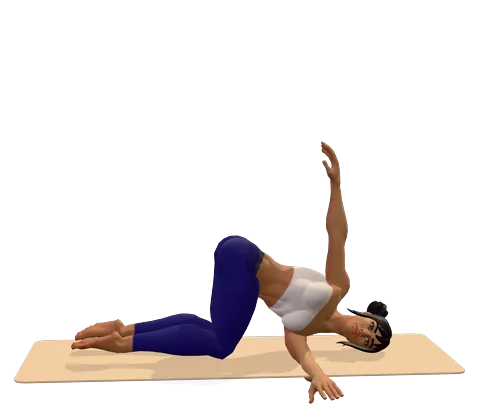
How to do Thread the Needle Pose step by step
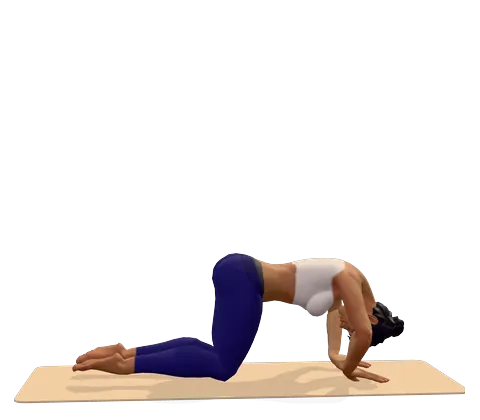
- Come onto your hands and knees. Place your knees under your hips and your hands under your shoulders, with the tops of your feet resting on the mat.
- Breathe in and reach your right arm up toward the ceiling, turning your chest to the right.
- Breathe out and slide your left arm under your chest toward the right side of the mat, palm facing up.
- Lower your left shoulder and the left side of your head onto the mat. Keep your hips high, right above your knees.
- Stretch your right arm up toward the ceiling, or rest the right hand on the floor in front of you for a gentler twist.
- Hold for 30–60 seconds (about 5–8 slow breaths), letting the upper back soften with each breath out.
- Press into your right hand, slide your left arm back out and return to hands and knees. Repeat on the right side.
Where you feel Thread the Needle Pose: what it stretches and strengthens
Slide your arm under your chest and rest your shoulder and temple down. In the 3D guide, turn on Body guide: areas that stretch glow green and areas that work glow saffron.
Stretches
- Upper back
- Shoulders
- Neck
Benefits and precautions
Benefits
- Stretches the back of the shoulder and the muscles between the shoulder blades
- Gently rotates the upper back, which often stiffens with desk work
- Eases tension in the neck and upper trapezius
- A calm, low-effort twist that suits warm-ups, cool-downs and bedtime practice
- Builds the shoulder and upper-back mobility you need for twists and binds
Avoid or modify if
- Shoulder injury or recent dislocation — keep the threaded arm shallow or skip the pose
- Neck pain or a neck injury — rest your head on a folded blanket or block so the neck stays neutral
- Knee pain — pad your knees with a folded blanket, or try the reclined version on your back
- Pregnancy — widen your knees, keep the twist small and stop if the belly feels squeezed; ask your midwife or doctor
- Stop if you feel tingling or numbness down the arm
Thread the needle pose (Parsva Balasana) is a kneeling twist in which you slide one arm under your chest and rest your shoulder and head on the mat. The arm passes through the gap between your other arm and your knee, like thread through the eye of a needle. It asks for very little strength, yet it reaches the stiff area between the shoulder blades that most stretches miss. This page explains what the pose does, how to get the alignment right, which version suits you and when to modify it.
What is thread the needle pose in yoga?
It is a gentle upper-back twist done from hands and knees. The Sanskrit name for thread the needle pose is Parsva Balasana: parsva means side, bala means child and asana means pose, so the name reads "side child's pose". That fits, because the resting shape grows out of child's pose. Some books use the name Urdhva Mukha Pasasana ("upward-facing noose pose") for a similar shape.
The English yoga name of the pose tells you the movement: threading the needle is exactly what your arm does as it passes under your chest. That is the whole meaning of thread the needle here.
Do not mix it up with Parsva Bakasana, which is side crow, an arm balance, or Parsva Halasana, a sideways plough. The English name, thread the needle, is also used for a physical therapy drill, which we explain below.
How to do thread the needle pose well
The steps above take you in and out. These details make the difference between a pleasant stretch and a strained neck:
- Hips stay up. Keep your hips over your knees. If they drift back toward your heels, the twist moves out of the upper back.
- Slide, do not drop. Move the threaded arm along the floor and lower the shoulder slowly. The weight should rest on the back of the shoulder, not on the neck.
- Head on the side, not the face. Rest your temple on the mat. If your head does not reach, place a block or folded blanket under it.
- Breathe into the back. Each breath out, let the shoulder blade of the threaded arm spread a little more.
What should you feel? A broad stretch across the back of the shoulder and between the shoulder blades, and a soft twist through the middle back. You should not feel pinching in the neck or pain in the knee.
Thread the needle pose benefits
Whether you practise it as a yoga pose or as an exercise, the thread the needle stretch benefits the same areas. The main benefits of thread the needle pose come from rotating the thoracic spine (upper and middle back) while the shoulder is gently stretched by your own body weight. Many people who sit for hours find this area stiff, and the twist can ease that feeling. It fits well into yoga for neck pain and yoga for office workers, and it is a calm way to end a practice before sleep.
Thread the needle stretch muscles
| Stretches | Works gently |
|---|---|
| Back of the threaded shoulder (rear deltoid, rotator cuff) | Supporting arm and shoulder that press into the floor |
| Rhomboids and middle trapezius between the shoulder blades | Deep back muscles that control the twist |
| Side of the neck and upper trapezius | Hips and thighs that hold the tabletop |
The 3D guide's Body guide button lights up these areas in green, so you can see where the stretch should land.
Thread the needle pose for beginners, variations and modifications
- Child's pose with thread the needle: start in child's pose, then walk your hands to one side and thread one arm under. The hips rest low, so the twist is softer and the knees carry less weight.
- Supporting hand down: keep the free hand on the floor instead of reaching up. This is the easiest thread the needle yoga pose for beginners.
- Thread the needle yin pose: in yin yoga you stay 2–3 minutes with the body fully relaxed and the head supported on a block.
- Arm wrapped behind: for a deeper stretch, wrap the free arm behind your back toward the opposite hip.
- Reclined thread the needle: a different pose with the same name. You lie on your back, cross one ankle over the other knee and pull the legs in. It stretches the hips, not the shoulders — see eye of the needle pose.
What is thread the needle exercise for?
In physical therapy (PT), therapists turn the thread the needle yoga move into a threading exercise done as a slow movement rather than a hold. From hands and knees you reach one arm under the body, then sweep it up toward the ceiling while your eyes follow the hand, and repeat 8–10 times each side. The purpose of the thread the needle exercise is to improve rotation of the upper back, which can take strain off the neck and lower back. Your therapist will tell you how many repetitions suit you.
Standing thread the needle
If kneeling hurts, do thread the needle in standing. Stand with your feet wide, bend your knees and rest one hand on a chair seat or table. Reach the other arm under your chest, then open it up toward the ceiling. The standing thread the needle stretch is a handy exercise for seniors, in chair yoga and at work.
Thread the needle pose in pregnancy
Many prenatal classes include a mild version. Widen your knees so the belly has space, keep the twist in the upper back only and keep the free hand on the floor. Skip it if you feel pressure on the belly, dizziness or pelvic pain, and ask your midwife or doctor before you start any new practice. Our prenatal yoga page has more safe choices.
Common mistakes and teacher cues
The most common mistakes are sitting the hips back, letting the head take the weight and forcing the top arm higher than the spine allows. Useful thread the needle pose cues are "hips over knees", "rest on the back of the shoulder" and "let the top arm be light". Before this pose, warm up with cat pose and cow pose. Afterwards, rest in child's pose. You can add all of them to your own sequence in the session builder.
पार्श्व बालासन (Thread the Needle Pose) — हिंदी में: हाथों और घुटनों के बल आ जाएँ। बाएँ हाथ को हथेली ऊपर रखते हुए छाती के नीचे से दाईं ओर सरकाएँ और बायाँ कंधा और सिर का बायाँ हिस्सा ज़मीन पर टिका दें। दायाँ हाथ ऊपर छत की ओर उठाएँ और 5–8 साँस रुकें, फिर दूसरी ओर करें। यह आसन कंधों, गर्दन और पीठ के ऊपरी हिस्से की अकड़न कम करता है। कंधे या गर्दन में चोट हो तो सावधानी रखें।
Frequently asked questions
What is thread the needle pose good for?
It stretches the back of the shoulder and the muscles between the shoulder blades and gently twists the upper back. Many people use it to ease stiffness from sitting, as a warm-up or at the end of the day.
What is the Sanskrit name for thread the needle pose?
Parsva Balasana, which means "side child's pose". Some sources call a similar shape Urdhva Mukha Pasasana.
How long should I hold thread the needle?
Hold for 30–60 seconds on each side. In yin yoga people stay 2–3 minutes with the head supported.
Is thread the needle safe in pregnancy?
A mild version with wide knees and a small upper-back twist is often fine. Avoid it if you feel pressure on the belly, and ask your midwife or doctor first.
What is the thread the needle exercise in physical therapy?
It is a moving version: from hands and knees you reach one arm under the body, then open it up toward the ceiling, several times each side, to improve upper-back rotation.
Why do I feel it in my neck?
Usually the head is taking too much weight or the hips have dropped back. Put a block under your head, lift the hips over the knees and rest on the back of the shoulder.
What is the thread the needle pose Hindi name?
पार्श्व बालासन (Parsva Balasana). "Parsva" means side and "bala" means child.
This page is for general education. Check with your doctor before starting yoga if you are pregnant, have a medical condition or an injury. Stop if you feel pain, dizziness or shortness of breath.