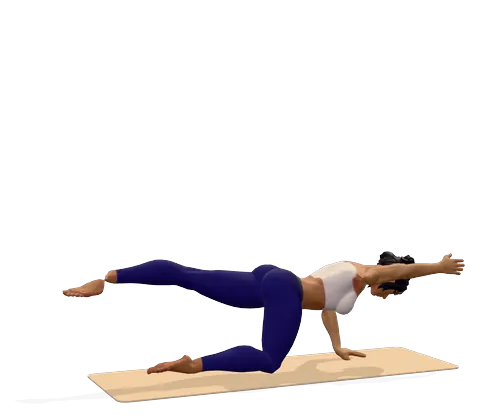
How to do Bird Dog Pose step by step
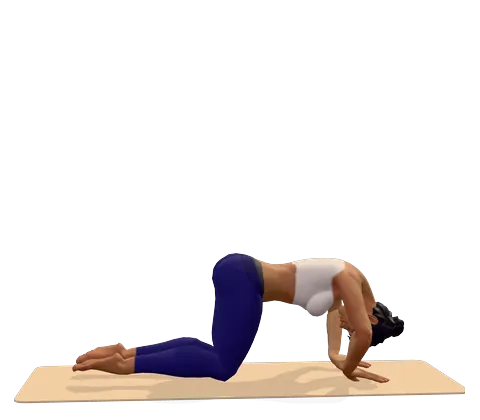
- Start in tabletop: wrists under shoulders, knees under hips, back flat and gaze down at the mat.
- Draw your belly gently in so your lower back does not sag. Keep your hips level, as if balancing a cup of tea on your lower back.
- Slide your left leg straight back along the mat, then lift it to hip height with the toes pointing down.
- Keeping your balance, lift your right arm forward to shoulder height, thumb facing up.
- Reach long through your right fingertips and your left heel at the same time. Keep your neck in line with your spine.
- Hold for 3–5 slow breaths (15–20 seconds). If your hips tip or your back arches, lower the arm or leg a little.
- Breathe out and lower your hand and knee back to tabletop. Repeat with the right leg and left arm.
Where you feel Bird Dog Pose: what it stretches and strengthens
Reach long through the opposite arm and leg and keep your hips level. In the 3D guide, turn on Body guide: areas that stretch glow green and areas that work glow saffron.
Strengthens
- Glutes
- Abs
- Lower back
Benefits and precautions
Benefits
- Strengthens the back extensors, buttocks and deep core together
- Trains the trunk to stay steady while the arms and legs move
- Improves balance and coordination between opposite limbs
- A widely used low-load exercise in back pain and rehabilitation programmes
- Gentle on the joints and easy to scale for beginners and seniors
- Supports posture by working the muscles that hold the spine upright
Avoid or modify if
- Wrist pain or carpal tunnel — use fists or forearms, or lift only the leg
- Knee pain — pad the knees well; skip the pose if kneeling hurts
- Acute back pain or a recent back injury — start with just the leg slide and ask your physiotherapist
- Poor balance — practise lifting one limb at a time, near a wall
- Pregnancy — usually suitable with care; keep the back neutral and follow your midwife's advice
Bird dog pose (Dandayamana Bharmanasana) is a balancing table pose: from your hands and knees you reach one arm forward and the opposite leg back, holding your spine still like a tabletop. It is found in yoga classes, Pilates studios and physiotherapy clinics alike, because it strengthens the back and core without loading the spine. This guide covers what it is, how to do bird dog correctly, its benefits, the muscles it works, easier and harder variations, and who should modify it.
What is bird dog pose in yoga?
What is bird dog pose? It is a spinal balance yoga pose done on all fours: one arm and the opposite leg reach out, parallel to the floor, while the trunk stays level. Is bird dog a yoga pose? Yes — bird dog is a classic yoga pose, a physiotherapy (PT) exercise and a Pilates pose too.
Bird dog pose Sanskrit name
In yoga, the Sanskrit name for bird dog pose is Dandayamana Bharmanasana: dandayamana means "balancing" or "standing like a stick", and Bharmanasana is the table top yoga pose (tabletop pose). So in yoga it simply means "balancing table pose". Some teachers use the name Chakravakasana ("sunbird pose") for this yoga pose, but that name is also used for the flowing cat-cow stretch (Chakravakasana) in some styles, so the pose you practise depends on the teacher.
Why is bird dog called bird dog?
The name comes from hunting dogs called "bird dogs" (pointers), which freeze with one leg lifted and the body stretched long when they point at a bird. The bird dog pose name in English yoga simply describes that long, pointing shape.
How to do bird dog pose correctly
The steps above show the left leg first, as the 3D guide does. These bird dog yoga pose instructions work for the exercise version too. How to do a proper bird dog comes down to control, not height:
- Hips level. The lifted-leg hip wants to open toward the ceiling. Keep both hip points facing the floor.
- No sag, no arch. Draw the belly gently in. If the lower back arches, lower the leg a little.
- Reach long, not high. Think of pushing the heel back and the fingertips forward, not lifting them up.
- Slow and steady. Move on a breath out, hold, then return with control.
- Neck neutral. Look at the mat, slightly ahead of the hands.
A simple test: place a light object, such as a folded towel, on your lower back. If it slides off, your hips are rocking.
Bird dog pose benefits
What does bird dog exercise do? The main purpose of the bird dog exercise is to teach the trunk to stay still while the limbs work — the skill you need to lift, carry and walk without straining your back. The key bird dog yoga pose benefits are:
- Core and back strength: the back extensors, buttocks and deep core all work at a low, safe level.
- Balance and coordination: moving opposite arm and leg trains the brain and body to work across the midline. Among balancing poses in yoga, it is one of the best yoga balance poses and balancing yoga poses for beginners, since it does not need standing.
- Back pain: bird dog exercise for lower back pain is common in physiotherapy because it strengthens the back without heavy load. Spine researcher Stuart McGill includes it in his well-known "big three" core exercises. It is a gentle yoga pose for lower back pain when kept pain-free; see yoga for back pain for more poses for yoga for back pain.
- Posture: stronger back muscles support an upright spine — see yoga for posture.
Other claims need care. The bird dog exercise benefits for weight loss are small: it burns few calories, so pair it with regular movement (see yoga for weight loss). The bird dog exercise benefits for the pelvic floor come mainly from core co-ordination; for targeted work see yoga for the pelvic floor.
Bird dog muscles worked
What muscles does bird dog work, and what do bird dogs strengthen? In this pose, the bird dog exercise muscles used, or worked, are:
| Muscle group | Role in the pose |
|---|---|
| Gluteus maximus (buttock of the lifted leg) | Lifts and holds the leg at hip height |
| Erector spinae and multifidus (lower back) | Keep the spine long and level |
| Deep abdominal muscles and obliques | Stop the trunk from twisting or sagging |
| Shoulder muscles of both arms | Hold the reaching arm up and the supporting arm steady |
It is a strength pose more than a stretch, though you may feel a gentle bird dog pose stretch along the front of the extended hip. Turn on the Body guide in the 3D demo to see the working areas glow saffron.
Bird dog yoga pose for beginners: exercise variations
- Modified bird dog exercise: lift only the leg, or only the arm, until you can keep the hips steady — the simplest of the modifications for yoga poses on all fours.
- Seated bird dog exercise for beginners: sit tall on a chair and lift the opposite arm and knee — useful if you cannot kneel.
- Standing bird dog: hands on a wall or table, reach one leg back. Standing bird dog exercise benefits include balance training for seniors.
- Bird dog hold: stay for up to 10 breaths; bird dog hold exercise benefits are extra endurance for the back muscles.
- Dynamic bird dog: draw the elbow and knee together under the belly on the exhale, then reach out again. Dynamic bird dog benefits include more core work.
- Bird dog on back: the lying version, often called "dead bug", lowers opposite arm and leg while you lie on your back.
Unlike the donkey kicks exercise, where you kick the bent leg up toward the ceiling, bird dog keeps the leg straight and at hip height, so the back stays neutral. Many sequences move from bird dog into child's pose to rest, and it pairs well with cat pose before and tiger pose as a harder follow-up.
Balancing table pose for kids, seniors and pregnancy
For kids it becomes a bird pose: arms like a wing, leg like a tail. It is one of the easiest balance poses for kids — see yoga for kids. For older adults it builds safe balance close to the floor. In pregnancy, bird dog exercise benefits include keeping your back and core strong; keep the movement small and the back neutral, and follow your midwife's advice. Practise it in the guided sessions or add it to a flow with the sequence builder.
बर्ड डॉग पोज़ (bird dog pose in Hindi) — हिंदी में: हाथों और घुटनों के बल टेबलटॉप में आएँ। बायाँ पैर पीछे सीधा फैलाएँ और दायाँ हाथ आगे कंधे की ऊँचाई तक उठाएँ। कूल्हे सीधे रखें और नज़र नीचे। 3–5 साँस रुकें, फिर दूसरी तरफ़ करें। फायदे (bird dog exercise benefits in Hindi): कमर, नितंब और पेट की मांसपेशियाँ मज़बूत होती हैं, संतुलन सुधरता है और पीठ दर्द के व्यायामों में यह बहुत उपयोग होता है।
Frequently asked questions
What is bird dog pose?
Bird dog (Dandayamana Bharmanasana, balancing table pose) is a hands-and-knees pose in which you reach one arm forward and the opposite leg back while keeping the spine level.
What are the benefits of bird dog pose?
It strengthens the back, buttocks and deep core together, improves balance and coordination, supports posture and is widely used in back pain programmes.
What muscles does bird dog work?
Mainly the gluteus maximus, the erector spinae and multifidus along the spine, the deep abdominals and obliques, and the shoulder muscles.
Is bird dog good for lower back pain?
It is one of the most common exercises in back rehabilitation because it strengthens the back with little load. Keep it slow and pain-free, and ask your physiotherapist if you have an acute injury.
How long should I hold bird dog?
Hold for 3–5 slow breaths (15–20 seconds) on each side, and repeat 3–5 times. Quality matters more than time.
What is the Sanskrit name of bird dog pose?
Dandayamana Bharmanasana, which means "balancing table pose". Some teachers also call it Chakravakasana.
Why is it called bird dog?
It resembles a hunting "bird dog" (pointer) that freezes with one leg lifted and its body stretched long while pointing at a bird.
This page is for general education. Check with your doctor before starting yoga if you are pregnant, have a medical condition or an injury. Stop if you feel pain, dizziness or shortness of breath.