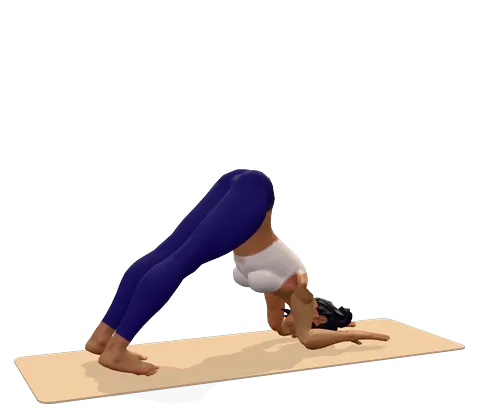
How to do Dolphin Pose step by step
- Start on your hands and knees. Lower onto your forearms with your elbows directly under your shoulders and your forearms parallel, palms flat.
- Tuck your toes under. Breathe out and lift your knees off the floor, sending your hips up and back.
- Press your forearms firmly into the mat and draw your shoulders away from your ears, so your chest moves back toward your thighs.
- Straighten your legs as far as your hamstrings allow, then walk your feet a few steps toward your elbows. Keep your back long; bend your knees if it starts to round.
- Let your head hang freely between your upper arms without resting it on the floor. Look back toward your feet.
- Hold for 20–45 seconds (4–8 breaths), keeping the elbows from sliding apart.
- Breathe out, lower your knees to the mat and rest in child's pose.
Where you feel Dolphin Pose: what it stretches and strengthens
Press your forearms down and walk your feet toward your elbows. In the 3D guide, turn on Body guide: areas that stretch glow green and areas that work glow saffron.
Stretches
- Hamstrings
- Calves
Strengthens
- Shoulders
- Upper back
- Abs
Benefits and precautions
Benefits
- Builds strength in the shoulders, upper back and core
- Stretches the hamstrings and calves, like downward dog
- Kinder to the wrists than downward dog, because the weight rests on the forearms
- Prepares the shoulders for forearm stand and headstand
- A strong pose that warms the whole body quickly
- Teaches you to keep the shoulders stable while the hips lift
Avoid or modify if
- High blood pressure, heart disease, glaucoma or a detached retina — the head is below the heart; avoid it
- Shoulder or neck injury — practise the knees-down puppy version or ask a physiotherapist
- Migraine attack, sinus congestion or dizziness — skip inversions until it passes
- Later pregnancy — avoid unless your midwife or doctor has cleared inversions
- Stop if you feel pressure in the head, eyes or neck
Dolphin pose (Ardha Pincha Mayurasana) is an inverted V shape like downward-facing dog, but you stand on your forearms instead of your hands. That small change moves the work into the shoulders and upper back and takes the load off the wrists. It is a strong, simple pose, and it is the standard preparation for forearm stand and headstand. This guide explains what dolphin pose is, how to do it step by step, what it works, how to make it easier or harder, and who should avoid it.
What is dolphin pose in yoga?
The dolphin pose Sanskrit name is Ardha Pincha Mayurasana. Ardha means half, pincha means feather and mayura means peacock, so it is the "half feathered peacock pose". The full Pincha Mayurasana is the forearm stand, where the legs rise over the head like a peacock's tail. Dolphin keeps the feet on the floor, so it is the half version. The English name comes from the shape: with the hips high and the head low, the body looks like a dolphin arching out of the water.
A note on names: some schools call the dolphin pose Makarasana, but on this site Makarasana is the crocodile pose, a relaxing pose lying on your front. And if you came here wondering how to do Mayurasana, that is the peacock pose, an advanced arm balance, not this one.
How to do dolphin pose step by step: alignment tips
The steps above give the full sequence. The details below keep the pose in your shoulders and out of your neck:
- Elbows under shoulders. If the elbows slide wider than your shoulders, the chest collapses. A strap looped just above the elbows keeps them in place.
- Palms flat or hands clasped. Parallel forearms train the shoulders for forearm stand; clasped hands form a triangle and feel more stable for many beginners.
- Back long before legs straight. A long spine matters more than straight knees. Bend the knees as much as you need to lift the sitting bones.
- Head free. The top of the head should not touch the floor. If it does, press the forearms down harder and push the chest back.
What should you feel? Strong work around the shoulder blades and in the upper arms, and a stretch in the backs of the legs. The 3D figure shows the full pose; rotate it to see the line from the elbows to the hips.
Dolphin pose benefits
The yoga dolphin pose benefits come from doing three jobs at once. The main dolphin pose benefits are shoulder strength and stability, a steady core and a hamstring stretch in one pose. Because the forearms carry the weight, it is a useful choice for people whose wrists complain in downward dog. It is also the best preparation for inversions: if you cannot hold dolphin with a long back for 30 seconds, you are not ready for headstand.
Is dolphin a yoga pose for back pain? It strengthens the upper back and can improve posture, but it is not a treatment for back pain. If you are looking for poses for yoga for back pain relief, start with the gentler options in our yoga for back pain guide, which also covers yoga poses for lower back pain. If getting down to the floor is hard, chair yoga poses for back pain are a good place to begin. As for dolphin pose benefits for weight loss: it is a demanding pose that raises your heart rate, but weight loss depends on regular exercise and diet overall, not on one pose.
What muscles does dolphin pose work?
| Strengthens | Stretches |
|---|---|
| Shoulders (deltoids, rotator cuff, serratus anterior) | Hamstrings |
| Upper back (trapezius, rhomboids) | Calves and Achilles tendons |
| Abdominal muscles and triceps | Upper back and armpits (latissimus dorsi) |
These dolphin pose muscles worked are highlighted when you press the Body guide button next to the 3D figure.
Dolphin pose variations for beginners and modifications
- Knees down (puppy dolphin): keep your knees on the mat and walk them back until your hips are over your knees. This is the first dolphin pose yoga option for beginners.
- Knees bent, heels high: lift the hips but keep the knees bent so the spine stays long.
- Block between the hands: press your hands into a block to stop the elbows sliding apart.
- Dolphin pose push-ups: from dolphin, shift forward into forearm plank, then push back into dolphin. Repeat 5–8 times to build shoulder strength.
- One-legged dolphin: lift one leg behind you, like three-legged dog.
As with all modifications for yoga poses, use the one that lets you keep the back long and the neck free. Helpful dolphin pose cues from teachers are "elbows under shoulders", "chest toward thighs" and "head hangs free". Dolphin is not one of the simple yoga poses for beginners on day one, but the knees-down version is.
The dolphin plank pose benefits the core even more: from dolphin, walk the feet back until the body is one straight line on the forearms, which is the forearm plank.
Dolphin pose to forearm stand and headstand
Dolphin pose preparation, often called dolphin pose prep in class, is the usual route into forearm stand and headstand. Walk the feet in until the hips are over the shoulders, keep the elbows steady and practise lifting one foot at a time. Only move on when you can hold dolphin for a minute with good form, and learn inversions near a wall with a qualified teacher's advice. Do not try them with high blood pressure, eye conditions or a neck problem.
Dolphin pose vs downward dog and puppy pose
In downward dog you press into straight arms; in dolphin you press into the forearms, so the shoulders must open more and the chest sits closer to the floor. Dolphin pose vs puppy pose: in extended puppy pose the knees stay down and the chest melts toward the floor as a passive stretch, while dolphin is active and lifts the hips high.
A short dolphin pose sequence
Try this simple flow. Do cat-cow for a minute, then downward dog. Next, move from dolphin pose to forearm plank and back three times, and finish in child's pose. This short dolphin pose yoga sequence warms the shoulders in about three minutes.
Moving from dolphin to downward dog is also a neat way to feel the difference between the two. In kids yoga, the dolphin often sits next to shark pose in ocean-themed classes, with a playful "splash" as the hips lift; keep it short.
अर्ध पिंच मयूरासन (Dolphin Pose in Hindi) — हिंदी में: हाथों और घुटनों के बल आएँ और कोहनियाँ कंधों के ठीक नीचे रखते हुए अग्रबाहुओं (forearms) पर आ जाएँ। पंजे मोड़ें और साँस छोड़ते हुए कूल्हे ऊपर उठाएँ, फिर पैरों को कोहनियों की ओर थोड़ा पास लाएँ। सिर ढीला लटका रहे। 4–8 साँस रुकें। इसके फायदे: कंधे, पीठ का ऊपरी हिस्सा और पेट मज़बूत होते हैं और पैरों के पीछे खिंचाव आता है। हाई ब्लड प्रेशर, ग्लूकोमा या गर्दन की चोट में न करें।
Frequently asked questions
What are the benefits of dolphin pose?
Dolphin pose strengthens the shoulders, upper back and core, stretches the hamstrings and calves, and prepares you for forearm stand and headstand. It is easier on the wrists than downward dog.
What is the Sanskrit name for dolphin?
The dolphin pose yoga Sanskrit name is Ardha Pincha Mayurasana, "half feathered peacock pose". The dolphin pose Hindi name is अर्ध पिंच मयूरासन.
Is dolphin pose harder than downward dog?
For most people, yes. The shoulders have to open and stabilise more, and tight hamstrings make it harder to keep the back long.
How long should I hold dolphin pose?
Hold for 20–45 seconds. Beginners can do two or three shorter holds with rest in child's pose between them.
Why does my head touch the floor in dolphin?
Usually the shoulders are collapsing. Press your forearms down firmly, push your chest back toward your legs and bend your knees to lift the hips.
What are the yoga position dolphin pose steps for beginners?
Come onto your forearms with elbows under your shoulders, tuck your toes, lift your hips and walk your feet in only as far as your back stays long. Keep your knees bent or down at first; many yoga poses for beginners start this way.
Who should not do dolphin pose?
Avoid it with high blood pressure, heart disease, glaucoma, a detached retina, a migraine attack or a neck or shoulder injury. In later pregnancy ask your midwife or doctor first.
Can kids do dolphin pose?
Yes, kids yoga often includes the dolphin pose. Keep the holds short, let them bend their knees, and skip it if they feel dizzy.
This page is for general education. Check with your doctor before starting yoga if you are pregnant, have a medical condition or an injury. Stop if you feel pain, dizziness or shortness of breath.