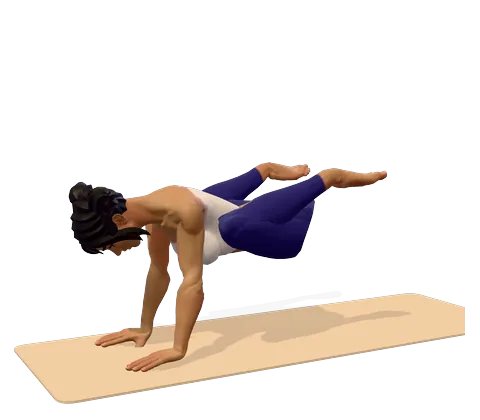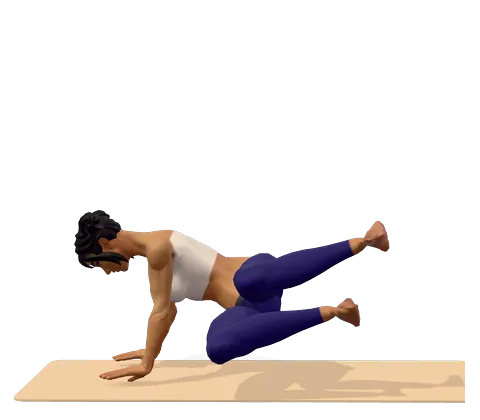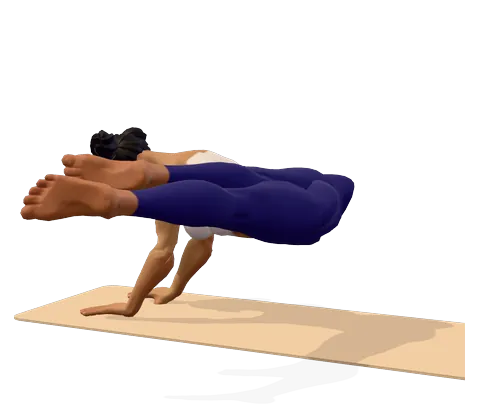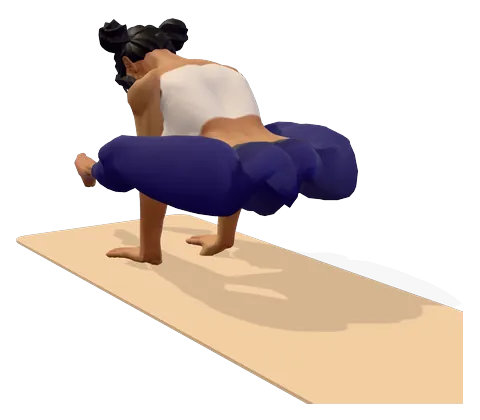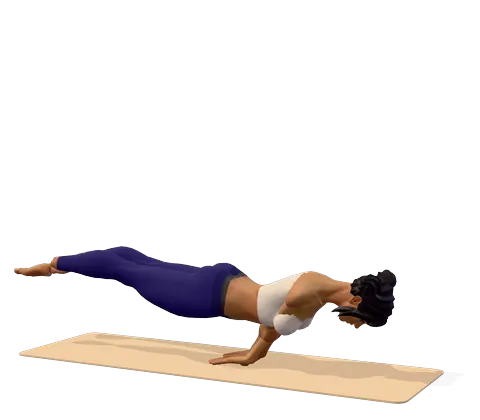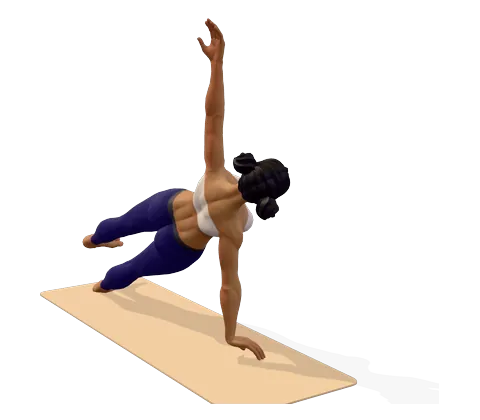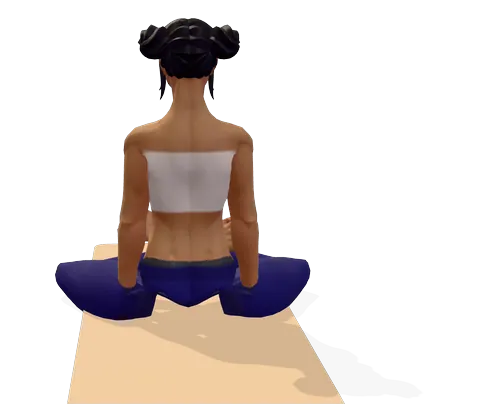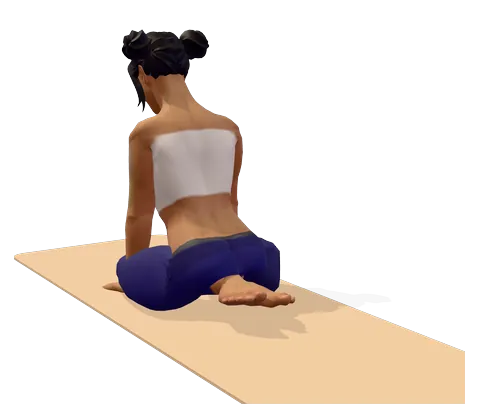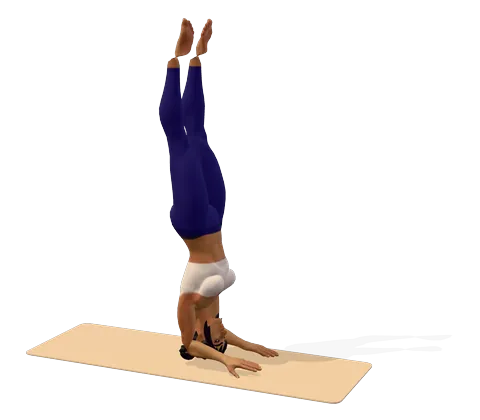
How to do Forearm Stand step by step
- Kneel facing a wall. Place your forearms on the mat, parallel and shoulder-width apart, elbows under your shoulders and fingertips a few centimetres from the wall.
- Tuck your toes and lift your hips into dolphin pose. Walk your feet in until your hips are close to above your shoulders.
- Lift one straight leg high. Bend the standing knee, press your forearms down and hop lightly so the lifted leg swings up; let the other follow until your heels touch the wall.
- Press your forearms and palms into the floor and lift your shoulders away from it. Draw your ribs in and squeeze your legs together.
- Look forward between your hands and hold for 3–5 breaths (15–30 seconds).
- Lower one leg at a time and rest in child's pose for a few breaths.
Where you feel Forearm Stand: what it stretches and strengthens
Press your forearms down and lift through your legs. In the 3D guide, turn on Body guide: areas that stretch glow green and areas that work glow saffron.
Stretches
- Chest
Strengthens
- Shoulders
- Upper back
- Abs
Benefits and precautions
Benefits
- Strengthens the shoulders, upper back, arms and core
- Improves overhead shoulder mobility and opens the chest
- Builds balance and body awareness upside down
- Keeps weight off the head and neck, unlike headstand
- Trains focus and calm under effort
Avoid or modify if
- High blood pressure, heart disease, glaucoma or a detached retina — do not go upside down
- Shoulder, elbow or neck injury, or very stiff shoulders
- Pregnancy — do not practise
- Epilepsy, recent head injury, or during a migraine attack
- During your period many people choose to skip inversions
Forearm stand (Pincha Mayurasana) is an inversion in which you balance upside down on your forearms, with your legs reaching straight up. The base is wider and lower than in a handstand, and your head stays off the floor. Many people find it the most "floaty" inversion once it clicks, but it demands open, strong shoulders. Below are the forearm stand yoga steps in context: the meaning, prep poses, a wall progression for beginners, alignment tips, benefits and safety.
What is Pincha Mayurasana? Name and meaning
The forearm stand yoga name in Sanskrit has three parts: pincha means "feather" (a tail feather), mayura means "peacock" and asana means "pose". So Pincha Mayurasana is the feathered peacock pose of yoga — the legs rise like a peacock lifting its tail. It is one of several bird poses in yoga, along with crow, eagle and pigeon.
It is not the same as Mayurasana (peacock pose), a level arm balance on the hands. In gymnastics, calisthenics and contortion the same shape is often called an elbow stand, and an elbow stand tutorial teaches the same skill.
Forearm stand prep: what you need first
Most people who struggle here are held back by their shoulders, not their balance. Before you hop up, work toward these benchmarks:
- Dolphin pose (Ardha Pincha Mayurasana): the "half" version, on forearms with feet on the floor. Hold for 60 seconds with your chest moving toward your thighs.
- Standard forearm plank: 60 seconds with a straight body and no sagging.
- Overhead reach: lying on your back, you can take straight arms to the floor behind you without the ribs flaring. Extended puppy pose helps here.
- Downward dog: a steady minute in downward-facing dog.
Two props solve the most common problem, elbows sliding apart: a strap looped just above the elbows at shoulder width, and a block held between your hands.
How to do a forearm stand for beginners: wall progression
This forearm stand tutorial works best as a regular practice: 10–15 minutes at a time, three or four times a week. Stay at each stage until it feels steady:
- Dolphin push-ups: from dolphin, shift your chin forward past your hands, then press back. Ten slow reps build shoulder strength.
- Dolphin walk-ins: walk your feet toward your elbows until your hips stack over your shoulders. Lift one leg; hold for three breaths.
- Wall L-shape on forearms: with your back to the wall, place your forearms down and walk your feet up to hip height.
- Hops at the wall: small hops with one leg lifted, landing softly. You do not need to reach the wall yet.
- Forearm stand against the wall: the full kick-up, following the steps above.
- Away from the wall: float one heel off, then both. Learn to come down by stepping one foot to the side; do not roll over your head unless a teacher has shown you how.
Our wall yoga guide has more ways to use a wall as a safe training partner.
Forearm stand tips: alignment
- Forearms parallel: elbows directly under the shoulders, hands no wider than the elbows.
- Shoulders lifted: push the floor away. If your chest sinks toward the mat, the lower back arches and the pose feels heavy.
- Ribs in, legs strong: squeeze the legs together and reach through the feet to avoid a "banana" back.
- Gaze forward: look at the floor between your hands, keeping the neck neutral.
Forearm stand benefits and muscles worked
The main forearm stand yoga benefits are upper-body strength, shoulder mobility and balance. Pincha Mayurasana benefits also include training the core to hold a long straight line, and learning to stay calm while upside down.
| Strengthens | Stretches |
|---|---|
| Deltoids, trapezius, serratus anterior | Latissimus dorsi (sides of the back) |
| Triceps and forearm muscles | Chest and front of the shoulders |
| Abdominals, glutes and legs | Upper back, into extension |
Like all inversions, it does not "detox" the body or improve eyesight. Practise it for strength, mobility and focus.
Forearm stand vs handstand and headstand
Are forearm stands easier than handstands? For balance, usually yes: the base is wider and your centre of gravity is lower. For the shoulders, often no: the forearms fix your arms in place, so tight shoulders turn it into a backbend. Many people learn headstand first, then this pose, then handstand.
Compared with headstand, the big difference is the neck. In a forearm stand no weight rests on your head, which is why some teachers prefer it for students with a sensitive neck (though a neck injury still rules it out).
Forearm stand variations
- Forearm stand split or stag: one leg forward and one back, or one knee bent. Both make balancing easier.
- Forearm stand scorpion pose (Vrischikasana): bend the knees and arch the back so the feet move toward the head. An advanced backbend for people with a healthy, flexible spine.
- With a yoga wheel: some people rest the back against a wheel while learning; keep it steady against a wall.
- Forearm stand to handstand: pressing up onto straight arms. Very advanced; build a steady hold in both shapes first.
Who should avoid Pincha Mayurasana
Do not practise inversions with high blood pressure (see yoga for high blood pressure instead), heart disease, glaucoma, a detached retina, epilepsy, a neck or shoulder injury, or during pregnancy. Many people skip inversions during their period. Come down at once if you feel dizzy, pressure in the eyes or pain in the shoulders.
A short forearm stand yoga sequence and flow
Warm up with cat and cow, downward dog and extended puppy pose. Add dolphin, five dolphin push-ups and a forearm plank. Practise your wall stage three to five times, resting in child's pose between tries. Finish with a gentle twist and a few quiet breaths lying down.
Frequently asked questions
Is forearm stand easier than handstand?
For balance, often yes, because the base is wider and lower. But it needs more shoulder flexibility, so people with tight shoulders may find handstand easier.
How long does it take to get a forearm stand?
With regular practice most people need several weeks to months. Steady progress in dolphin pose and at the wall matters more than attempts in open space.
Why do my elbows slide apart?
This usually means the shoulders are tight or weak. Loop a strap above your elbows at shoulder width and hold a block between your hands.
What is the feathered peacock pose?
It is another name for Pincha Mayurasana. "Pincha" means feather and "mayura" means peacock; the raised legs look like tail feathers.
What is the best prep pose for this inversion?
Dolphin pose (Ardha Pincha Mayurasana). It uses the same forearm base and builds the shoulder strength and flexibility you need.
Is it safe for the neck?
No weight rests on the head, so it is gentler on the neck than headstand. Still, avoid it with a neck injury and keep your gaze forward.
Who should not practise it?
People with high blood pressure, heart disease, glaucoma, epilepsy, shoulder or neck injuries, and pregnant women. Many skip inversions during their period.
This page is for general education. Check with your doctor before starting yoga if you are pregnant, have a medical condition or an injury. Stop if you feel pain, dizziness or shortness of breath.