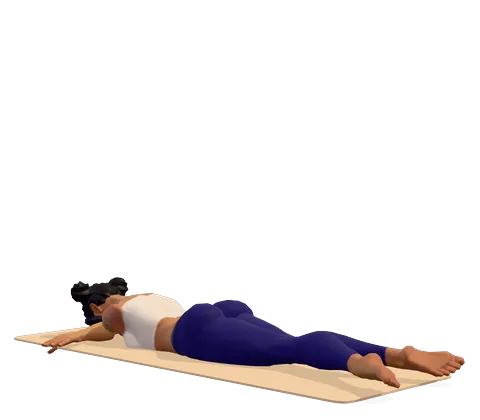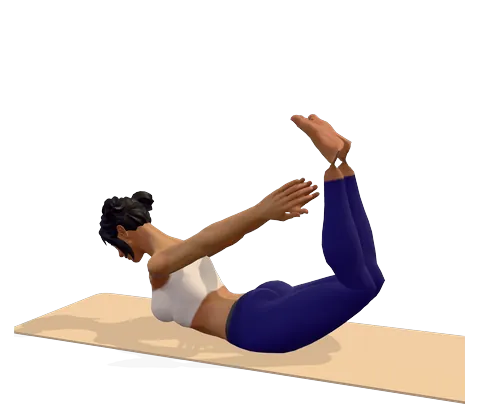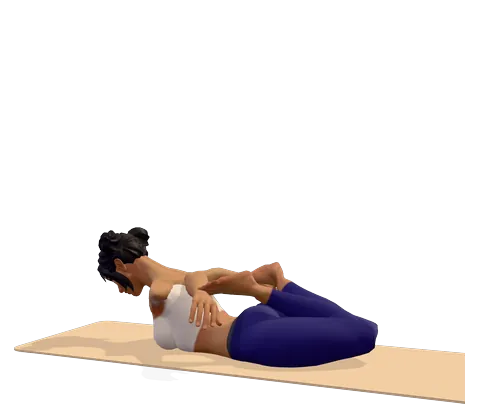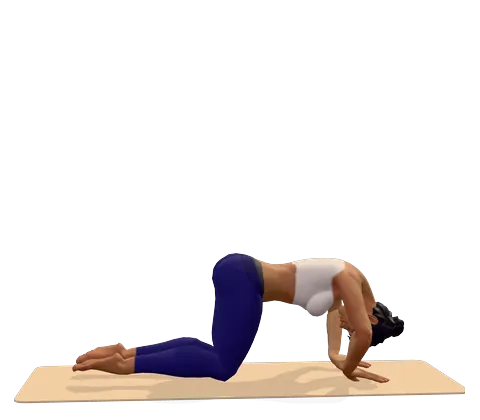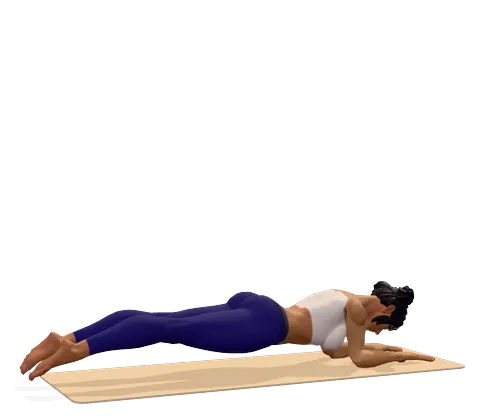
How to do Forearm Plank step by step
- Start on your hands and knees. Lower onto your forearms with your elbows directly under your shoulders and your forearms parallel, palms flat on the mat.
- Tuck your toes under and step your feet back one at a time until your legs are straight.
- Make one straight line from your head to your heels. Your hips are level with your shoulders — not sagging, not lifted.
- Press your forearms into the mat and spread your shoulder blades slightly, so your chest does not sink between them.
- Draw your navel gently toward your spine, squeeze your glutes and press back through your heels. Look at the floor just in front of your hands.
- Hold for 20–60 seconds while breathing steadily. Stop as soon as your hips sag or your lower back aches.
- Lower your knees to the mat and rest in child's pose.
Where you feel Forearm Plank: what it stretches and strengthens
Hold a straight line from head to heels on your forearms. In the 3D guide, turn on Body guide: areas that stretch glow green and areas that work glow saffron.
Strengthens
- Abs
- Shoulders
- Glutes
Benefits and precautions
Benefits
- Strengthens the deep and outer abdominal muscles that stabilise the spine
- Builds endurance in the shoulders, upper back and glutes
- Easier on the wrists than a straight-arm plank
- Teaches you to hold a neutral spine, which carries over to lifting and posture
- Needs no equipment and only a few minutes a day
- Builds the base for chaturanga, side plank and arm balances
Avoid or modify if
- Shoulder or elbow injury — start from the knees or skip it until a physiotherapist clears you
- Low back pain that gets worse in the pose — use the knees-down version and stop if it hurts
- High blood pressure — breathe steadily and keep holds short; never hold your breath
- Pregnancy — after the first trimester use an incline plank with the hands on a wall or table, or ask your midwife
- Diastasis recti or a recent abdominal or hernia operation — avoid full planks until cleared by your doctor
The forearm plank (Makara Adho Mukha Svanasana), also called the elbow plank or dolphin plank, is a plank you hold on your forearms instead of your hands. It is one of the simplest core exercises there is: no movement, no equipment, just a straight body and steady breathing. Yoga classes use it between dolphin and downward dog; gyms use it as a core test. This page covers correct form, muscles worked, how long to hold it, easier and harder variations, and when it is not a good idea.
What is a forearm plank?
A forearm plank is a static hold where your weight rests on your forearms and toes while your body stays in one straight line. The Sanskrit name Makara Adho Mukha Svanasana joins makara, a sea creature from Indian stories usually translated as crocodile, with adho mukha svanasana, downward-facing dog. The name tells you where the pose sits in a yoga class: it is the long, low "crocodile" version of the forearm dog, which is dolphin pose. That is why many teachers simply call it the dolphin plank pose.
How to do a forearm plank: correct form
This elbow plank exercise looks easy, and most mistakes come from trying to hold it too long. Proper form for the forearm plank matters more than time:
- Sagging hips: the most common fault, and the one that makes the lower back ache. Squeeze your glutes and draw the lower belly in.
- Hips too high: an easy way to take work off the abs. Lower until the hips line up with the shoulders.
- Sinking chest: if the shoulder blades squeeze together, press the forearms down and let the upper back fill out.
- Craning the neck: keep your gaze on the floor just in front of your hands, so your head stays in line with your spine.
- Holding the breath: breathe slowly through the nose the whole time.
The 3D guide shows the correct forearm plank position from the side. Rotate it to check the line from ear to shoulder, hip and heel.
Forearm plank benefits and muscles worked
As a core exercise, the forearm plank works because the benefits of the plank come from holding the spine still while gravity tries to bend it. That trains the core to protect the back during everyday lifting, carrying and twisting. It also builds shoulder and glute endurance and improves body awareness. These health benefits of planks apply to everyone; the forearm plank benefits for female and male practitioners are the same, since muscles respond to training the same way.
Muscles used in forearm plank
| Main work | Supporting work |
|---|---|
| Rectus abdominis and transverse abdominis (front and deep core) | Shoulders (deltoids, serratus anterior) |
| Obliques (sides of the waist) | Glutes and quadriceps, which keep the legs straight |
| Erector spinae (back muscles that hold the spine straight) | Upper back and chest |
The elbow plank muscles worked are the same in every variation; only the balance changes. Press the Body guide button beside the 3D figure to see the abs, shoulders and glutes glow as the working areas.
Forearm plank vs straight arm (high) plank
Is a forearm plank easier or harder than a full plank? For the core it is usually harder, because your body sits lower and the abs carry more of the load. For the wrists it is easier, since there is no weight on the hands. The straight arm plank benefits the arms and wrists more, and it is the start of push-ups and chaturanga. So which is better? Neither; do the forearm version for core focus or sore wrists, and the high plank for arm strength. Many people do both.
How long should you hold a forearm plank?
Hold it only as long as your form stays perfect. For most beginners that is 15–30 seconds; 60 seconds with good form is a solid goal. Two or three good holds with rest between them beat one long shaky one. Long forearm plank challenge records do not add much once you can hold a minute; change the variation instead. The forearm plank test used by coaches and in some fitness assessments simply times how long you keep the line.
Forearm plank for beginners and modifications
- Forearm plank on knees: keep the knees down and the line from head to knees straight. This modified version is the best forearm plank exercise for beginners.
- Incline plank: forearms on a bench, table or chair seat. The higher the surface, the easier it gets.
- Short holds: 10 seconds on, 10 seconds off, repeated five times.
Forearm plank variations
- Forearm plank with hip dips: rotate your hips from side to side toward the floor to work the obliques.
- Forearm plank with shoulder taps or a reach: lift one forearm and touch the opposite shoulder, or reach forward, without letting the hips rock.
- Forearm plank with knee taps: tap your knees to the floor and lift them again with control.
- Forearm plank body saw: slide your body forward and back over your elbows by a few centimetres.
- Forearm plank to high plank: press up onto one hand, then the other, and lower back down.
- Forearm plank to dolphin pose (or pike): push your hips up into dolphin and lower back to the plank. This dolphin plank exercise is a classic shoulder builder.
- Side plank on forearm: turn onto one forearm and stack the feet. This forearm side plank is used in yoga as a gentler version of side plank.
In a flow, you can move from forearm plank to downward dog by placing your hands under your shoulders and pressing the hips back.
Is plank good for lower back pain?
Core-strengthening work such as the plank activity is often part of back-pain programmes, and a well-held plank may help you move with more support. But planks for lower back pain only help when the form is right, so learn how to do the plank properly first: a sagging plank loads the lower back. Any plank exercise for lower back pain should feel steady, never painful. Start on your knees, keep holds short and stop if the pain increases or spreads down a leg. If you have a diagnosed disc problem, ask your physiotherapist first. Our yoga for back pain and Core Strength session show gentler ways to build up.
फोरआर्म प्लैंक (Forearm Plank) — हिंदी में: कोहनियों को कंधों के ठीक नीचे रखकर अग्रबाहुओं पर आएँ, पैर पीछे ले जाएँ और पंजे मोड़ें। सिर से एड़ी तक शरीर एक सीधी रेखा में रहे, कूल्हे न नीचे गिरें न ऊपर उठें। सामान्य साँस लेते हुए 20–60 सेकंड रुकें। इसके फायदे: पेट, कमर, कंधे और नितंब की मांसपेशियाँ मज़बूत होती हैं और शरीर का संतुलन सुधरता है। कमर में दर्द बढ़े तो तुरंत रुकें और घुटनों के बल करें।
Frequently asked questions
What are the benefits of a forearm plank?
It strengthens the abdominal muscles, back, shoulders and glutes, teaches you to hold a neutral spine and is easier on the wrists than a straight-arm plank.
How long should I hold a forearm plank?
As long as your form stays perfect: 15–30 seconds for most beginners, building up to about 60 seconds. Several short, clean holds are better than one long sagging one.
Is forearm plank or full arm plank better?
They do different jobs. The version on the forearms puts more load on the core and spares the wrists; the high plank works the arms and shoulders more. Doing both is ideal.
What is Makara Adho Mukha Svanasana?
It is the Sanskrit name of the dolphin plank. "Makara" is a mythical sea creature often translated as crocodile, and "adho mukha svanasana" means downward-facing dog.
Why does my lower back hurt in plank?
Usually the hips are sagging. Squeeze your glutes, draw your lower belly in, lower to your knees and shorten the hold. Stop if the pain continues.
What is an elbow plank?
An elbow plank is the same pose: a plank held on the elbows and forearms with the body in a straight line. Elbow plank variations include hip dips, knee taps and the side plank on one forearm.
What are the forearm plank benefits in Hindi?
फोरआर्म प्लैंक पेट, कमर और कंधों की मांसपेशियों को मज़बूत करता है और शरीर को स्थिर रखना सिखाता है।
This page is for general education. Check with your doctor before starting yoga if you are pregnant, have a medical condition or an injury. Stop if you feel pain, dizziness or shortness of breath.