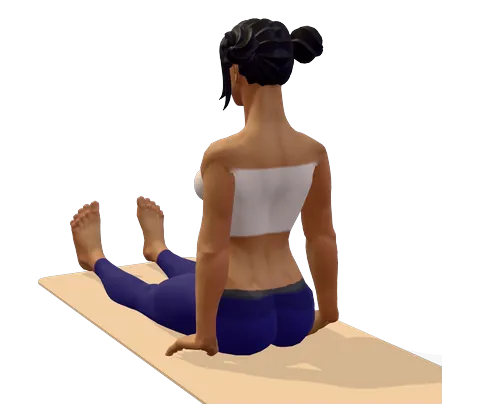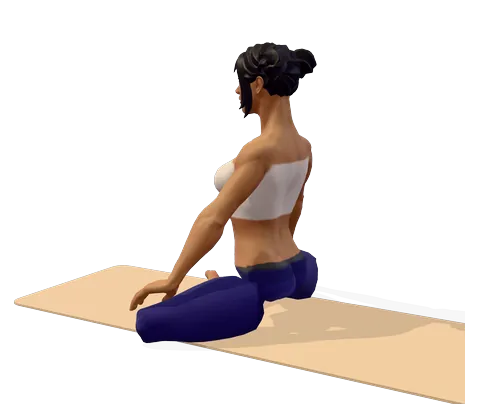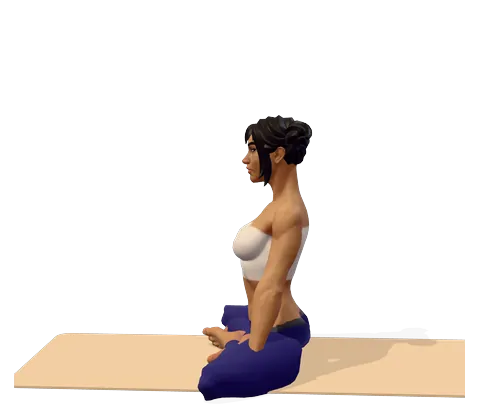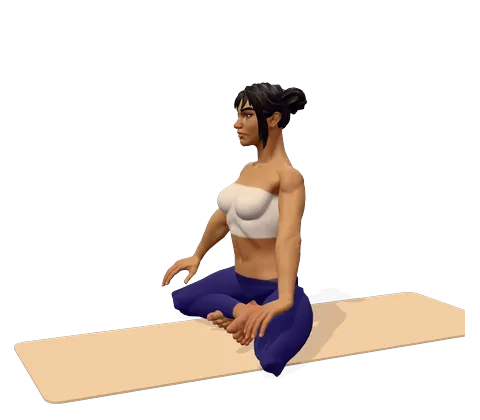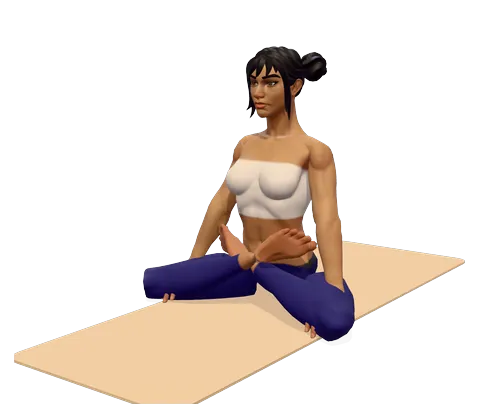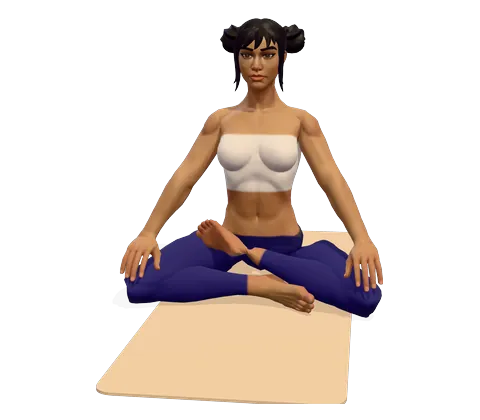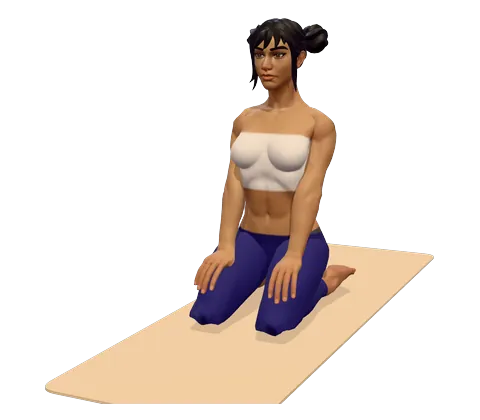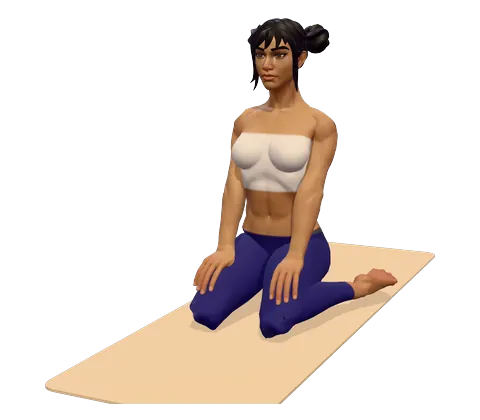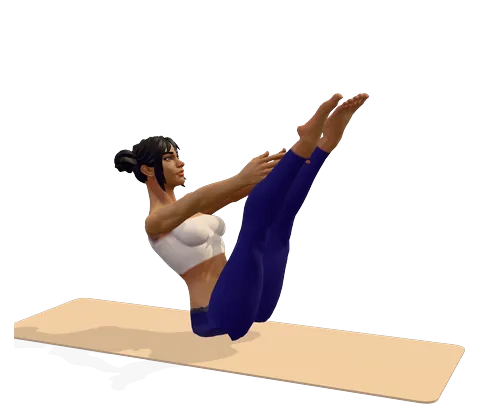
How to do Both Big Toes Pose step by step
- Sit in Staff Pose. Bend both knees and bring your feet close to your buttocks, feet together on the floor.
- Hold each big toe with the first two fingers and thumb of the same hand (yogi toe lock). Use a strap around the feet if you cannot reach.
- Lean back a little until you balance on your sitting bones and the feet lift off the floor. Keep your chest lifted and your back straight.
- Breathe in and slowly straighten both legs up in front of you, still holding the toes. Your legs point up at a steep angle and your arms stay long, elbows slightly out.
- Draw the legs gently toward you, lift the chest toward the legs and look up toward your toes. Do not round the lower back.
- Hold for 10–15 seconds (2–3 breaths), breathing smoothly.
- Breathe out, bend your knees, release the toes and lower your feet to the floor. Rest in Staff Pose.
Where you feel Both Big Toes Pose: what it stretches and strengthens
Balance on your sitting bones and draw both legs close. In the 3D guide, turn on Body guide: areas that stretch glow green and areas that work glow saffron.
Stretches
- Hamstrings
- Calves
Strengthens
- Abs
- Hip flexors
- Spine
Benefits and precautions
Benefits
- Gives a strong stretch to the hamstrings and calves of both legs
- Strengthens the abdominal muscles and hip flexors
- Strengthens the back muscles that keep the spine straight
- Trains balance and concentration on a small base
- Builds the control needed for Boat Pose and other advanced seated balances
Avoid or modify if
- Slipped disc, sciatica or acute low back pain — avoid; rounding under the pull of straight legs loads the lower back
- Hamstring injury — avoid until healed, then practise bent-knee versions
- Pregnancy, hernia or recent abdominal surgery — avoid
- Tailbone (coccyx) pain — sit on a folded blanket or skip the pose
- Neck problems — do not try the rolling entry from Plow Pose used in Ashtanga; enter from sitting
Ubhaya Padangusthasana, the both big toes pose, is an advanced seated balance in which you hold both big toes and lift both straight legs up in front of you, balancing on your sitting bones. It combines a deep hamstring stretch with core strength and balance. In Ashtanga yoga it appears in the Primary Series, often entered by rolling up from Plow Pose. This page explains the name, the prerequisites, the steps, the benefits and easier versions for people who are not ready yet.
Ubhaya Padangusthasana is a level 3 (advanced) pose. Try the full pose only when you can hold Boat Pose with a straight back for five breaths and fold in a seated forward bend without rounding your lower back. Skip it with a disc problem, sciatica or a hamstring injury.
Ubhaya Padangusthasana meaning
The name has four parts: ubhaya means both, pada means foot, angustha means big toe and asana means pose. So Ubhaya Padangusthasana is the both big toe pose, sometimes called double big toe pose. It belongs to a family of big toe poses: Padangusthasana (standing forward bend holding the toes), Supta Padangusthasana (reclining) and Utthita Hasta Padangusthasana (standing on one leg, sometimes listed as Utthita Hasta Padangusthasana 1 when the leg is held forward). The revolved hand to big toe pose adds a standing twist. A different family, the head to toe pose (Janu Sirsasana), folds over one leg without holding the toes in a lock.
Prerequisites: who is ready?
- Straight-leg forward bend: you can hold your feet in Paschimottanasana with a long spine.
- Reclining big toe pose: in reclining big toe pose yoga you can lift each leg to vertical with the knee straight. That shows your hamstrings can handle the full shape.
- Core strength: you can hold Boat Pose for 20–30 seconds with the chest lifted.
- No current back pain. This pose is not for a sensitive lower back.
How to do Ubhaya Padangusthasana: what are the steps?
The steps above follow the 3D guide, which shows the finished shape: sitting bones down, legs up at a steep angle, hands at the feet, chest lifted. If you are asking "what are the steps of Padangusthasana poses in general?", the pattern is the same in all of them: hold the big toes, lengthen the spine first, then move the legs. These cues matter most:
- Bent knees first. Find the balance with bent knees before you straighten the legs. Balance first, stretch second.
- Chest up. Lead with the breastbone toward the feet. If your back rounds, bend the knees again.
- Legs together. Press the inner thighs and big toe edges together.
- Soft shoulders. The arms are straight but the shoulders stay away from the ears.
- Light belly engagement. In Ashtanga, teachers cue a gentle lower-belly lift (mula and uddiyana bandha, see bandhas) to steady the balance. The benefits of Uddiyana Bandha in this pose are mainly steadiness and control; keep it gentle and never strain.
Ubhaya Padangusthasana benefits
What are the benefits of Padangusthasana poses? In this seated version, both hamstrings and calves get a long stretch at the same time, while the abdominal muscles, hip flexors and back muscles work to hold you up. The double big toe pose benefits also include balance and focus, because the base is small and any rounding tips you backward. These big toe pose benefits build over weeks of steady practice, not in one session.
Muscles stretched and worked
| Stretched | Worked |
|---|---|
| Hamstrings of both legs | Abdominal muscles |
| Calves | Hip flexors, lifting the legs |
| Muscles along the spine, keeping the back straight |
Easier versions and modifications
These modifications for yoga poses of this kind let you practise the same idea safely:
- Bent-knee version: hold the toes with the knees bent and the shins parallel to the floor. This is a good yoga pose for beginners who want to learn the balance.
- Strap version: loop a strap around both feet and straighten the legs as far as the back stays straight.
- Hold the ankles or shins instead of the toes.
- Lying version: lie on your back, hold both big toes and lift straight legs toward your face. The floor keeps the back safe.
Does the big toe help balance?
When you stand, yes: the big toe is a key point of the foot's base, and pressing it down helps you stay upright. That is why weak or stiff big toes can affect standing balance. In this pose, though, you balance on your sitting bones, not on your feet, so the balance comes from the core and the back. Holding the toes simply connects your hands to your legs. Toe raises, standing on your toes and slowly lowering, are good for you because they strengthen the calves and feet; the benefits of toe raises for balance are well known in fall-prevention exercise. Toe yoga, lifting only the big toe while the other toes stay down and then the reverse, is a simple way to do toe yoga at home, and its benefits are better control of the small foot muscles. If you want to work on how your toes help with balance, standing poses such as Tree Pose train it more directly.
Which muscle moves the big toe?
Two long muscles of the lower leg do most of the work. The flexor hallucis longus is the muscle that flexes the big toe (curls it down), and the extensor hallucis longus lifts it. So which muscle extends the big toe? That one, helped by a smaller short extensor on top of the foot. In the yogi toe lock you press the big toe gently into your fingers, a small action of the muscles of the great toe that helps you feel the whole leg working.
Toe touching and back pain
People often ask about the benefits of touching your toes. A toe touch exercise stretches the hamstrings, and a flat-backed version can improve flexibility over time. But this pose, like any toe touch done with a rounded back, is not a yoga pose for back pain. If you have low back pain, choose gentle beginner yoga poses for back pain relief, some simple workouts and poses for back pain, and at least one easy yoga pose for lower back pain from our yoga for back pain plan first, and ask your doctor or physiotherapist if pain spreads down your leg.
उभय पादांगुष्ठासन (Ubhaya Padangusthasana) — both big toe pose in Hindi: बैठकर घुटने मोड़ें और दोनों हाथों से पैरों के अंगूठे पकड़ें। थोड़ा पीछे झुककर नितंबों पर संतुलन बनाएँ, फिर साँस लेते हुए दोनों पैर सीधे ऊपर उठाएँ और पीठ सीधी रखें। 10–15 सेकंड रुकें। इस आसन से जाँघों के पीछे की मांसपेशियों में खिंचाव और पेट की मांसपेशियाँ मज़बूत होती हैं। कमर दर्द, स्लिप डिस्क या गर्भावस्था में यह आसन न करें।
Frequently asked questions
What does Ubhaya Padangusthasana mean?
Ubhaya means both, pada means foot and angustha means big toe. It is the both big toes pose, also called double big toe pose.
What are the benefits of Ubhaya Padangusthasana?
It stretches the hamstrings and calves, strengthens the abdominal muscles, hip flexors and back, and trains balance and focus.
Is Ubhaya Padangusthasana good for beginners?
Not in its full form. Beginners can practise the bent-knee version, a strap version or the lying version first.
What is the difference between Ubhaya Padangusthasana and Boat Pose?
In Boat Pose the arms reach forward and the legs are free. In Ubhaya Padangusthasana the hands hold the big toes and the legs are drawn closer, so the hamstring stretch is much stronger.
Why do I roll backward in this pose?
Your back is rounding. Bend your knees, lift your chest and find the balance on the front of your sitting bones before you straighten the legs.
Who should not do Ubhaya Padangusthasana?
Avoid it with a slipped disc, sciatica, acute low back pain, a hamstring injury, a hernia, after abdominal surgery and during pregnancy.
This page is for general education. Check with your doctor before starting yoga if you are pregnant, have a medical condition or an injury. Stop if you feel pain, dizziness or shortness of breath.