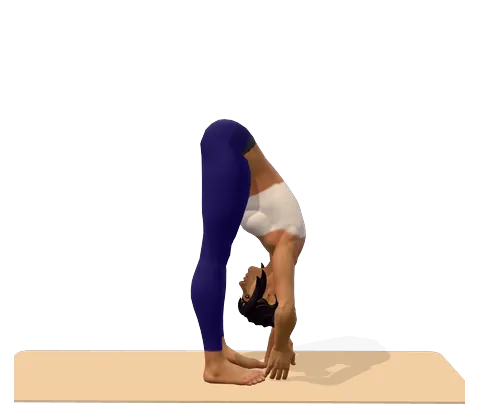
How to do Big Toe Pose step by step
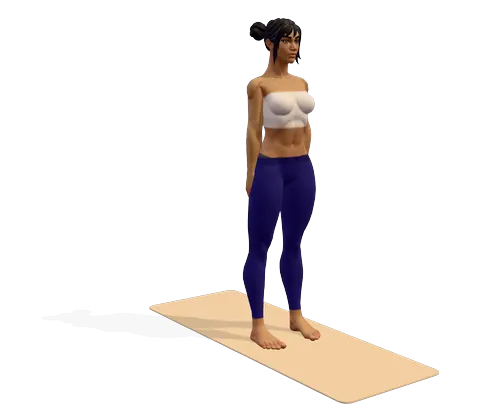
- Stand with your feet hip-width apart and parallel, hands on your hips. Breathe in and lengthen your spine.
- Breathing out, hinge forward from the hips. Bend your knees enough to reach your feet.
- Wrap your index and middle fingers around your big toes and press the thumbs on top to lock the grip. Press the toes down into your fingers.
- Breathing in, lift your chest and straighten your arms so your back becomes flat and long, gaze toward the floor ahead (the half position).
- Breathing out, bend your elbows out to the sides and draw your chest toward your legs. Let the head hang and the neck relax.
- Hold for 5 breaths (about 30 seconds). With each inhale lengthen a little; with each exhale fold a little.
- To come out, release the toes, bring your hands to your hips, bend your knees and rise slowly on an inhale.
Where you feel Big Toe Pose: what it stretches and strengthens
Hold your big toes and gently lengthen your spine forward. In the 3D guide, turn on Body guide: areas that stretch glow green and areas that work glow saffron.
Stretches
- Hamstrings
- Calves
- Lower back
Strengthens
- Front thighs
- Arms
Benefits and precautions
Benefits
- Stretches the hamstrings, calves and back of the body
- Lengthens the spine by pulling actively against the toe grip
- Engages the arms and shoulders, unlike a passive forward fold
- Strengthens the thighs, which lift the kneecaps
- Many people find the head-down fold calming
- Prepares you for seated forward bends and standing leg balances
Avoid or modify if
- Acute back pain, disc injury or sciatica — keep knees well bent and back flat, or skip it
- High blood pressure, glaucoma or recent eye surgery — the head goes below the heart; keep to the half position
- Low blood pressure or dizziness — come up slowly with bent knees
- Hamstring strain or tear — do not pull into the stretch
- Pregnancy — use a wide stance and hold the shins instead; ask your doctor or midwife
Big toe pose (Padangusthasana) is a standing forward bend where you hold your big toes with your fingers. The grip changes everything: instead of simply hanging, you pull gently against your toes to lengthen your spine and fold from the hips. It is a strong hamstring stretch and the opening forward bend of Ashtanga yoga. Here is how to do big toe pose, its benefits, props and variations, and how it relates to the other hand-to-big-toe poses.
What is big toe pose?
In yoga, Padangusthasana is a standing hand-to-big-toe forward fold. The Sanskrit name has three parts: pada means "foot", angustha means "big toe" and asana means "pose". So the Padangusthasana meaning is simply "foot–big toe pose". In Hindi, Padangusthasana is written पादांगुष्ठासन. Padangusthasana pronunciation: pah-dahn-goosh-TAHS-uh-nuh.
Don't confuse it with the one-legged standing balance Utthita Hasta Padangusthasana (extended hand-to-big-toe pose) or the lying-down Supta Padangusthasana (reclining big toe pose). All three share the big toe grip; this one keeps both feet on the floor.
How to do Padangusthasana (Padangusthasana kaise kare)
Follow the steps above, then refine with these big toe pose cues:
- Lock the grip. Index and middle finger go between the big toe and second toe, thumbs on top. This "yogi toe lock" gives you something to pull against.
- Two phases, one breath each. Inhale to a long, flat back with straight arms; exhale to fold with elbows bending out. The inhale makes space, the exhale uses it.
- Elbows out, not back. Bending the elbows sideways widens the shoulders and keeps the neck free.
- Hips over heels. Keep the weight slightly forward, toward the balls of the feet, so the legs stay vertical.
- Bend your knees if your back rounds. A flat back with bent knees is safer and more useful than straight legs and a hunched spine.
Big toe pose benefits (Padangusthasana ke fayde)
The main Padangusthasana benefits come from the active stretch:
- Hamstrings and calves. Because you pull against the toes, the stretch reaches deep into the back of the legs.
- A longer spine. The inhale-and-lengthen phase teaches you to fold from the hips rather than rounding the lower back — a skill that transfers to seated forward bend and every other fold.
- Active arms and shoulders. Unlike a hanging fold, the arms work, which makes this a more engaged stretch.
- Calm and focus. Like other forward bends, many people find the slow, head-down breathing quietening.
Big toe pose is not a treatment for back pain. If you have a sensitive back, see our yoga for back pain plan for gentler options first.
Muscles worked
| Stretches | Strengthens / engages |
|---|---|
| Hamstrings and calves | Quadriceps (lifting the kneecaps) |
| Muscles along the spine and buttocks | Biceps and shoulders (the pull on the toes) |
| Upper back and neck | Hip flexors (drawing the torso down) |
Padangusthasana for beginners: modifications
- Bent knees: the simplest way to reach your toes. Keep the belly close to the thighs.
- Strap around the feet: loop a strap under the balls of both feet and hold the ends. You get the same pull without reaching the toes.
- Hands on shins: if you can't yet reach, hold your shins and practise the flat-back half position.
- Half position only: stay in the inhale phase with a flat back — useful for tight hamstrings, high blood pressure or a sensitive back.
Good Padangusthasana preparatory poses are a standing forward bend and downward-facing dog. Put the three together as a short Padangusthasana sequence in the sequence builder and let the 3D guide lead you.
Padangusthasana vs Padahastasana
In Ashtanga yoga, big toe pose is immediately followed by Padahastasana, where you slide your palms under your feet, toes to the wrist creases. Padahastasana is deeper because it stretches the wrists and asks for more hamstring length. In Hatha Surya Namaskar, the name Padahastasana is also used for the standing forward bend with palms on the floor. Both are part of the same family; start with the toe grip.
Hand-to-big-toe pose variations
The big toe grip appears in several poses, from easy to advanced:
- Reclining big toe pose (Supta Padangusthasana): lying on your back, one leg up, often with a strap. The safest hamstring stretch for beginners and for sensitive backs.
- Extended hand-to-big-toe pose (Utthita Hasta Padangusthasana): standing on one leg, the other leg held out in front. A strong balance.
- Revolved hand-to-big-toe pose: the standing balance with a twist, holding the lifted foot with the opposite hand. Advanced.
- Both big toe pose (Ubhaya Padangusthasana): a seated balance holding both big toes with the legs lifted in a V.
Padangusthasana precautions and contraindications
Because the head goes below the heart and the hamstrings are stretched strongly, the caution box above matters. If you feel pain behind the knee, sharp pulling at the sit bones, or pain travelling down a leg, ease off and bend the knees. A stiff or painful big toe joint is another reason to hold the shins or use a strap. Come up slowly to avoid dizziness.
पादांगुष्ठासन (Padangusthasana) — हिंदी में: पैरों को कूल्हों की चौड़ाई पर रखकर खड़े हों। साँस छोड़ते हुए आगे झुकें और दोनों हाथों की पहली दो उंगलियों से पैर के अंगूठे पकड़ें। साँस लेते हुए पीठ सीधी करें, फिर साँस छोड़ते हुए कोहनियाँ बाहर मोड़कर और नीचे झुकें। 30 सेकंड रुकें। पादांगुष्ठासन के फायदे: जाँघों के पीछे की मांसपेशियाँ और पीठ खिंचती हैं और रीढ़ लंबी होती है। कमर दर्द या हाई ब्लड प्रेशर में घुटने मोड़कर या आधा झुककर करें।
Frequently asked questions
What is big toe pose?
Big toe pose (Padangusthasana) is a standing forward bend in which you hold your big toes with your first two fingers and use the grip to lengthen your spine and deepen the fold.
What are the benefits of big toe pose?
It stretches the hamstrings, calves and back, teaches you to fold from the hips, engages the arms and shoulders, and many people find it calming.
What if I can’t reach my toes?
Bend your knees, hold your shins, or loop a strap under the balls of your feet. The flat-back half position already gives most of the benefit.
What is the difference between Padangusthasana and Padahastasana?
In Padangusthasana you hold the big toes. In Padahastasana you slide your palms under your feet, which is deeper. In Ashtanga yoga they are practised one after the other.
Is big toe pose the same as hand-to-big-toe pose?
No. Big toe pose keeps both feet on the floor in a forward fold. Extended hand-to-big-toe pose is a one-legged standing balance, and reclining hand-to-big-toe pose is done lying on your back.
How long should I hold big toe pose?
About 5 breaths, or 30 seconds. You can repeat it two or three times, going a little deeper each time.
Who should avoid Padangusthasana?
Modify or skip it with an acute back or disc injury, sciatica, a hamstring tear, high blood pressure, glaucoma or recent eye surgery. In pregnancy, use a wide stance and hold the shins.
This page is for general education. Check with your doctor before starting yoga if you are pregnant, have a medical condition or an injury. Stop if you feel pain, dizziness or shortness of breath.