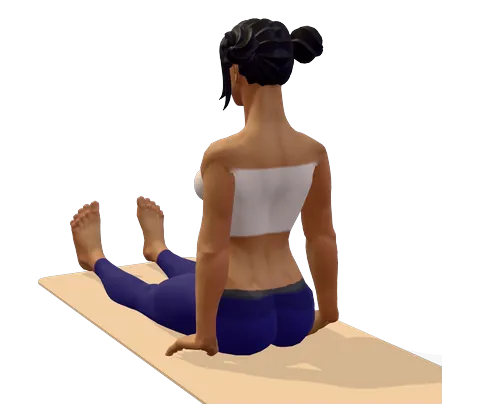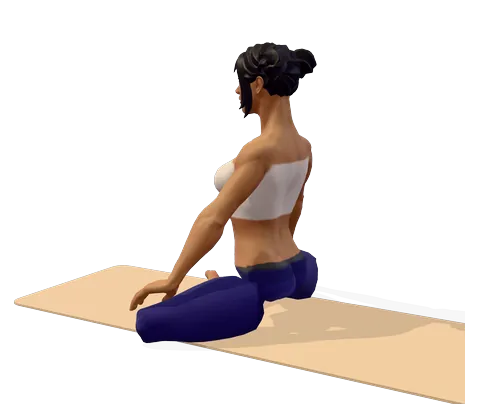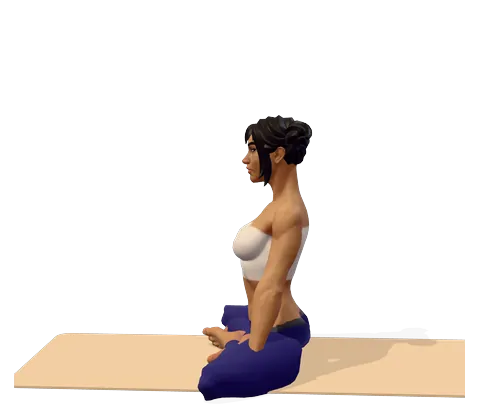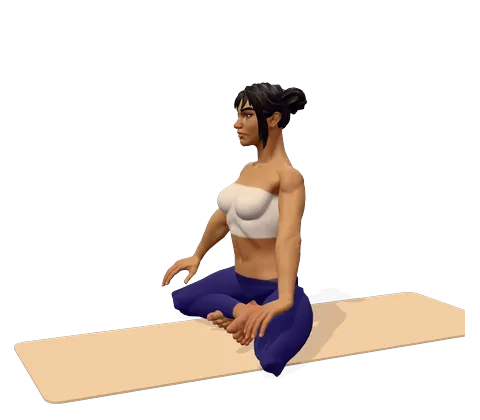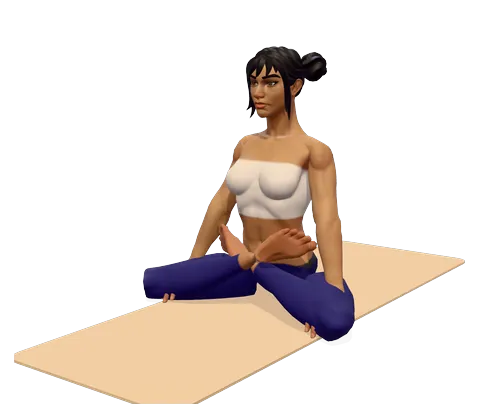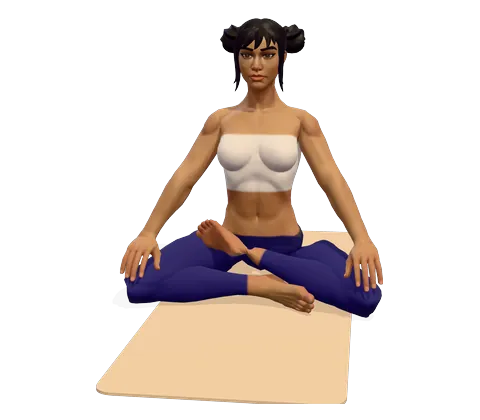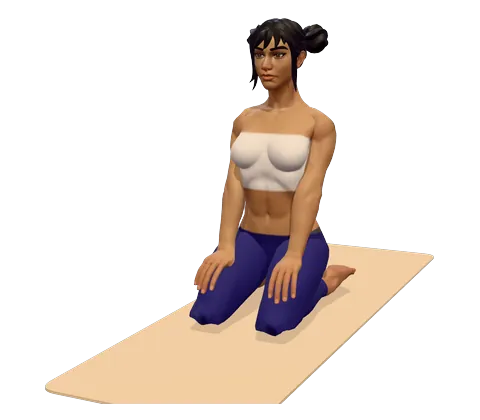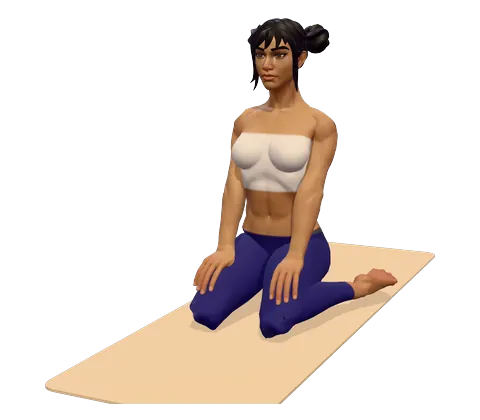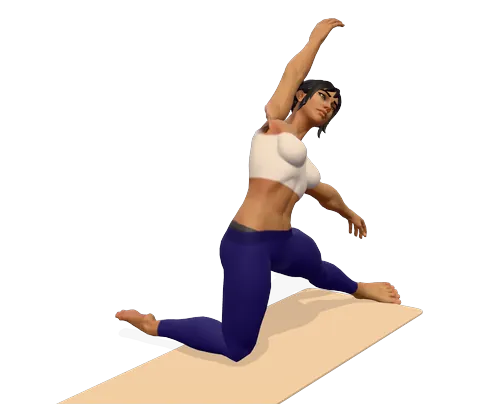
How to do Gate Pose step by step
- Kneel on your mat with your knees hip-width apart and your thighs upright. Put a folded blanket under your knees if the floor feels hard.
- Stretch your left leg out to the left side, in line with your right knee. Keep the left leg straight, the foot flat and the toes pointing forward.
- Check that your hips face forward and stay directly above your right knee, not pushed back toward your heel.
- Breathe in and raise your right arm up beside your ear. Rest your left hand lightly on your left thigh or shin.
- Breathe out and bend sideways over your left leg, sliding the left hand down the leg. Reach the right arm over your head without letting your chest turn toward the floor.
- Hold for 3–5 slow breaths (about 20–30 seconds), breathing into the stretched right ribs. Look forward, or up under the top arm if your neck is comfortable.
- Breathe in to come back up to kneeling, bring the left knee back beside the right and repeat on the other side.
Where you feel Gate Pose: what it stretches and strengthens
Arch sideways and feel your whole side body open. In the 3D guide, turn on Body guide: areas that stretch glow green and areas that work glow saffron.
Stretches
- Side waist
- Inner thighs
- Hamstrings
Strengthens
- Glutes
Benefits and precautions
Benefits
- Stretches the whole side of the trunk: the waist muscles (obliques), the back of the armpit (latissimus dorsi) and the muscles between the ribs
- Lengthens the hamstrings and inner thigh of the straight leg
- Gives the ribs room to expand, so breathing into the side and back of the chest feels easier
- Mobilises the shoulder of the raised arm; a gentle option for a stiff or frozen shoulder
- Wakes up the core and hip muscles that keep you steady on one knee
- Counters long hours of sitting, when the sides of the body stay short
Avoid or modify if
- Knee pain or injury in the kneeling knee — pad it well, or do the chair version
- Acute low back, hip or sacroiliac (SI) joint pain — keep the side bend very small or skip it
- Shoulder injury — keep the top hand on your hip instead of reaching overhead
- Neck pain — look straight ahead rather than up at the raised arm
- Osteoporosis — bend slowly, never bounce or force the stretch, and ask your doctor which movements suit you
- Pregnancy — usually fine as a small side stretch if your midwife or doctor has cleared you for exercise; hold a chair for balance
Gate pose (Parighasana) is a kneeling side bend: one knee on the mat, the other leg stretched out to the side, and your body leaning over that leg like a gate swinging on its hinge. It stretches the waist, ribs and shoulders in a direction daily life rarely asks for, which makes it a useful warm-up and a quick break from desk work. Below you will find the alignment details, what the pose is good for, the muscles it works, variations and who should take care.
What is gate pose in yoga?
It is a lateral (sideways) stretch done from kneeling. The Sanskrit name describes the shape: parigha is the heavy bar that locks a gate and asana means pose. So the Parighasana meaning is "cross-bar pose", and its usual English name is gate pose. The straight leg is the bar; the long line from the kneeling knee to the reaching hand is the gate.
Gate pose in Hindi is परिघासन (Parighasana), and in German classes Parighasana is called Torhaltung, "gate posture". No equipment is needed, though a blanket under the knee helps.
Gate pose alignment tips and cues
The steps above take you in and out. These points are the difference between a real side stretch and a collapsed lean:
- Stack the hips over the kneeling knee. If your bottom drifts back toward your heel, the stretch disappears.
- Line up the legs. The heel of the straight leg sits roughly in line with the kneeling knee. Turning the foot out a little eases a tight hamstring.
- Bend sideways, not forward. Imagine your body between two panes of glass and roll the top shoulder back.
- Length before depth. Reach up first, then over. A long, shallow curve beats a deep bend that crunches the lower waist.
- Keep the lower hand light. Let the side muscles hold you, not the hand on your leg.
Is gate pose an inhale or an exhale?
Both. Breathe in as you lift the arm and lengthen, breathe out as you bend. While you hold, send each inhale into the ribs on the stretched side and feel them widen.
Gate pose benefits
What is gate pose good for? Mainly lengthening the sides of the trunk. Sitting, driving and most gym exercises move us forward and back, rarely sideways, so these muscles stay short.
What does gate pose stretch?
On the long side it stretches the obliques, the quadratus lumborum (a deep muscle running from the lowest ribs to the pelvis), the latissimus dorsi and the muscles between the ribs. The straight leg gets a hamstring and inner-thigh stretch, and the raised arm opens the shoulder.
As the ribs spread, breathing into the side and back of the chest often feels easier. Raising the arm slowly also mobilises the shoulder, which is why the pose appears in our yoga for frozen shoulder plan, where you lift the arm only as far as it goes without pain. It is not a treatment by itself, but regular practice helps keep the spine and shoulders moving.
Gate pose muscles worked
| Stretches | Works and strengthens |
|---|---|
| Obliques and quadratus lumborum on the upper side | Obliques on the lower side, which control the bend |
| Latissimus dorsi and the intercostal muscles | Gluteus medius and deep hip muscles of the kneeling leg |
| Hamstrings and adductors of the straight leg | Quadriceps of the straight leg, which keep the knee firm |
Gate pose for beginners: modifications
- Sore knee: fold a blanket under the kneeling knee.
- Tight hamstrings: bend the straight leg slightly, or rest the heel down with the toes pointing up.
- Short reach: rest the lower hand on a block beside the straight leg.
- Shoulder pain: keep the top hand on your hip and simply lengthen.
- Gate pose on a chair: sit sideways on a sturdy chair, stretch one leg out and bend over it. It is the easiest version, ideal in chair yoga and for seniors who cannot kneel.
Gate pose for kids works well as a game: "open the gate" by bending over the leg, "close the gate" by coming back up.
Gate pose variations
- Classic Parighasana: in the Iyengar yoga version the lower hand slides to the ankle and the top arm reaches over until the palms meet above the foot.
- Revolved gate pose: turn the chest toward the straight leg and reach the top arm toward the foot, adding a twist.
- Gate pose with thread the needle: sweep the top arm down and under your chest so that shoulder moves toward the floor — a release for the upper back.
- Gate pose forward fold: face the straight leg and fold over it, a hamstring stretch close to head-to-knee pose.
- Gate pose to supported side plank: put the hand on the kneeling side on the floor under your shoulder, lift your hips and sweep the other arm up. Stronger students then straighten into full side plank.
Gate pose vs modified side plank and stargazer
All three start from kneeling with one leg out. In gate pose your weight stays on the kneeling knee and the work is mostly stretching. In a modified side plank one hand goes to the floor and the hips lift, so the side body works against gravity. Stargazer is a kneeling side plank with the top arm reaching overhead past the ear. Gate pose is the usual preparation for both.
Parighasana contraindications and precautions
If you feel pinching in the lower waist, you have gone too deep: come up a little and lengthen. Sharp pain in the kneeling knee means stop and pad the knee or use a chair. After a recent shoulder or back injury, ask a physiotherapist first. In pregnancy, widen the base, keep the bend small and hold a chair if balance feels uncertain.
Gate pose prep, warm up and flow
Good Parighasana preparatory poses are cat pose and cow for the spine, a low lunge for the hip flexors and a gentle standing side bend. A simple gate pose yoga sequence: cat–cow, low lunge on each side, gate pose on each side, a kneeling side plank, then rest in child's pose. Triangle pose gives a similar side opening while standing. Build your own flow in the sequence builder or follow a voice-guided session on the practice page.
परिघासन (Parighasana) — हिंदी में: घुटनों के बल बैठें और बायाँ पैर सीधा करके बगल की ओर फैलाएँ। साँस लेते हुए दायाँ हाथ ऊपर उठाएँ और साँस छोड़ते हुए बाईं ओर झुकें। 20–30 सेकंड रुकें, फिर दूसरी तरफ़ करें। परिघासन के फायदे: कमर और पसलियों के किनारे खिंचते हैं, साँस गहरी होती है और कंधे खुलते हैं। घुटने में दर्द हो तो नीचे कंबल रखें या कुर्सी पर बैठकर करें।
Health conditions this pose is used for
Yoga for frozen shoulder · Yoga for tennis elbow
Frequently asked questions
What is gate pose good for?
It stretches the sides of the trunk, the ribs and the shoulder of the raised arm, and lengthens the hamstrings of the straight leg. It is a useful warm-up and a good counter-stretch after sitting.
What are the benefits, precautions and contraindications of Parighasana?
Benefits: a deep side-body stretch, easier breathing into the side ribs and better shoulder mobility. Take care or skip it with a knee injury in the kneeling leg, acute low back or SI joint pain, a shoulder injury or neck pain.
How do I get into gate pose if kneeling hurts?
Put a folded blanket under the kneeling knee. If that still hurts, sit sideways on a chair, stretch one leg out and bend over it — the same side stretch with no weight on the knee.
How long should I hold gate pose?
Hold for 20–30 seconds (3–5 breaths) on each side. In a slow practice you can stay up to a minute if the knee is comfortable.
Can I do gate pose during pregnancy?
Usually yes, as a gentle side stretch, if your doctor or midwife has cleared you for exercise. Widen the kneeling base, keep the bend small and hold a chair for balance.
What is Parighasana also known as?
Its English name is gate pose. "Parigha" means the bar that locks a gate. In Hindi it is परिघासन, and German classes call it Torhaltung.
This page is for general education. Check with your doctor before starting yoga if you are pregnant, have a medical condition or an injury. Stop if you feel pain, dizziness or shortness of breath.