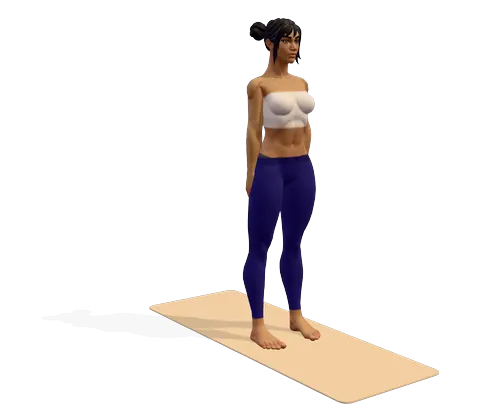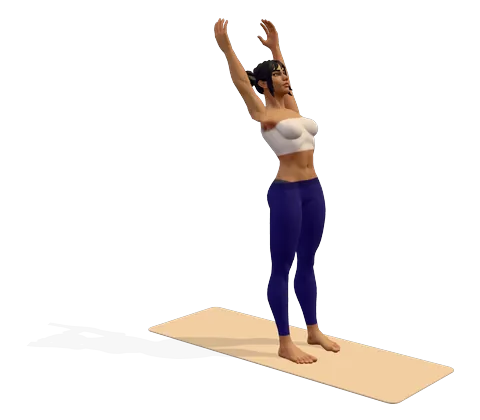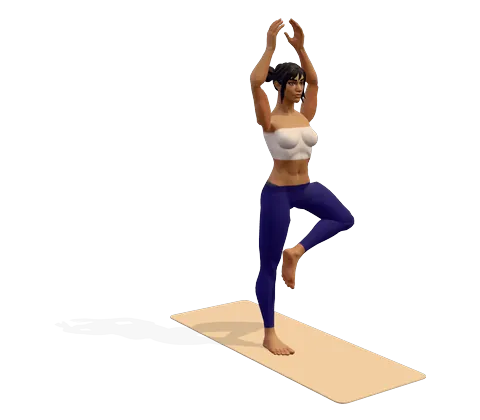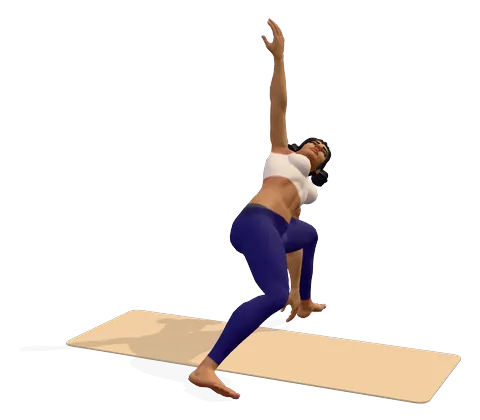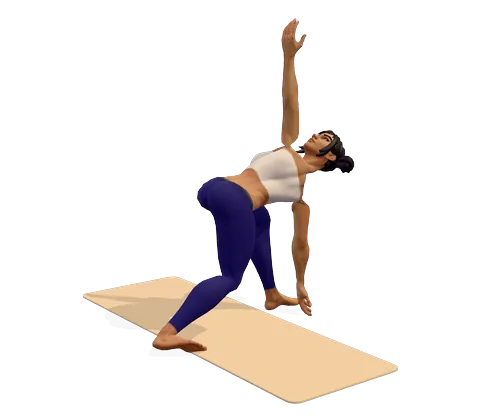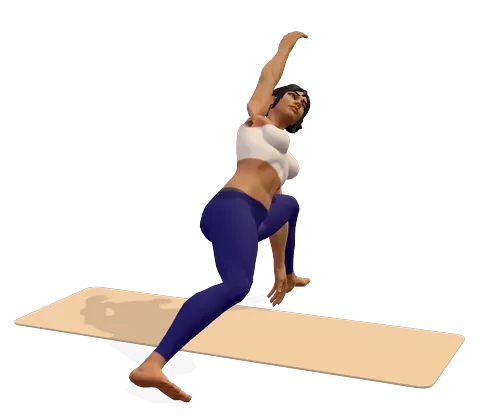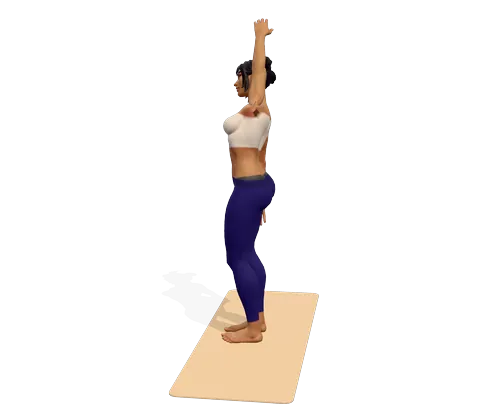
How to do Lateral Arc Pose step by step
- Stand tall with your feet a little apart, arms by your sides, weight even on both feet.
- Breathing in, raise your left arm out to the side and up until your upper arm is beside your ear, palm facing in.
- Stretch up through your left fingertips to lengthen the left side of your waist.
- Breathing out, bend slowly to the right from the waist. Let your right hand slide down the outside of your right leg.
- Reach your left arm up and over your head toward the right. Keep your chest and face turned forward and do not lean forward or back.
- Hold for 15–20 seconds (2–4 breaths), breathing into the stretched left side.
- Breathing in, return to upright, lower your left arm, and repeat on the other side with the right arm up.
Where you feel Lateral Arc Pose: what it stretches and strengthens
Reach the top arm up and over and feel one side of your waist lengthen. In the 3D guide, turn on Body guide: areas that stretch glow green and areas that work glow saffron.
Stretches
- Side waist
- Shoulders
- Spine
Strengthens
- Abs
Benefits and precautions
Benefits
- Stretches the side waist (obliques) and the sides of the ribs
- Stretches the shoulder and underarm of the raised arm
- Moves the spine sideways, improving everyday flexibility
- Works the abdominal muscles that hold and return the bend
- Opens the side ribs so breathing feels fuller
- An easy warm-up for triangle and other standing poses
Avoid or modify if
- Acute back pain, a slipped disc or scoliosis — bend only a little and ask your physiotherapist
- Recent abdominal surgery or a hernia — avoid until your doctor says it is safe
- Shoulder injury — keep the raised hand on your hip or on your head instead
- After hip surgery — follow your surgeon’s hip precautions, including any rules for the lateral or anterior lateral approach
- Vertigo or dizziness — move slowly and keep your eyes looking straight ahead
Ardha Kati Chakrasana (lateral arc pose) is a standing side bend in which you raise one arm beside your ear and bend sideways, letting the other hand slide down your leg. It is one of the first poses taught in Indian schools and yoga centres, often under the name Konasana, because it is easy, needs no props and stretches the whole side of the body. This guide shows how to do it step by step, what it is good for and how to keep it safe.
What is Ardha Kati Chakrasana?
The Sanskrit name means "half waist wheel pose": ardha is "half", kati is "waist", chakra is "wheel" and asana is "pose". The body makes half of an arc or a wheel from the waist, which is why it is called the lateral arc pose (you may also see "lateral arch pose"). In English it is simply a standing side bend in yoga. There is no single standing side bend Sanskrit name used by every school; Ardha Kati Chakrasana and Konasana are the two you will meet most.
What is lateral bending?
Lateral bending, or lateral flexion, means bending the spine sideways, to the left or right. It is one of the six directions the spine can move (forward, back, two sides and two twists). Yoga lateral flexion poses like this one, swaying palm tree and gate pose train a movement most of us almost never use in daily life.
How to do Ardha Kati Chakrasana (Ardha Kati Chakrasana kaise kare)
The steps above follow the 3D guide: left arm up, bending to the right. In Ardha Kati Chakrasana yoga practice, the whole movement is slow and led by the breath, which is what makes it different from a quick standing side bend exercise. These points make the stretch work:
- Lift before you bend. Reach the arm up first to create length, then arc over. This standing side bend with overhead reach keeps the waist long instead of crunched.
- Stay in one plane. Imagine a wall in front of and behind you. Do not let the chest turn down or the hips swing back.
- Both feet grounded. Press the foot on the stretching side into the floor; it anchors the whole arc.
- Arm by the ear, not in front of the face. Keep the elbow straight and the shoulder away from the ear.
- Breathe into the long side. Feel the ribs open on each inhale.
A gentle "standing side bend pulses" version, bending a little deeper and back a little with the breath, is a nice way to warm up before holding still.
Ardha Kati Chakrasana benefits
The main benefits of this standing side bend are flexibility and awareness in the side body. The obliques and the muscles between the ribs stretch, the shoulder and underarm of the raised arm open, and the spine moves in a direction it rarely does. At the same time the abdominal muscles, especially on the stretched side, control the bend and lift you back up, so there is gentle work for the waist too.
Is it a standing side bend for abs? It works the obliques lightly, but it is mainly a stretch. Unlike a standing side bend with weights in the gym, it uses only body weight and focuses on length, not load. Many people also find breathing easier afterwards, because the side ribs have more room.
Muscles stretched and worked
| Stretched | Worked |
|---|---|
| Obliques on the side of the raised arm | Abdominal muscles, controlling the bend |
| Shoulder and underarm of the raised arm | Obliques, lifting you back to upright |
| Spine (side bending) | Feet and legs, keeping you steady |
Konasana yoga and its variations
Kona means "angle". In many Indian syllabi and teacher-training courses, Konasana is taught as numbered versions, such as Konasana 1 and Konasana 2, which change the width of the feet and whether one or both arms reach up. The idea is always the same: a sideways bend with a long waist. Other variations:
- Both arms up: join the palms overhead and bend; this is closer to swaying palm tree.
- Hand on the head: for a sore shoulder, rest the top hand on your head. If your shoulders are tight in general, learning how to do Gomukhasana arms helps over time.
- Chair version: sit tall on a chair and bend sideways; one of the easiest chair yoga poses for back pain and stiffness.
Do not confuse it with the seated "konasana" poses: Baddha Konasana (bound angle), Upavistha Konasana (wide-angle seated forward bend) and Supta Baddha Konasana. Baddha Konasana yoga practice opens the hips and inner thighs, Upavistha Konasana benefits the hamstrings, and Supta Baddha Konasana (the meaning is "reclining bound angle") is a resting yoga pose; the supported Baddha Konasana benefits are mostly relaxation. None of them is a side bend. For beginners, Baddha Konasana and Upavistha Konasana both work best sitting on a folded blanket.
Ardha Kati Chakrasana vs Ardha Chakrasana and Chakrasana
The names are close but the poses are not. Ardha Chakrasana (half wheel pose) is a standing backward bend with the hands supporting the lower back; the benefits of Ardha Chakrasana are for the chest and front of the body. Full Chakrasana, the wheel pose, is an advanced backbend from lying down. How to do Chakrasana easily? Not quickly: learn bridge pose and half wheel first, then follow the wheel page step by step. Ardha Kati Chakrasana is the easy one of the three.
The extended side angle pose offers similar benefits for the side body with a deep lunge, so it is a good next step once this feels easy.
Is it a good yoga pose for back pain?
For general stiffness, gentle side bends are often included among poses for yoga for back pain and in simple workouts or poses for back pain at home, and many people find them relieving. Among yoga poses for low back pain, side bends are usually combined with a gentle twist such as Ardha Matsyendrasana, which beginners can do with the lower leg straight. For a slipped disc, scoliosis or sharp pain, bend only a little and choose the order of poses in our yoga for back pain plan. The best asanas for back pain relief, and the best yoga poses for lower back pain relief in general, are the ones that leave you feeling better the next day. If a yoga pose for lower back pain makes the pain spread into a leg, stop. You can practise with voice guidance in our guided sessions.
Students often need a stick diagram of Katichakrasana for school practical files. Instead of static Ardha Kati Chakrasana images, Konasana images or Ardh Chakra asana images, pause the 3D figure and rotate it to see the arc from the front; that also works for Konasana yoga images in other variations.
Ardha Kati Chakrasana benefits in Hindi
Many readers search for Chakrasana benefits in Hindi; here is this side bend in short.
अर्ध कटि चक्रासन (Ardha Kati Chakrasana) — हिंदी में: सीधे खड़े हों, पैरों में थोड़ा अंतर रखें। साँस लेते हुए बायाँ हाथ कान के पास ऊपर उठाएँ। साँस छोड़ते हुए दाईं ओर झुकें, दायाँ हाथ पैर पर नीचे सरकाएँ। 15–20 सेकंड रुकें, फिर दूसरी तरफ़ करें। फायदे: कमर के किनारे और कंधों में खिंचाव, रीढ़ में लचीलापन और साँस लेने में आसानी। कमर में तेज़ दर्द हो तो कम झुकें।
Frequently asked questions
What is Ardha Kati Chakrasana?
It is a standing side bend, also called lateral arc pose or Konasana. You raise one arm beside your ear and bend sideways from the waist while the other hand slides down your leg.
What are the benefits of Ardha Kati Chakrasana?
It stretches the side waist, ribs and shoulder, moves the spine sideways, gently works the abdominal muscles and makes side-rib breathing easier.
Is Ardha Kati Chakrasana the same as Konasana?
Very often, yes. Many Indian schools use Konasana for the same standing side bend. Some courses number the versions, such as Konasana 1 and 2.
How long should I hold Ardha Kati Chakrasana?
Hold for 15–20 seconds (2–4 breaths) on each side, and do 2–3 rounds.
Who should avoid it?
Take care with acute back pain, a slipped disc, a hernia, recent abdominal or hip surgery, or a shoulder injury. Bend only a little or ask your doctor or physiotherapist.
What is the difference between Ardha Kati Chakrasana and Ardha Chakrasana?
Ardha Kati Chakrasana bends sideways. Ardha Chakrasana bends backward with the hands supporting the lower back.
This page is for general education. Check with your doctor before starting yoga if you are pregnant, have a medical condition or an injury. Stop if you feel pain, dizziness or shortness of breath.