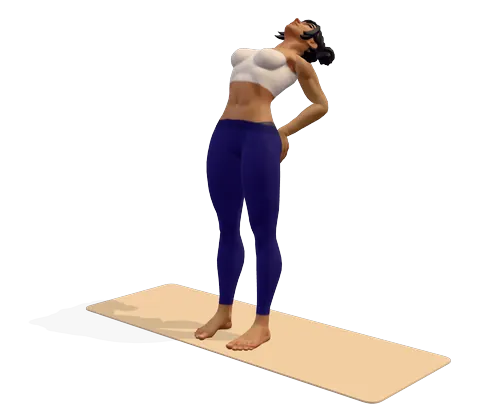
How to do Standing Backward Bend step by step
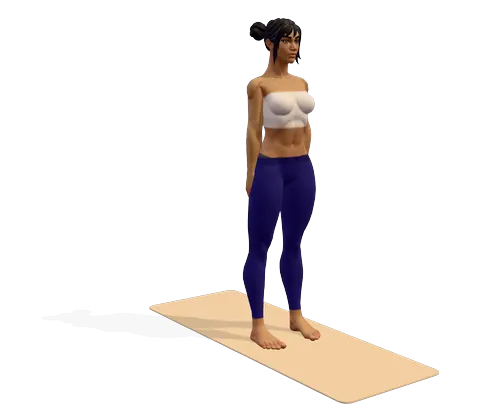
- Stand tall with your feet together or hip-width apart and your arms by your sides. Take a few steady breaths.
- Place your palms on your lower back, on the back of the hips, with the fingers pointing down. Draw your elbows back toward each other.
- Press your feet into the floor, firm your thighs and gently squeeze your buttocks to protect the lower back.
- Breathing in, lift your chest up toward the ceiling first, then bend backward slowly from the upper back. Let your hips move forward a little over your feet.
- Let your head follow gently, keeping the back of the neck long. Look up or back only as far as is comfortable.
- Hold for 10–20 seconds (2–4 breaths), breathing normally, with your hands supporting your back.
- Breathing out, lead with your chest and come up slowly to standing, head last. Lower your arms and relax.
Where you feel Standing Backward Bend: what it stretches and strengthens
Support your lower back with your hands and lift your chest as you bend back. In the 3D guide, turn on Body guide: areas that stretch glow green and areas that work glow saffron.
Stretches
- Chest
- Abs
- Hip flexors
Strengthens
- Lower back
- Glutes
Benefits and precautions
Benefits
- Stretches the chest, the front of the shoulders and the abdomen
- Stretches the hip flexors at the front of the hips
- Strengthens the lower back muscles and the glutes
- Counters slouching and long hours of sitting
- Opens the chest so breathing feels fuller
- Prepares you safely for deeper backbends
Avoid or modify if
- Vertigo, dizziness or low blood pressure — bend only a little, keep your eyes looking forward, and come up slowly
- Neck problems — do not drop the head back; keep the chin slightly tucked and look forward
- Spondylolisthesis, spinal stenosis or lower back pain that worsens when you arch — skip it or ask your physiotherapist
- Recent abdominal or spinal surgery, or a hernia — avoid until your doctor says it is safe
- Heart disease or uncontrolled high blood pressure — only a very gentle bend, after checking with your doctor
- Pregnancy — a very small lift of the chest with support only; ask your midwife or doctor
Ardha Chakrasana (standing backward bend) is a gentle backbend done standing, with your palms supporting your lower back. It is the easiest way to learn to bend backward safely, which is why it is part of the Common Yoga Protocol taught on International Yoga Day and of most school yoga programmes. It opens the chest and the front of the hips and strengthens the back, a useful counter to sitting and looking down at screens.
What is Ardha Chakrasana?
The Ardha Chakrasana meaning is "half wheel pose": ardha means "half", chakra means "wheel" and asana means "pose". The spine curves backward like half of a wheel, which is why some teachers call it the half circle yoga pose. In English it goes by several names: standing backward bend, standing backbend and half wheel pose. Some modern styles use another standing backbend Sanskrit name, Anuvittasana, often with the arms reaching overhead instead.
What is a back bend?
A back bend is any movement that arches the spine backward (extension), opening the front of the body. Back bend poses in yoga range from gentle ones like this and Cobra pose to strong ones like Camel and the full wheel. Are backbends good for you? For most healthy people, gentle ones practised with care are a useful balance to all the forward bending we do in daily life.
How to do a standing backbend (Ardha Chakrasana steps)
The steps above follow the 3D guide. If you want the simplest answer to "how to do a backbend easy", this is it: hands on your lower back, lift the chest first, then bend. Here is how to do a proper backbend from standing:
- Lift, then bend. Think "up and over", not "back and down". The chest rises toward the ceiling before the spine arches.
- Bend from the upper back. Most people bend only at the waist, which pinches the lower back. Spread the bend along the whole spine.
- Hands support, they do not push. The pose with hands behind the back steadies the pelvis; it should not shove the hips forward.
- Legs strong. Keep the knees straight but not locked, and the thighs firm.
- Neck long. Let the head follow the chest; do not throw it back.
How to stand up from a backbend
Coming out matters as much as going in. Breathe out, press your feet down, lead with your chest and let your head come up last. Pause in Mountain pose for a breath before the next pose, especially if you tend to feel dizzy.
In Ardha Chakrasana, which is the correct pose? Hands on the lower back with fingers pointing down, elbows drawn back, legs straight, chest lifted and head gently back. That is the version shown by the 3D figure. Some programmes, including the Common Yoga Protocol, wrap the fingers forward around the waist with the thumbs behind; both hand positions are correct as long as they support the back.
Ardha Chakrasana benefits
The benefits of standing backbend practice come from opening the front of the body. The chest, the front of the shoulders and the abdomen stretch, and so do the hip flexors, which get tight from sitting. At the same time the lower back muscles and the glutes work to control the bend, which makes it one of the simplest standing exercises to strengthen back muscles.
Many people find it improves posture awareness and makes breathing feel fuller, because the chest opens. These backward bend benefits make it a good pause for desk workers; it fits well with our yoga for posture plan.
Muscles stretched and worked
| Stretched | Strengthened |
|---|---|
| Chest and front of the shoulders | Lower back muscles along the spine |
| Abdominal muscles | Glutes, which support the pelvis |
| Hip flexors at the front of the hips | Thighs, holding the legs steady |
Standing backbend for beginners
- Stay small. A lift of the chest with a tiny bend is a complete pose.
- Feet hip-width apart give a steadier base than feet together.
- Use a wall: stand a forearm's length from a wall, facing away, and let your hands slide up the wall behind you as you lift the chest.
- Keep your eyes forward if you feel unsteady.
- Warm up first: raised arms pose, cat and cow, or a few rounds of Surya Namaskar.
Half wheel pose vs wheel pose in yoga
The full wheel pose (Urdhva Dhanurasana or Chakrasana) starts lying on your back and presses up on the hands and feet. How difficult is the wheel pose? Quite: it needs open shoulders, strong arms and a flexible spine. For a yoga wheel pose for beginners path, learn Ardha Chakrasana, Bridge pose and Camel first. Wheel yoga pose benefits are similar but much stronger. The standing backbend gymnastics students do, dropping back to the hands or a kickover, is a separate skill and needs a coach.
Do not confuse Ardha Chakrasana with Ardha Kati Chakrasana, a standing side bend; the benefits of Ardha Kati Chakrasana are for the side waist rather than the front of the body. Other gentle yoga backward bending poses include the half bow pose.
Ardha Chakrasana contraindications
Standing back bending asanas are gentle, but not for everyone. Skip or modify the pose with vertigo, low blood pressure or dizziness, neck problems, spondylolisthesis, spinal stenosis, recent abdominal or spinal surgery, a hernia, heart disease or uncontrolled high blood pressure. What are back precautions? After spinal surgery, doctors often give "no bending, lifting or twisting" precautions; any spinal precautions with no bending include backward bending, so wait for your surgeon's approval. Back precautions for spinal stenosis often limit arching: see yoga for spinal stenosis. With a standing backbend and a bulging disc, some people feel better and some worse; stop at once if pain spreads into a leg. Practise safely with voice guidance in our guided sessions.
अर्ध चक्रासन (Ardha Chakrasana) — हिंदी में: सीधे खड़े हों और हथेलियों को कमर के पीछे रखें, उँगलियाँ नीचे की ओर। साँस लेते हुए छाती ऊपर उठाएँ और धीरे-धीरे पीछे झुकें, गर्दन को आराम से पीछे जाने दें। 10–20 सेकंड रुकें और साँस छोड़ते हुए वापस आएँ। अर्ध चक्रासन के फायदे: छाती और पेट में खिंचाव, कमर की मांसपेशियाँ मज़बूत, बैठने से आई झुकी मुद्रा में सुधार। चक्कर आते हों या कमर में तेज़ दर्द हो तो यह आसन न करें।
Frequently asked questions
What are the benefits of Ardha Chakrasana?
It stretches the chest, abdomen, shoulders and hip flexors, strengthens the lower back and glutes, counters slouching and makes breathing feel fuller.
Who should not do Ardha Chakrasana?
Skip or modify it with vertigo, low blood pressure, neck problems, spondylolisthesis, spinal stenosis, recent abdominal or spinal surgery, a hernia, heart disease or uncontrolled high blood pressure.
How long should I hold Ardha Chakrasana?
Hold for 10–20 seconds (2–4 breaths). Repeat 2–3 times with a pause in between.
Is Ardha Chakrasana good for back pain?
For general stiffness from sitting, a gentle version may help. If arching increases your pain, or you have a disc problem or spinal stenosis, ask a physiotherapist first.
What is the difference between Ardha Chakrasana and Chakrasana?
Ardha Chakrasana is a gentle standing backbend with the hands on the lower back. Chakrasana (wheel pose) is a full backbend lifted from the floor on the hands and feet.
Where should my hands be in Ardha Chakrasana?
On the back of your hips or lower back, fingers pointing down, with the elbows drawn back toward each other.
This page is for general education. Check with your doctor before starting yoga if you are pregnant, have a medical condition or an injury. Stop if you feel pain, dizziness or shortness of breath.