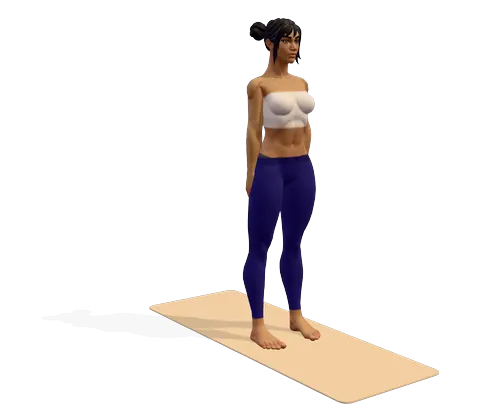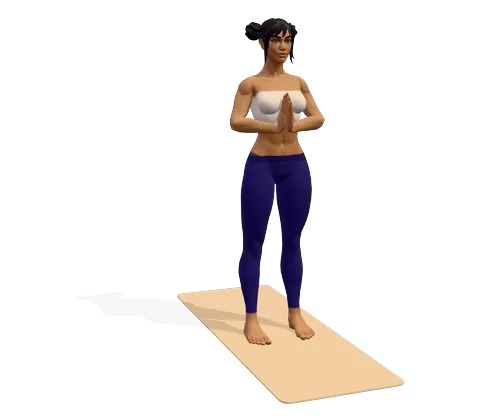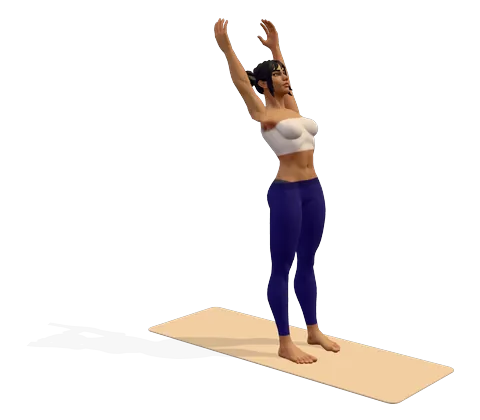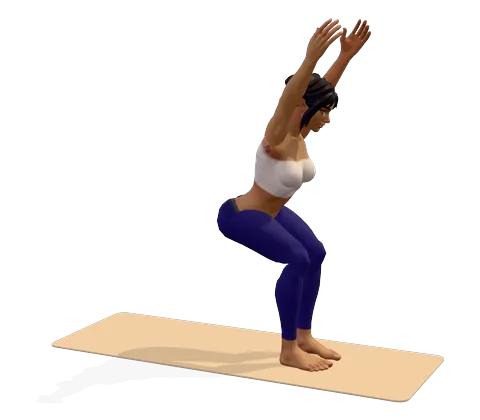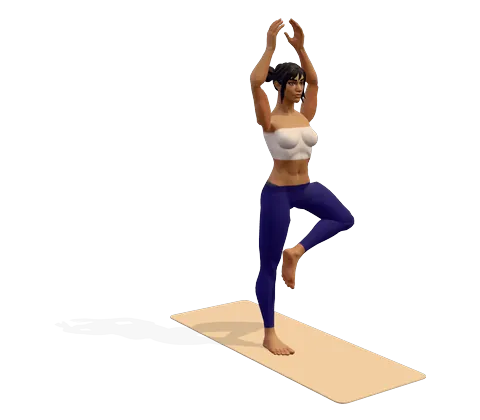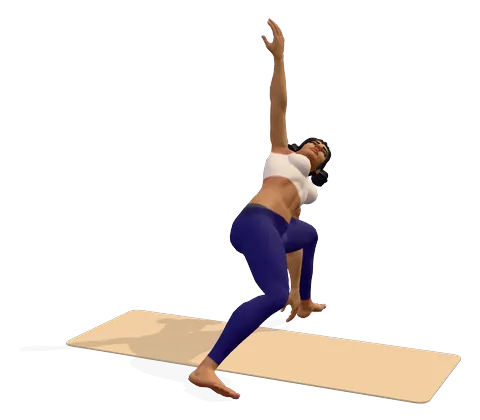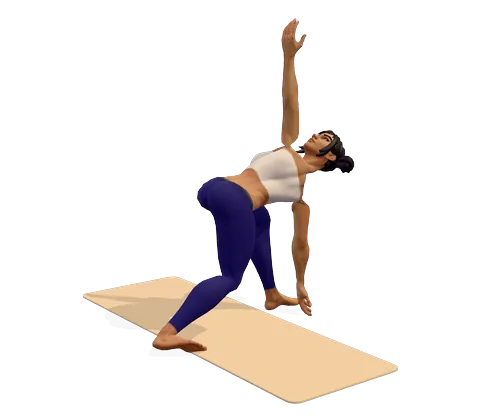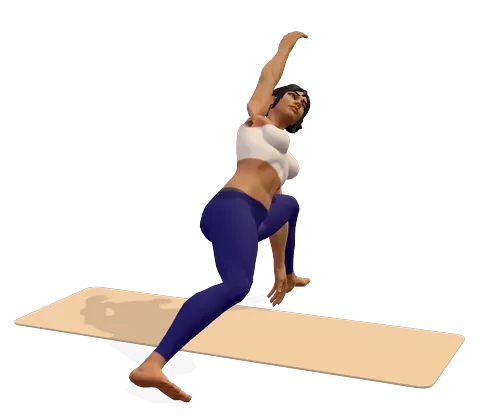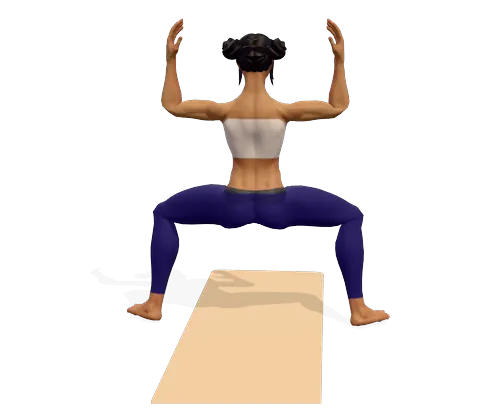
How to do Goddess Pose step by step
- Stand with your feet about one leg-length apart (roughly 1 metre). Turn your toes out about 45 degrees so your heels point slightly in.
- Breathing out, bend your knees and lower your hips straight down. Your knees should point in the same direction as your toes and stay over your ankles or just behind them.
- Sink until your thighs move toward level with the floor, or only as far as your knees are comfortable. Keep your weight spread through both feet.
- Lift your arms out to the sides at shoulder height and bend your elbows so your forearms point up, palms facing forward (cactus arms).
- Keep your chest upright, your tailbone pointing down and your shoulders away from your ears. Draw your lower belly gently in.
- Hold for 5 steady breaths (about 30 seconds), pressing your knees gently back toward your little toes.
- To come out, press into your feet and straighten your legs on an inhale. Lower your arms and step your feet together.
Where you feel Goddess Pose: what it stretches and strengthens
Push your knees out over your toes and sink low. In the 3D guide, turn on Body guide: areas that stretch glow green and areas that work glow saffron.
Stretches
- Inner thighs
- Hip flexors
Strengthens
- Front thighs
- Glutes
- Shoulders
Benefits and precautions
Benefits
- Strengthens the thighs, buttocks, inner thighs and calves
- Opens the hips and inner groin
- Builds endurance and warms the body quickly
- Strengthens the core and back muscles that keep the spine upright
- Opens the chest and shoulders with the cactus arms
- Improves stability for walking, lifting and carrying
Avoid or modify if
- Knee pain or knee injury — keep the bend shallow and never let the knees fall inward
- Recent hip, groin or ankle injury — ask your physiotherapist first
- Pelvic girdle pain (SPD) in pregnancy — keep the stance narrow or skip it
- Shoulder injury — rest the hands on the thighs instead of raising the arms
- High blood pressure or heart disease — keep the hold short, breathe freely and never hold your breath
Goddess pose (Utkata Konasana) is a wide-legged squat: feet apart, toes turned out, knees bent and arms raised. It looks simple, but after 30 seconds your thighs will tell you it is working. It builds leg strength, opens the hips and warms the body, which is why it appears in strength flows, prenatal classes and hip-opening sequences alike. This guide covers how to do goddess pose, its benefits, muscles worked, variations and how it compares with horse stance.
What is goddess pose in yoga?
It is a standing squat with a wide stance. The Sanskrit name has three parts: utkata means "fierce" or "powerful", kona means "angle", and asana means "pose". So the goddess pose meaning in Sanskrit is "fierce angle pose". The English name goddess pose is modern; it points to the strong, grounded stance of the fierce goddess figures of Indian art, such as Kali. You may also see it called horse stance, victory squat or star squat. In Hindi it is written उत्कट कोणासन.
Utkata Konasana pronunciation: OOT-kah-tah koh-NAHS-uh-nuh.
How to do goddess pose correctly
Follow the steps above. These goddess pose cues keep the knees and back safe:
- Knees follow toes. This is the single most important rule. If the knees drift inward, turn the toes out less or bring the feet a little closer.
- Straight down, not forward. Lower the hips like sitting onto a low stool behind and between your feet, keeping the chest over the pelvis.
- Neutral pelvis. Don't stick the bottom out and don't over-tuck. Let the tailbone point down toward the floor.
- Active arms, soft shoulders. Spread the fingers and press the elbows gently back, but keep the neck relaxed.
- Breathe. Strong poses tempt you to hold your breath. Keep breathing smoothly through the nose.
How long to hold goddess pose
Beginners can hold for 15–30 seconds and repeat two or three times. With practice you can build to a minute. In martial arts, horse stance holds are much longer, but for yoga practice, good form matters more than time.
Goddess pose benefits
What is goddess pose good for? Mostly strength and hip mobility. The main Utkata Konasana benefits:
- Strong legs: the thighs and buttocks hold you in a squat, so the pose builds muscular endurance without any equipment.
- Open hips: the turned-out thighs stretch the inner groin, which is why it is part of our yoga for tight hips plan and the Hip Opener session.
- Heat and calorie burn: big leg muscles working together raise your heart rate. That is why it appears in our yoga for weight loss plan — as part of regular practice with good food and movement, not a fat-burning trick on its own.
- Posture: keeping the chest upright with the arms raised works the upper back and opens the chest.
Benefits for women and men
Goddess pose benefits for women and men are largely the same: stronger legs, looser hips and better stability. Women often meet it in prenatal yoga, where a gentle, supported version can help keep the legs strong in pregnancy — only with your doctor's or midwife's approval, and not if you have pelvic girdle pain. For men who lift weights or run, it is a useful hip-mobility drill.
Goddess pose muscles worked
| Strengthens | Stretches |
|---|---|
| Quadriceps (front of the thighs) | Inner thighs (adductors) and groin |
| Gluteal muscles (buttocks) and hip rotators | Hips and chest |
| Calves and small muscles of the feet | Front of the shoulders (cactus arms) |
| Core and the muscles along the spine |
Goddess pose for beginners and variations
- Shallow goddess: bend the knees only a little and rest your hands on your thighs. Build depth over weeks.
- Goddess at a wall: stand with your back against a wall to learn an upright spine — like a wide wall sit.
- Chair support: hold the back of a chair in front of you for balance, useful for seniors.
- Goddess pose with a twist: place your hands on your thighs and dip one shoulder toward the opposite knee to twist the upper back. Skip deep twists in pregnancy.
- Goddess pose on toes: lift both heels to strengthen the calves and challenge balance.
- Goddess pulses: move up and down a few centimetres with the breath for more heat.
- Arm options: prayer hands at the chest, eagle arms, or arms reaching overhead.
For a restful counterpart, try the reclining version — lying on your back with the soles together, known as reclining bound angle pose.
Goddess pose vs horse stance, sumo squat and Malasana
- Goddess pose vs horse stance: in the traditional horse stance of kung fu and tai chi, the feet point forward and parallel. In goddess pose the toes turn out, which is easier on the knees and opens the hips more.
- Goddess pose vs sumo squat: a sumo squat is a moving strength exercise, often with a weight. Goddess pose is held with the arms active and the breath steady.
- Goddess pose vs Malasana: Malasana (garland pose) is a deep squat with the hips close to the floor and the feet closer together; goddess keeps the hips at knee height.
- Goddess vs chair pose: chair pose uses the same "fierce" root, utkata, but with the feet together.
Goddess pose in a sequence
Warm up with a few rounds of Sun Salutation, then move from Warrior II into goddess by turning both feet out. After holding, fold forward with the legs wide, or rest in child's pose. Build your own flow in the sequence builder, or follow the Hip Opener session in the guided sessions.
Goddess pose contraindications and precautions
Most people can do some version of goddess pose. Be careful with knee, hip or ankle problems, and follow the caution box above. Is horse stance good for lower back pain? It may help by strengthening the legs and core, but only if you keep a neutral spine; if your back hurts in the squat, come up and ask a physiotherapist.
उत्कट कोणासन (Goddess Pose) — हिंदी में: पैरों को चौड़ा फैलाएँ और पंजों को बाहर की ओर मोड़ें। घुटने मोड़कर कूल्हों को नीचे ले जाएँ; घुटने पंजों की दिशा में रहें। हाथों को कंधे की ऊँचाई पर उठाकर कोहनियाँ ऊपर मोड़ें। 30 सेकंड रुकें और साँस चलती रहे। फायदे: जाँघें और कूल्हे मज़बूत होते हैं, कूल्हे खुलते हैं और शरीर में गर्मी आती है।
Health conditions this pose is used for
Yoga for hip pain and tight hips · Yoga for weight loss · Yoga for pregnancy (prenatal yoga) · Yoga for erectile dysfunction · Yoga for self-confidence
Where this practice is used
Chakras: Svadhisthana (Sacral Chakra)
Frequently asked questions
What is goddess pose good for?
Goddess pose strengthens the thighs, buttocks and core, opens the hips and inner thighs, and warms the body. It is used in strength, hip-opening and prenatal classes.
How long should I hold goddess pose?
Start with 15–30 seconds and repeat two or three times. Build up to about a minute as your legs get stronger, keeping the knees in line with the toes.
What is the difference between goddess pose and horse stance?
In horse stance the feet point straight ahead and the thighs are parallel to the floor. In goddess pose the toes turn out, which opens the hips and is kinder to the knees.
Is goddess pose safe in pregnancy?
A gentle, supported version is common in prenatal yoga, but ask your doctor or midwife first. Skip it or keep the stance narrow if you have pelvic girdle pain.
Why do my knees hurt in goddess pose?
Usually the knees are falling inward or going past the toes. Turn the toes out less, press the knees back toward the little toes and don’t squat as low.
What muscles does goddess pose work?
Mainly the quadriceps, gluteal muscles, inner thighs and calves, plus the core and upper back when the arms are raised.
What is Utkata Konasana in Sanskrit?
Utkata means fierce or powerful, kona means angle and asana means pose — "fierce angle pose", known in English as goddess pose.
This page is for general education. Check with your doctor before starting yoga if you are pregnant, have a medical condition or an injury. Stop if you feel pain, dizziness or shortness of breath.