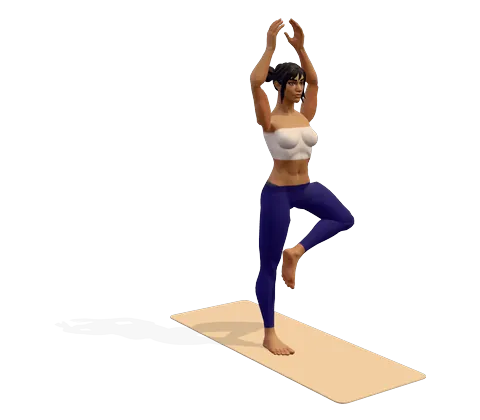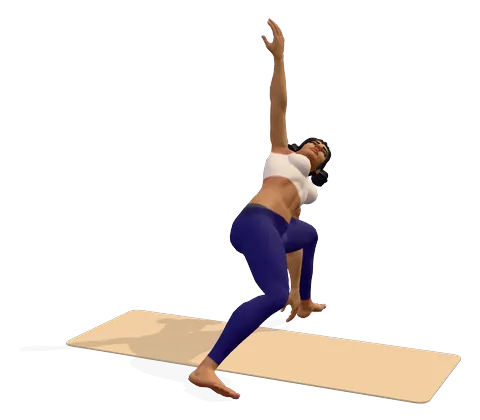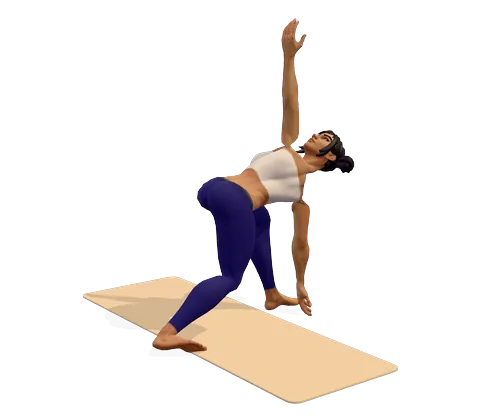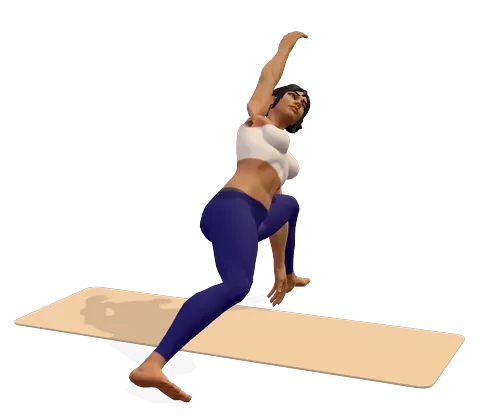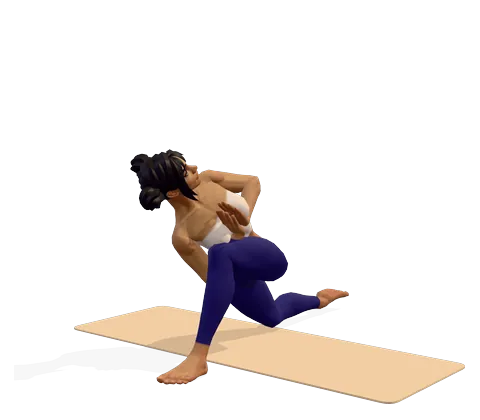
How to do Revolved Low Lunge step by step
- From Downward Dog or a forward fold, step your left foot forward between your hands and lower your right knee to the mat. Slide the right knee back until you feel a stretch at the front of the right hip.
- Place your left knee over your left ankle and rest the top of your right foot on the mat. Pad the back knee with a folded blanket if it is sensitive.
- Lift your chest and bring your palms together at the centre of your chest.
- Breathe in to lengthen your spine. Breathing out, turn your chest to the left and hook your right elbow outside your left knee.
- Press your palms together to roll your left shoulder back and turn your chest up. Look up or to the side if your neck is comfortable.
- Hold for 20–30 seconds (3–5 breaths): lengthen on the inhale, turn a little more on the exhale.
- Breathe in, return to the centre, place your hands on the floor and step back. Repeat with the right foot forward.
Where you feel Revolved Low Lunge: what it stretches and strengthens
Hook your elbow outside the front knee and turn your chest up. In the 3D guide, turn on Body guide: areas that stretch glow green and areas that work glow saffron.
Stretches
- Hip flexors
- Side waist
- Upper back
Strengthens
- Front thighs
- Glutes
Benefits and precautions
Benefits
- Stretches the hip flexors and front of the thigh of the back leg
- Rotates and mobilises the upper back and stretches the obliques
- Strengthens the thighs and glutes of the front leg
- Opens the chest and the front of the shoulders
- Supported by the back knee, so it is steadier than a standing twist
- The gentle squeeze of the belly is often felt as helpful for digestion
Avoid or modify if
- Pregnancy: avoid closed twists; turn open, away from the front leg, only gently, or skip it
- Disc problems (for example at L4–L5), sciatica or recent back injury: keep the twist small or skip it and follow your physiotherapist
- Knee pain: pad the back knee well and keep the front knee over the ankle, not past the toes
- Recent abdominal surgery or hernia: avoid twisting until your doctor clears you
- Neck problems: keep your gaze forward or down instead of up
Revolved low lunge (Parivrtta Anjaneyasana) combines two things most bodies need: a hip flexor stretch and a spinal twist. You kneel in a low lunge with the back knee on the floor, bring your palms together and turn your chest toward the front leg. Because the back knee supports you, it is a steadier way to twist than a standing pose, which makes it a good first revolved lunge for beginners.
What is a revolved low lunge? Sanskrit name
The revolved low lunge pose Sanskrit name is Parivrtta Anjaneyasana. Parivrtta means "revolved" or "turned", Anjaneya is a name of Hanuman, the monkey god, son of Anjana, and asana means "pose". Anjaneyasana is the plain low lunge, often called crescent lunge in yoga, so this pose is also called revolved crescent low lunge, twisted crescent lunge or a low lunge with rotation.
When the back knee lifts and the back leg straightens, the shape becomes the revolved high lunge pose, also called revolved crescent lunge pose (Parivrtta Ashta Chandrasana, the revolved crescent lunge Sanskrit name). That version is harder on balance.
How to do a correct lunge twist: revolved crescent lunge cues
The steps above follow the 3D figure, which twists to the left over the left leg first. These are the lunge with twist teaching points that matter most:
- Hips stay low and level. The twist should not pull the back hip up. Keep sinking forward and down.
- Front knee over ankle. As you twist, the front knee often drifts inward. Press it into your arm to keep it steady.
- Lengthen first, then turn. Lift the chest on the inhale; turn on the exhale. Twisting with a rounded back puts the effort in the wrong place.
- Turn from the ribs. The twist lives in the upper and middle back, not the lower back.
- Keep the neck easy. Look up only if it feels fine; forward is just as good.
Feel it at the front of the back hip and through the middle back, never as sharp knee or back pain.
Revolved low lunge benefits
The revolved (rotated) low lunge stretch works on the front of the hips, which tighten from sitting, and on the upper back, which stiffens from leaning over screens. Twisting the ribs over a fixed pelvis mobilises the spine and stretches the obliques. The front leg works to hold the lunge, building strength in the thigh and glutes.
| Stretched | Worked |
|---|---|
| Hip flexors and front thigh of the back leg | Quadriceps and glutes of the front leg |
| Obliques and the sides of the waist | Core muscles that turn and steady the torso |
| Upper back, chest and front of the shoulders | Muscles between the shoulder blades |
Twists are often promoted as a "detox". There is no good evidence for that, but many people do find that a gentle twist feels good for digestion. See yoga for digestion for a fuller routine.
Revolved low lunge and crescent lunge variations: more ways to twist in yoga
- Hand on the floor: place the right hand on the floor or a block inside the front foot and reach the left arm up. This open twist is kinder on the shoulders.
- Revolved bound low lunge: wrap the lower arm under the front thigh and the top arm behind your back to clasp hands. Only for flexible, experienced students.
- Revolved crescent lunge twist, knee lifted: the high version, with the back leg straight. Try it after high crescent lunge feels steady.
Low lunge vs high lunge in yoga
Crescent lunge vs low lunge is mostly about the back knee. With the knee down (low lunge), balance is easy and the hip flexor stretch is deeper. With the knee lifted (high or crescent lunge), the legs work harder and balance is the challenge. The same is true for crescent lunge vs high lunge in their twisted forms: the revolved low lunge pose with the knee on the floor is the easier starting point.
Lunges with a twist in fitness training
Outside yoga, a lunge and twist exercise is a popular warm-up. A walking lunge with twist, a reverse lunge with twist or rotation and a runner’s lunge with twist are all lunges with a torso twist, done while moving. Used as a lunge with twist dynamic stretch, they warm up the hips and spine before running or sports. The yoga pose is the slow, held version of the same idea.
Are lunges bad for the lower back?
Not usually; many people with low back stiffness find lunges helpful, because tight hip flexors can pull on the lower back. The twist is the part to be careful with. If you have a disc problem, for example low back pain from an L4–L5 disc, ask your physiotherapist before twisting and read our yoga for slip disc guidance. A plain low lunge without the twist is often a safer place to start. More gentle options are in our yoga for back pain plan.
How to modify a lunge, and what to do instead of lunges
- Sore back knee: fold the mat or a blanket under it.
- Tight hips: shorten the stance and place your hands on blocks.
- Cannot kneel at all: sit sideways on a chair for a gentle twist, or try revolved chair pose standing.
A simple low lunge yoga flow: Downward Dog, low lunge, revolved low lunge, lizard pose, back to Downward Dog, then the other side. You can practise twists with voice in our guided sessions.
Frequently asked questions
What is revolved low lunge good for?
It stretches the hip flexors of the back leg, rotates the upper back, stretches the obliques and strengthens the front leg. It is a useful counter to long hours of sitting.
Is the back knee down in revolved low lunge?
Yes. In revolved low lunge the back knee rests on the floor. Lifting it turns the pose into revolved high (crescent) lunge.
Why does my back knee hurt in low lunge?
The kneecap is pressing into a hard floor. Fold a blanket under the knee or slide it back so you rest just above the kneecap.
Can I do revolved low lunge in pregnancy?
Closed twists that press the belly toward the thigh are not recommended in pregnancy. An open, gentle twist away from the front leg may be fine; ask your midwife or doctor.
What are the benefits of lunges with a twist?
They combine leg strength, hip flexor stretch and spinal rotation in one movement, which makes them an efficient warm-up for walking, running and sports.
How long should I hold revolved low lunge?
Hold for 20–30 seconds, or 3–5 breaths, on each side, then repeat with the other leg forward.
This page is for general education. Check with your doctor before starting yoga if you are pregnant, have a medical condition or an injury. Stop if you feel pain, dizziness or shortness of breath.