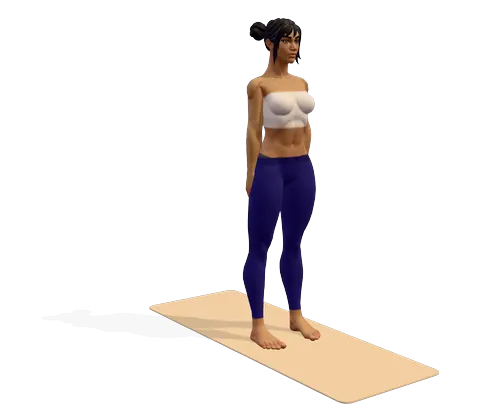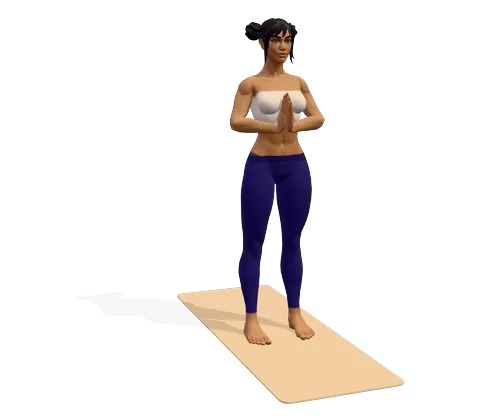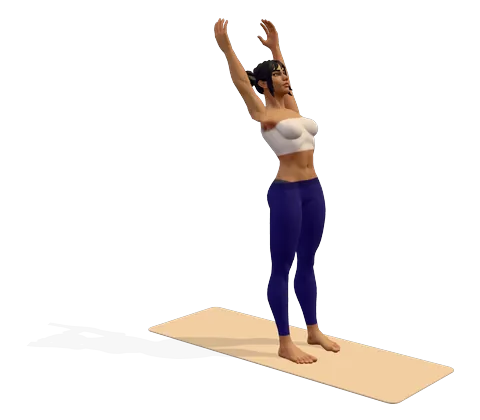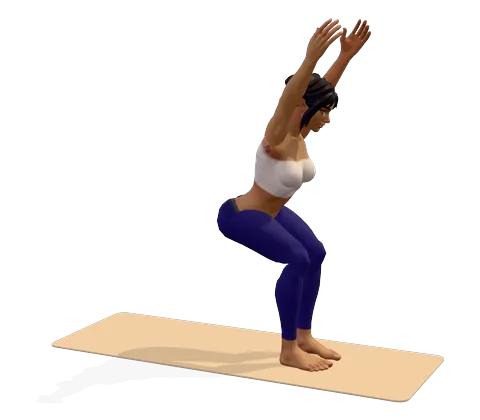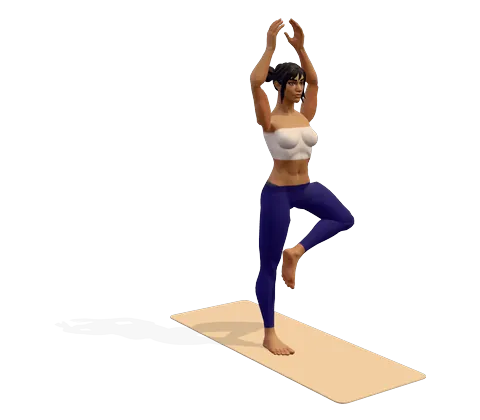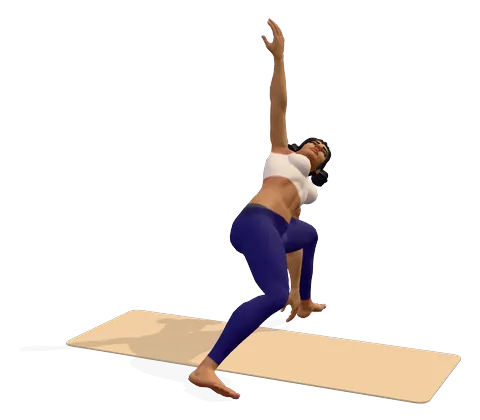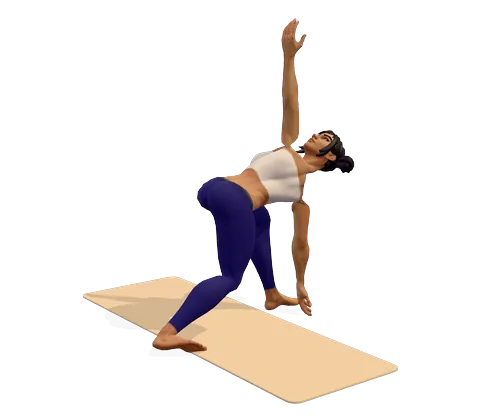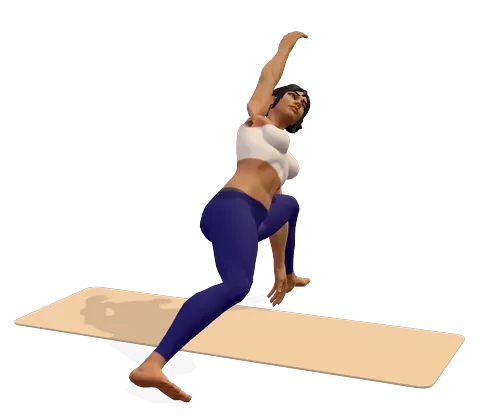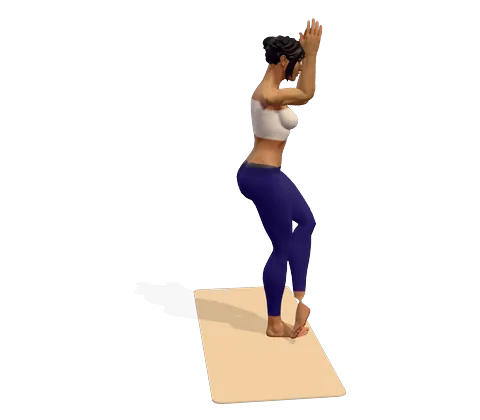
How to do Eagle Pose step by step
- Stand in mountain pose. Bend both knees slightly, as if starting to sit into a chair.
- Shift your weight onto your right foot. Lift your left leg and cross your left thigh over your right thigh.
- If you can, hook the top of your left foot behind your right calf. If not, rest the left toes on the floor or on a block beside your right foot.
- Stretch your arms forward at shoulder height. Cross them so one elbow rests in the crook of the other, bend the elbows and bring the backs of the hands — or the palms — together.
- Lift your elbows to shoulder height and move your forearms away from your face. Sit a little lower and keep your chest upright.
- Fix your gaze on one point in front of you and hold for 3–5 breaths (about 15–20 seconds).
- Unwind your arms and legs slowly, stand in mountain pose, and repeat with the other leg and arm on top.
Where you feel Eagle Pose: what it stretches and strengthens
Squeeze the wrapped limbs together and sit low. In the 3D guide, turn on Body guide: areas that stretch glow green and areas that work glow saffron.
Stretches
- Upper back
- Shoulders
- Glutes
Strengthens
- Front thighs
- Ankles
- Inner thighs
Benefits and precautions
Benefits
- Stretches the upper back and the muscles between the shoulder blades (rhomboids) and the back of the shoulders
- Stretches the outer hips and thighs
- Strengthens the standing leg, ankle and the muscles around the knee
- Trains balance on one bent leg
- Demands steady attention, which many people use to practise concentration
- The arm position alone can ease upper-back tightness from desk work
Avoid or modify if
- Knee injury or knee pain — skip the leg wrap; cross the thighs only, or do eagle arms alone
- Ankle injury or balance problems — practise with your back against a wall or sitting on a chair
- Frozen shoulder or a shoulder injury — hug your shoulders instead of wrapping the arms
- Pregnancy — balance changes, so practise the seated version or keep a wall within reach
- Low blood pressure or dizziness — come out slowly and stand for a moment before moving on
Eagle pose (Garudasana) is a standing balance in which you wrap one leg around the other and one arm around the other, then sink into a bent standing knee. It looks tangled, yet it is a compact, focusing pose: the arm wrap stretches the upper back and shoulders, the leg wrap opens the outer hips, and balancing on one bent leg asks for full attention. This guide explains what Garudasana is, how to do it step by step, which arm goes on top, the benefits, the muscles it works, easier versions and who should be careful.
What is Garudasana (eagle pose) in yoga?
What is Garudasana? It is a standing, one-legged pose with crossed arms and legs. The eagle pose Sanskrit name comes from Garuda, the king of birds in Hindu mythology, and asana, "pose". So Garudasana meaning is "Garuda's pose" — the eagle pose is also called the Garuda pose or eagle posture.
Why is it called eagle pose?
In the stories, Garuda is a huge eagle-like bird who carries the god Vishnu. What does eagle pose represent? The wrapped limbs are often compared to folded wings and a bird's gripping talons, and the steady gaze to an eagle's sharp focus. B.K.S. Iyengar described it as a pose for strong ankles and freer shoulders, and it is part of the Bikram standing series.
How to do eagle pose step by step (Garudasana kaise kare)
The steps above show how to do Garudasana step by step. Take it in two stages: first the legs, then the arms. These eagle pose cues and alignment points solve the most common problems:
- Sit first, then wrap. Bending the standing knee before you cross the legs makes the wrap far easier. Straight legs cannot wrap.
- Hips level and facing forward. The hip of the top leg tends to swing forward. Draw it back so both hip points face the front.
- Chest up. Many people fold forward over the wrapped arms. Lift the breastbone and keep the spine long.
- Elbows up, hands forward. Raising the elbows toward shoulder height and moving the hands away from your face deepens the stretch between the shoulder blades.
- Eagle pose drishti. Choose one still point at eye level or on the floor ahead and keep your eyes there.
Eagle pose arms: which arm goes on top?
Most teachers put the opposite arm on top of the leg that is on top: left leg over right, right arm over left. Some traditions use the same side. There is no strict rule — the important thing is to practise both sides evenly. If your palms do not meet, press the backs of the hands together, or simply hold opposite shoulders in a self-hug.
Can't do the eagle pose legs?
That is very common. Thighs, calves and hip width all affect whether the foot can hook behind the calf. Cross the thighs only and rest the toes of the top foot on the floor like a kickstand, or on a block. You still get the hip stretch and the balance work.
Eagle pose benefits
What is eagle pose good for? Eagle pose benefits come from three things: a stretch for the upper back and outer hips, strength in the standing leg, and practice in balance and focus.
Eagle arms benefits for the shoulders and neck
In eagle pose the arm wrap spreads the shoulder blades apart, giving a rhomboid stretch that many desk workers find relieving. That is why eagle arms appear in our yoga for neck pain plan and the Neck and Shoulder Release session. In yoga for frozen shoulder, a gentle self-hug version is used to ease the shoulder toward more movement; never force the wrap on a painful, stiff shoulder. Is eagle pose good for back pain? It can relieve tension in the upper back, but it is not a treatment for lower back problems.
Balance and concentration
Because it demands your whole attention, eagle pose is part of our yoga for memory and concentration plan and the Balance and Focus session. Evidence for yoga and memory is still emerging, so treat this as training attention rather than a proven brain booster.
Are there special eagle pose benefits for males or females? No — the benefits are the same for everyone. Claims that Garudasana boosts hormones or fertility are not supported by research.
Eagle pose muscles worked and stretched
| Stretches | Strengthens |
|---|---|
| Rhomboids, trapezius and the back of the shoulders | Quadriceps and glutes of the standing leg |
| Outer hips (gluteus medius, piriformis) and the band along the outer thigh | Ankle and foot stabilisers |
| Upper arms (triceps) | Inner thighs, which squeeze to hold the wrap |
Eagle pose for beginners: variations and modifications
- Arms only: stand on both feet and practise the arm wrap. Good as an eagle pose warm up at a desk.
- Toes down (kickstand): cross the thighs and rest the top toes on the floor. The easiest balance.
- Eagle pose with a block: rest the top foot on a block instead of hooking it.
- Eagle pose with a strap: if the arms will not wrap, hold a strap between the hands with the arms crossed.
- Seated version: sit on a chair and cross the legs and arms. Seated eagle pose benefits are the same stretches without the balance — one of the best options for seniors and in chair yoga.
- Eagle pose lying down: lie on your back, cross the legs in eagle and let the knees fall to one side for a gentle twist.
In kids yoga, eagle pose is a fun "wrap yourself up" game; let them try the arms first and then the legs.
Garudasana vs Gomukhasana
Both poses cross the thighs and stretch the outer hips and shoulders. Cow face pose (Gomukhasana) is seated, with one arm reaching up and one down behind the back — it opens the front of the shoulders and triceps more. Garudasana is standing and wraps the arms in front, stretching the upper back instead. Gomukhasana is the gentler choice when balance is a problem.
Eagle pose preparatory poses and sequence
Good Garudasana prep poses are chair pose (the same bent-knee base), tree pose for balance, a figure-four stretch for the outer hips and eagle arms on their own. A short eagle pose sequence: mountain, chair, eagle on each side, then tree. Many flows move from eagle pose to Warrior 3 by unwinding the top leg and reaching it back into Warrior III. As a counter pose, stand in mountain pose and roll the shoulders, or open the chest with the hands clasped behind the back. You can play both sessions mentioned above with voice guidance in our guided sessions.
Garudasana contraindications and precautions
The caution box above lists who should modify or skip the pose. The key point: the leg wrap twists the knees slightly. If you feel any pain inside the knee, unwrap at once and use the toes-down version. With a painful shoulder use the self-hug, and with poor balance practise next to a wall.
गरुड़ासन (Garudasana) — हिंदी में: गरुड़ासन कैसे करें: सीधे खड़े होकर घुटने थोड़े मोड़ें। बायाँ पैर दाहिने पैर के ऊपर से लपेटें और हो सके तो बायाँ पंजा दाहिनी पिंडली के पीछे फँसाएँ। दोनों हाथ सामने क्रॉस करके कोहनियाँ मोड़ें और हथेलियाँ मिलाएँ। 15–20 सेकंड रुकें, फिर दूसरी तरफ़ करें। गरुड़ासन के फायदे: कंधों और पीठ के ऊपरी हिस्से में खिंचाव, पैरों में ताकत, संतुलन और एकाग्रता। घुटने में दर्द हो तो पैर न लपेटें।
Health conditions this pose is used for
Yoga for neck pain and cervical spondylosis · Yoga for frozen shoulder · Yoga for desk workers and sitting all day · Yoga for shoulder pain · Yoga for tennis elbow · Yoga for carpal tunnel syndrome · Yoga for memory and concentration
Where this practice is used
Chakras: Ajna (Third Eye Chakra)
Frequently asked questions
What is eagle pose good for?
Eagle pose stretches the upper back, shoulders and outer hips, strengthens the standing leg and ankle, and trains balance and concentration.
Which arm goes on top in eagle pose?
Most teachers put the opposite arm on top of the top leg — left leg over, right arm over. Either way is fine as long as you practise both sides evenly.
What if I cannot hook my foot in eagle pose?
Cross the thighs only and rest the toes of the top foot on the floor or a block. The foot hook depends on body shape, and you still get the benefits without it.
What are the Garudasana benefits and contraindications?
Benefits: shoulder, upper-back and hip stretch, leg strength and balance. Garudasana contraindications: knee or ankle injuries, frozen shoulder and poor balance — use the seated or toes-down version instead.
How long should I hold eagle pose?
Hold for 3–5 breaths (about 15–20 seconds) on each side. Beginners can repeat a short hold twice rather than holding longer.
What is Garudasana in Hindi?
Garudasana in Hindi is गरुड़ासन, named after Garuda, the king of birds. The Hindi box above explains eagle pose kaise karte hain and the Garudasana benefits in Hindi (Garudasana ke fayde).
This page is for general education. Check with your doctor before starting yoga if you are pregnant, have a medical condition or an injury. Stop if you feel pain, dizziness or shortness of breath.