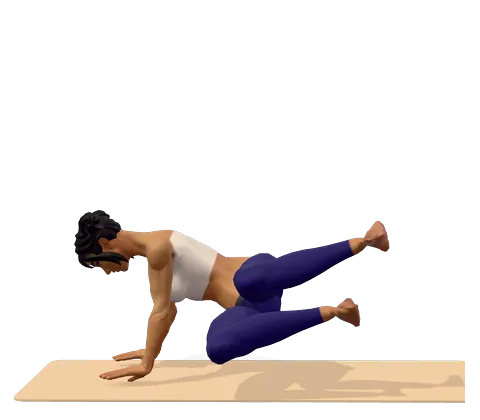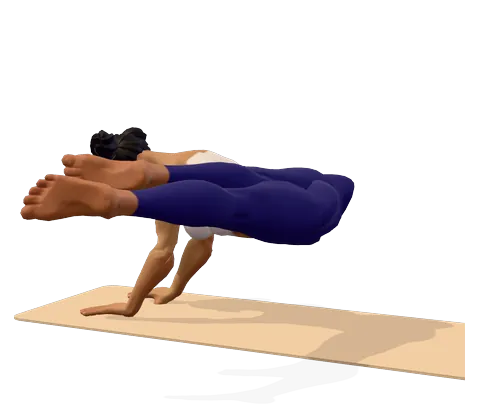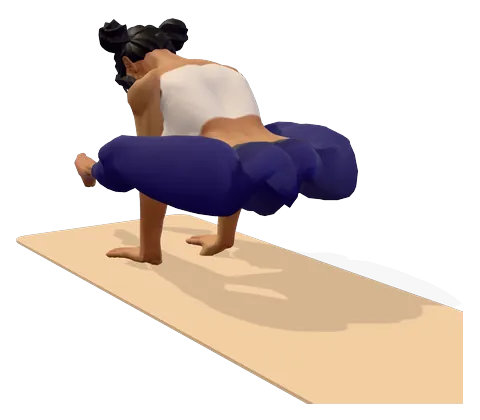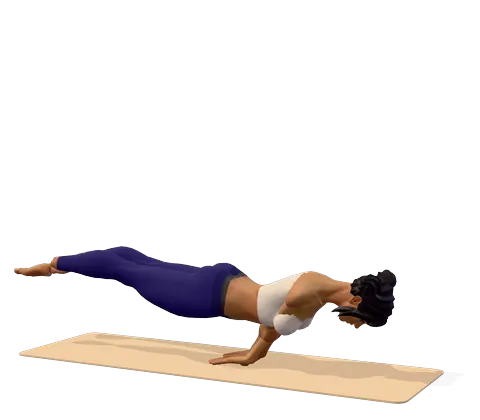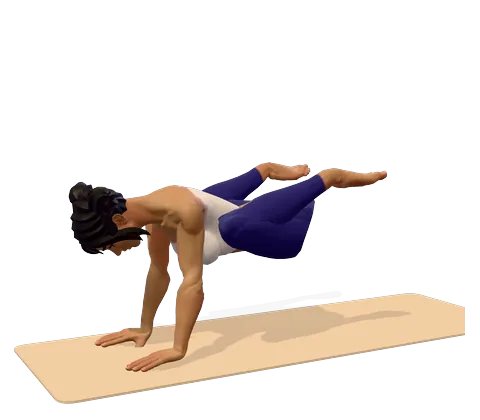
How to do Crow Pose step by step
- Warm up your wrists, shoulders and core. Squat with your feet close together and your knees wide, heels down or on a folded blanket.
- Place your palms flat on the mat, shoulder-width apart and about a foot in front of your feet. Spread your fingers wide and grip the floor with your fingertips.
- Bend your elbows slightly backward and lift your hips. Place your knees high on the backs of your upper arms, well above the elbows.
- Look forward, not down at your feet. Shift your weight slowly forward into your hands until your feet feel light.
- Lift one foot, then the other, and draw your heels toward your seat. Squeeze your knees into your arms and round your upper back slightly.
- Hold for 3–5 breaths (about 15 seconds), keeping the breath smooth.
- To come out, lower your feet slowly back to the mat, sit back into your squat and shake out your wrists. Rest in child's pose.
Where you feel Crow Pose: what it stretches and strengthens
Lean forward over your hands and round your back. In the 3D guide, turn on Body guide: areas that stretch glow green and areas that work glow saffron.
Stretches
- Upper back
Strengthens
- Arms
- Wrists
- Abs
Benefits and precautions
Benefits
- Strengthens the wrists, forearms, arms and shoulders
- Builds deep core strength and teaches the core and arms to work together
- Improves balance, focus and body awareness
- Builds confidence: it is a clear, reachable goal for many students
- Prepares you for harder arm balances, jump-backs and handstand work
Avoid or modify if
- Wrist pain, carpal tunnel syndrome or a recent wrist, elbow or shoulder injury
- Frozen shoulder or shoulder pain when you bear weight on your hands
- Pregnancy — the risk of falling forward and pressure on the belly make it unsuitable
- Recent abdominal surgery or a hernia — the core works hard and the thighs press into the belly
- Place a cushion in front of your face while learning, and never practise on a slippery surface
Crow pose (Bakasana) is an arm balance in which you rest your knees on the backs of your bent arms and tip forward until your feet float off the mat. It looks like a strength move, but it is mostly about balance, trust and where you put your weight. This guide explains the Sanskrit name, what to practise first, how to do it step by step, how crow differs from crane and frog stand, and how to avoid the common aches.
What is crow pose in yoga? Sanskrit name and meaning
The crow pose Sanskrit name is usually given as Kakasana; the Kakasana meaning is kaka, "crow", plus asana, "pose". Bakasana meaning is "crane pose" — baka is a crane or heron. In practice the two names are often swapped, and most classes simply call it Bakasana. The crow pose Hindi name is काकासन (Kakasana), and बकासन (Bakasana) for crane.
Kakasana vs Bakasana
Many yoga teachers use Kakasana for the bent-arm version, with knees on the backs of the upper arms, and Bakasana for the straight-arm crane pose, with knees high near the armpits. The 3D figure shows the bent-arm crow, which is the one to learn first.
Poses to prepare for crow pose
What is before crow pose? Make sure you can hold these comfortably:
- Garland pose (Malasana) — the squat you start from.
- Plank pose for 30–60 seconds with a steady core.
- Four-limbed staff pose — it teaches the same elbow position.
- Boat pose for the curling core action that pulls your knees in.
Warm the wrists by circling them and rocking gently forward and back on all fours. This crow pose prep takes five minutes and makes the pose far easier on the wrists.
How to do crow pose step by step (for beginners)
This crow pose tutorial breaks the pose into small wins. Stay at each stage until it feels steady.
- Squat and place hands. Hands shoulder-width, fingers spread, knees wide.
- Knees on arms. Rest the knees on the backs of the upper arms and just lean forward, feet still down.
- Crow pose with blocks. Stand your feet on a yoga block. Starting higher makes it much easier to get the hips over the hands.
- One foot at a time. Lift one foot, put it down, then the other.
- Both feet. Lift both feet and hold for one breath, then build to five.
Crow pose tips and alignment cues
- Look forward, not down. If your head drops, your weight tips too far forward. A cushion under your face helps with the fear of a crow pose head down fall.
- Hug the elbows in. Keep them pointing back, not out to the sides.
- Round the upper back. Push the floor away and curl like a cat. This lifts the hips and makes you lighter.
- Grip with your fingertips. Press them down to brake if you tip forward.
How to do crow pose without hurting your arms
Crow pose arm bruises come from dropping your knees onto your arms. Instead, squeeze your knees in and lift your belly so the legs grip, rather than hang. Place the knees higher up the arm, and wear long sleeves while learning.
How long does it take to do crow pose?
Some people float in their first week; others practise for a few months. Two or three short sessions a week are enough. Strength matters, but trust and weight placement usually decide it.
Crow pose vs crane pose
In crow the arms stay bent and the knees rest lower, on the backs of the arms. In crane pose the arms are straight and the knees lift high toward the armpits, so it needs more core and shoulder strength. To go from crow pose to crane, lift the hips higher, draw the knees up and slowly straighten the arms. How to do crane pose safely: learn a steady crow first, then practise straight arms for one breath at a time.
If you searched for crane pose from karate, that is a standing one-legged stance, not this arm balance. The nearest yoga cousin is tree pose.
Crow pose vs frog stand and frog pose
In crow pose calisthenics and gymnastics circles, the frog stand is a close cousin: the knees rest on the outside of the elbows, the feet are wider and the chest stays more upright. It is a little easier to balance. Crow pose vs frog pose is a different comparison: frog pose in yoga is a hip-opening stretch on the floor, not an arm balance.
Crow pose variations and transitions
- Baby crow pose: the same shape on your forearms. It is lower and less scary, but still strong.
- One-legged crow: lift one leg straight back from crow pose.
- Side crow: knees stacked on one arm with a twist. See side crow pose for beginners.
- Flying crow pose: a shin balanced on the arms and the other leg extended back, also called flying pigeon.
- Crow pose to plank: jump or float the feet back into chaturanga — common in Ashtanga and Vinyasa flows.
- Crow pose to headstand or handstand: advanced transitions that press up from crow into a headstand or handstand. Learn a solid handstand against a wall first.
Crow pose benefits and muscles worked
The main crow pose benefits are strength and balance: the arms, wrists and shoulders carry your weight while the core holds the knees in place. It also trains focus, because you cannot hold it while your mind wanders.
| Area | Crow pose muscles worked |
|---|---|
| Arms and wrists | Forearm and wrist flexors, triceps, biceps |
| Shoulders and chest | Deltoids, serratus anterior, pectorals |
| Core and hips | Rectus and transverse abdominis, hip flexors and inner thighs |
Crow pose benefits and precautions go together: it is not a treatment pose. If you are asking which yoga asana helps relieve back pain, crow is not it; gentler poses suit that goal.
Crow pose benefits and contraindications
Skip it or use an alternative if you have the conditions in the caution box. With shoulder pain, weight-bearing on the arms may make it worse — see our yoga for frozen shoulder page. A good crow pose alternative is boat pose or a squat with the hands in prayer, which build the same core without loading the wrists.
A simple crow pose sequence
Try this short crow pose yoga flow: wrist warm-up, cat and cow, plank, garland pose, three attempts at crow, then a cool down in child's pose with gentle wrist stretches. You can build it in the sequence builder and let the voice guide you through it.
Crow pose yoga in Hindi — काकासन (crow) / बकासन (crane pose), with benefits: पंजों के बल बैठें, हथेलियाँ कंधों की चौड़ाई पर ज़मीन पर रखें। घुटनों को ऊपरी बाँहों के पीछे टिकाएँ, सामने देखें और धीरे-धीरे आगे झुकते हुए पैर ज़मीन से उठाएँ। 3–5 साँस रुकें। फायदे: कलाई, बाँहें, कंधे और पेट की मांसपेशियाँ मज़बूत होती हैं और संतुलन व एकाग्रता बढ़ती है। कलाई या कंधे की चोट और गर्भावस्था में यह आसन न करें।
Frequently asked questions
What is the crow pose?
Crow pose (Kakasana, often called Bakasana) is an arm balance: you squat, place your knees on the backs of your bent arms and lean forward until your feet lift. It builds arm, wrist and core strength and balance.
Is crow pose for beginners?
It is one of the first arm balances people learn, but it is not a first-day pose. Build up with plank, garland pose and boat pose, then follow the step-by-step progression with a block under your feet.
What is the difference between Kakasana and Bakasana?
Kaka means crow and baka means crane. Many teachers call the bent-arm version crow (Kakasana) and the straight-arm version crane (Bakasana), but the names are often used for the same pose.
How long does it take to learn crow pose?
Anywhere from a week to a few months. Practise two or three times a week; the key is shifting your weight forward with the gaze ahead, not pure strength.
Why do my arms hurt in crow pose?
Usually because the knees are dropping onto the arms. Squeeze the knees in, lift the belly and place the knees higher; long sleeves help while you learn.
What is the difference between crow pose and frog stand?
In frog stand the knees rest on the outside of the elbows and the chest is more upright. In crow the knees are on the backs of the upper arms and you lean further forward.
How do I stop falling on my face in crow pose?
Put a cushion in front of you, look forward rather than down, and press your fingertips into the floor to brake. Lift one foot at a time until you trust the balance.
What are the benefits of Bakasana?
It strengthens the wrists, arms, shoulders and core, improves balance and focus, and prepares you for harder arm balances.
This page is for general education. Check with your doctor before starting yoga if you are pregnant, have a medical condition or an injury. Stop if you feel pain, dizziness or shortness of breath.