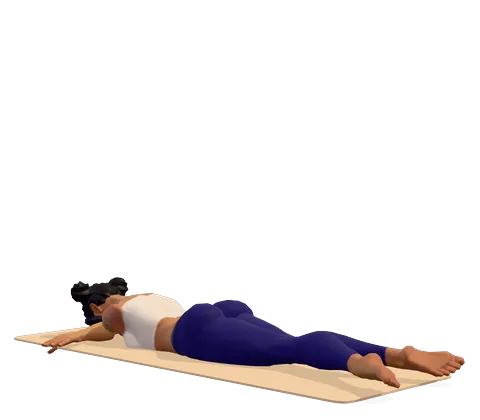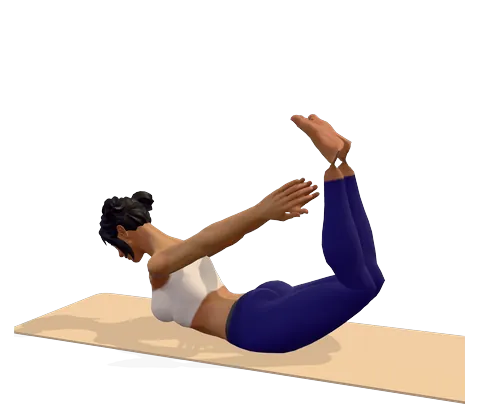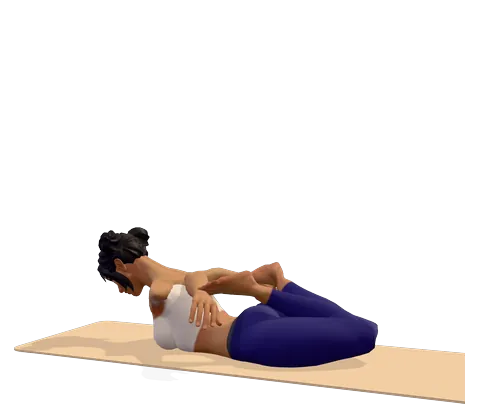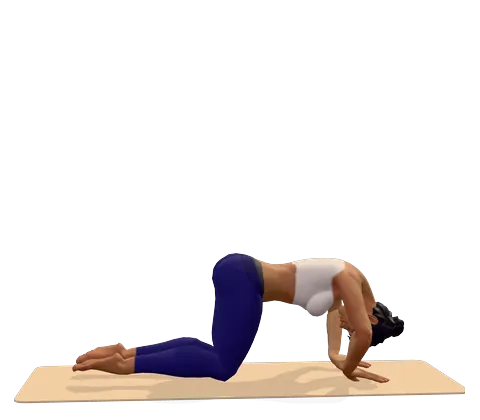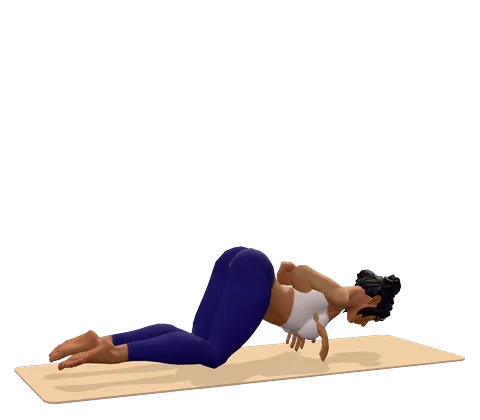
How to do Knees-Chest-Chin Pose step by step
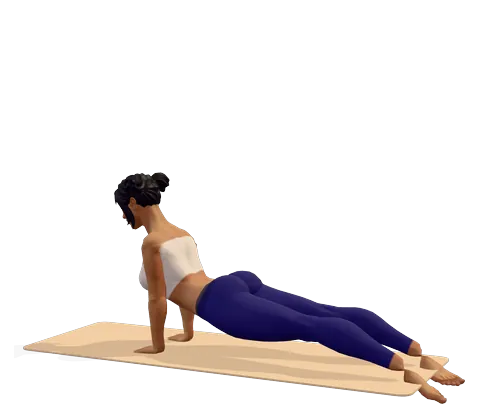
- Start in plank pose, hands under your shoulders and body in one line from head to heels.
- Lower both knees to the mat and keep your toes tucked under.
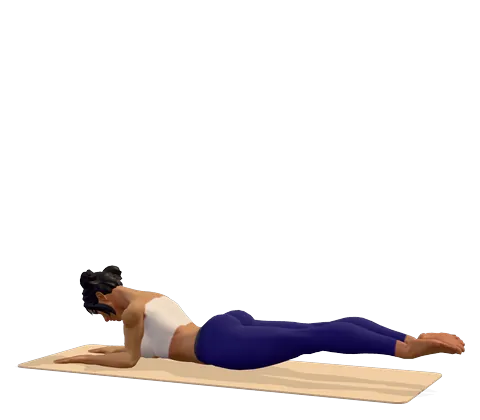
- Breathe out, bend your elbows straight back, close to your ribs, and slide your chest down between your hands.
- Rest your chin (or forehead, if your neck prefers) on the mat. Your hips stay lifted, so your spine makes a gentle wave from knees to chin.
- Check the eight points on the mat: two feet, two knees, two hands, chest and chin. The belly stays off the floor.
- Stay for a moment — one breath out in Surya Namaskar, or 2–3 breaths when practising it alone.
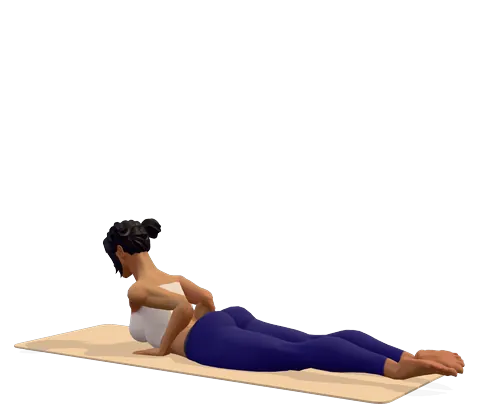
- Breathe in and glide forward into cobra pose, or lower your hips and rest on your belly.
Where you feel Knees-Chest-Chin Pose: what it stretches and strengthens
Lower knees, chest and chin with elbows hugging in. In the 3D guide, turn on Body guide: areas that stretch glow green and areas that work glow saffron.
Stretches
- Chest
Strengthens
- Arms
- Shoulders
- Abs
Benefits and precautions
Benefits
- Builds strength in the arms, chest and shoulders as a first step toward Chaturanga
- Gently bends the upper back and opens the chest
- Teaches controlled lowering, which protects the shoulders in sun salutations
- Keeps the lower back safe, because the knees take part of the body weight
- Links plank and cobra smoothly in Surya Namaskar
Avoid or modify if
- Pregnancy — skip it and step through a gentle kneeling transition instead
- Wrist pain or carpal tunnel — lower more slowly and keep the weight toward the knees
- Shoulder injury — lower only halfway, or lie down fully and skip the pose
- Neck pain — rest the forehead instead of the chin, so the neck is not bent back
- Recent abdominal or chest surgery — wait until your doctor clears you
Ashtanga Namaskara, also called the knees-chest-chin pose or eight-limbed pose, is step 6 of the classic 12-step Surya Namaskar. From plank, you lower your knees, chest and chin to the floor while your hips stay slightly raised. It takes only a breath in a sun salutation, but done well it builds arm strength, protects the shoulders and prepares you for the more demanding Chaturanga.
What is Ashtanga Namaskara?
The name is Sanskrit: ashta means "eight", anga means "limb" or "part", and namaskara means "salutation". So the knees chest chin pose Sanskrit name translates as "salute with eight parts". You will also see it spelled Ashtanga Namaskar or Ashtanga Namaskarasana, and in English called the eight point pose in yoga classes, or "caterpillar" in children's yoga. Knees-chest-chin pose is its plain English yoga name: it tells you which parts touch the floor.
The eight points that touch the mat
| Body part | Count | What it does |
|---|---|---|
| Toes (feet) | 2 | Tucked under, anchor the legs |
| Knees | 2 | Take part of the body weight |
| Hands | 2 | Flat under the shoulders, control the lowering |
| Chest | 1 | Rests between the hands |
| Chin | 1 | Touches lightly; the forehead is a gentler option |
What is a namaskara? It is a salutation, as in "namaste". Bowing so many parts of the body to the ground is a sign of respect, which is why Ashtanga Namaskara sits at the humble low point of the sun salutation.
Not the same as the eight limbs of yoga
The word ashtanga causes confusion. Patanjali's Yoga Sutras describe the 8 limbs of yoga, explained here in one line: they are stages of practice, not body parts. The eight limbs of yoga are yama (ethics), niyama (self-discipline), asana (posture), pranayama (breath), pratyahara (turning the senses inward), dharana (concentration), dhyana (meditation) and samadhi (absorption). What is the 8th limb of yoga? Samadhi. You can read more in what is yoga. In Hindi, अष्टांग योग (Ashtanga yoga) usually refers to these eight limbs.
The eight limbs of Ashtanga yoga also give their name to Ashtanga Vinyasa yoga, a style that, confusingly, uses Chaturanga rather than this pose in its sun salutations (Ashtanga Surya Namaskar A and B). The benefits of Ashtanga yoga come from repeating that fixed sequence daily; the style page explains Ashtanga yoga for beginners.
So the pose has eight body parts on the floor, while the philosophy has eight stages of practice. They share a number, not a meaning.
Not the knees-to-chest pose either
People searching for a knees to chest yoga pose usually mean something different: lying on your back and hugging both knees in. That is Apanasana or wind-relieving pose. What does knees to chest mean in yoga? Bringing the thighs toward the body to round and release the lower back. Knees to chest stretch benefits are mainly lower back relief, which makes it one of the gentlest lower back pain yoga poses and a good way to finish a stronger session. It appears among the yoga poses for back pain relief in our yoga for back pain plan. A standing knee to chest yoga pose is a balance where you hug one knee in. Similarly, eight angle pose yoga refers to Astavakrasana, an advanced arm balance.
How to do Ashtanga Namaskara well
The steps above cover the basic shape. These points make the difference between a controlled pose and a collapse:
- Knees first, then chest. Lowering the knees before bending the arms takes weight off the shoulders. This is the main reason the pose is taught to beginners instead of Chaturanga.
- Elbows back, not out. Bend them straight back along the ribs, like the four-limbed staff pose yoga teachers use in Vinyasa. Winging elbows strain the front of the shoulder.
- Chest slides forward. Think of sliding the breastbone forward and down between the hands, not dropping straight down.
- Hips stay up. The belly does not touch the mat. If your hips flop down, you have simply lain on your front.
- Light chin. The chin touches, it does not carry weight. If the neck complains, use the forehead.
Breathing
In Surya Namaskar you lower on the breath out. Some traditions keep the breath out for a moment in this pose before breathing in to rise into cobra pose. When practising the pose on its own, breathe normally.
Ashtanga Namaskara benefits
The main Ashtanga Namaskara benefits are strength and control. Lowering slowly works the triceps, chest (pectorals) and front of the shoulders, while the lifted hips and lowered chest put a mild bend into the upper back. Because your knees share the load, the lower back stays safe, which also makes it useful for people learning yoga after back pain.
The wider benefits of doing Surya Namaskar (or Surya Namaskaram, as it is often spelled in South India) come from the whole sequence: rounds of sun salutation warm the body, raise your heart rate and move every joint. The pose is one link in that chain. When people talk about Surya Namaskar ke fayde (the benefits of sun salutation), they mean the full 12 steps done regularly, not one pose.
Ashtanga Namaskara for beginners
This is one of the most common and popular yoga poses for beginners in India because it replaces the harder Chaturanga. If Surya Namaskar for beginners feels too fast, practise this transition on its own: plank, knees down, lower, then rest your belly on the mat. Repeat 5 times slowly. When you can lower without your chest crashing, the pose is ready to go back into the flow. Our yoga for beginners guide lists other basic yoga poses for beginners to learn alongside it.
Afterwards, rest in child's pose. Child's pose for back pain eases the lower back, and child pose stretch benefits also include a gentle release for the shoulders after lowering.
अष्टांग नमस्कार (Ashtanga Namaskara) — हिंदी में: यह सूर्य नमस्कार का छठा आसन है। प्लैंक से घुटने नीचे रखें, कोहनियाँ मोड़ें और साँस छोड़ते हुए छाती और ठोड़ी को ज़मीन पर लाएँ। कूल्हे थोड़े ऊपर रहें। शरीर के आठ अंग — दो पैर, दो घुटने, दो हाथ, छाती और ठोड़ी — ज़मीन को छूते हैं। इसके फायदे: बाँहें और कंधे मज़बूत होते हैं और छाती खुलती है। गर्भावस्था में यह आसन न करें।
Frequently asked questions
What is Ashtanga Namaskara?
Ashtanga Namaskara (knees-chest-chin pose) is step 6 of Surya Namaskar. From plank, you lower your knees, chest and chin to the mat with the hips slightly raised, so eight body parts touch the floor.
What are the eight points in Ashtanga Namaskara?
Two feet (toes), two knees, two hands, the chest and the chin.
What are the benefits of Ashtanga Namaskara?
It strengthens the arms, chest and shoulders, gently bends the upper back and teaches controlled lowering. It is a safer step toward Chaturanga for beginners.
Is Ashtanga Namaskara the same as the eight limbs of yoga?
No. The pose has eight body parts touching the floor. The eight limbs of yoga are Patanjali's eight stages of practice, from ethics (yama) to absorption (samadhi).
Is knees-chest-chin pose the same as knees-to-chest pose?
No. Knees-to-chest pose (Apanasana) is done lying on your back hugging your knees. Knees-chest-chin pose is done face down with the hips lifted.
Why do some people do Chaturanga instead?
Ashtanga Vinyasa and many Vinyasa classes lower through Chaturanga, which needs more strength. Hatha and Indian Surya Namaskar usually use Ashtanga Namaskara, which is easier on the shoulders.
Can I do Ashtanga Namaskara during pregnancy?
It is best avoided. Lowering the chest to the floor puts the belly close to the mat and strains the abdomen. Use a gentle kneeling transition instead and follow your doctor's advice.
This page is for general education. Check with your doctor before starting yoga if you are pregnant, have a medical condition or an injury. Stop if you feel pain, dizziness or shortness of breath.