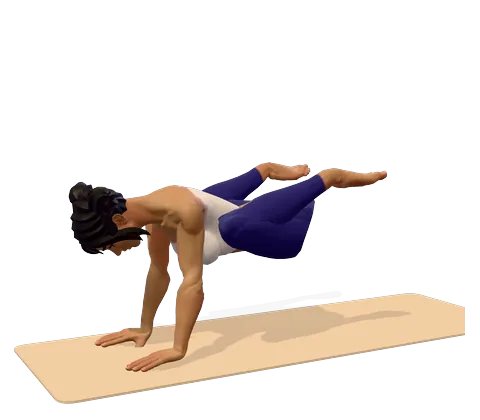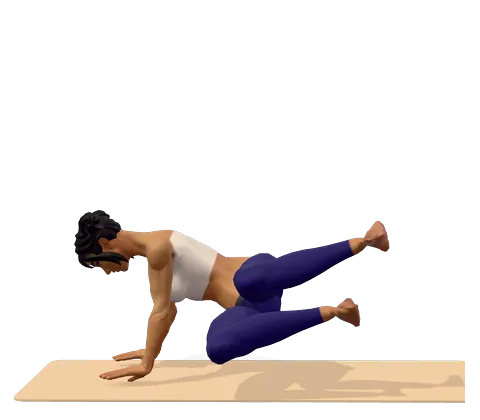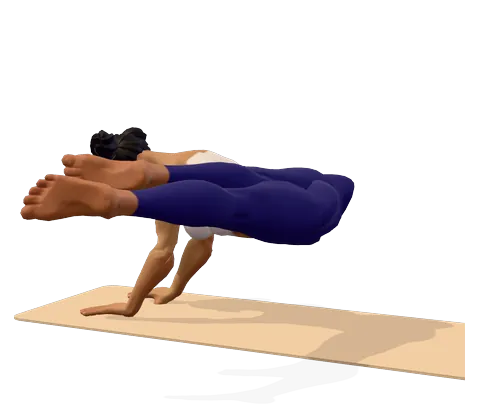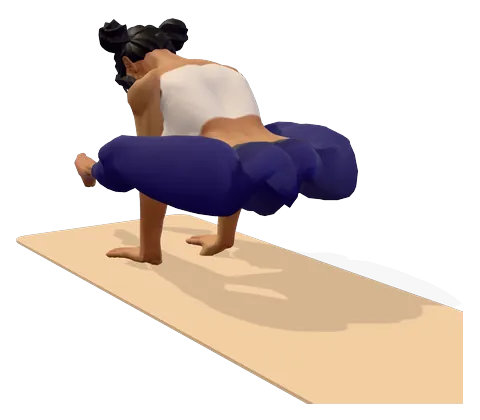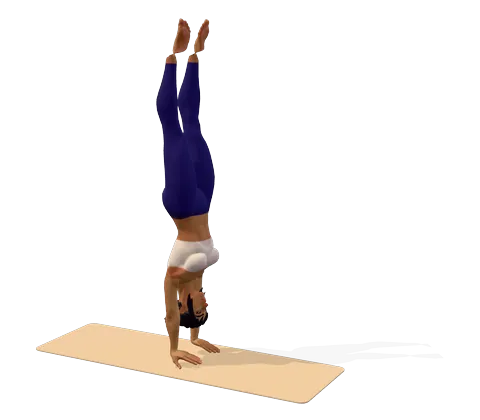
How to do Handstand step by step
- Come into downward dog with your hands about a hand's length from a wall, shoulder-width apart, fingers spread and index fingers pointing forward.
- Walk your feet in until your hips are nearly over your shoulders. Lift one straight leg high behind you.
- Bend the standing knee, press the floor away and hop lightly, swinging the lifted leg up. Let the other leg follow.
- Bring your heels to the wall. Stack wrists, shoulders, hips and ankles in one line, draw your ribs in and squeeze your legs together.
- Push the floor away so your shoulders lift toward your ears. Look at the floor between your hands.
- Hold for 3–5 breaths (15–30 seconds), breathing steadily.
- Come down one leg at a time and rest in child's pose for a few breaths before you stand up.
Where you feel Handstand: what it stretches and strengthens
Stack your hips over your shoulders and push the floor away. In the 3D guide, turn on Body guide: areas that stretch glow green and areas that work glow saffron.
Strengthens
- Shoulders
- Arms
- Abs
Benefits and precautions
Benefits
- Builds strong shoulders, arms, wrists and upper back
- Trains the core to hold the body in one straight line
- Improves balance and body awareness upside down
- Loads the upper body with your own weight, a simple form of strength training
- Builds focus and teaches you to stay calm when something feels scary
- Prepares you for forearm stand, arm balances and advanced flows
Avoid or modify if
- High blood pressure, heart disease, glaucoma or a detached retina — do not go upside down
- Neck, shoulder or wrist injury, including carpal tunnel syndrome
- Pregnancy — do not practise
- Epilepsy, recent head injury or stroke, or during a migraine attack
- During your period many people choose to skip inversions
- Stop if you feel dizzy, get a headache or feel pressure in your eyes
Handstand (Adho Mukha Vrikshasana) is the full inversion on the hands: your body stands upside down, straight as a tree, with your weight on your palms. It is a strength skill as much as a balance, and almost everyone learns it at a wall first. This guide covers what the pose is, the prerequisites, a step-by-step wall progression for beginners, alignment tips, the real benefits and who should not do it.
What is handstand in yoga?
The handstand meaning in Sanskrit is simple (the name is also spelled Adho Mukha Vrksasana): adho means "downward", mukha means "face", vriksha means "tree" and asana means "pose". So Adho Mukha Vrikshasana is "downward-facing tree pose" — tree pose turned upside down. It shares its first two words with Adho Mukha Svanasana, downward-facing dog (svana means dog), which is also its best warm-up: Adho Mukha Svanasana benefits include the shoulder strength and wrist conditioning you need here.
What is a handstand in gymnastics? The same shape, usually entered with a kick or a cartwheel, with a slightly hollow body. The yoga version is held longer and often entered with a hop, but the alignment goals are the same.
Prerequisites: are you ready to go upside down?
Can you learn this in one day? Honestly, no. Most adults need weeks to months of regular practice. Start the wall drills below when you can:
- Hold downward dog for one minute with straight arms and no wrist pain.
- Hold plank pose for 60 seconds with a straight body.
- Raise your arms straight overhead without arching your lower back (shoulder mobility).
- Stay calm upside down. Balancing in crow pose helps you trust your hands.
Do your handstand on a yoga mat laid on a firm floor, never on a bed or cushion, and clear the space around you. Handstand blocks or a folded mat under the heels of your hands take strain off sensitive wrists.
Handstand progression for beginners: the wall method
These are the handstand learning steps for beginners at home, in six stages. Stay with each stage for at least a week in a 10–15 minute routine, three to five times a week. Our wall yoga guide has more prep exercises.
- Wall L-shape (half handstand): sit with your back to the wall and mark where your feet reach. Place your hands there, walk your feet up the wall to hip height and make an L. Hold for 20–30 seconds. This builds shoulder strength safely.
- Wall walk: from plank with your feet at the wall, walk your feet up and your hands in until your chest is close to the wall.
- Chest-to-wall hold: the best of all handstand drills for a straight line. Hold for 30–60 seconds, pressing the floor away.
- Kick-up to the wall: facing the wall, hop with bent standing knee and a straight top leg until your heels touch it. Soft, controlled hops beat big kicks.
- Heel pulls: at the wall, draw one heel and then both away until you balance for a moment. Aim for a calm 30-second hold against the wall before you move on.
- Freestanding practice: in open space, hop up and learn to bail out by turning one hand and stepping down to the side, like half a cartwheel.
Handstand alignment and form tips
- Stack the joints: wrists, shoulders, hips and ankles in one vertical line.
- Push tall: press the floor away so the shoulders lift toward the ears. Sinking into the shoulders loads the neck.
- Ribs in, no banana: an arched back is the most common fault. Draw the ribs in and squeeze the glutes and legs.
- Fingers are the brakes: if you tip toward your back, press your fingertips into the floor.
- Gaze: look at the floor between your hands, not at your feet.
Handstand benefits and muscles worked
What are the benefits of handstand in yoga? The benefits of handstands are mostly strength, balance and confidence. You carry your body weight through the arms, the core keeps you straight, and learning to stay calm upside down trains focus.
| Muscles | Role |
|---|---|
| Deltoids, upper trapezius, serratus anterior | Hold the arms overhead and push the floor away |
| Triceps, forearms and wrist muscles | Keep the arms straight and make balance corrections |
| Abdominals and obliques | Keep the ribs in and the body straight |
| Glutes, inner thighs and quadriceps | Hold the legs together and firm |
Handstand benefits for hair, face, skin or eyes are often promised online, based on "more blood to the head". There is no good evidence for any of these, and inversions raise eye pressure, which is why people with glaucoma should avoid them. Handstand benefits for weight loss are small too: a few minutes of practice burn few calories (try the yoga calories calculator). The benefits for women, men and kids are the same — upper-body and core strength.
Handstand vs headstand and forearm stand
In headstand your forearms and head share the load, so the base is wider but the neck is involved. A handstand keeps the head free and asks more of the shoulders and wrists. Forearm stand sits in between: a wider base than the hands, no weight on the head, but it needs open shoulders. Compared with crow pose, the handstand is a full inversion rather than a forward-leaning arm balance. Headstand contraindications are similar to those below, with extra care for the neck; see its page for headstand yoga benefits.
Handstand variations
Once you can hold the basic shape, these yoga handstand poses add variety:
- Handstand split or stag: one leg forward and one back, or one knee bent — both lower your centre of gravity.
- Straddle: legs wide; a stepping stone to the press handstand.
- Press: lifting up slowly without a hop. Needs strong shoulders and open hamstrings.
- Handstand walk: moving on your hands, a gymnastics skill that comes after a steady hold.
- Handstand push-ups: a calisthenics exercise at the wall that works the shoulders and triceps. Treat it as strength training, not a yoga pose.
Who should not do handstand
Inversions are not for everyone. Do not practise if you have high blood pressure (see yoga for high blood pressure for safe options), heart disease, glaucoma, a detached retina, epilepsy, a neck or shoulder injury, or if you are pregnant. Many people skip inversions during their period. If you have a health condition, ask your doctor before you start. Children can practise at a wall on a soft floor with an adult nearby.
Handstand yoga in Hindi — meaning, steps and benefits (अधोमुख वृक्षासन): दीवार से एक हाथ की दूरी पर हथेलियाँ कंधों की चौड़ाई पर रखें। पैरों को पास लाएँ, एक पैर ऊपर उठाएँ और हल्का सा उछलकर दोनों एड़ियाँ दीवार पर टिकाएँ। हाथों से ज़मीन को धकेलें और शरीर को सीधी रेखा में रखें। फायदे: कंधे, बाजू और कोर मज़बूत होते हैं और संतुलन बढ़ता है। हाई ब्लड प्रेशर, हृदय रोग, ग्लूकोमा, गर्दन की चोट या गर्भावस्था में यह आसन न करें।
Frequently asked questions
How long does it take to learn a handstand?
Most adults need weeks to months of regular wall practice. Practising 10–15 minutes, three to five times a week, works better than one long session.
How do I do a handstand at home safely?
Use a wall, a firm floor and clear space around you. Start with the wall L-shape and chest-to-wall holds before you kick up, and learn to bail out to the side.
What muscles does a handstand work?
The shoulders (deltoids, trapezius, serratus anterior), triceps, forearms and wrists, the abdominals, glutes and legs.
Is handstand better than headstand?
Neither is better. A handstand keeps weight off the head and neck but needs more shoulder and wrist strength; a headstand needs a strong neck set-up with forearms taking most of the weight.
Does handstand help hair growth or skin?
There is no reliable evidence that inversions improve hair growth, skin or eyesight. Practise it for strength and balance.
Why do I fall over in handstand?
Usually from an arched back, bent arms or looking at your feet. Draw your ribs in, push the floor away, look between your hands and use your fingertips as brakes.
Who should not do handstand?
People with high blood pressure, heart disease, glaucoma, epilepsy, neck, shoulder or wrist injuries, and pregnant women. Many people skip inversions during their period.
What is the yoga name for handstand?
The yoga asana name is Adho Mukha Vrikshasana, meaning downward-facing tree pose. In Hindi it is written अधोमुख वृक्षासन.
This page is for general education. Check with your doctor before starting yoga if you are pregnant, have a medical condition or an injury. Stop if you feel pain, dizziness or shortness of breath.