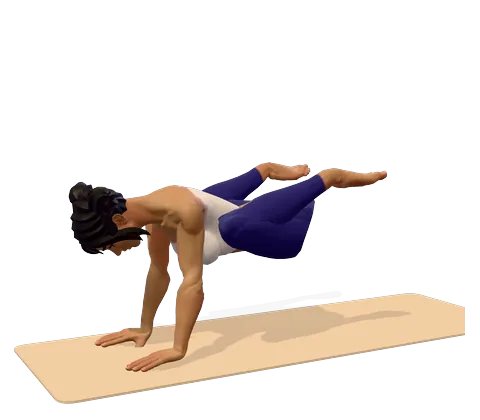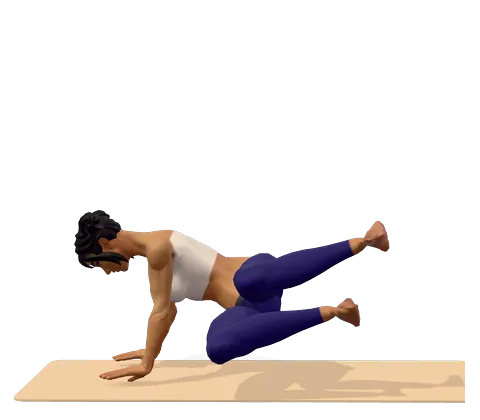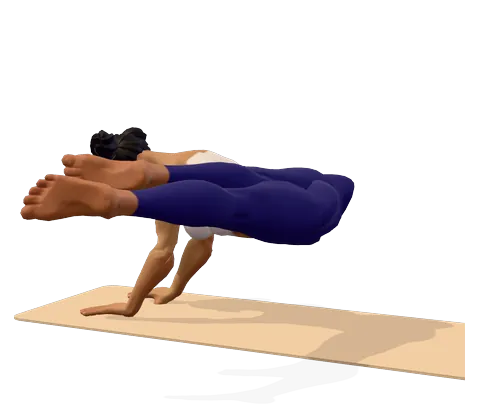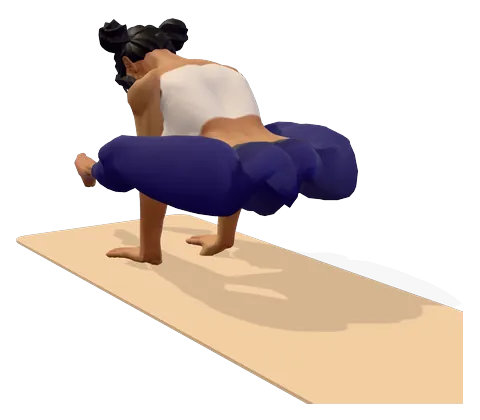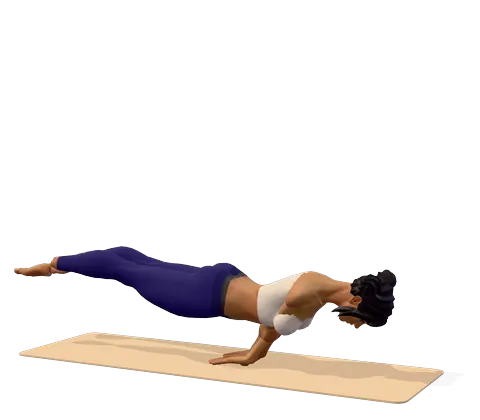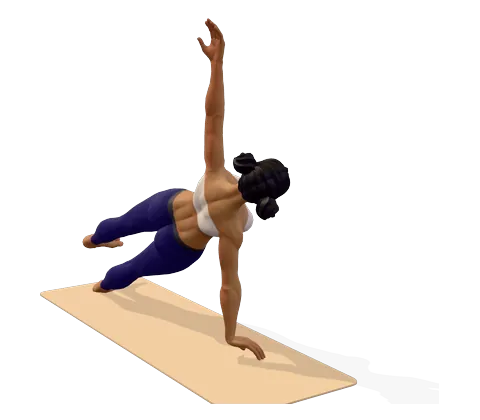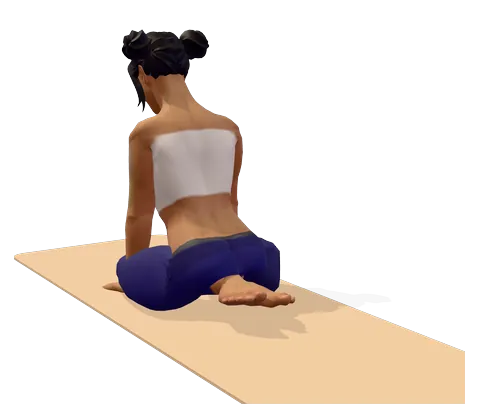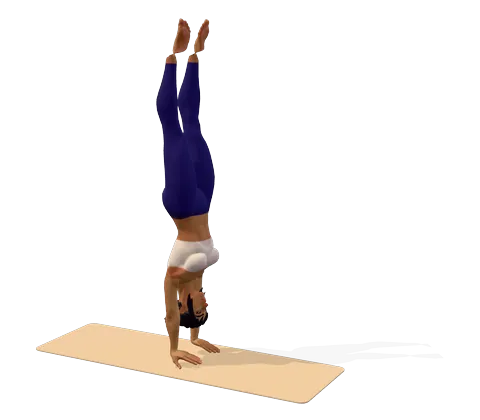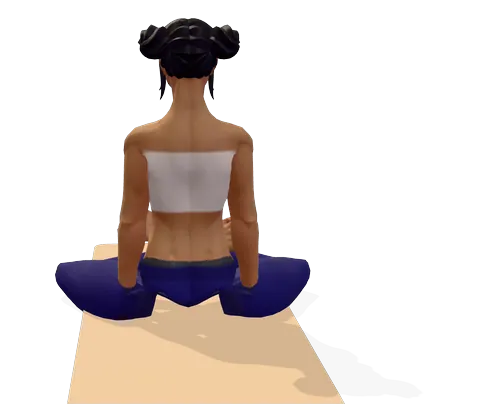
How to do Scale Pose step by step
- Sit in lotus pose (Padmasana). If full lotus is not comfortable for your knees, use half lotus or simply cross your legs.
- Place your palms flat on the floor beside your hips, fingers pointing forward. Put a block under each hand if your arms feel short.
- Breathe out, draw your belly in and press firmly down through both hands.
- Straighten your arms and lift your hips, then your knees, off the floor. Your body hangs between your arms like the pan of a scale.
- Hold for 3–5 breaths (10–20 seconds). Keep your shoulders down, chest lifted and gaze forward.
- Lower slowly, release the lotus and change which leg is on top. Repeat once on the second cross.
Where you feel Scale Pose: what it stretches and strengthens
Press your hands down and lift your crossed legs. In the 3D guide, turn on Body guide: areas that stretch glow green and areas that work glow saffron.
Stretches
- Knees
- Ankles
Strengthens
- Abs
- Arms
- Wrists
Benefits and precautions
Benefits
- Strengthens the wrists, arms and shoulders
- Works the abdominal muscles and hip flexors hard in a short hold
- Builds the lift needed for arm balances such as crow and pendant pose
- Trains you to engage the belly and pelvic floor (the bandhas) under effort
- Improves focus and steady breathing
Avoid or modify if
- Knee injury or stiff hips — never force lotus; use crossed legs or skip the pose
- Wrist, elbow or shoulder injury
- Pregnancy, hernia or recent abdominal surgery
- High blood pressure — keep breathing and keep holds short
- Stop if you feel pain in the knees or a pulling in the groin
Scale pose (Tolasana) is a seated arm balance: you sit in lotus, place your hands beside your hips and lift your entire body off the floor. The shape is small and quiet, but it is one of the most concentrated core exercises in yoga (browse our yoga poses and the benefits of each pose to compare). This page explains the name, clears up some common mix-ups, lists what you need before you try it and gives easier versions for beginners.
Tolasana meaning: why it is called scale pose
In Sanskrit tola means a scale or balance — the old weighing scale with two pans hanging from a beam. Asana means "pose", so the Tolasana meaning in English is simply "scale pose". Your arms are the beam's chains and your folded legs are the pan hanging below them. It is also spelled Tulasana, from tula, another word for balance.
In the Ashtanga method the same lifted lotus closes every practice, where it is called Utpluthih ("uprooting"). Hatha teachers often use it to teach bandhas, the locks of the belly and pelvic floor.
Tolasana, Tulasana, Talasana or Tadasana?
These names sound alike, so many people land on the wrong pose:
- Tolasana / Tulasana: this page — the yoga name of a seated pose that lifts from lotus.
- Talasana: palm tree pose, a standing stretch on tiptoes with the arms raised.
- Tadasana: mountain pose, the basic standing pose and probably the most common yoga pose of all, since most standing poses start from it. If you wanted to know how to perform Tadasana and its benefits for the spine, see Tadasana (mountain pose).
- Scale in gymnastics or cheer: here a scale pose is a standing balance on one leg with the other leg lifted, such as the standing scale, the Y scale pose or the needle scale, and it is a different skill from the yoga pose despite the shared English name.
What you need before you try scale pose
Scale pose needs two separate abilities, and most people have only one of them at the start:
- A comfortable lotus. You should be able to sit in lotus pose for a minute with no knee pain. If not, practise half lotus and hip openers first — and never lever the foot into place.
- Pressing strength. You should be able to hold boat pose for 30 seconds and a plank for 45 seconds. Those build the belly and arm strength that do the lifting — the same benefits of plank pose that help every arm balance.
Your arm length matters too. If your hands barely reach the floor beside your hips, blocks are not cheating; they are the right tool.
How to do scale pose: cues and common mistakes
- Lift from the belly, not the shoulders. Before you push, draw the navel back and up. The lift begins in the core.
- Push the floor away. Straight, strong arms with the shoulders pressing down away from the ears.
- Knees toward the chest. Gently hug the lotus up toward you; this shifts the weight and makes the knees lift.
- Keep breathing. Short, steady breaths through the nose. Holding your breath makes the pose feel easier for two seconds and then much harder.
The two most common mistakes are shrugging the shoulders and leaning back. In a good scale position the chest stays over the hips or slightly forward; the yoga version never leans back.
Scale pose for beginners: a scaled-down path
- Blocks under the hands: the extra height makes lifting much easier.
- Crossed legs: sit cross-legged, press down and lift only the hips. The feet may stay down at first.
- Half lotus: with one foot on the opposite thigh, lift the hips and the bent knees.
- Full scale pose: lift the whole lotus and hold for three breaths.
Practise two or three times a week, a few short lifts each time, after warming the hips with bound angle pose and a Malasana (garland pose) squat. Progress usually takes weeks, not days.
Scale pose benefits and muscles worked
The main scale pose yoga benefits are strength and control. In a few seconds you load the arms, lift your body weight with the abdominal muscles and practise keeping calm under effort.
| Body area | What it does in Tolasana |
|---|---|
| Triceps, shoulders, wrists | Press the floor away and hold you up |
| Rectus abdominis and deep core | Curl the pelvis and lift the legs |
| Hip flexors (psoas, iliacus) | Draw the lotus toward the chest |
| Serratus anterior and lower trapezius | Keep the shoulders down and steady |
Scale pose calisthenics fans will recognise the L-sit: the same lift with straight legs. It also prepares you for crow pose and pendant pose (Lolasana), which use the same "lift and round" action.
Is Tolasana one of the yoga poses or asanas for lower back pain or low back pain? Not really. Its value is strength, and the strong core effort can irritate a sore back. For beginner yoga poses and asanas for back pain relief, including chair yoga poses, see our yoga for back pain plan.
Scale pose variations
- Swinging scale: once you can lift, swing the lotus gently forward and back between the arms, as in the Ashtanga closing sequence.
- Straight-leg lift: sit in staff pose and lift with legs straight — the calisthenics L-sit.
- Kneeling lift: cross the ankles and lift from kneeling — that is pendant pose.
Who should avoid Tolasana
The knees are the main risk. Forcing lotus twists the knee joint rather than opening the hip, and that can injure the meniscus. If your knees complain, use crossed legs or skip the pose; our yoga for knee pain page has kinder options. Also skip it in pregnancy, with a hernia or recent surgery, and with wrist, elbow or shoulder injuries.
Scale pose in Hindi — तोलासन (Tolasana): पद्मासन या सुखासन में बैठें और हथेलियाँ कूल्हों के पास ज़मीन पर रखें। साँस छोड़ते हुए पेट अंदर खींचें, हाथों से ज़मीन को दबाएँ और पूरे शरीर को ऊपर उठाएँ। 10–20 सेकंड रुकें और धीरे से नीचे आएँ। इससे कलाइयाँ, बाजू और पेट की मांसपेशियाँ मज़बूत होती हैं। घुटनों में दर्द हो तो पद्मासन के लिए ज़ोर न लगाएँ।
Frequently asked questions
What does Tolasana mean?
Tola is Sanskrit for a weighing scale or balance, and asana means pose. The body hangs between the arms like the pan of a scale, so it is called scale pose.
Can I do scale pose without lotus?
Yes. Sit cross-legged or in half lotus, put blocks under your hands and lift your hips. The full lotus version is optional.
Why can I not lift off the floor?
Most people need more core strength or longer arms. Use blocks under the hands, draw the belly in first, and bring the knees toward the chest as you press down.
How long should I hold Tolasana?
Start with 2–3 breaths and build to about 20 seconds. Several short lifts are better than one long, shaky one.
Is Tolasana the same as Tadasana?
No. Tolasana is a seated arm balance lifting from lotus; Tadasana is mountain pose, a basic standing posture.
Is scale pose the same as a gymnastics scale?
No. In gymnastics and cheerleading a scale is a standing balance on one leg. The yoga pose lifts the whole body on the hands.
Who should not do scale pose?
Skip it with knee or hip injuries, wrist or shoulder problems, a hernia, recent abdominal surgery or in pregnancy.
This page is for general education. Check with your doctor before starting yoga if you are pregnant, have a medical condition or an injury. Stop if you feel pain, dizziness or shortness of breath.