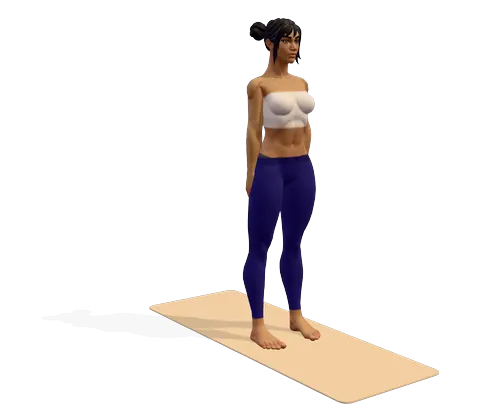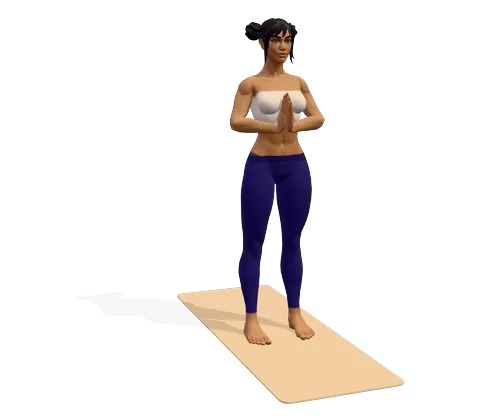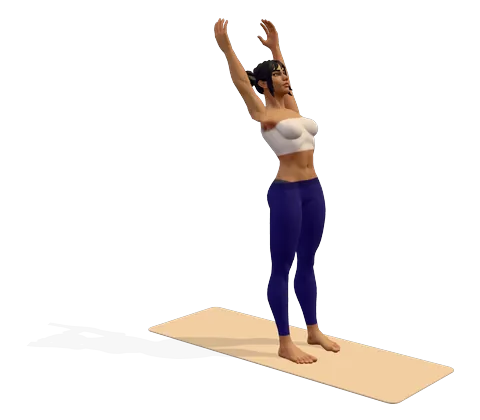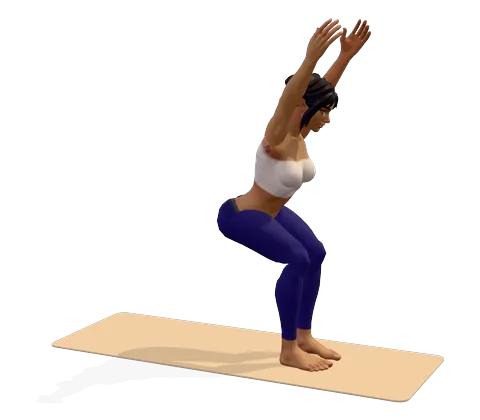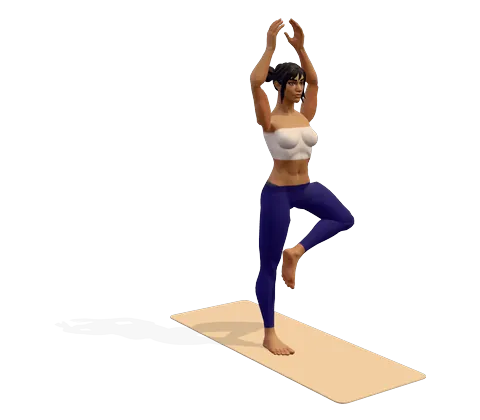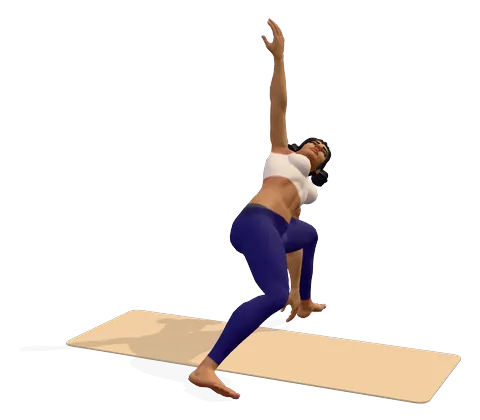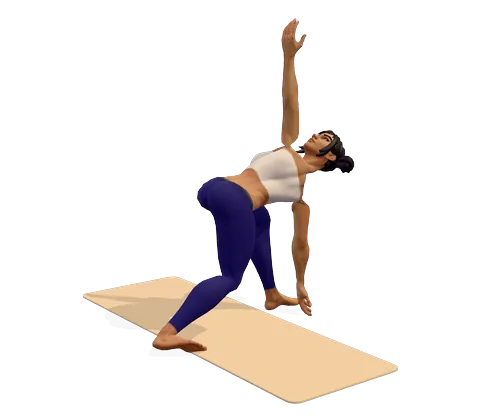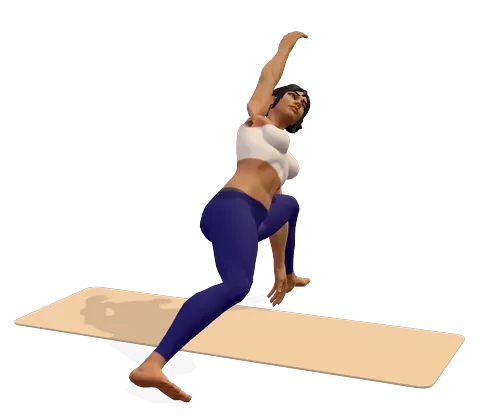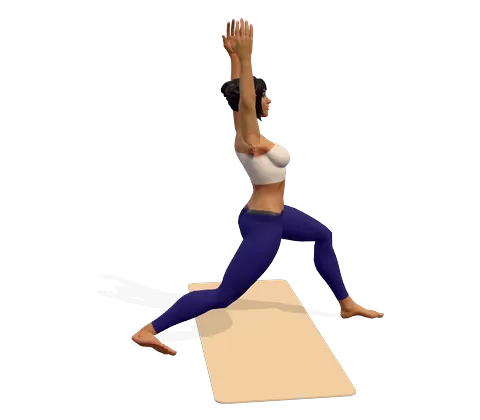
How to do Warrior I Pose step by step
- Stand at the front of your mat. Step your right foot back about one leg-length and turn the back toes out about 45 degrees, with the whole back heel on the mat.
- Set your feet hip-width apart, as if on two railway tracks, so your hips can face the front of the mat.
- Bend your left knee until it is over your ankle. Keep your right leg straight and press the outer edge of the right foot down.
- Breathe in and reach both arms up beside your ears, palms facing each other or touching.
- Lift your chest, let your lower ribs soften down, and look straight ahead or gently up.
- Hold for 3–5 breaths (about 20–30 seconds), pressing into both feet.
- To come out, lower your arms, straighten your front knee and step forward. Repeat with the other leg in front.
Where you feel Warrior I Pose: what it stretches and strengthens
Bend the front knee and feel the front of the back hip stretch. In the 3D guide, turn on Body guide: areas that stretch glow green and areas that work glow saffron.
Stretches
- Hip flexors
- Calves
- Chest
Strengthens
- Front thighs
- Glutes
- Shoulders
Benefits and precautions
Benefits
- Strengthens the thighs, buttocks and calves of both legs
- Stretches the hip flexors and calf of the back leg, which tighten with long sitting
- Opens the chest and shoulders as the arms reach overhead
- Builds stability in the ankles, knees and hips
- Trains balance and full-body coordination
- Raises the heart rate a little, especially when repeated in a flow
Avoid or modify if
- Knee injury or knee pain — bend the front knee less and keep it over the ankle, never past the toes
- Hip or sacroiliac joint pain — shorten your stance and widen your feet; skip squaring the hips fully
- Shoulder injury or neck pain — keep your hands on your hips or at your chest, and look straight ahead
- High blood pressure or a heart condition — keep your hands on your hips and breathe freely; ask your doctor first
- Pregnancy — use a shorter, wider stance and a wall or chair for balance
Warrior I pose (Virabhadrasana I) is a standing lunge in which your front knee bends, your back leg stays straight with the heel down, your hips face forward and your arms reach overhead. Warrior 1 is one of the best-known yoga poses: strong, upright and simple to learn, yet it stretches the front of the back hip while building leg strength. This guide covers what Warrior 1 is, where the name comes from, how to do it correctly, its benefits, easier versions and how it differs from Warrior 2 and the crescent lunge.
What is Warrior 1 pose?
What is a warrior pose? In yoga, the "warrior poses" are a family of standing poses on bent-knee lunges. There are three main ones — the warrior poses I, II, III — plus reverse warrior. Of these, Warrior I pose in yoga is the version where the hips and chest face the front of the mat and the arms go up.
Warrior pose meaning: the Warrior 1 Sanskrit name
The warrior pose name in Sanskrit is Virabhadrasana: vira means "hero" or "warrior", bhadra means "auspicious" or "friend", and asana means "pose". Virabhadrasana in English is therefore "the pose of Virabhadra", and the warrior I pose Sanskrit name is Virabhadrasana I. In Hindi it is वीरभद्रासन.
Warrior pose mythology: the story of the warrior poses
Virabhadrasana is named after a fierce warrior form of Shiva. In the Hindu legend, Shiva's wife Sati is insulted by her father, Daksha, and gives up her life. In grief and anger Shiva creates Virabhadra, who rises from the earth and rushes to Daksha's gathering. In modern teaching, Warrior I is linked to Virabhadra rising with his sword raised overhead, Warrior II to him fixing his eyes on the opponent, and Warrior III to the swift final stroke. The poses themselves are fairly modern; the story gives them meaning rather than history.
How to do Warrior 1 pose correctly (warrior pose kaise karte hain)
The steps above show how to do Warrior 1 pose step by step. Most problems come from the stance, so check these points:
- Feet on two tracks, not a tightrope. If your front heel lines up with your back heel, your hips cannot turn forward and your back knee twists. Step the feet hip-width apart.
- Back heel down, toes out about 45 degrees. This is what makes it Warrior I and not a high lunge. If the back heel will not stay down, shorten the stance.
- Front knee over the ankle. Track the knee toward the second and third toes. Do not let it drop inward.
- Hips toward the front, but not forced. Draw the front-leg hip back and the back-leg hip forward only as far as your body allows. Squaring the hips completely is not the goal for everyone.
- Ribs down, arms up. Avoid arching the lower back to lift the chest. Keep a light hold in the belly and let the upper back do the lifting.
Warrior I pose benefits
What is warrior pose good for? Mainly strength and mobility. The main Warrior 1 benefits are strong legs, more open hip flexors on the back-leg side and better balance and posture. Because the back-leg hip is stretched while the front leg works hard, Warrior I is a good counter to long hours of sitting.
Warrior poses also appear in yoga plans for weight management, because holding and repeating them uses large muscle groups. No single pose burns much fat on its own, though; see our yoga for weight loss plan for how these poses fit into regular practice.
Warrior 1 muscles used: what muscles does warrior pose work?
| Strengthens | Stretches |
|---|---|
| Quadriceps and gluteal muscles of the front leg | Hip flexors (psoas and front of the hip) of the back leg |
| Calf and ankle stabilisers of the back leg | Calf and Achilles tendon of the back leg |
| Core muscles and the muscles along the spine | Chest, shoulders and the sides of the waist |
Warrior 1 pose for beginners: modifications and variations
- Shorter stance: the easiest fix for a heel that lifts or a knee that complains.
- Hands on hips: takes strain off the shoulders and lets you focus on the legs.
- Warrior pose with a chair: in chair yoga, sit sideways on the chair with the front thigh supported and the back leg extended behind you, then raise the arms.
- Wall support: press the back heel against a wall to learn how grounding it feels.
- Prayer or cactus arms: palms together at the chest, or elbows bent at shoulder height.
Other Warrior 1 variations include clasping the hands behind the back and folding inside the front knee (humble warrior), and a warrior pose twist with the palms together and the opposite elbow outside the front knee. For warrior pose in pregnancy, keep a wider, shorter stance and a hand on a wall; many prenatal yoga classes use it. Warrior pose for kids is a popular game of "drawing a sword" overhead; the benefits for kids are leg strength and balance.
Warrior 1 pose vs Warrior 2 and crescent lunge
In Warrior 1 the hips and chest face the front of the mat and the arms go overhead. In Warrior 2 the hips and chest open to the side, the front heel lines up with the back arch, and the arms stretch out at shoulder height. Warrior 1 stretches the back hip flexors more; Warrior 2 opens the inner thighs more.
Warrior 1 vs high lunge (crescent lunge): in the high lunge the back heel is lifted and the back foot points forward, so the hips square easily and the calf is not stretched. In Warrior I the back heel is down and the foot is turned out, which asks for more ankle and hip flexibility. The kneeling version, low lunge, is the gentlest of the three.
Warrior 3 is the balancing member of the family: from Warrior 1 you tilt forward and lift the back leg until the body forms a T. Practising Warrior 1 2 3 (Virabhadrasana 1 2 3) in order is a common standing sequence.
Warrior 1 prep poses and a sequence for beginners
Good Warrior 1 prep poses are downward dog for the calves, low lunge for the hip flexors, and mountain pose for posture. A simple Warrior 1 sequence for beginners: mountain, forward fold, step back to low lunge, rise to Warrior I, then Warrior II and reverse warrior on the same side before switching legs. The Ashtanga Sun Salutation B also includes Warrior I. You can play a warrior flow with voice guidance in our guided sessions or build your own.
Warrior 1 pose contraindications and precautions
The caution box above lists who should modify or avoid the pose. Warrior I should feel strong, not painful. Sharp knee pain, pinching in the front of the hip or lower-back strain mean the stance is too long or the hips are forced forward: shorten the stance and turn the back foot out more.
वीरभद्रासन 1 (Warrior I) — हिंदी में: सीधे खड़े होकर दाहिना पैर पीछे ले जाएँ और पंजा थोड़ा बाहर घुमाएँ। बायाँ घुटना मोड़कर टखने के ऊपर रखें, पिछला पैर सीधा रहे। साँस लेते हुए दोनों हाथ ऊपर उठाएँ और 20–30 सेकंड रुकें, फिर दूसरी तरफ़ करें। वीरभद्रासन के फायदे: पैरों और कूल्हों में ताकत, कमर के आगे की मांसपेशियों में खिंचाव, छाती खुलती है और संतुलन बेहतर होता है। घुटने की चोट या हाई बीपी हो तो हाथ कमर पर रखें और डॉक्टर से सलाह लें।
Health conditions this pose is used for
Yoga for osteoporosis and bone health · Yoga for plantar fasciitis and heel pain · Yoga for flat feet · Yoga for weight loss · Yoga for healthy weight gain · Yoga for self-confidence · Yoga for cold hands and feet (circulation)
Where this practice is used
Chakras: Manipura (Solar Plexus Chakra)
Frequently asked questions
What is the difference between Warrior 1 and Warrior 2?
In Warrior 1 the hips and chest face forward and the arms go overhead. In Warrior 2 the hips and chest open to the side and the arms stretch out at shoulder height.
Why does my back heel lift in Warrior 1?
Your stance is probably too long or your calf and ankle are tight. Step your back foot a little closer, turn the toes out more, and press the outer edge of the foot down.
Should my hips be square in Warrior 1?
Point them toward the front as much as is comfortable. Few bodies can square them fully with the back heel down; setting the feet hip-width apart helps a lot.
What is warrior pose called in Hindi?
The warrior pose Hindi name is वीरभद्रासन (Virabhadrasana). Warrior pose kya hota hai? It is a standing lunge that builds leg strength and balance. The Hindi box above explains the warrior pose ke fayde (benefits).
How long should I hold Warrior 1?
Beginners can hold it for 3–5 breaths (about 20–30 seconds) per side. In a flowing class it is often held for a single breath.
Who should not do Warrior 1 pose?
Take care with knee, hip or shoulder injuries, and keep your hands on your hips if you have high blood pressure or a heart condition. In pregnancy use a shorter stance and support for balance.
This page is for general education. Check with your doctor before starting yoga if you are pregnant, have a medical condition or an injury. Stop if you feel pain, dizziness or shortness of breath.