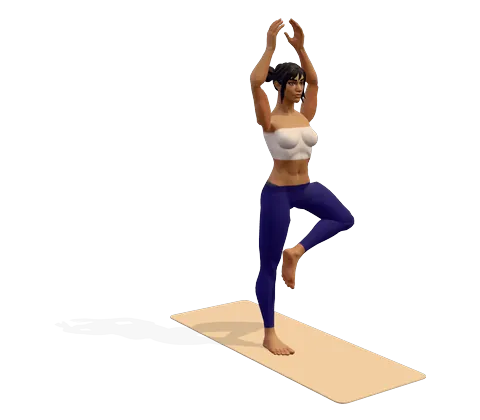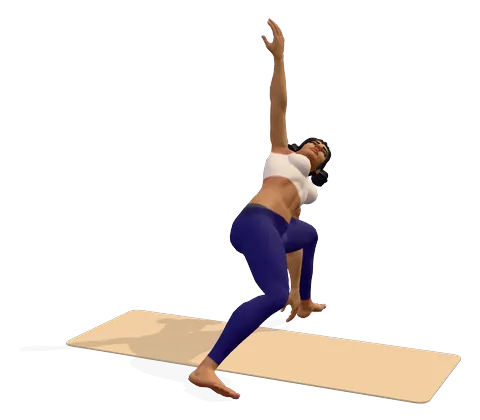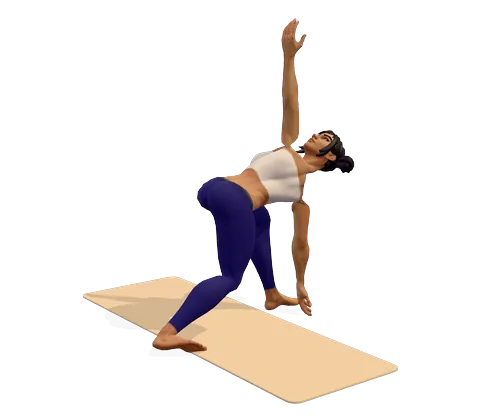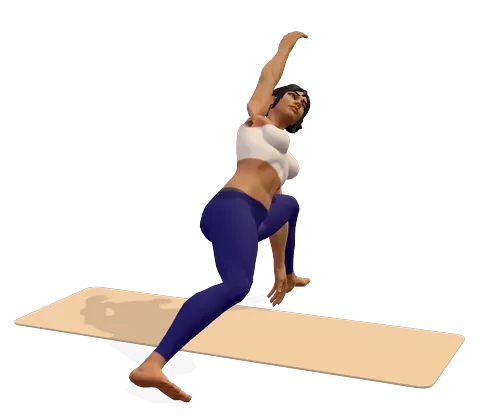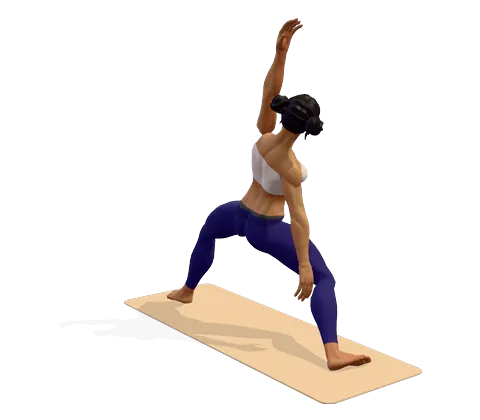
How to do Reverse Warrior Pose step by step
- Start in Warrior II with your left knee bent over your left ankle, your right leg straight and your arms stretched out at shoulder height.
- Turn your left palm to face the ceiling.
- Breathe in and reach your left arm up and slightly back over your head, lengthening the left side of your waist.
- Let your right hand slide lightly down the back of your right thigh or calf. Do not lean your weight on it.
- Keep the front knee bent and tracking over the ankle as you arch gently back. Look up at your top hand, or straight ahead if your neck prefers.
- Hold for 3–5 breaths (about 15–20 seconds), breathing into the stretched side of your ribs.
- To come out, breathe out and return to Warrior II, then straighten the front leg. Repeat on the other side.
Where you feel Reverse Warrior Pose: what it stretches and strengthens
Keep the front knee bent as you arch up and back. In the 3D guide, turn on Body guide: areas that stretch glow green and areas that work glow saffron.
Stretches
- Side waist
- Inner thighs
- Shoulders
Strengthens
- Front thighs
- Glutes
Benefits and precautions
Benefits
- Stretches the whole side of the body, from the hip to the fingertips
- Strengthens the thighs and buttocks of the bent front leg
- Opens the space between the ribs, so breathing into the side chest feels easier
- Stretches the hip flexors of the back leg and the inner thigh of the front leg
- Mobilises the spine sideways, which most daily movement rarely does
- Balances the effort of strong standing poses with a feeling of lift and openness
Avoid or modify if
- Neck pain — look straight ahead or down at the back foot instead of up
- Shoulder injury — keep the top hand on your hip or at your heart
- Knee pain — straighten the front leg a little or use a shorter stance
- Low back pain — lean back only a little; think of lengthening sideways rather than bending backward
- Dizziness or low blood pressure — keep the gaze level and come up slowly
Reverse warrior pose (Viparita Virabhadrasana) is a standing side stretch built on the legs of Warrior II. The front knee stays bent while the front arm sweeps up and back and the back hand rests on the back leg, so the side of the body forms a long arc. It is a favourite in flowing classes because it balances the hard leg work of the warrior poses with a feeling of openness. This guide covers what the pose is, the names behind it, how to do it, benefits, variations and how it compares with peaceful and exalted warrior.
What is reverse warrior pose?
What is a warrior pose? The warrior poses are standing lunges named after Virabhadra, a fierce warrior in Hindu mythology. Reverse warrior pose in yoga is the version in which you "reverse" the direction of Warrior II: instead of reaching forward over the front knee, you lean back toward the back leg.
Viparita Virabhadrasana meaning and Sanskrit name
In yoga, the reverse warrior pose Sanskrit name is Viparita Virabhadrasana: viparita means "reversed" or "turned the other way", vira "hero", bhadra "auspicious" and asana "pose". So the reverse warrior pose meaning, and Viparita Virabhadrasana in English, is "reversed warrior pose". For Viparita Virabhadrasana pronunciation, say vip-uh-REE-tah veer-uh-bud-RAHS-anna. Some teachers call it reverse warrior 2 or Viparita Virabhadrasana 2, because this yoga pose is built on Warrior II; a "Viparita Virabhadrasana 1" built on Warrior I legs is rare.
Do not confuse it with Viparita Karani, the restful legs-up-the-wall pose, which only shares the word "viparita". If you were looking for how long to hold Viparita Karani pose, most people rest there for 5–15 minutes — see legs-up-the-wall pose.
Peaceful warrior meaning
Peaceful warrior pose is another yoga name for reverse warrior. The peaceful warrior pose meaning comes from the calm, open shape: after the fierce focus of Warrior II, the warrior lifts the heart and softens. Reverse warrior pose in Hindi is विपरीत वीरभद्रासन (Viparita Virabhadrasana), and the peaceful warrior meaning in Hindi is शांत योद्धा, a calm warrior.
How to do reverse warrior pose: cues and alignment
The steps above give reverse warrior pose instructions from Warrior II. These reverse warrior pose cues fix the common mistakes:
- Keep the front knee bent. Most people straighten the front leg as they lean back. Keep the thigh working and the knee over the ankle — that is the "warrior" in the pose.
- Lift before you lean. Reach the top arm up first, lengthening the waist, and only then arc back. This spreads the bend along the whole side body instead of crunching the lower back.
- The back hand is light. It slides along the back leg for guidance; it should not carry your weight.
- Hips stay low and level. Imagine sitting slightly deeper into the front leg as the arm rises.
- Shoulders soft. The top shoulder moves away from the ear; the neck stays long whether you look up or ahead.
Breathe into the stretched ribs. A slow, steady breath (you could try Ujjayi) makes the side stretch feel wider with each inhale.
Reverse warrior pose benefits
The main benefits of reverse warrior pose in yoga are a deep side-body stretch combined with leg strength. The muscles between the ribs, the side waist (obliques and quadratus lumborum) and the latissimus dorsi of the top arm lengthen, while the front thigh and buttocks keep working. What muscles does warrior pose work here? The quadriceps and glutes of the front leg, the inner thighs and the core muscles that stop you from collapsing backward.
What is warrior pose good for, then, in this reversed form? It helps balance a practice full of forward folds and strong lunges, and it gives the spine a sideways movement it rarely gets in daily life. Many people also find the open, upward shape uplifting. Like any single pose, it will not fix back pain or posture on its own, but it is a useful part of a varied routine.
Reverse warrior pose variations and modifications
- Hand on hip: the easiest of the reverse warrior pose modifications for sore shoulders or neck.
- Reverse warrior pose with straight leg: straighten the front leg slightly if the knee complains. You lose some strength work but keep the side stretch.
- Kneeling reverse warrior pose: start from low lunge with the back knee down, or kneel on one knee with the other leg stretched to the side, and reach the arm up and over. Good for balance problems and for beginners.
- Bound variation: wrap the back arm behind your waist and reach for the front thigh to open the shoulder.
- Revolved (twisted) reverse warrior pose: an advanced flow variation in which you add a twist toward the back leg. Build up to it only once the basic shape is steady.
Peaceful warrior vs reverse warrior, exalted and humble warrior
Peaceful warrior pose vs reverse warrior: they are the same pose with two names. Exalted warrior pose vs reverse warrior: "exalted warrior" (or reverse exalted warrior pose) is another common name for the same shape; some teachers use it for a version where the chest turns more toward the ceiling. Peaceful warrior vs humble warrior: humble warrior is quite different — it uses Warrior I legs, clasps the hands behind the back and folds the chest down inside the front knee.
Pose after reverse warrior and a peaceful warrior sequence
Reverse warrior is usually linked with other Warrior II-based poses on the same side:
- Reverse warrior to side angle pose: keep the knee bent, bring the front forearm to the thigh or the hand to the floor and sweep the top arm forward into extended side angle.
- Reverse warrior to triangle pose: straighten the front leg, reach forward and tilt down into triangle pose.
A simple peaceful warrior sequence: Warrior II, reverse warrior, extended side angle, back to Warrior II, then the other side. In a Vinyasa class, the pose after reverse warrior is often a "windmill" of the arms down to plank and downward dog. You can arrange this flow with voice guidance in the sequence builder.
Some teachers link the reverse warrior pose chakra to the heart (Anahata) because of the lifted, open chest; this is a modern idea rather than a classical teaching.
विपरीत वीरभद्रासन (Reverse Warrior) — हिंदी में: वीरभद्रासन 2 में खड़े हों, बायाँ घुटना मुड़ा रहे। बाईं हथेली ऊपर घुमाएँ, साँस लेते हुए बायाँ हाथ ऊपर और पीछे की ओर ले जाएँ और दाहिना हाथ हल्के से पिछले पैर पर रखें। 15–20 सेकंड रुकें, फिर दूसरी तरफ़ करें। इसके फायदे: कमर और पसलियों की साइड में अच्छा खिंचाव, पैरों में ताकत और साँस लेने में खुलापन। गर्दन या कंधे में दर्द हो तो ऊपर न देखें और हाथ कमर पर रखें।
Frequently asked questions
What are the benefits of reverse warrior pose?
It stretches the whole side body and the muscles between the ribs, strengthens the front thigh and buttocks, stretches the hip flexors of the back leg and gives the spine a sideways movement.
Is peaceful warrior the same as reverse warrior?
Yes. Peaceful warrior, reverse warrior and exalted warrior are common names for the same pose, Viparita Virabhadrasana.
How do you do peaceful warrior?
From Warrior II, turn the front palm up, reach that arm overhead and lean gently back while the back hand slides down the back leg. Keep the front knee bent.
Why does my lower back hurt in reverse warrior?
You are probably bending backward from the lower back rather than lengthening sideways. Lift the top arm first, lean less, and keep the front knee bent so the hips stay low.
How long should I hold reverse warrior?
Hold for 3–5 breaths (about 15–20 seconds) per side. In a flowing class it is often held for a single breath.
Where should I look in reverse warrior?
Up at your top hand if your neck is comfortable. With neck pain, look straight ahead or down toward your back foot.
This page is for general education. Check with your doctor before starting yoga if you are pregnant, have a medical condition or an injury. Stop if you feel pain, dizziness or shortness of breath.