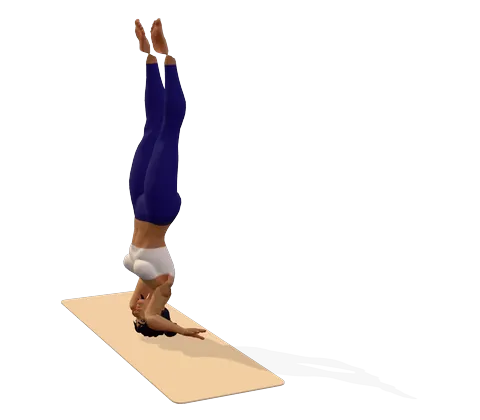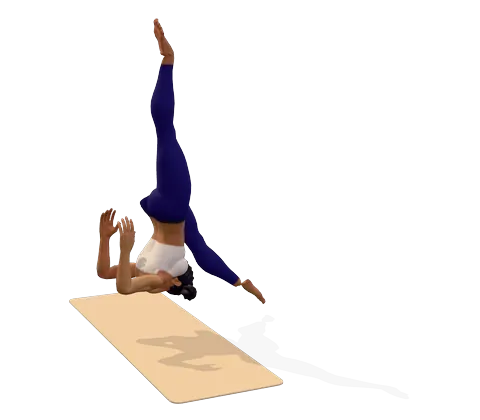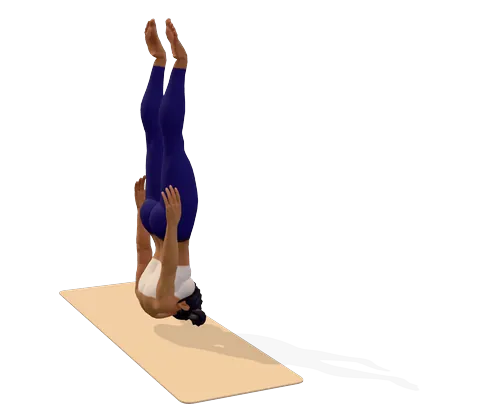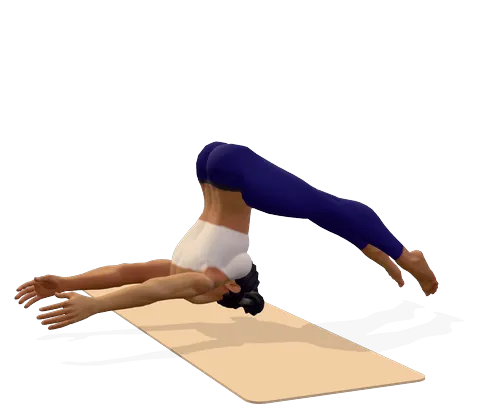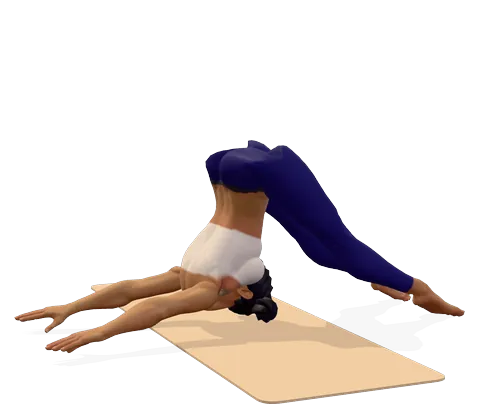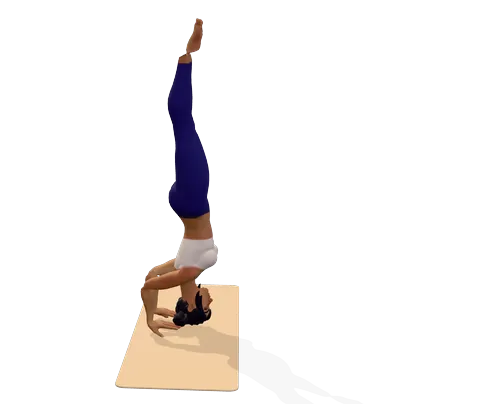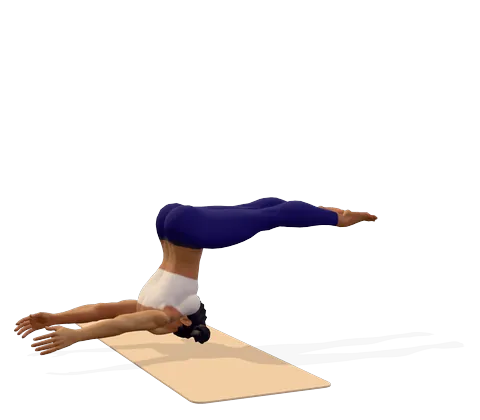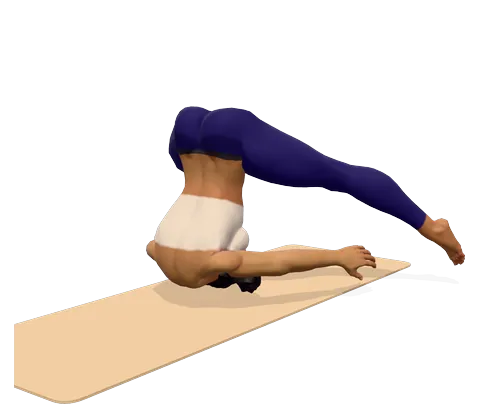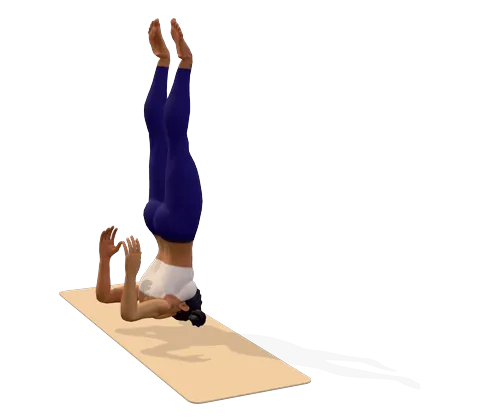
How to do Shoulder Stand step by step
- Fold two or three firm blankets into a neat stack and lie on your back with your shoulders on the stack and your head on the floor beyond its edge.
- Bend your knees, feet flat, arms beside you with palms down. Walk your shoulder blades in under your back so your chest lifts slightly.
- Press your arms into the floor and swing or roll your knees towards your chest, then lift your hips off the floor.
- Place your hands on your back, fingers pointing up, and draw your elbows no wider than your shoulders.
- Straighten your legs up one at a time until your hips, knees and ankles stack over your shoulders. Keep your head still and look towards your chest.
- Stay for 30 seconds to start and breathe quietly through your nose. Build up slowly over weeks.
- To come down, bend your knees, lower your hips onto your hands, then roll your spine slowly to the floor and rest.
Where you feel Shoulder Stand: what it stretches and strengthens
Walk your elbows in and lift your legs straight up. In the 3D guide, turn on Body guide: areas that stretch glow green and areas that work glow saffron.
Stretches
- Neck
- Upper back
Strengthens
- Abs
- Glutes
- Shoulders
Benefits and precautions
Benefits
- Builds strength in the upper back, shoulders, core and legs
- Stretches the back of the neck and upper back in a controlled way
- Reverses the usual pull of gravity, which many people find refreshing for tired legs
- Encourages slow, calm breathing and a quiet, inward focus
- Trains body awareness and balance while upside down
- Leads naturally into plow pose and other inversions in a longer practice
Avoid or modify if
- Neck injury, cervical spondylosis, disc problems or osteoporosis in the spine — do not do it; use legs up the wall instead
- High blood pressure, heart disease, glaucoma or other eye pressure problems, or a history of stroke
- Pregnancy, epilepsy, a migraine attack, or an ear or sinus infection
- Many teachers advise skipping inversions during the heavy days of a period
- Stop at once if you feel pressure in the head, pain in the neck, or pins and needles in the arms
Shoulder stand (Salamba Sarvangasana) is an inversion in which you rest on your shoulders and upper arms, support your back with your hands and lift your legs straight up. B.K.S. Iyengar called it the queen of asanas. Done badly, it strains the neck, so this guide covers setup and safety as carefully as benefits.
What is a shoulder stand in yoga?
In the shoulder stand yoga pose your body forms a straight vertical line from shoulders to feet. Only the back of the head, the shoulders and the upper arms touch the ground. The weight should sit on the shoulders and arms, not on the neck.
Sanskrit name and meaning
The shoulder stand Sanskrit name breaks into four parts: salamba means "with support", sarva means "all", anga means "limb" and asana means "pose". So Sarvangasana meaning is "all-limbs pose", because the whole body takes part. In Hindi, Sarvangasana is written सर्वांगासन.
The blanket setup that protects your neck
On a flat floor, lifting the legs bends the neck forward at a sharp angle. A stack of blankets raises the shoulders so the neck keeps a little of its natural curve. This is the single most useful shoulder stand support.
- Stack: two or three firm, folded blankets, about 5–8 cm high, with clean folded edges on one side.
- Position: shoulders on the stack, about 3–5 cm in from the folded edge; head and neck on the floor beyond it.
- Grip: a sticky mat folded over the top of the stack stops the elbows sliding apart.
- Check: there should be a small space between the back of your neck and the floor. If your neck is pressed flat, add height.
Never turn your head to look around while you are up. Turning the head under load twists the neck. Keep your gaze on your chest from start to finish.
Shoulder stand for beginners: preparation and a safe progression
If you are new to inversions, do not start with the full pose. Move through these stages over several weeks and only go on when the previous one feels easy.
- Legs up the wall: Viparita Karani gives you the gentle inverted feeling with no load on the neck.
- Bridge pose: Setu Bandha Sarvangasana is the best sarvangasana preparatory pose. It teaches you to walk the shoulders under and lift the chest. Setu bandha sarvangasana for beginners works well with a block under the sacrum.
- Half shoulder stand at the wall: lie with your buttocks near the wall, walk your feet up it, lift your hips and put your hands on your back. This answers how to do shoulder stand on wall with the wall carrying part of your weight.
- Supported shoulder stand on blankets: from the wall version, take one foot off, then the other, until you can hold the full yoga pose with blanket support.
For yoga shoulder stand for beginners, the blanket stack is part of the pose, not an extra.
Shoulder stand yoga cues and common mistakes
- Elbows sliding wide: the chest collapses and weight moves to the neck. Loop a strap just above the elbows at shoulder width.
- Hips hanging behind you: walk your hands higher up your back, towards the shoulder blades, and lift the tailbone.
- Legs tipping over your face: firm the thighs and move the feet back until the ankles line up over the hips.
- Chin jammed into the chest: you need more height under the shoulders, or you need to stay in the half version for now; half shoulder stand benefits are similar, with less load on the neck.
- Holding the breath: the throat is slightly compressed, so breathe slowly through the nose. A soft Ujjayi breath helps some people.
Shoulder stand benefits
The clearest benefits of shoulder stand in yoga are physical: it strengthens the upper back, shoulders and core. Supported shoulder stand benefits also include a sense of calm, which is why it often comes at the end of a practice.
Shoulder stand benefits for thyroid
Traditional texts say Sarvangasana "stimulates" the thyroid by pressing on the throat. There is no good evidence that it changes thyroid hormone levels. It appears in yoga for thyroid plans as part of a general practice for energy and mood. Keep taking your prescribed thyroid medicine, and only practise it with a healthy neck.
Hair, skin, men and women
Claims about shoulder stand benefits for hair and skin come from the idea that more blood flows to the head; no study shows it improves either. Shoulder stand benefits for male and female practitioners are the same. For women, the main difference is the period advice below.
Shoulder stand yoga variations and modifications
- Shoulder stand against the wall: feet on the wall, as in stage 3 above. The easiest of the shoulder stand variations for beginners.
- Shoulder stand with chair: in Iyengar yoga a folding chair supports the hips while you hold its legs. Learn this one with a teacher.
- Shoulder stand tuck: knees bent towards the forehead, hands on the back. Less leverage, so it is easier to hold.
- Straddle and split: the legs open wide sideways, or in a shoulder stand split one moves forward and one back. See one-legged shoulder stand.
- Without hand support: the advanced unsupported version takes the hands off the back.
Shoulder stand sequence: before and after
Warm up with bridge and cat–cow. A common yoga sequence goes from shoulder stand to plow pose, lowering the straight legs over the head to the floor. The counter pose of Sarvangasana is fish pose, which bends the neck and upper back the other way. Finish in corpse pose. In Ashtanga, shoulder stand sits in the closing sequence, followed by plow, ear-pressure pose and, a little later, fish.
How long to hold shoulder stand
Sarvangasana pose duration depends on experience. Start with 30 seconds and add 15 seconds a week if your neck feels easy the next day. Experienced students hold it for 3–5 minutes. The shoulder stand stretch on the back of the neck needs time to settle, so do not rush longer holds. Practise on an empty stomach, ideally in the morning or before relaxation.
Is shoulder stand dangerous? Sarvangasana pose precautions
For a healthy person with good setup, the risk is low. Done on a bare floor, with the head turned or with a stiff neck, it can strain the cervical spine. These shoulder stand yoga precautions and contraindications are strict: skip it with a neck injury, high blood pressure, glaucoma, heart disease or pregnancy. See yoga for neck pain for safer options. Many teachers also advise not going upside down during the first days of a period.
Shoulder stand alternative: legs up the wall gives most of the calming effect with none of the neck load.
सर्वांगासन (Sarvangasana) — हिंदी में: कंधों के नीचे मोड़े हुए कंबल रखकर पीठ के बल लेटें। हाथों से कमर को सहारा देते हुए पैरों को सीधा ऊपर उठाएँ, गर्दन को न घुमाएँ। शुरुआत में 30 सेकंड रुकें। सर्वांगासन के फायदे: कंधे, पीठ और पेट मज़बूत होते हैं और मन शांत होता है। गर्दन की चोट, हाई ब्लड प्रेशर, ग्लूकोमा, हृदय रोग और गर्भावस्था में यह आसन न करें।
Health conditions this pose is used for
Frequently asked questions
How do you do a shoulder stand step by step?
Lie with your shoulders on folded blankets, lift your hips, support your back with your hands and straighten your legs up, head still. Beginners should start with legs up the wall and bridge pose.
Is shoulder stand dangerous for the neck?
It can be if you practise on a flat floor, turn your head or already have a neck problem. With blankets under the shoulders and a still head, most healthy people practise it safely.
How long should I hold Sarvangasana?
Beginners hold it for about 30 seconds. With regular practice you can build up to 3–5 minutes. Come down before your neck, face or breathing feel strained.
Does shoulder stand help the thyroid?
It is traditionally linked with the thyroid, but there is no good evidence it changes thyroid hormones. It can be part of a general yoga practice. Keep taking your prescribed medicine.
Can I do shoulder stand during my period?
Many teachers advise skipping inversions on the heavy days of a period and choosing restful poses instead. There is no strict medical rule, so follow what feels comfortable.
What is the counter pose of Sarvangasana?
Fish pose (Matsyasana) is the classic counter pose because it arches the upper back and neck the other way. Hold it for about a third of your shoulder stand time.
Can kids do a shoulder stand?
Many children enjoy a short, playful half version with bent knees and hands on the back, on a soft surface.
What is the difference between shoulder stand and plow pose?
In Sarvangasana the legs point straight up. In plow pose they lower over the head until the toes touch the floor behind you. Plow usually follows it in a sequence.
This page is for general education. Check with your doctor before starting yoga if you are pregnant, have a medical condition or an injury. Stop if you feel pain, dizziness or shortness of breath.