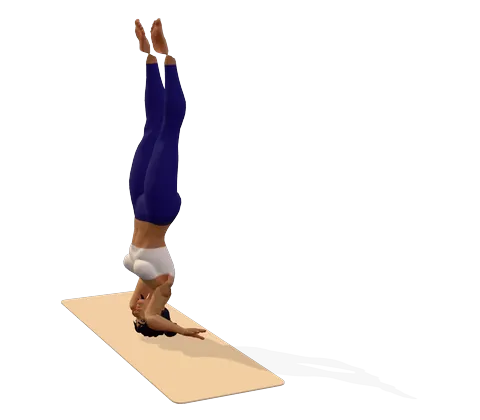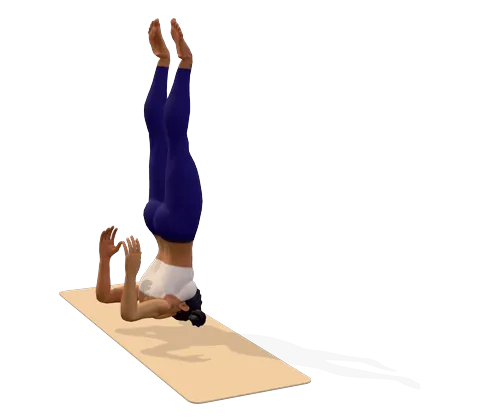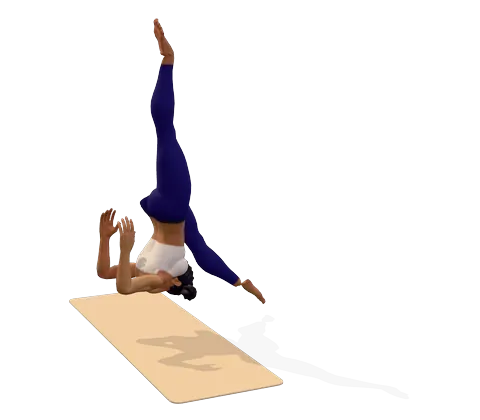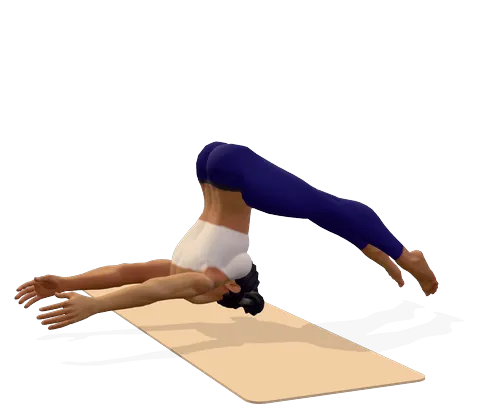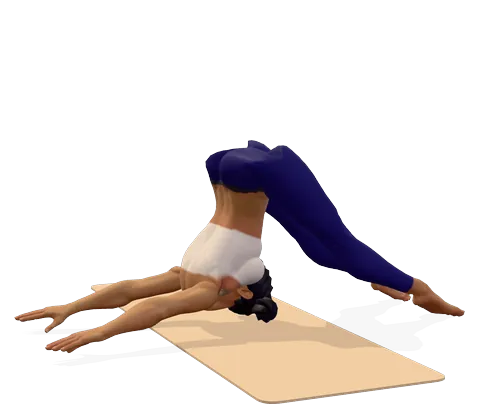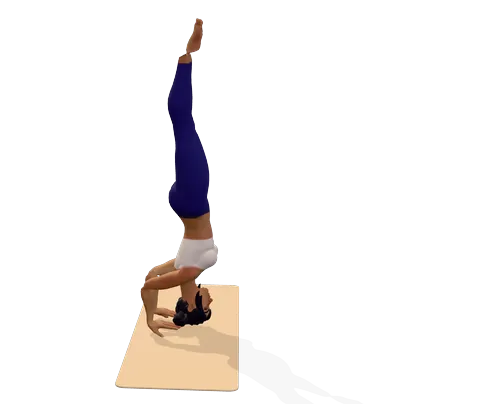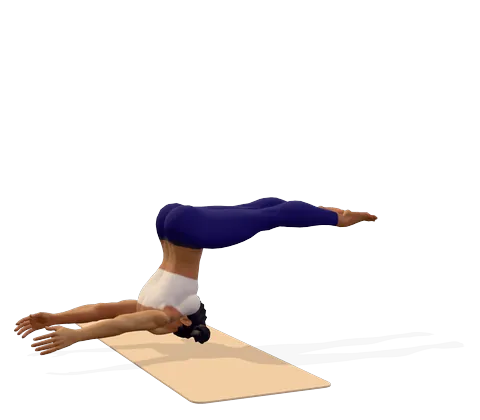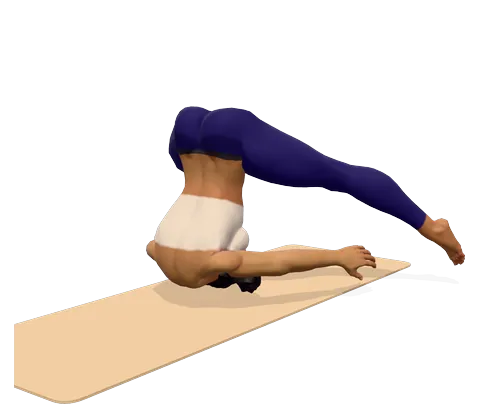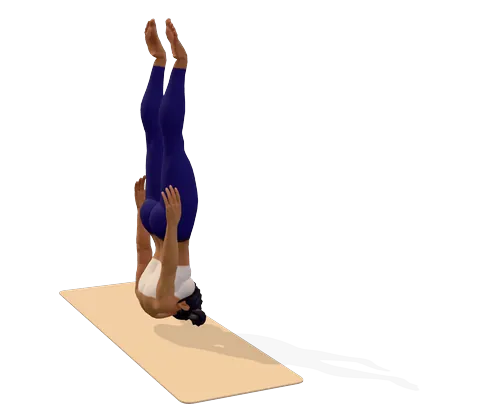
How to do Unsupported Shoulder Stand step by step
- Set up two or three folded blankets, lie with your shoulders on them and your head on the floor, and come into a steady supported shoulder stand.
- Walk your hands high up your back and lift your hips, legs and chest into one straight vertical line. Stay here for a few breaths.
- Firm your legs and belly. Take one hand off your back and rest that arm on the floor; if you stay steady, release the other hand.
- Raise both arms up beside your legs, palms facing your thighs, fingers reaching towards the ceiling.
- Balance on the back of your shoulders for 10–15 seconds, breathing slowly, head still and gaze on your chest.
- Return your hands to your back one at a time, then bend your knees and roll your spine slowly down to the floor.
Where you feel Unsupported Shoulder Stand: what it stretches and strengthens
Balance on your shoulders with arms free and body tall. In the 3D guide, turn on Body guide: areas that stretch glow green and areas that work glow saffron.
Stretches
- Neck
Strengthens
- Abs
- Glutes
- Upper back
Benefits and precautions
Benefits
- Builds deep core strength, since the abdominals and back muscles must hold the body upright alone
- Strengthens the upper back and the back of the shoulders
- Trains fine balance and body awareness upside down
- Shows whether your shoulder stand is truly aligned, not propped up by your hands
- Needs calm, even breathing and steady focus to hold
Avoid or modify if
- Only for people who can already hold a supported shoulder stand for 2–3 minutes with ease
- Neck injury, cervical spondylosis, disc problems or osteoporosis — do not do it
- High blood pressure, heart disease, glaucoma, a history of stroke, epilepsy or pregnancy
- A recent shoulder dislocation, shoulder surgery or shoulder instability
- Many teachers advise skipping inversions on the heavy days of a period; avoid during a migraine
Unsupported shoulder stand (Niralamba Sarvangasana) is the shoulder stand with the hands taken off the back. With nothing propping up your spine, the core and back muscles must hold your body vertical on their own. It is an advanced inversion and a real test of alignment: if your shoulder stand leans, you will know within a breath.
What is Niralamba Sarvangasana?
The Sanskrit name has three parts: niralamba means "without support" (nir, "without", and alamba, "support"), sarva means "all" and anga means "limb". Sarvangasana is the "all-limbs pose", and Niralamba Sarvangasana is its unsupported form.
There are two common versions. In the one our 3D guide shows, the arms reach up beside the legs with the palms facing the thighs. In the other, the arms rest on the floor behind the head. Both remove the hands from the back, which is the point of the pose.
Supported vs unsupported shoulder stand
If you are asking what a shoulder stand is, start with the basic supported shoulder stand pose (Salamba Sarvangasana). The word salamba means "with support": the hands hold the back and the upper arms share the weight. In the supported shoulder stand yoga students learn first, the hands let you lift the chest and fine-tune your line.
| Supported (Salamba) | Unsupported (Niralamba) | |
|---|---|---|
| Hands | On the back | Beside the legs or on the floor |
| What holds you up | Arms, shoulders and back | Shoulders, core and back alone |
| Level | Intermediate | Advanced |
| Typical hold | 30 seconds to 5 minutes | 10–30 seconds |
Supported shoulder stand benefits include strength, calm breathing and a steady inverted position. The unsupported form adds balance and core work, but it also leaves less margin for error, so the neck rules matter even more.
How to prepare: blankets, core and progression
The blanket setup
Use the same shoulder and back support as for the supported pose: two or three firm blankets folded into a stack about 5–8 cm high. Lie with your shoulders on the stack and your head on the floor so the back of your neck stays slightly off the ground. Never turn your head once you are up.
Build the strength first
In this pose your abdominal and back muscles do the job your hands did. Good preparation includes boat pose and upward extended feet pose for the core, and bridge pose to learn to roll the shoulders under.
A step-by-step progression
- Get comfortable with legs up the wall.
- Hold a supported shoulder stand on blankets for 2–3 minutes with no strain in the neck.
- From there, place one hand on the floor for a few breaths, then the other.
- Next, lift both hands off the back and rest them on the fronts of your thighs.
- Finally, reach the arms up beside the legs, as in the 3D guide.
Each stage may take several weeks. If your hips drift back or your legs tip over your face when the hands leave, go back a step.
Alignment tips and common mistakes
- Stack before you let go. Hips, knees and ankles must line up over the shoulders before either hand moves.
- Legs together and active. Press the inner thighs together and reach the heels up. Loose legs make the body sway.
- Belly firm, not gripped. A gentle draw of the lower belly keeps the pelvis from sagging, while the breath stays smooth.
- Head still. Keep your gaze on your chest. Rolling the head or looking at your feet puts sideways load on the neck.
- Come out slowly. Hands back first, then bend the knees and roll down. You can also lower into plow pose first.
Niralamba Sarvangasana benefits
The benefits of shoulder stand pose practice, and of Sarvangasana yoga in general — strength in the upper back and shoulders, calm breathing and body awareness — all apply. The unsupported shoulder stand benefits on top of that are mostly about control: stronger abdominals and back muscles, finer balance, and a clear check of your alignment.
The benefits of strong shoulders show up here too. The main muscle for shoulder extension is the posterior deltoid, at the back of the shoulder (the posterior shoulder, in medical terms). With the latissimus dorsi and triceps, these muscles that extend the shoulder press the upper arms and shoulder blades into the blankets. Of any muscle that supports the shoulder joint here, the rotator cuff matters most: the SITS muscles (supraspinatus, infraspinatus, teres minor and subscapularis) keep each joint centred. Working these muscles under control is one way to increase shoulder stability over time. Claims that this pose changes hormones or organs are not backed by research.
Safety: who should not practise it
Because nothing props you up, a wobble goes straight to the neck. Skip Niralamba Sarvangasana with a neck injury, high blood pressure, glaucoma, heart disease, epilepsy or pregnancy. Many teachers advise leaving out inversions on the heavy days of a period.
Shoulder injuries and surgery
The same restrictions for shoulder injury apply as in any weight-bearing arm pose. To avoid and prevent shoulder injuries in any inversion, keep your weight on the tops of the shoulders and never force the position. After an anterior or posterior shoulder dislocation, follow the precautions your physiotherapist gives before you bear weight like this. After shoulder surgery, including a total or reverse shoulder replacement, the usual precautions and restrictions rule out shoulder stands for a long time; ask your surgeon. If you have pain in the back of the shoulder or back and shoulder pain from desk work, gentler options are in our yoga for neck pain plan.
When to practise it, and what to do after
Practise it on an empty stomach, near the end of a session when the body is warm but not tired. A typical order is supported shoulder stand, Niralamba Sarvangasana, then plow pose. You can save that order in the sequence builder and let the voice guide time each hold.
Afterwards, rest flat for a few breaths, then take fish pose as a counter pose to arch the neck and upper back the other way. Finish in corpse pose.
निरालंब सर्वांगासन (Niralamba Sarvangasana) — हिंदी में: "निरालंब" का अर्थ है बिना सहारे का। पहले कंबल के सहारे सर्वांगासन में स्थिर हों, फिर एक-एक करके हाथ कमर से हटाएँ और पैरों के साथ ऊपर उठाएँ। 10–15 सेकंड रुकें। इससे पेट और पीठ की मांसपेशियाँ मज़बूत होती हैं और संतुलन सुधरता है। यह उन्नत आसन है; गर्दन की चोट, हाई ब्लड प्रेशर, ग्लूकोमा और गर्भावस्था में न करें।
Frequently asked questions
What does Niralamba Sarvangasana mean?
"Niralamba" means "without support", so it is the shoulder stand without the hands on the back. "Sarvangasana" means "all-limbs pose".
Is the unsupported shoulder stand harder than the supported one?
Yes. Without your hands on your back, your core and back muscles must hold you upright, and any lean is harder to correct. Learn the supported version well first.
How long should I hold Niralamba Sarvangasana?
Start with 10–15 seconds and build to about 30 seconds. Come down as soon as your body starts to sway or your neck feels strained.
What if I tip over when I take my hands away?
Your hips are probably not stacked over your shoulders yet. Return your hands, lift the hips and legs into a straight line, and try letting go of one hand only.
Is it safe for beginners?
No. It is an advanced pose. Beginners should practise legs up the wall, bridge and a supported shoulder stand with blankets first.
Where should my arms go?
Either up beside your legs with the palms facing your thighs, as the 3D guide shows, or resting on the floor behind your head. Choose the version your teacher uses and keep the shoulders under you.
This page is for general education. Check with your doctor before starting yoga if you are pregnant, have a medical condition or an injury. Stop if you feel pain, dizziness or shortness of breath.