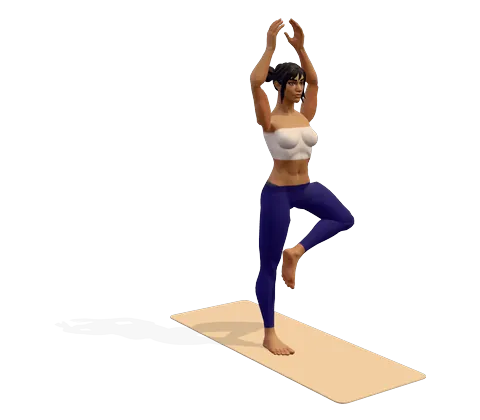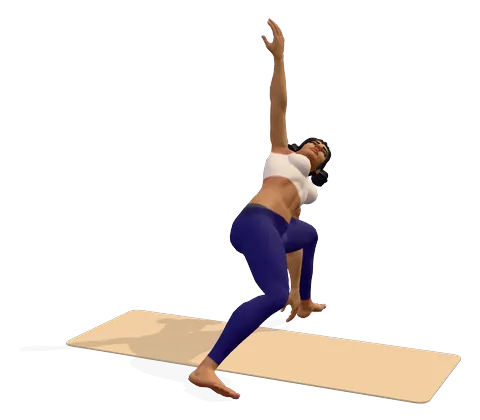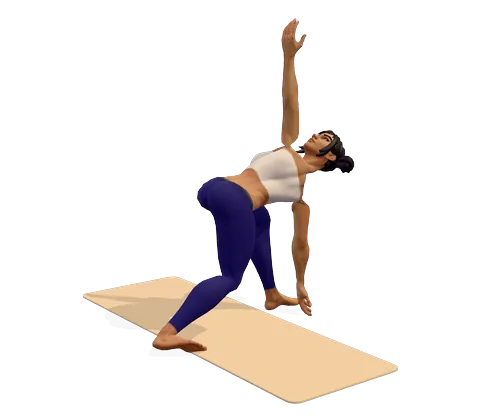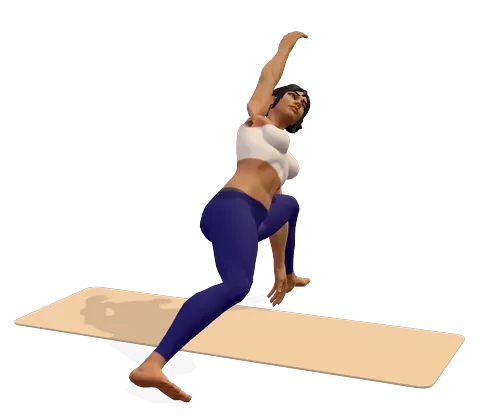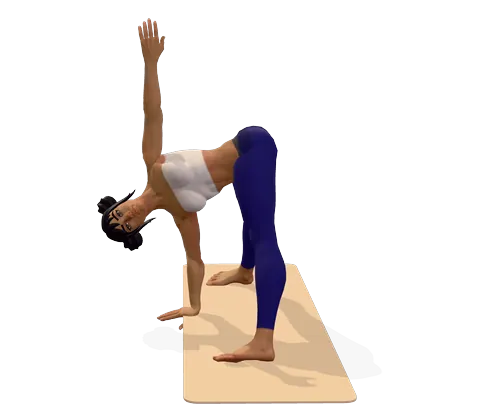
How to do Revolved Wide-Legged Forward Bend step by step
- Stand with your feet wide apart, about 1.2 metres, toes pointing forward and the outer edges of the feet parallel.
- Place your hands on your hips, lengthen your spine as you breathe in, and fold forward from the hips as you breathe out.
- Place both hands on the mat under your shoulders. Keep your back long and your knees soft.
- Walk your right hand to the centre of the mat, under your face, in line with your feet.
- Breathing in, place your left hand on your lower back or reach your left arm straight up as you turn your chest to the left.
- Look down, to the side, or up toward your left hand. Hold for 15–20 seconds (3–5 breaths), keeping both hips level.
- Breathing out, lower your left hand to the mat. Repeat the twist to the right, then walk the hands under the shoulders, bring your hands to your hips and rise with a long back.
Where you feel Revolved Wide-Legged Forward Bend: what it stretches and strengthens
Keep one hand under your face and twist to reach the other arm up. In the 3D guide, turn on Body guide: areas that stretch glow green and areas that work glow saffron.
Stretches
- Hamstrings
- Inner thighs
- Upper back
Strengthens
- Side waist
- Front thighs
Benefits and precautions
Benefits
- Stretches the hamstrings and inner thighs in a wide stance
- Adds a gentle twist that mobilises the upper back and ribs
- Works the obliques and the thigh muscles that keep the pelvis steady
- Stretches the back of the shoulder on the lifted-arm side
- Calms the mind as a mild forward fold with the head low
- Prepares the body for revolved triangle and other standing twists
Avoid or modify if
- High blood pressure, glaucoma or other eye pressure problems — keep your head above your heart with hands on blocks or a chair, or skip the pose
- Low back or disc problems — use blocks, keep the spine long and twist only a little; stop if pain spreads down the leg
- Pregnancy — avoid the twist; ask your midwife or doctor before any deep folds
- Dizziness or vertigo — rise slowly with your hands on your hips and keep the gaze down
- Hamstring or groin strain — bend the knees and shorten the stance
Revolved wide-legged forward bend (Parivrtta Prasarita Padottanasana) is a wide leg forward bend with a twist added. Your feet stay wide, your torso folds forward, one hand stays on the mat under your face and the other arm reaches up to the ceiling. It combines a hamstring and inner-thigh stretch with an upper-back twist in one steady shape, and it is a friendlier first standing twist than revolved triangle because the wide stance is very stable.
Name and meaning
The revolved wide-legged forward fold Sanskrit name has five parts: parivrtta means "revolved" or "turned", prasarita "spread out" or "wide", pada "foot", uttana "intense stretch" and asana "pose". So Parivrtta Prasarita Padottanasana is "revolved, wide-footed intense stretch pose". Some teachers call it a wide leg forward fold twist or a twisted wide-legged forward fold.
Where it fits: Prasarita Padottanasana A, B, C, D
In Ashtanga yoga, the standing wide leg forward fold is taught in four arm positions: A (hands on the floor), B (hands on the hips), C (hands clasped behind the back) and D (holding the big toes). The revolved version is not one of these four; it is a separate variation used in many vinyasa and Iyengar-based classes. Learn the basic wide-legged forward bend first.
How to do revolved wide-legged forward bend
The steps above follow the 3D figure: right hand down, twist to the left first. A few details make the pose safe and comfortable:
- Hand under the face, not under the shoulder. Moving the bottom hand to the centre line gives your chest room to turn.
- Hips stay level. When you twist left, the left hip tends to lift. Draw it back and down so the turn comes from the ribs and upper back.
- Long spine first, then turn. Lengthen from tailbone to crown on the inhale; twist on the exhale.
- Feet grounded. Press the outer edges of both feet down and lift the arches. If your feet slide on the mat, bring them closer.
- Top arm optional. A hand on the lower back gives a gentler twist than an arm reaching up.
Revolved wide-legged forward bend for beginners
If your hands do not reach the floor with a flat back, use a block under the bottom hand, on its tallest height. A chair seat in front of you works too and keeps the head higher. Bend your knees a little if the backs of your legs pull hard; a wide leg stretch in yoga should feel strong but never sharp. As with any wide legged forward fold for beginners, it is better to keep a long back than to touch the floor.
Revolved wide-legged forward bend benefits
The benefits start with the legs. Like all wide legged forward fold benefits, the hamstrings and the inner thighs lengthen, and the thighs work to hold the stance. The twist then adds movement to the upper back and ribs, which many people who sit all day rarely turn. The top arm stretches the back of the shoulder, and the obliques work to hold the turn.
Because the head is low and the legs are wide, many people find this pose steadying and calming. The usual standing forward bend benefits, a longer back of the body and a quieter breath, apply here as well. You can add this wide legged stretch yoga pose to your own sequence in the session builder, and it combines well with poses from our yoga for posture plan.
Is it good for lower back pain?
It can help a stiff upper back, but it is not the first pose for a painful lower back. A seated torso twist for lower back pain, such as simple seated twist, is gentler because the pelvis rests on the floor. If you have back pain, see our yoga for back pain plan first.
Muscles stretched and worked
| Stretched | Strengthened |
|---|---|
| Hamstrings of both legs | Obliques, holding the twist |
| Inner thighs (adductors) | Quadriceps, keeping the knees steady |
| Upper back and the back of the lifted shoulder | Muscles around the feet and ankles |
Switch on the Body guide on the 3D figure to see these areas glow: green for the stretch, saffron for the work.
Revolved wide-legged forward bend vs similar poses
- vs revolved triangle: revolved triangle has one foot in front of the other, so balance is harder and the front hamstring stretches more. The wide stance here is easier to hold.
- vs a single leg forward bend: in a single leg forward fold such as pyramid pose, you fold over one front leg. The stretch goes deeper into one hamstring, while the wide fold spreads it over both legs and the inner thighs.
- vs a seated wide legged forward fold: the seated wide leg forward fold (Upavistha Konasana) is a yoga seated forward bend with the floor supporting you. The standing version lets gravity help the fold.
Other seated relatives include the seated forward bend pose yoga classes teach as Paschimottanasana, and revolved head-to-knee pose. Parivrtta Janu Sirsasana benefits are similar (hamstrings plus side body), but it is a side bend rather than a forward fold with a twist.
When to practise it
Place it after a few standing poses, such as triangle pose and Warrior II, when the legs are warm. Do the plain wide leg forward bend first, then the revolved version on each side, and finish with a gentle standing forward fold yoga pose or a seated pose. Two or three rounds per side a few times a week are enough to feel the hamstrings loosen. Among yoga forward bend poses, it is a good bridge between simple folds and deeper standing twists, and you can practise the standing poses around it in our guided sessions.
Precautions
This is a mild inversion: your head goes below your heart. With high blood pressure, glaucoma or a recent eye operation, keep your hands on a chair so the head stays higher, or leave the pose out. Skip the twist in pregnancy, and move slowly if you feel dizzy when you stand up. If you have a disc problem, keep the fold shallow and ask your physiotherapist which forward bend pose yoga options suit you.
Frequently asked questions
What is Parivrtta Prasarita Padottanasana?
It is the revolved wide-legged forward bend: a wide standing fold in which one hand rests on the mat under your face and the other arm reaches up as you twist your chest to the side.
What are the benefits of the revolved wide-legged forward bend?
It stretches the hamstrings and inner thighs, adds a gentle twist for the upper back, works the obliques and thighs, and can feel calming because the head is low.
How wide should my feet be?
About one leg-length apart (roughly 1.2 metres) for most adults. Bring them closer if your feet slip or your inner thighs strain.
What if my hands do not reach the floor?
Put a block or a chair under the bottom hand. A long back matters more than touching the floor.
How long should I hold the pose?
Hold for 15–20 seconds (3–5 breaths) on each side, then return to the centre before you come up.
Is it safe with high blood pressure?
The head goes below the heart. With high blood pressure or glaucoma, keep your hands on a chair so your head stays higher, or skip it, and ask your doctor.
Is this pose one of Prasarita Padottanasana A, B, C, D?
No. A, B, C and D are the four Ashtanga arm variations of the plain wide-legged forward bend. The revolved version is a separate variation.
This page is for general education. Check with your doctor before starting yoga if you are pregnant, have a medical condition or an injury. Stop if you feel pain, dizziness or shortness of breath.