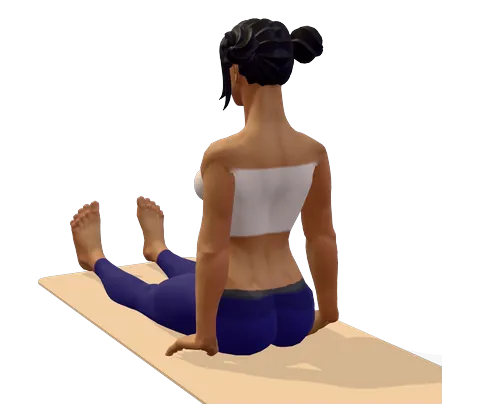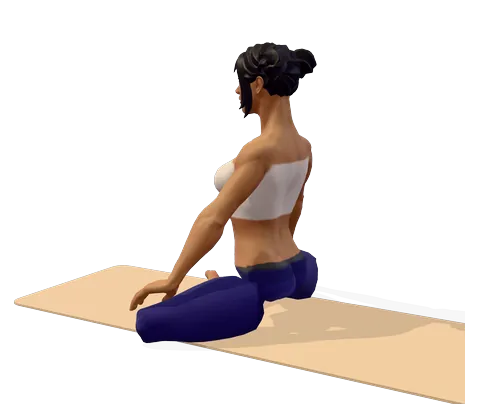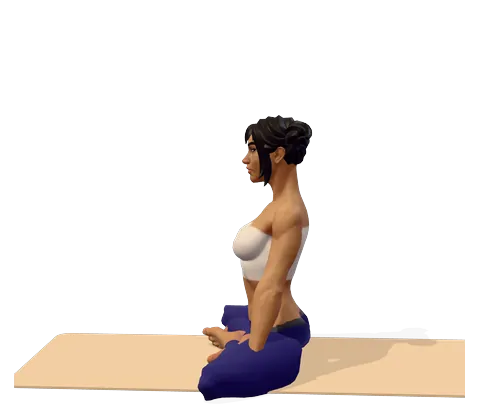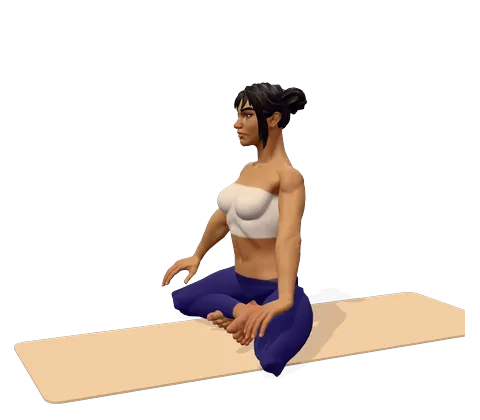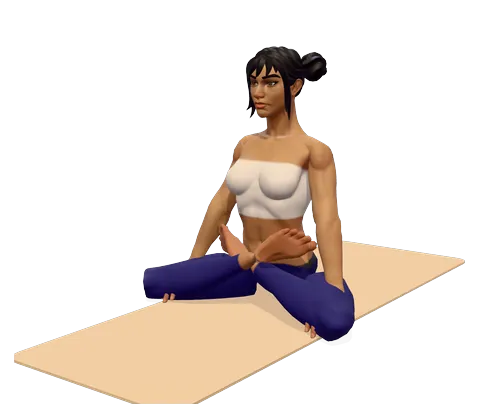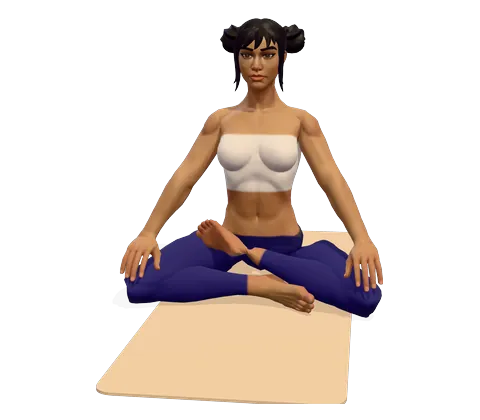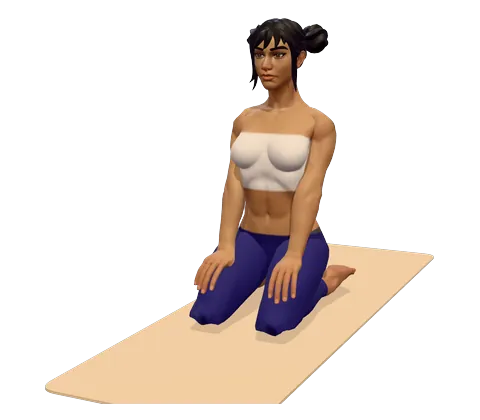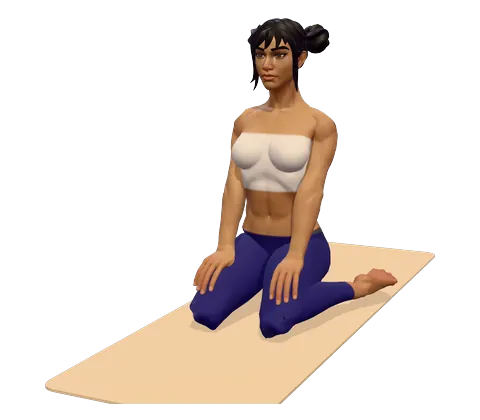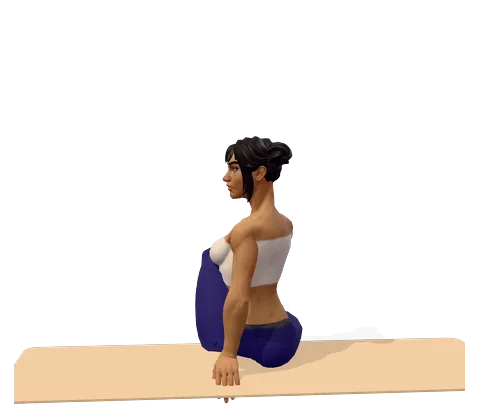
How to do Simple Seated Twist step by step
- Sit in Staff Pose (Dandasana): legs straight in front of you, spine tall, hands beside your hips.
- Bend your left knee and place your left foot flat on the floor beside your right knee.
- Place your left hand on the floor behind you, close to your hips, fingers pointing back. Use it to sit up tall.
- Breathing in, raise your right arm. Breathing out, bring it over the outside of your left knee and hold your left ankle, or hook your elbow outside the knee.
- Turn your belly, then your chest, then your head to the left and look over your left shoulder. Keep both sitting bones on the floor.
- Hold for 20–30 seconds (4–6 breaths), growing taller on each inhale and turning a little more on each exhale.
- Breathing in, turn back to the centre, release the hands and straighten the left leg. Repeat on the right side.
Where you feel Simple Seated Twist: what it stretches and strengthens
Sit tall first, then twist from your waist toward the bent knee. In the 3D guide, turn on Body guide: areas that stretch glow green and areas that work glow saffron.
Stretches
- Side waist
- Spine
- Glutes
Strengthens
- Upper back
Benefits and precautions
Benefits
- Improves the rotation of the spine and eases stiffness from long sitting
- Stretches the side waist (obliques), the outer hip and the muscles along the spine
- Strengthens the upper back muscles that keep you sitting upright
- Gently compresses and releases the belly, which many people find helps digestion feel easier
- A safe, simple way to learn twisting before Ardha Matsyendrasana
- Calms the breath as a quiet seated pose
Avoid or modify if
- Slipped disc, sciatica or recent back injury — twist only a little, keep the spine long, or ask your physiotherapist first
- Recent abdominal or spine surgery, or a hernia — avoid twisting until your doctor clears you
- Pregnancy — avoid closed twists that press the belly; an open twist, turning away from the bent knee, is gentler; ask your midwife or doctor
- Knee pain in the bent leg — keep the foot further forward or sit on a folded blanket
- Severe osteoporosis — twist gently and do not pull with the arms
Vakrasana (simple seated twist) is one of the easiest twisting poses in yoga. You sit with one leg straight, bend the other knee, and turn your spine toward the bent knee with one hand behind you for support. It is often taught in schools and beginner classes in India because it gives the benefits of a spinal twist without the complex leg position of harder twists. It suits almost anyone who can sit on the floor.
What is the meaning of vakra in Vakrasana?
Vakra is Sanskrit for "twisted" or "turned", and asana means "pose". So the Vakrasana meaning is simply "twisted pose". You may see it written as Vakra Asana. In English it is called the simple seated twist, and some teachers use the name twisted pose yoga.
What is a seated spinal twist?
A seated twist is any pose in which you sit and rotate your spine while the pelvis stays grounded. The floor steadies your hips, so the turn happens in the waist, ribs and upper back. Vakrasana, easy seated twist and Ardha Matsyendrasana are all seated twists. The easy seated twist Sanskrit name is Parivrtta Sukhasana ("revolved easy pose").
A yoga twist is not the same as the seated Russian twist, an ab exercise in which you lean back and rotate quickly from side to side, often holding a weight. A yoga seated twist is slow and held, and it aims at mobility rather than strength.
How to do Vakrasana (Vakrasana kaise kare)
The steps above give the full Vakrasana procedure, left side first, as the 3D figure shows it. These seated torso twist instructions help you do it well:
- Lift before you turn. Grow tall on the inhale, twist on the exhale. A twist from a slumped spine goes nowhere.
- Turn from the belly up. Belly first, then ribs, then shoulders, then head. The neck turns last and least.
- Back hand close to the hips. If it is far behind you, you lean back and lose the twist.
- Do not crank with the arm. The arm on the knee is a guide, not a lever.
- Keep both sitting bones down. If one lifts, twist a little less.
Vakrasana pose for beginners
Sit on a folded blanket if your lower back rounds. If holding the ankle is hard, hug the bent knee with your right arm instead. For a chair yoga seated twist, sit tall on a chair, hold the back of the chair with one hand and the outer knee with the other, and turn. This seated spinal twist exercise also works at your desk during the day.
Vakrasana benefits
The main Vakrasana pose benefits are for the spine. The twist moves the joints between the vertebrae through rotation, a movement many people rarely make, and it stretches the obliques, the outer hip and the small muscles along the spine. The upper back works to keep you sitting tall, so the pose also teaches the benefits of sitting up straight.
Vakrasana benefits for back pain
For everyday stiffness from sitting, a gentle seated torso twist for lower back pain can make the back feel looser. Which yoga asana helps relieve back pain depends on the cause, so treat Vakrasana as one of several seated stretches and seated exercises for back pain, not a cure. With a slipped disc or sciatica, twist only a little or ask your physiotherapist. Our yoga for back pain plan lists the best asanas for lower back pain relief in a safe order.
Vakrasana benefits for digestion, diabetes and weight loss
Traditional texts say twists "massage" the abdominal organs. There is little direct research on this pose, but many people find gentle twists help digestion feel easier and ease bloating; see yoga for digestion. Vakrasana benefits for diabetes and for weight loss are indirect: regular yoga practice as a whole, with diet, medicine and activity, may help blood sugar and weight. Keep taking your prescribed medicine and read our yoga for diabetes page.
Seated torso twist muscles worked
| Stretched | Worked |
|---|---|
| Obliques (side waist) | Upper back muscles, keeping you upright |
| Muscles along the spine | Deep core, turning the torso |
| Outer hip and glute of the bent leg |
Seated torso twist benefits are mainly mobility and posture, not strength or calorie burn. The benefits of this movement, as with other torso twists, come from slow, held rotation rather than speed. Turn on the Body guide on the 3D figure to see the stretch areas in green and the working upper back in saffron.
Vakrasana and Ardha Matsyendrasana
Vakrasana is the preparation for Ardha Matsyendrasana. In Vakrasana the bottom leg stays straight and the bent foot is beside the knee. In Ardha Matsyendrasana the bottom leg folds under you and the foot of the top leg crosses outside the opposite knee, so the twist and the hip stretch are deeper. Learn the simple seated twist yoga pose first; among twisted poses in yoga, it is the simplest place to start. Easy seated twist (Parivrtta Sukhasana) is an even gentler yoga pose because you twist in a cross-legged seat.
Standing yoga twist poses such as Kati Chakrasana add movement from the legs and suit a warm-up.
Where it fits in a practice
In school yoga syllabi in India, Vakrasana is often taught with poses such as Vajrasana, Makarasana and Chakrasana. A simple order: sit in Dandasana, do Vakrasana on both sides, then a forward bend such as Paschimottanasana, and finish lying down. Hold each side for 20–30 seconds and repeat twice. You can practise twists with voice guidance in our guided sessions.
Vakrasana precautions and contraindications
Vakrasana is a gentle pose with some benefits and precautions that go together, and its contraindications are few but real. Avoid it or ask your doctor after recent abdominal or spine surgery or with a hernia. With a slipped disc, sciatica or severe osteoporosis, twist gently and never pull with the arms. The usual bending, lifting and twisting precautions for back problems apply: move slowly and stop if pain spreads down a leg. In pregnancy, avoid closed twists that press the belly.
वक्रासन (Vakrasana) — हिंदी में: दोनों पैर सामने सीधे करके बैठें। बायाँ घुटना मोड़ें और बायाँ पैर दाएँ घुटने के पास रखें। बायाँ हाथ पीछे ज़मीन पर रखें, दायाँ हाथ बाएँ घुटने के बाहर से बाएँ टखने को पकड़ें और बाईं ओर मुड़कर पीछे देखें। 20–30 सेकंड रुकें, फिर दूसरी तरफ़ करें। वक्रासन के फायदे (Vakrasana ke fayde): रीढ़ लचीली होती है, कमर की अकड़न कम होती है और पाचन में आराम महसूस हो सकता है। स्लिप डिस्क या पेट की सर्जरी के बाद डॉक्टर से पूछकर ही करें।
Frequently asked questions
What is Vakrasana?
Vakrasana is a simple seated twist. You sit with one leg straight, bend the other knee, place one hand behind you and turn your spine toward the bent knee.
What are the benefits of Vakrasana?
It improves the rotation of the spine, stretches the side waist and outer hip, strengthens the upper back and can make digestion feel easier. It is also a preparation for Ardha Matsyendrasana.
What is the difference between Vakrasana and Ardha Matsyendrasana?
In Vakrasana the bottom leg stays straight. In Ardha Matsyendrasana the bottom leg folds under you and the top foot crosses outside the knee, which makes the twist deeper and harder.
Is Vakrasana good for back pain?
For everyday stiffness, a gentle twist often helps. With a slipped disc or sciatica, twist only a little and ask your physiotherapist first.
How long should I hold Vakrasana?
Hold for 20–30 seconds (4–6 breaths) on each side and repeat once or twice.
Who should not do Vakrasana?
Avoid it after recent abdominal or spine surgery, with a hernia, or in pregnancy (closed twist). With disc problems or severe osteoporosis, twist gently or ask your doctor.
Can I do a seated twist on a chair?
Yes. Sit tall, hold the back of the chair with one hand and the outer knee with the other, and turn slowly. It is a good office stretch.
This page is for general education. Check with your doctor before starting yoga if you are pregnant, have a medical condition or an injury. Stop if you feel pain, dizziness or shortness of breath.